
Piggyback Sailplane Launching
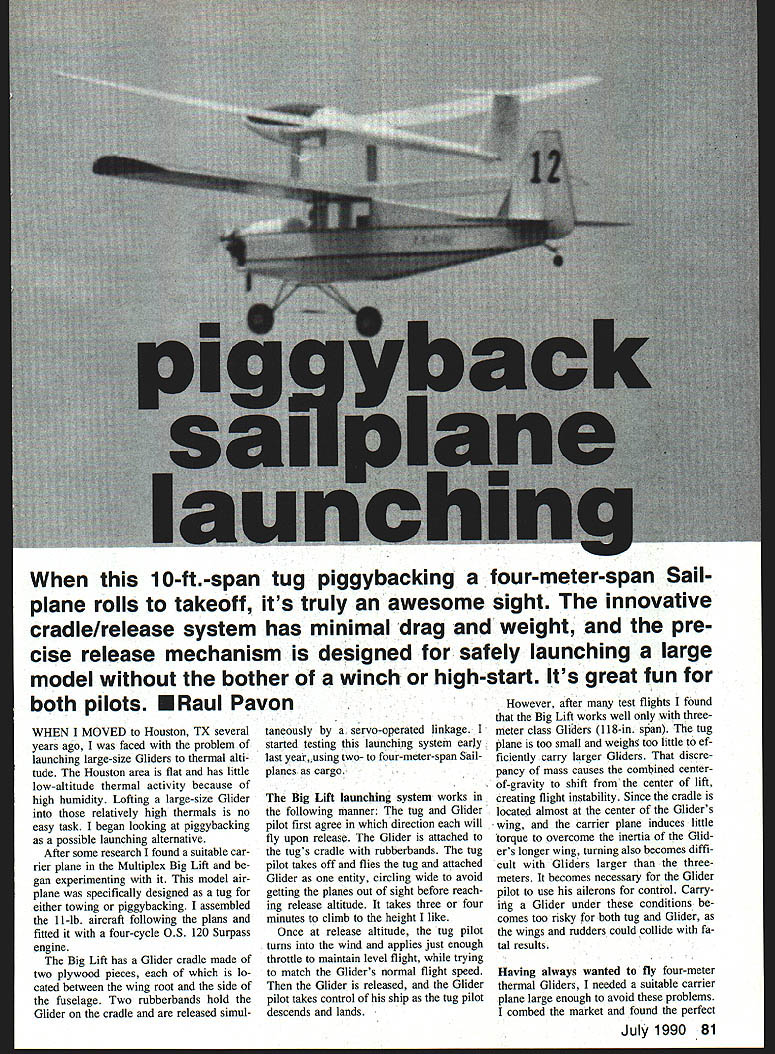
When this 10-ft.-span tug piggybacking a four-meter-span sailplane rolls to takeoff, it's truly an awesome sight. The innovative cradle/release system has minimal drag and weight, and the precise release mechanism is designed for safely launching a large model without the bother of a winch or high-start. It's great fun for both pilots. — Raul Pavon
Background
When I moved to Houston, TX, several years ago I faced the problem of launching large-size gliders to thermal altitude. The Houston area is flat and has little low-altitude thermal activity because of high humidity. Lofting a large-size glider into those relatively high thermals is no easy task, so I began looking at piggybacking as a possible launching alternative.
Initial experiments — Multiplex Big Lift
After some research I found a suitable carrier plane in the Multiplex Big Lift and began experimenting with it. This model airplane was specifically designed as a tug for either towing or piggybacking. I assembled the 11-lb. aircraft following the plans and fitted it with a four-cycle O.S. 120 Surpass engine.
The Big Lift has a glider cradle made of two plywood pieces, each located between the wing root and the side of the fuselage. Two #108 rubberbands hold the glider on the cradle and are released simultaneously by a servo-operated linkage. I started testing this launching system early last year, using two- to four-meter-span sailplanes as cargo.
The Big Lift launching procedure works as follows:
- The tug and glider pilots agree on the release-direction flight paths.
- The glider is attached to the tug's cradle with rubberbands.
- The tug pilot takes off and flies the tug and attached glider as one entity, circling wide to avoid losing sight before reaching release altitude.
- Once at release altitude (it takes about three or four minutes to climb to the height I like), the tug pilot turns into the wind and applies just enough throttle to maintain level flight while trying to match the glider's normal flight speed.
- The glider is released; the glider pilot takes control of his ship while the tug pilot descends and lands.
Limitations of the Big Lift
After many test flights I found that the Big Lift works well only with three-meter-class gliders (about 118 in. span). The tug plane is too small and weighs too little to efficiently carry larger gliders. That discrepancy of mass causes the combined center of gravity to shift from the center of lift, creating flight instability.
Because the cradle is located almost at the center of the glider's wing and the carrier plane induces little torque to overcome the inertia of a longer glider wing, turning becomes difficult. Gliders larger than three meters require the glider pilot to use ailerons for control while piggybacked; carrying a glider under these conditions becomes too risky, since both tug and glider wings and rudders could collide.
Choosing a larger tug — the SAC trainer
Having always wanted to fly four-meter thermal gliders, I needed a suitable carrier plane large enough to avoid these problems. I found the perfect solution in the SAC trainer.
This unusual 120-in. span model has a high-lift wing and is built very lightweight using aircraft blue foam, plywood, and pine. A 20 x 8 prop driven by a Quadra Q-40 fitted with an onboard starter powers the plane.
Because the projected takeoff weight of the SAC with a glider piggybacked was over 30 lb., I reinforced and modified the airframe as follows:
- Added a 3/8 x 3/4-in. pine spar to the front fuselage section.
- Doubled the engine mounting plate with a second 1/4-in. plywood plate.
- Fastened three large hatches to the 1/4-in. plywood bottom of the fuselage front section with 4-40 screws for easy access to batteries and electronics.
- Fully sheeted the wing center section and provided a solid trailing-edge connection to the fuselage frame.
- Doubled and stiffened the landing gear and added a tail wheel to improve ground handling.
- Epoxied the entire nose section and tail end with two layers of glass cloth (a unidirectional base layer and a bidirectional top layer).
The finished SAC trainer weighs a little under 24 lb — big even for gliders in the four-meter (157-in.) span range.
Electrical and release-system details
Because I planned to use seven high-torque servos, which draw large current from the receiver battery pack, receiver glitches were a concern. To prevent that, I used a Jomar isolation interface between the receiver and servos. I used two separate battery packs to drive the receiver and servos, and a third battery to power the onboard engine starter.
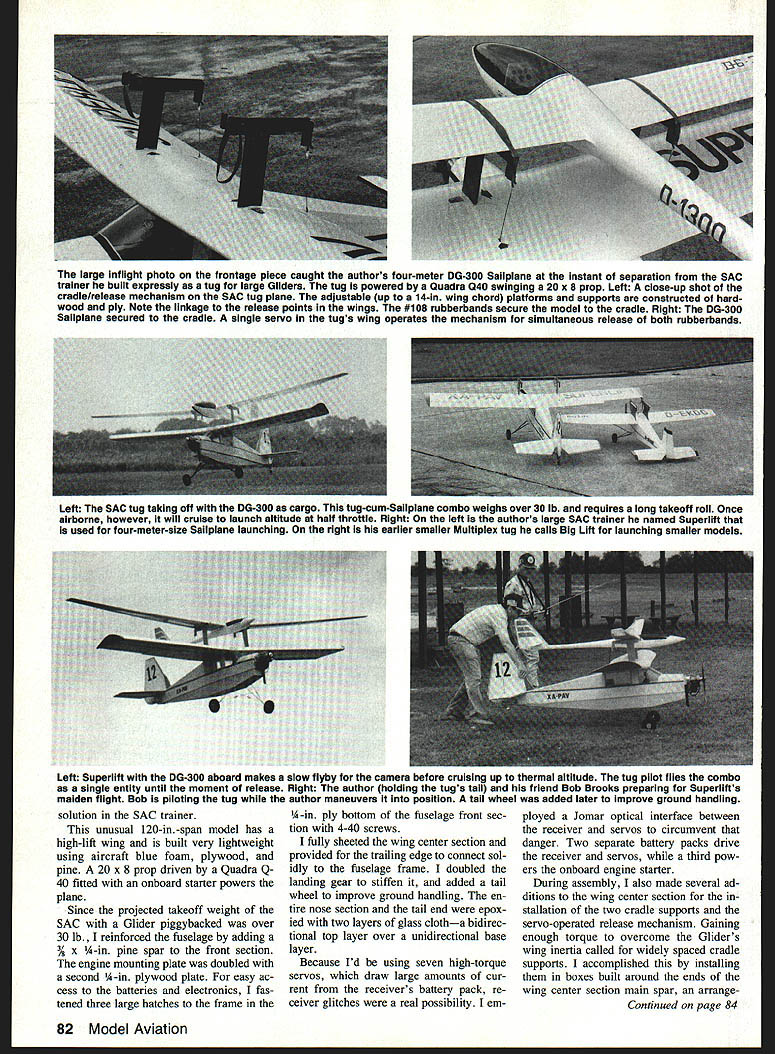
I made several additions to the wing center section for the two cradle supports and the servo-operated release mechanism. Gaining enough torque to overcome the glider's wing inertia called for widely spaced cradle supports. I accomplished this by installing the supports in boxes built around the ends of the wing center-section main spar; the arrangement is sheathed with plywood.
Each cradle support is adjustable fore and aft to accommodate gliders with various chord dimensions. The pickup points for the release linkage go through the wing into the cradle boxes. The #108 rubberbands are run through the cradle and over the supports, securing the glider to the cradle.
Release-mechanism operation:
- A centrally mounted servo (installed at a central point inside the wing) operates pushrods to the two cradle bellcranks.
- Each bellcrank holds a rubberband in place; when the servo moves the bellcranks, the rubberbands are freed and the glider is released.
- Synchronizing the servo linkage to the two release points is essential to prevent uneven separation of the glider from the cradle upon release, which could result in a midair accident.
Flight testing and performance
My first test flight with the SAC trainer took place in April 1989 using a four-meter Alpina glider as cargo. Since then, I’ve made many more flights carrying gliders larger than 3.5 meters (about 138 in. span) without apparent problems.
The SAC with a piggybacked DG-300 glider proved very stable and had plenty of power during takeoff and climb. The combination requires a long takeoff roll, but once airborne the tug cruises easily to release altitude at half throttle. The DG-300 releases cleanly, and the tug returns to the field without difficulty.
Two major design factors make this arrangement work well:
- The 22-in. separation of the cradle attachment points increases the torque available to overcome the glider's wing inertia.
- The glider wing incidence is set parallel to the tug wing incidence, which assures that the glider is flying its own weight and not creating a load on the tug.
A tug/glider duo of this size works well because the combined center of gravity remains where it should be. Turns are no longer a problem, and all the flying to release altitude is done by the tug pilot. The big, biplane-like combination is so stable and docile in flight that the pilot can even make low passes before climbing to the glider’s release altitude.
Benefits, notes, and conclusion
- Because the takeoff weight of the tug-plus-glider exceeds 30 lb, a long takeoff roll is necessary to gain lift-off speed.
- The air-carrier launching system greatly extends glider flight duration; spans of 20 minutes and longer are now quite normal.
- The system requires a minimum of two pilots, which encourages cooperation and teamwork and makes for a crowd-pleasing club demonstration.
I hope my findings will encourage others who live in areas with less-than-ideal conditions for launching big thermal gliders to try this piggyback approach. I can assure you that a tug of this size rolling to lift off with a four-meter glider atop is an awesome sight indeed.
Transcribed from original scans by AI. Minor OCR errors may remain.

