
Pima Air Museum
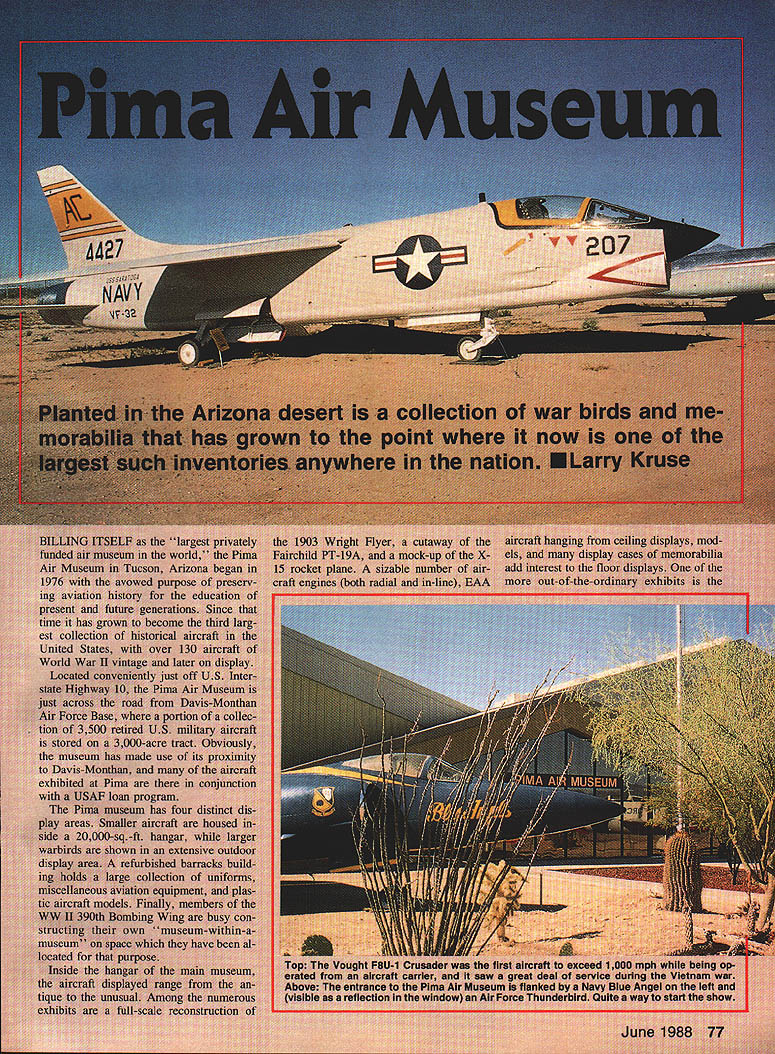
Planted in the Arizona desert is a collection of warbirds and memorabilia that has grown to become one of the largest such inventories in the nation.
Billing itself as the "largest privately funded air museum in the world," the Pima Air Museum in Tucson, Arizona, began in 1976 with the purpose of preserving aviation history for the education of present and future generations. Since that time it has grown to become the third-largest collection of historical aircraft in the United States, with over 130 aircraft of World War II vintage and later on display.
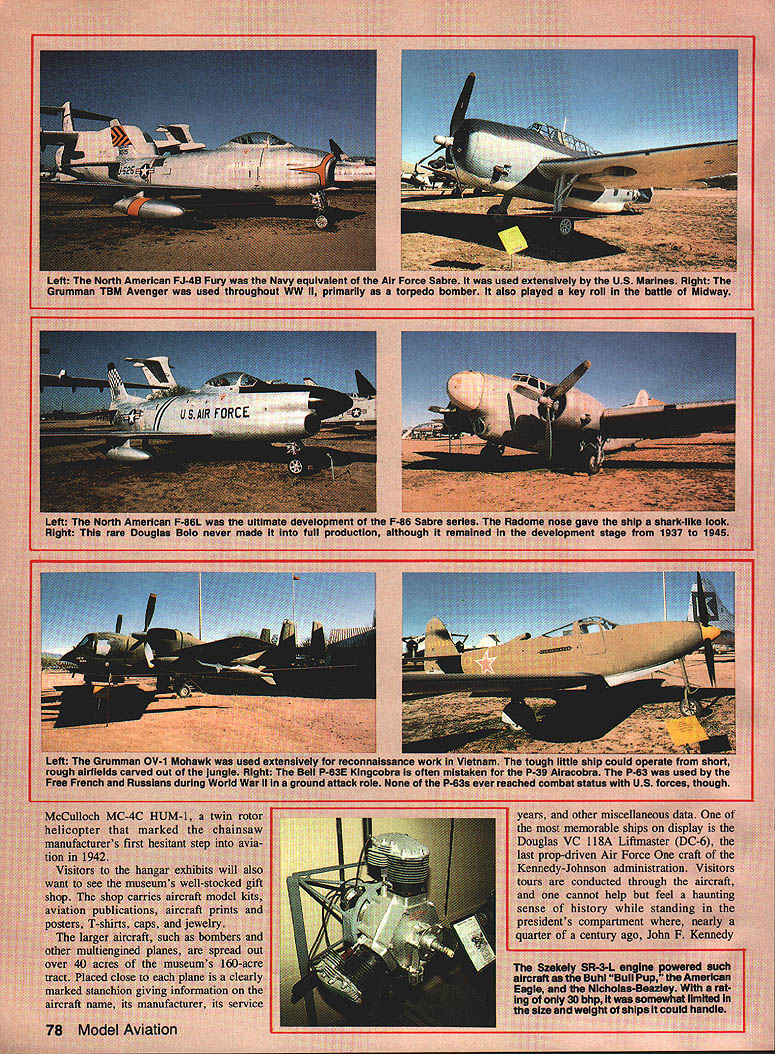
Located just off U.S. Interstate Highway 10, the museum sits across the road from Davis-Monthan Air Force Base, where a portion of a collection of 3,500 retired U.S. military aircraft is stored on a 3,000-acre tract. The museum has made use of its proximity to Davis-Monthan; many of the aircraft exhibited at Pima are there in conjunction with a USAF loan program.
Display areas
- Hangar: Smaller aircraft are housed inside a 20,000-sq.-ft. hangar.
- Outdoor display area: Larger warbirds are shown across an extensive outdoor area.
- Refurbished barracks: A restored 1940s-style barracks building holds a large collection of uniforms, miscellaneous aviation equipment, and plastic aircraft models.
- 390th Bombing Wing area: Members of the WWII 390th Bombing Wing are constructing a "museum-within-a-museum" in space allocated for that purpose.
Hangar exhibits
Inside the main hangar, the aircraft range from antique to unusual. Notable exhibits include:
- A full-scale reconstruction of the 1903 Wright Flyer.
- A cutaway of the Fairchild PT-19A.
- A mock-up of the X-15 rocket plane.
- A sizable number of aircraft engines (radial and inline), EAA aircraft hanging from ceiling displays, models, and many display cases of memorabilia.
- One of the more out-of-the-ordinary exhibits is the McCulloch MC-4C (HUM-1), a twin-rotor helicopter that marked the chainsaw manufacturer's first hesitant step into aviation in 1942.
Visitors to the hangar exhibits will also want to see the museum's well-stocked gift shop, which carries aircraft model kits, aviation publications, aircraft prints and posters, T-shirts, caps, and jewelry.
Outdoor displays
The larger aircraft, such as bombers and other multi-engined planes, are spread out over 40 acres of the museum's 160-acre tract. Each plane has a placard giving information on the aircraft name, manufacturer, service years, and other data. One of the most memorable ships on display is the Douglas VC-118A Liftmaster (DC-6), the last prop-driven Air Force One craft of the Kennedy–Johnson administration. Visitor tours are conducted through some aircraft; standing in the president's compartment evokes a strong sense of history.
The mild, dry Arizona climate makes the outdoor display possible and permits year-round access. Prevailing sunshine and light breezes act like a dry dock for the museum's aircraft, preventing the damaging effects that harsher environments would cause.
Refurbished barracks exhibit
The barracks building is outfitted in the fashion of the 1940s. Visitors can browse an ever-changing assortment of items on loan from individuals and groups, including an extensive collection of uniforms, aviation equipment, and numerous plastic models.
390th Bombing Wing exhibit
The 390th Bombing Wing exhibit area is a tribute to the squadron's past. A beautifully restored Boeing B-17 (on loan from the Air Force) is planned as the centerpiece of the wing's submuseum. Volunteers work regularly on restoration, and representatives of the 390th staff the memorabilia gallery, sharing memories and pointing out highlights of the wing's history. The exhibit offers a unique, close-up, and very personal look at the men and their war machines.
Aircraft highlights (representative selection)
- Beech 18D
- Beech C-45J
- Beech N35
- Beech L-23D (U-8D)
- Bell P-63E
- Bell UH-1F
- Boeing 307
- Boeing B-17G
- Boeing B-29
- Boeing B-47E
- Boeing KB-50J
- Boeing C-97G / KC-97G
- Boeing YC-14
- Boeing NB-52A
- Bowers Fly Baby
- Cessna UC-78 (JRC-1)
- Consolidated B-24J
- Convair VT-29D
- Convair B-58A
- Convair F-102A
- Curtiss C-46D
- De Havilland L-20A (U-6A)
- Douglas A-26C
- Douglas A-26A (B-26K)
- Douglas B-23
- Douglas WB-66D
- Douglas C-47 (R4D)
- Douglas VC-118A (Liftmaster / DC-6)
- Douglas C-124C
- Douglas C-133B
- Douglas AD-5N (A-1G)
- Douglas A-3D-1 (YEA-3A)
- Douglas A-4D-2; TA-4B
- Douglas F3D-2 (TF-10B)
- Douglas F4D-1 (F-6A)
- Douglas R4D-8 (C-117D)
- Fairchild PT-19A (cutaway on display)
- Fairchild PT-26
- Fairchild C-119C
- Fairchild C-123B
- Fleet Model 1 (updated to Model 7)
- Grumman F6F-3
- Grumman F9F-8
- Grumman F11F-1
- Grumman S2F-1
- Grumman WF-2 (E-1A)
- Grumman HU-16A (SA-16A)
- Grumman OV-1
- Hughes TH-55A
- Kaman H-43B
- Lockheed C-69
- Lockheed EC-121H
- Lockheed P-38L (F-5G)
- Lockheed P-80B (F-80)
- Lockheed T-33
- Lockheed T-2V (TV-2)
- Lockheed T-94C
- Lockheed F-104B
- Lockheed P2V-7 (AP-2H)
- Martin PBM-5A (Mariner)
- Martin B-57E
- Martin RB-57D
- McCulloch MC-4C (HUM-1)
- McDonnell RF-101H
- McDonnell F3H-2 (F-3B)
- McDonnell YF-4J
- McDonnell-Douglas YC-15
- North American B-25J
- North American F-86D
- North American F-86H
- North American F-100C
- North American F-107A
- North American AT-6G
- North American FJ-4B
- North American AF-1E
- North American T-28C
- North American RA-5C
- North American X-15A-2
- Northrop F-89J
- Piasecki H-21C
- Republic F-84F
- Republic RF-84F
- Republic F-105B
- Ryan PT-22
- Schweizer TG-3A
- Sikorsky H-19B
- Sikorsky H-34C
- Sikorsky H-37B
- Taylorcraft L-2M
- Vought F8U-1
- Vultee BT-13
- Wright Flyer (replica / display)
Drones and missiles
- Boeing CIM-10 (IM-99)
- Gyrodyne QH-50C
- DSN-3
- Hughes AIM-4D
- McDonnell ADM-20C
- MQM-57A
- North American AGM-28A
- OQ-3
- OQ-19
- Teledyne-Ryan AQM-34L
Photo captions and highlights
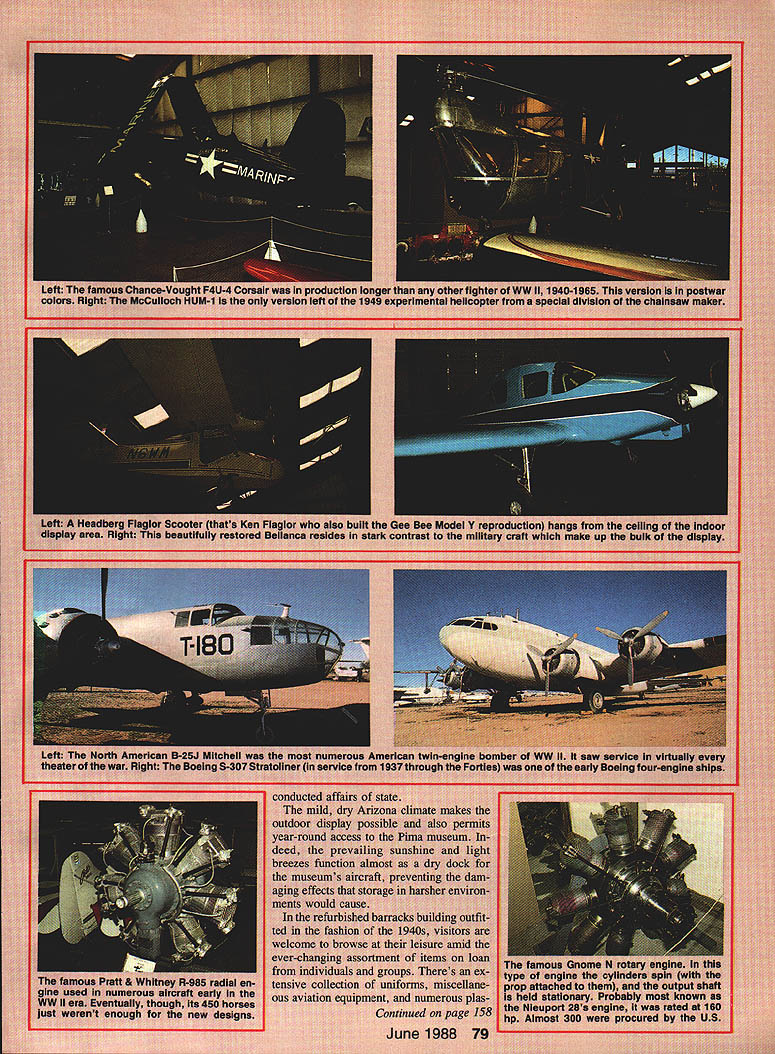
- The Douglas A-1G (AD-5N) Skyraider: used in Korea and Vietnam; could carry a bomb load comparable to a B-17.
- The Douglas C-47 Skytrain: military version of the DC-3. A Curtiss C-46D is often visible in the background.
- B-24 Liberators: more than 18,000 were built during WWII by several firms for Air Force, Navy, Marine, and Allied forces.
- Republic F-84: used by the U.S. Air Force Thunderbirds.
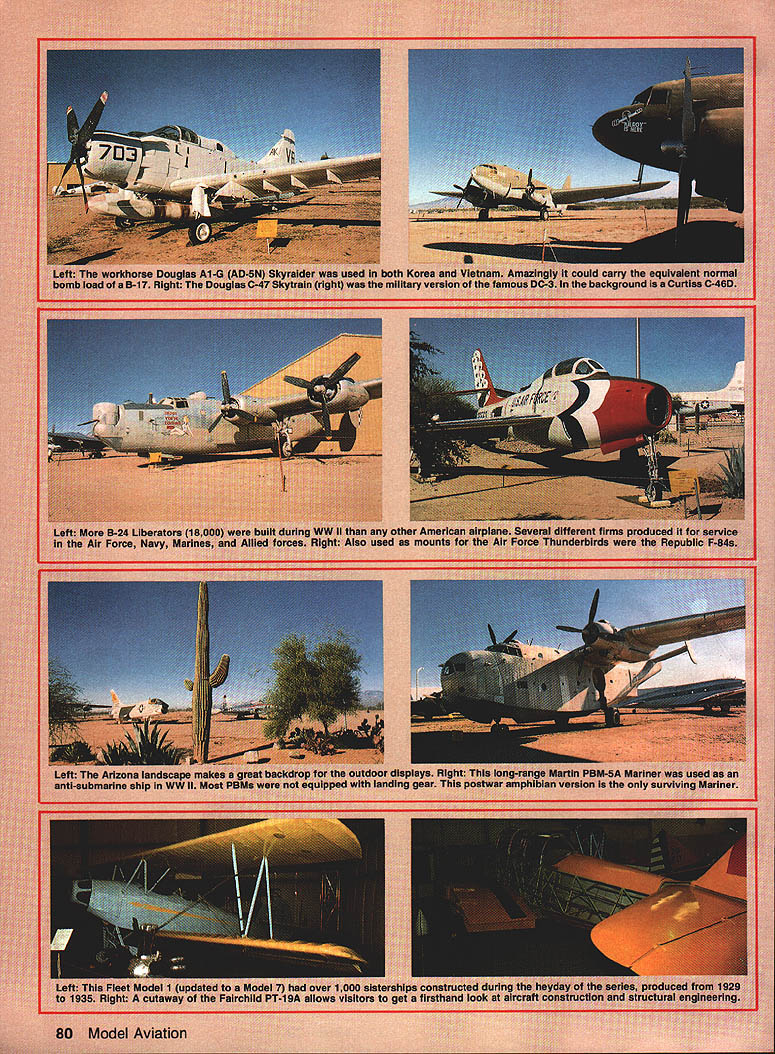
- Arizona landscape: provides a striking backdrop for outdoor displays.
- Martin PBM-5A Mariner: a long-range WWII anti-submarine amphibian; this postwar amphibian version is the only surviving Mariner.
- Fleet Model 1 / Model 7: over 1,000 sister ships were built between 1929 and 1935.
- Fairchild PT-19A cutaway: allows visitors to see aircraft construction and structural engineering firsthand.
Any modeler or aviation buff could easily set aside a day to stroll among the Pima displays and photograph many of the planes that helped shape American aviation history.
Transcribed from original scans by AI. Minor OCR errors may remain.

