
Piper PA-8 Skycycle
Kenneth D. Wilson
AIRPLANE MANUFACTURERS during 1944 were still being pressed to capacity with the war effort, but to many aviation companies a WWII Allied victory seemed likely. With this in mind, plans were already being formulated for a futuristic civilian airplane market.
At Piper Aircraft Corporation, Lock Haven, PA, the airplane as a postwar commodity was often the subject of discussion at brown-bag lunches and unofficial office get-togethers. By mid-June 1944, the scheduled weekly Piper executive conference was in session, and this theme was part of the official agenda.
Chairing the conference was Piper's president, William T. Piper, Sr. (1881–1970), one of the outstanding pioneers of aviation in America. Bill Piper was often referred to as "The Henry Ford of Aviation," a label which underscored his efforts to bring the airplane within financial reach of a world interested in private flying.
Also in attendance were Piper's son, W. T. Piper, Jr., who served as secretary-treasurer; W. B. St. John, sales manager; and Ted Wells, vice-president of sales and promotion.
Two other key Piper employees who complemented the meeting were Walter C. Jamouneau, chief engineer, and A. Hanford Eckman, superintendent/production manager. Both men directly supported and made Piper Aircraft Corporation successful, yet remained relatively unknown. Jamouneau was considered the power behind the throne; rarely did Bill Piper make a decision concerning company policies without consulting Jamouneau. Eckman had been with Curtiss Aeroplane Company and Consolidated Aircraft Company in Buffalo, NY before joining Piper's predecessor, the Taylor Aircraft Company, in March 1934. He contributed to the design of many Piper aircraft (the Piper J-4 Coupe was Eckman's project), and he aimed to see that Piper manufactured the safest and most economical aircraft possible.
After much pro-and-con dialogue, a decision was made that Piper Aircraft Corporation would build a trio of airplanes (patterned similar to Detroit's graduated auto sales system) which would offer the aviation customer a wide option of aerial conveyance. The trend was to build the lowest-cost airplane on the market, not necessarily the fanciest — a trend that proved correct with the success of the Piper J-3 Cub.
- The limousine of the new series was to be the sleek and sophisticated PA-6 Sky Sedan. Model tests showed it could cruise at 140 mph on 60% power with four passengers, but a decline in the family airplane market in mid-1947 limited production to a single prototype.
- The second member was the sporty dual-place Sky Coupe — featuring twin booms, a pusher-type engine enclosed in the fuselage cell between the booms, and a tricycle landing gear. Performance was disappointing and the idea was dropped.
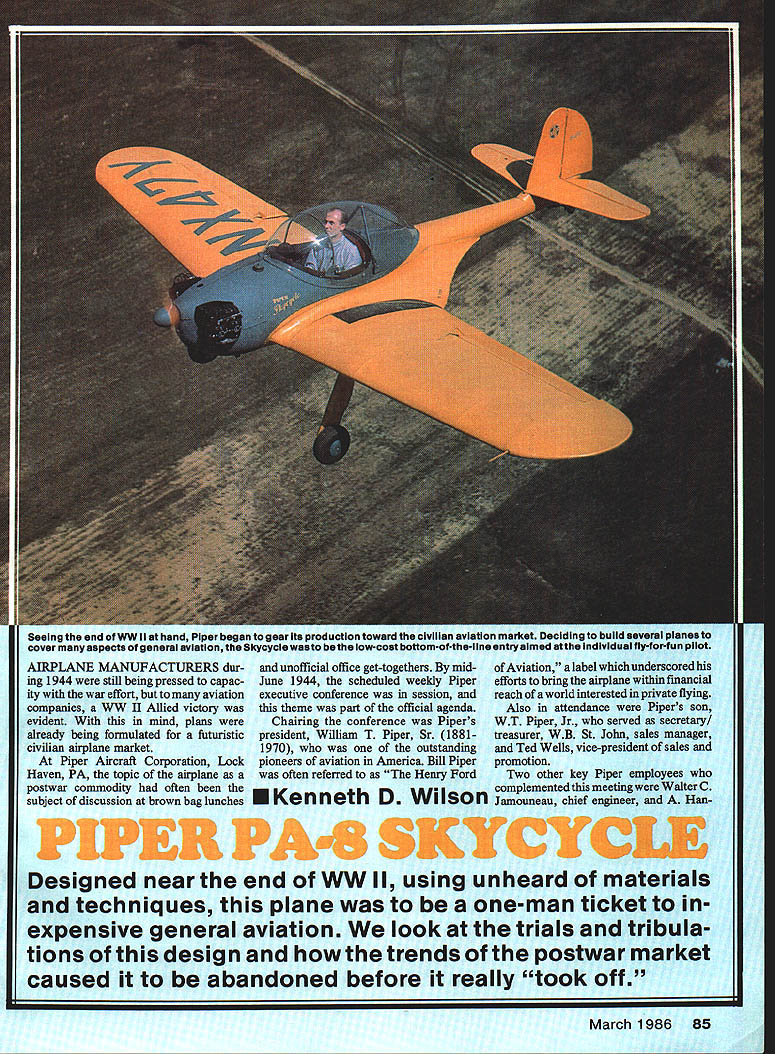
- The third and smallest was the PA-8 Skycycle, a one-man "sky motorcycle" intended to be inexpensive (target price under $1,000), economical, and easy to operate.
PIPER PA-8 SKYCYCLE
Designed near the end of WWII using unusual materials and techniques, the PA-8 Skycycle was to be a one-man ticket to inexpensive general aviation. Hanford Eckman conceived new uses for basic materials that led to unconventional construction methods on the PA-8 production assembly line. The prototype had to be built and withstand tedious testing before any production decision could be made.
Because wartime subcontracts occupied Piper's normal production areas and materials essential to the war effort were unavailable, Eckman set up a section in his production laboratory and lofting department for the Skycycle's initial assembly. He and Jamouneau sought out various composites and surplus stock.
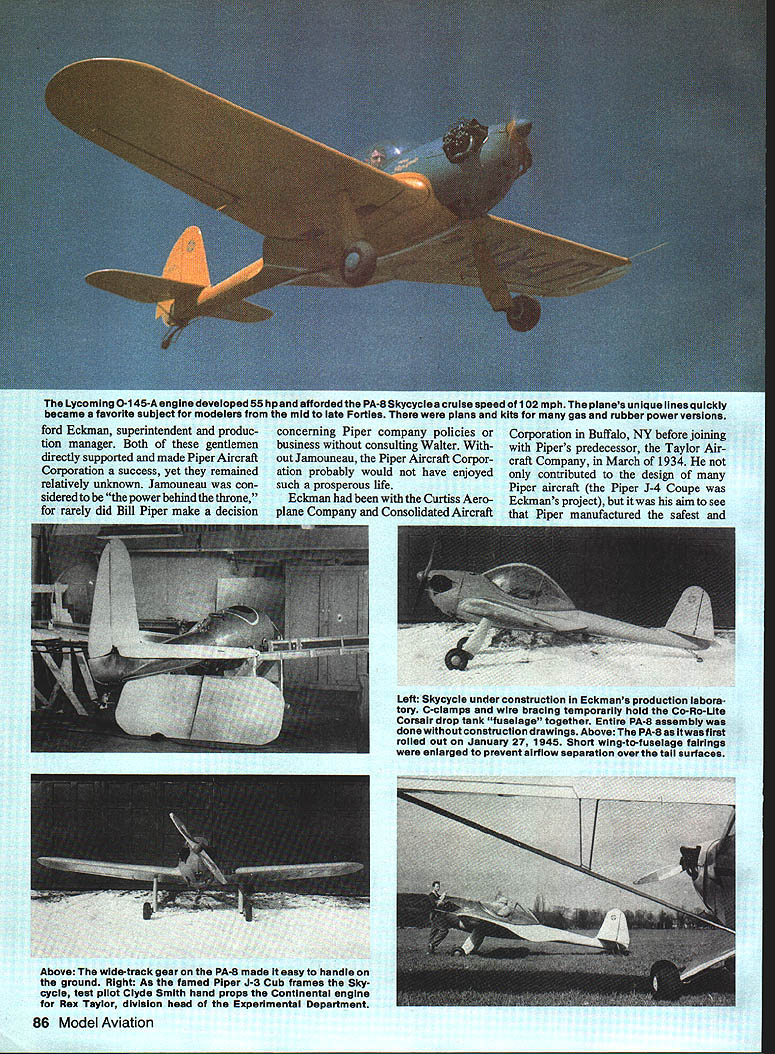
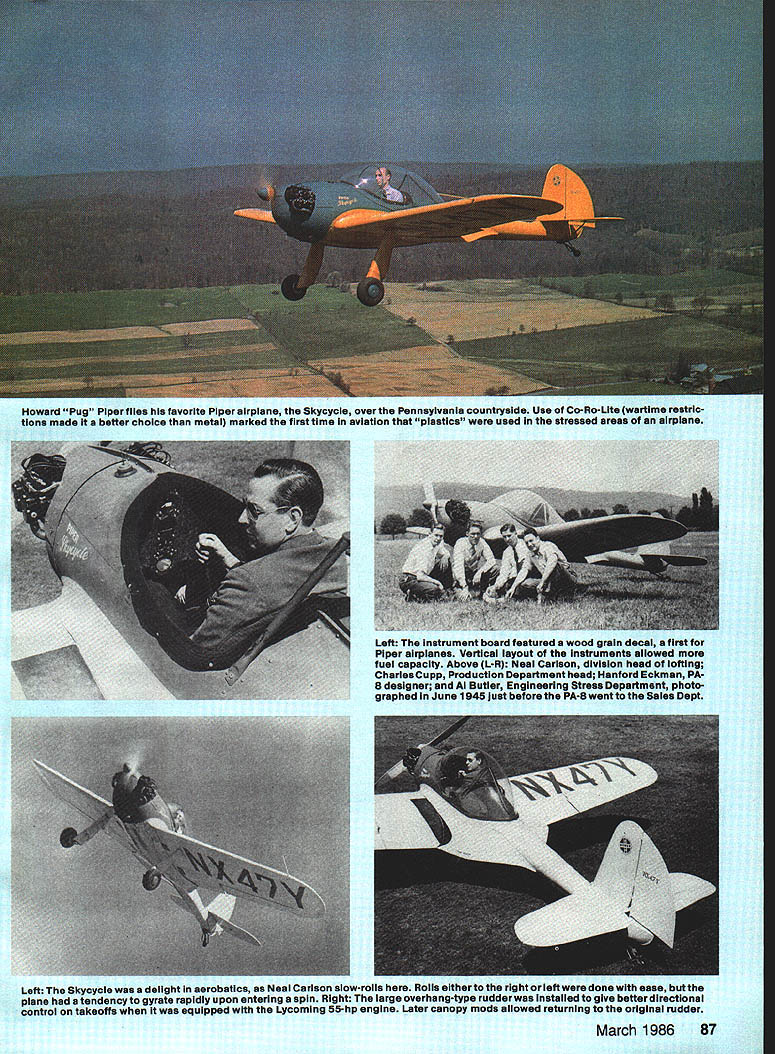
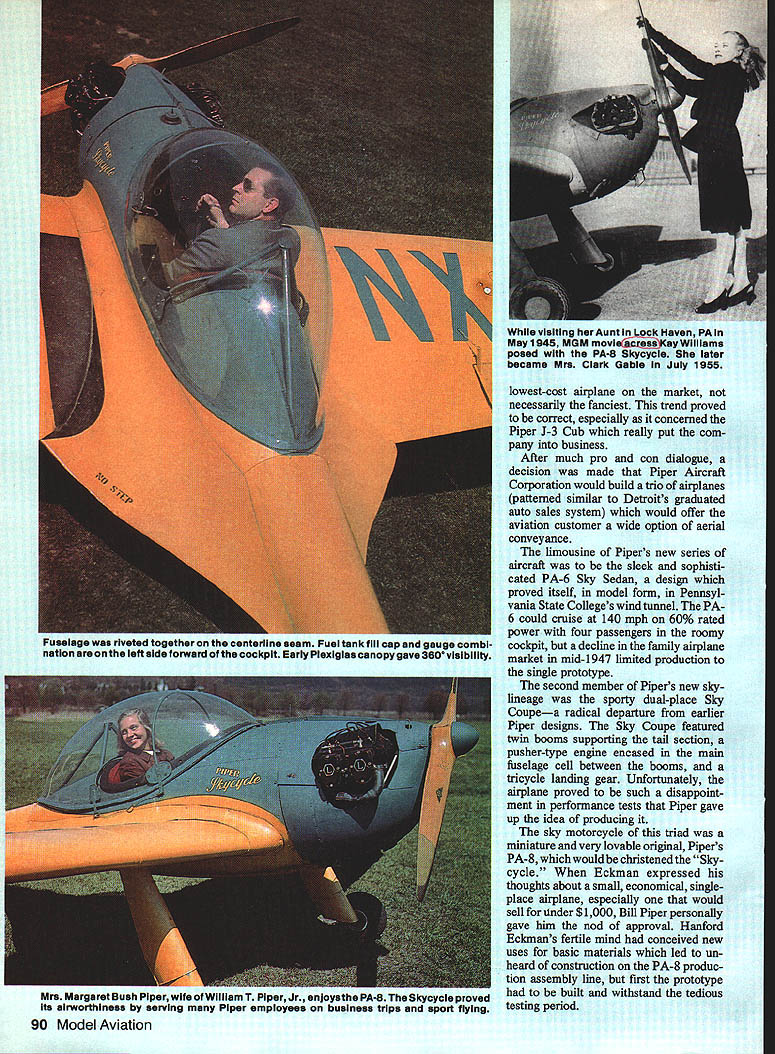
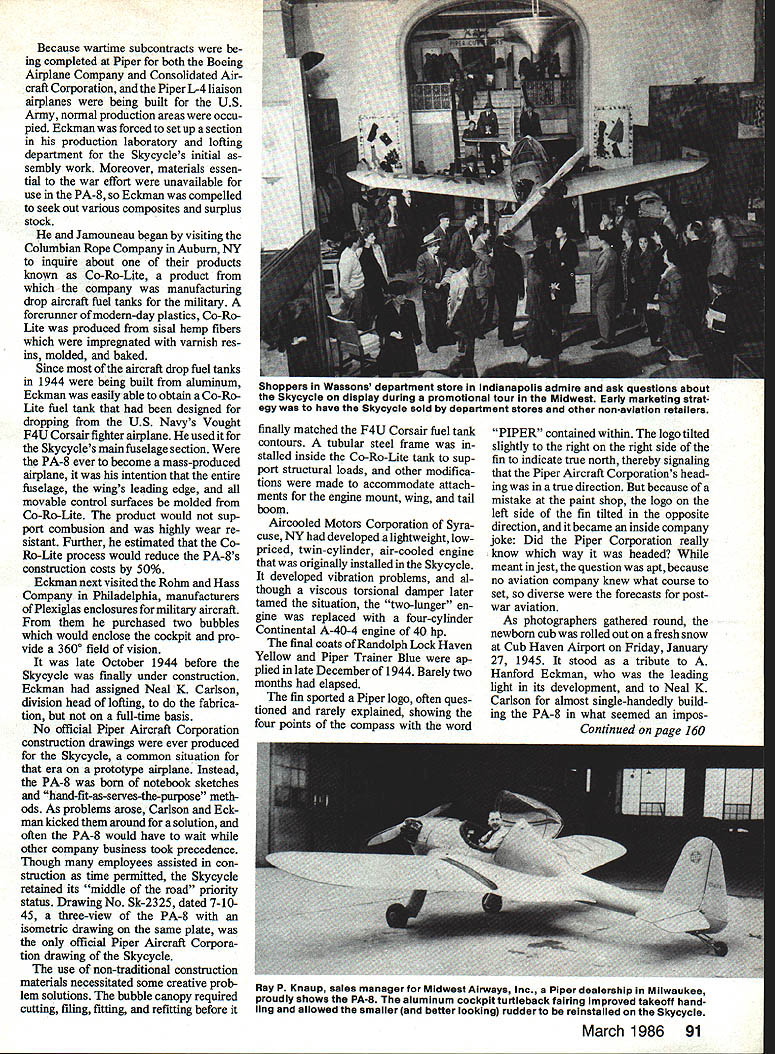
They visited the Columbian Rope Company in Auburn, NY, to inquire about Co‑Ro‑Lite, a product used for military drop fuel tanks. A forerunner of modern plastics, Co‑Ro‑Lite was produced from sisal hemp fibers impregnated with varnish resins, molded, and baked. Eckman obtained a Co‑Ro‑Lite fuel tank designed for dropping from the U.S. Navy's Vought F4U Corsair and used it for the Skycycle's main fuselage section. He intended that, for mass production, the entire fuselage, wing leading edges, and movable control surfaces be molded from Co‑Ro‑Lite — a process he estimated would reduce construction costs by 50%. The material was noncombustible and highly wear resistant.
Eckman also purchased two Plexiglas bubbles from Rohm and Haas in Philadelphia to enclose the cockpit and provide a 360° field of vision.
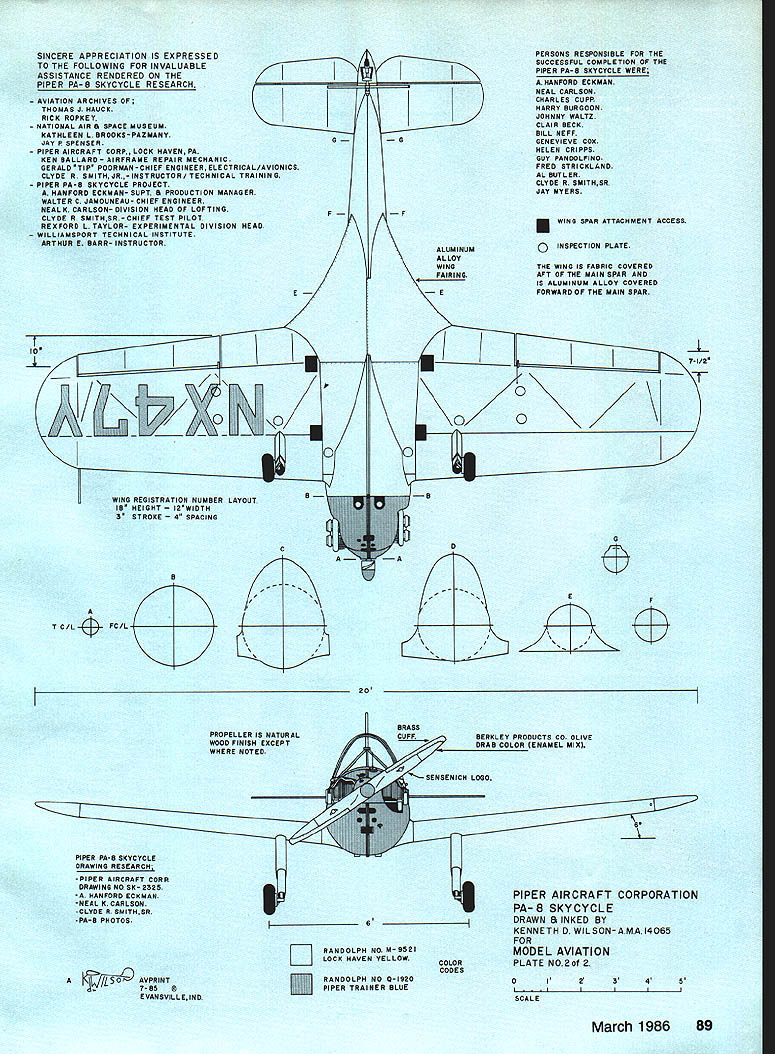
It was late October 1944 before the Skycycle was finally under construction. Eckman assigned Neal K. Carlson, division head of lofting, to fabricate the prototype, but not full-time. No official Piper construction drawings were produced for the Skycycle; it was born of notebook sketches and hand-fit methods. Drawing No. Sk-2325, dated 7-10-45, a three-view with an isometric drawing, was the only official PA-8 drawing.
The bubble canopy had to be cut, filled, fitted, and refitted before it matched the Corsair fuel tank contours. A tubular steel frame was installed inside the Co‑Ro‑Lite tank to support structural loads and to accommodate the engine mount, wing, and tail boom attachments.
Aircooled Motors Corporation of Syracuse, NY developed a lightweight, low-priced twin-cylinder air-cooled engine that was originally installed in the Skycycle. It developed vibration problems (later helped by a viscous torsional damper) and was replaced with a four-cylinder Continental A-40-4 engine of 40 hp.
The final coats of Randolph Lock Haven Yellow and Piper Trainer Blue were applied in late December 1944. On Friday, January 27, 1945, the newborn cub was rolled out on fresh snow at Cub Haven Airport. The Skycycle stood as a tribute to A. Hanford Eckman and to Neal K. Carlson for almost single-handedly building the PA-8.
Early flight testing
Clyde R. Smith, Sr., chief test pilot for Piper, made the initial test flights. On January 30, 1945, Smith completed the first flight after preflight checks and a successful first hot proping of the Continental A-40-4 engine. He climbed to 2,500 feet and eased back on power only to feel an unusual vibration shaking the tail surfaces. Increased power lessened the oscillation, but Smith suspected the tail boom might be disintegrating. He landed, inspected the airplane, and continued test flights as teething troubles were identified and corrected.
Investigations showed the cause to be the wing-to-fuselage fairing. The rear of the Corsair drop tank fuselage had a sharp taper, creating a large gap between the wing trailing edge and the fuselage. The small original fairing caused airflow separation and buffeting over the tail. A new, elongated fairing was fashioned and improved in-flight behavior considerably.
The Skycycle accumulated hours in the logbooks of Eckman, Carlson, Rex Taylor (head of the Experimental Division), and Howard "Pug" Piper, who considered it a favorite airplane. Other Piper executives also flew the PA-8.
Canopy incident and remedies
In late February 1945, Piper decided to test the Skycycle on skis for northern customers. Neal Carlson adapted cut-down J-3 Cub skis, and on March 2, 1945, Clyde Smith lifted the ski-equipped PA-8 and headed for the nearby railroad tracks to make speed runs. During a shallow dive recovery at about 75 feet, the bubble canopy cracked and partially turned, released its latch, and folded onto the right wing. With the canopy open, tail-surface controls were ineffective and the PA-8 dove to the right. Smith managed to hold the canopy and control the airplane enough to limp back to Cub Haven Airport.
Ground testing followed. Carlson installed a new 360° canopy and tethered the PA-8 with its tail raised to simulate inflight attitude. Three J-3 Cubs were placed in front of it with engines at full throttle to reproduce airflow. Although the canopy vibrated, it did not roll over. Additional interior bracing and latch modifications were made.
Powerplant and control changes
By April 1945, the 40-hp Continental had been upgraded to a 55-hp Lycoming O-145-A, improving performance. The Lycoming was later replaced with a 65-hp Continental A-65; Clyde Smith made the first flight with the A-65 on March 20, 1946. With the extra horsepower, some low-time pilots experienced ground-handling problems: full right rudder had to be applied at takeoff to counter torque with the original rudder. A larger-area rudder solved directional control problems but detracted somewhat from the airplane's appearance.
The new full-view bubble canopy later developed hairline cracks at the trailing edge. Approximately one-third of the back section of the bubble was cut off and replaced with a permanent aluminum turtleback fairing that blended cockpit enclosure to fuselage. The new fairing produced smoother airflow over the tail surfaces and allowed the original smaller rudder to be reintroduced without earlier directional instability at takeoff. Successful ski tests were later performed by Assistant Test Pilot Jay Miller.
By late June 1945 Piper's experimental department was satisfied with PA-8 testing and turned the Skycycle over to the sales department for promotion.
Publicity and promotion
C. W. "Bucky" Taylor, Piper sales promotional manager, quickly promoted the PA-8. Neal Carlson flew the Skycycle to Philadelphia for its first public showing at Aviation Week (a war bond drive/airshow) during the July 4 holiday week at Northeast Philadelphia Airport. The PA-8 was then displayed indoors at Macy's in Chicago, and later at Famous-Barr in St. Louis (where the fuselage was taken to the seventh floor by freight elevator and the wing hoisted through a window). Piper held a similar department store rally in Indianapolis, and Taylor invited prominent distributors to fly the Skycycle and allowed qualified local pilots to fly it.
While the Skycycle toured, WWII ended and Piper found itself overwhelmed with J-3 Cub orders from dealers. Returning ex-military personnel, aided by GI Training Bill benefits, flooded flight schools and local airports. Aeronca introduced the Model 7 AC Champion dual-seat trainer, prompting Piper to counter with the PA-11 Cub Special and later the PA-12 Super Cruiser. J-3 Cub production was moved to a new Piper factory at Ponca City, OK. With PA-11 and PA-12 production occupying all available space and many PA-8 supporters reassigned to Ponca City, the Skycycle project was shelved.
Final fate
The Skycycle became an orphan and was adopted by the Cub Flyers, Piper's company flying club. The PA-8 was a favorite for club flying. In April 1947, Slim Makin, head of Lock Haven security, checked out the PA-8. After a hard landing, the main wing spar was twisted at its fuselage entry point, affecting elevator control movement; the landing gear and rear fuselage cone were also damaged. Makin walked away; the damaged PA-8 lay in the Cub Haven hangar.
In late 1947 the wreck was stripped of its engine and instruments and given to the Aviation Department of the Williamsport Technical Institute for classroom instructional use. In early 1948 a trade was arranged with Johnstown Vocational Technical School for a cut-down J-3 Cub used in rigging training. Unaware of Piper's agreement with Williamsport, the Johnstown school began restoring the Skycycle toward flying status. About two weeks before the projected flight date, a paint-room explosion at Johnstown Vocational Technical School destroyed the building and consumed the PA-8, ending the Skycycle's story.
Legacy and modeling
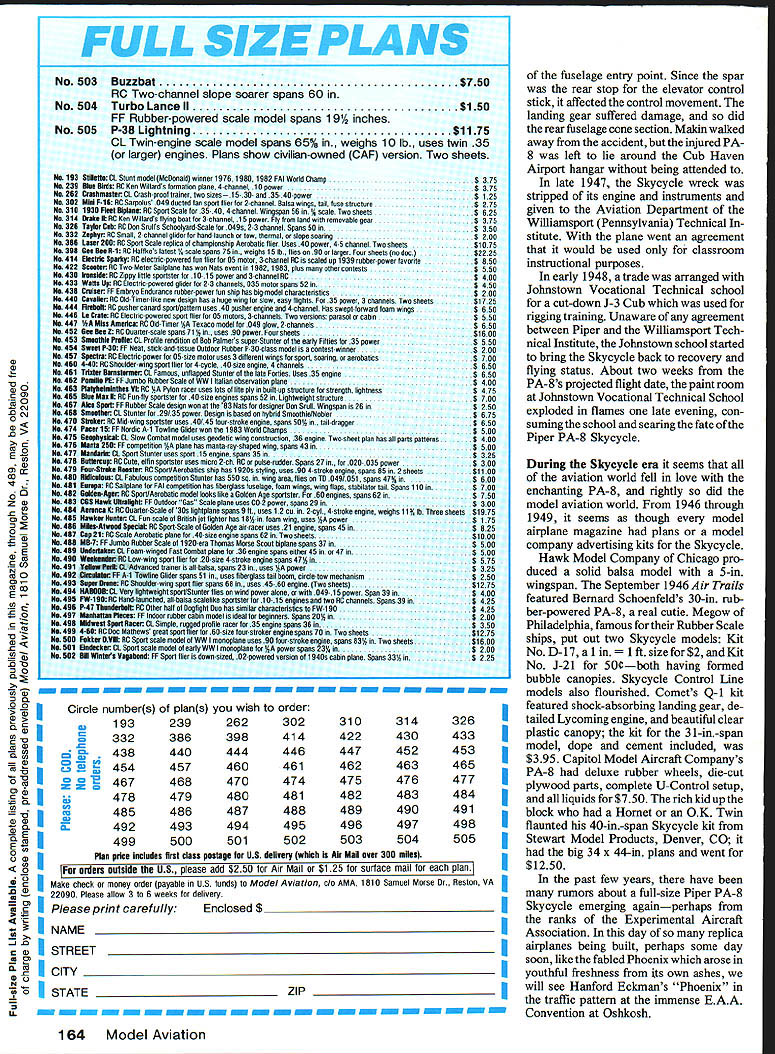
The Skycycle's unique lines quickly became a favorite subject for modelers from the mid-to-late 1940s. From 1946 through 1947, model airplane magazines and kit companies offered numerous Skycycle plans and kits:
- Hawk Model Company (Chicago): solid balsa model, 5-in. wingspan.
- Air Trails (September 1946): featured unusual projects including a power-pusher PA-8.
- Mego (Philadelphia): rubber-scale ship maker; produced two Skycycle models (Kit No. D-17A at 1 in. = 1 ft. for $2, and Kit No. J-21 for 50¢), both with formed bubble canopies.
- Comet: Q-1 control-line kit (31-in. span) with shock-absorbing gear and clear plastic canopy for $3.95.
- Capitol Model Aircraft Company: deluxe kit with rubber wheels, die-cut plywood parts, complete U-Control setup for $7.50.
- Stewart Model Products (Denver, CO): 40-in. span kit with 34 x 44-in. plans for $12.50.
In recent years there have been rumors of a full-size PA-8 Skycycle reappearing, perhaps from the ranks of the Experimental Aircraft Association. Given the number of replica aircraft being built today, it remains possible that Hanford Eckman's "Phoenix" could one day fly again at an EAA convention.
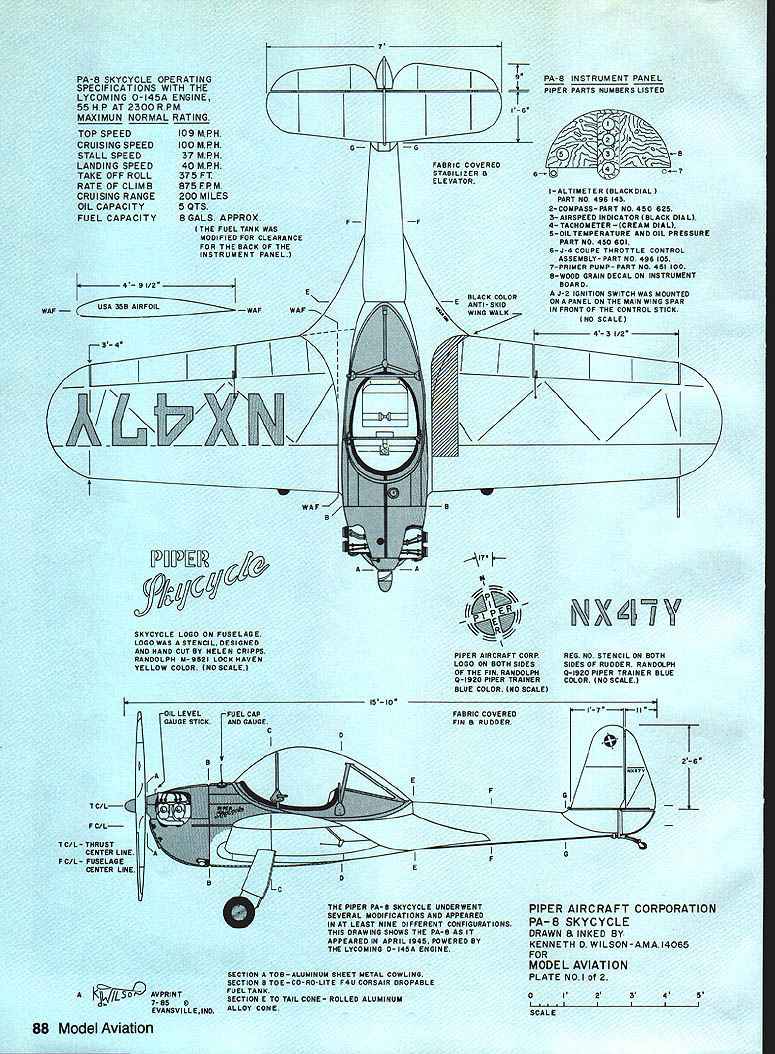
PA-8 Skycycle operating specifications (with Lycoming O-145-A engine, 55 hp at 2300 rpm — maximum normal rating)
- Top speed: 109 mph
- Cruising speed: 100 mph
- Stall speed: 37 mph
- Landing speed: 40 mph
- Takeoff roll: 375 ft
- Rate of climb: 875 fpm
- Cruising range: 200 miles
- Oil capacity: 5 qts
- Fuel capacity: 8 gals (approx.)
- Note: The fuel tank was modified for clearance for the back of the instrument panel.
Acknowledgments
Sincere appreciation is expressed to the following for invaluable assistance rendered on the Piper PA-8 Skycycle research:
- Aviation archives of:
- Thomas J. Hauck
- Rick Pokrzyk
- National Air & Space Museum
- Kathleen L. Brooks-Pazmany
- Jay P. Spensey
- Piper Aircraft Corp., Lock Haven, PA:
- Ken Ballard — Airframe repair mechanic
- Gerald "Tip" Poorman — Chief engineer, electrical/avionics
- Clyde R. Smith, Jr. — Instructor/technical training
Piper PA-8 Skycycle project personnel
- A. Hanford Eckman — Superintendent & production manager
- Walter C. Jamouneau — Chief engineer
- Neal K. Carlson — Division head of lofting
- Clyde R. Smith, Sr. — Chief test pilot
- Rexford L. Taylor — Experimental division head
- Williamsport Technical Institute:
- Arthur E. Barr — Instructor
Persons responsible for the successful completion of the Piper PA-8 Skycycle
- A. Hanford Eckman
- Neal Carlson
- Charles Cupp
- Harry Burgoon
- Johnny Waltz
- Clair Beck
- Bill Niff
- Genevieve Cox
- Helen Cripps
- Guy Panzolino
- Fred Strickland
- Al Butler
- Clyde R. Smith, Sr.
- Jay Wyers
Transcribed from original scans by AI. Minor OCR errors may remain.

