
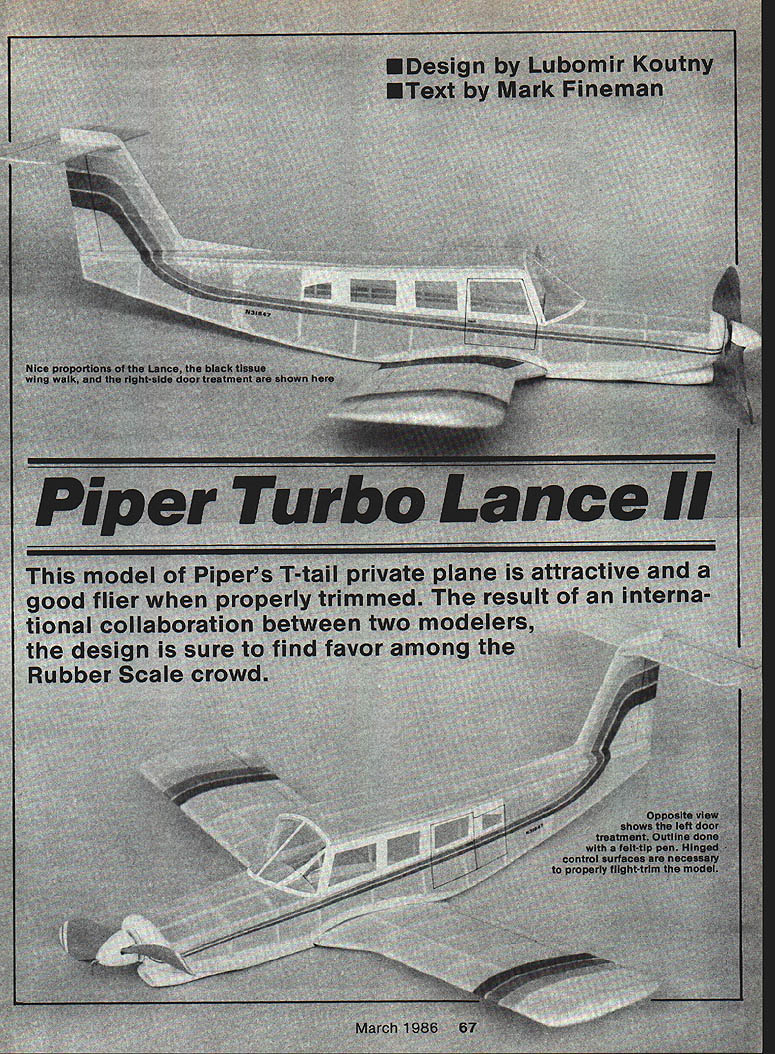
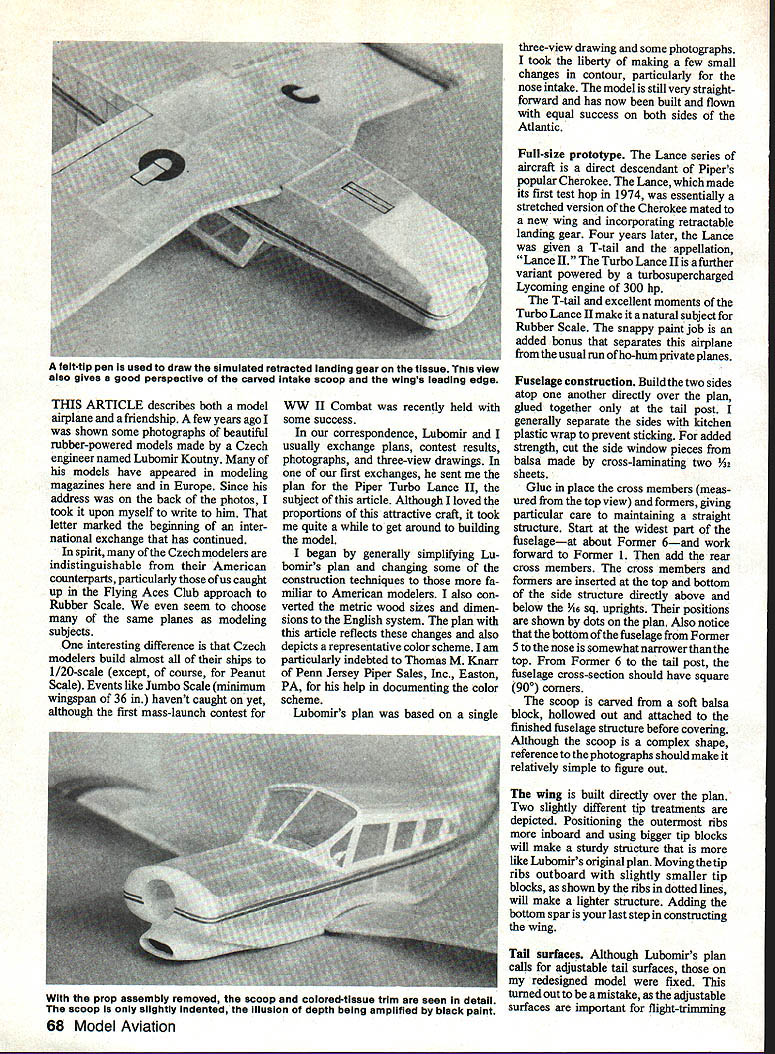
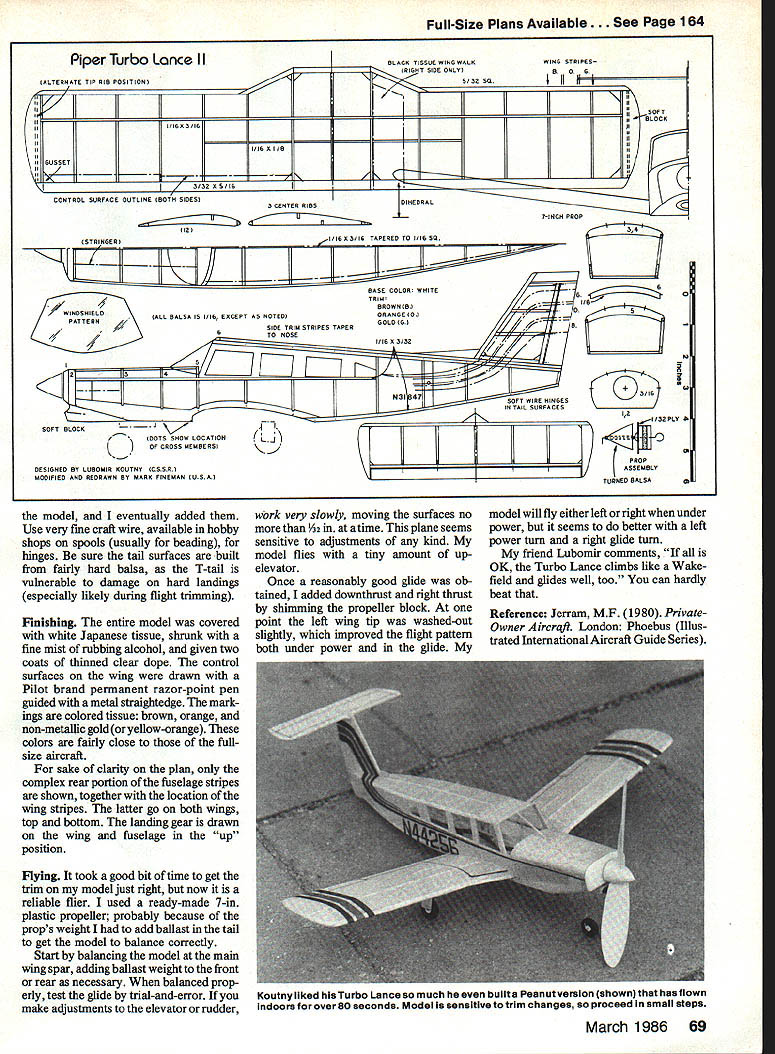
Piper Turbo Lance II
Design by Lubomir Koutny Text by Mark Fineman
This model of Piper's T-tail private plane is attractive and a good flier when properly trimmed. The result of an international collaboration between two modelers, the design is sure to find favor among the Rubber Scale crowd.
This article describes both a model airplane and a friendship. A few years ago I was shown some photographs of beautiful rubber-powered models made by a Czech engineer named Lubomir Koutny. Many of his models have appeared in modeling magazines here and in Europe. Since his address was on the back of the photos, I took it upon myself to write to him. That letter marked the beginning of the international exchange that has continued.
In spirit, many of the Czech modelers are indistinguishable from their American counterparts, particularly those of us caught up in the Flying Aces Club approach to Rubber Scale. We even seem to choose many of the same planes as modeling subjects.
One interesting difference is that Czech modelers build almost all of their ships to 1/20-scale (except, of course, for Peanut Scale). Events like Jumbo Scale (minimum wingspan of 36 in.) haven't caught on yet, although the first mass-launch contest for WWII Combat was recently held with some success.
In our correspondence, Lubomir and I usually exchange plans, contest results, photographs, and three-view drawings. In one of our first exchanges, he sent me the plan for the Piper Turbo Lance II, the subject of this article. Although I loved the proportions of this attractive craft, it took quite a while to get around to building the model.
I began by generally simplifying Lubomir's plan and changing some of the construction techniques to those more familiar to American modelers. I also converted the metric wood sizes and dimensions to the English system. The plan with this article reflects these changes and also depicts a representative color scheme. I am particularly indebted to Thomas M. Knarr of Penn-Jersey Piper Sales, Inc., Easton, PA, for his help in documenting the color scheme.
Lubomir's plan was based on a single three-view drawing and some photographs. I took the liberty of making a few small changes in contour, particularly for the nose intake. The model is still very straightforward and has now been built and flown with equal success on both sides of the Atlantic.
Full-size prototype
The Lance series of aircraft is a direct descendant of Piper's popular Cherokee. The Lance, which made its first test hop in 1974, was essentially a stretched version of the Cherokee mated to a new wing and incorporating retractable landing gear. Four years later, the Lance was given a T-tail and the appellation "Lance II." The Turbo Lance II is a further variant powered by a turbosupercharged Lycoming engine of 300 hp.
The T-tail and excellent moments of the Turbo Lance II make it a natural subject for Rubber Scale. The snappy paint job is an added bonus that separates this airplane from the usual run of ho-hum private planes.
Fuselage construction
Build the two sides atop one another directly over the plan, glued together only at the tail post. I generally separate the sides with kitchen plastic wrap to prevent sticking. For added strength, cut the side window pieces from balsa made by cross-laminating two 3/32 in. sheets.
Glue in place the cross members (measured from the top view) and formers, giving particular care to maintaining a straight structure. Start at the widest part of the fuselage—about Former 6—and work forward to Former 1. Then add the rear cross members. The cross members and formers are inserted at the top and bottom of the side structure directly above and below the 3/16 in. square uprights. Their positions are shown by dots on the plan. Also notice that the bottom of the fuselage from Former 5 to the nose is somewhat narrower than the top. From Former 6 to the tail post, the fuselage cross-section should have square (90°) corners.
The scoop is carved from a soft balsa block, hollowed out and attached to the finished fuselage structure before covering. Although the scoop is a complex shape, reference to the photographs should make it relatively simple to figure out.
The wing is built directly over the plan. Two slightly different tip treatments are depicted. Positioning the outermost ribs more inboard and using bigger tip blocks will make a sturdy structure that is more like Lubomir's original plan. Moving the tip ribs outboard with slightly smaller tip blocks, as shown by the ribs in dotted lines, will make a lighter structure. Adding the bottom spar is your last step in constructing the wing.
Tail surfaces
Although Lubomir's plan calls for adjustable tail surfaces, those on my redesigned model were fixed. This turned out to be a mistake, as the adjustable surfaces are important for flight-trimming.
Finishing
The entire model was covered with white Japanese tissue, shrunk with a fine mist of rubbing alcohol, and given two coats of thinned clear dope. The control surfaces on the wing were drawn with a Pilot-brand permanent razor-point pen guided with a metal straightedge. The markings are colored tissue: brown, orange, and non-metallic gold (or yellow-orange). These colors are fairly close to those of the full-size aircraft.
For the sake of clarity on the plan, only the complex rear portion of the fuselage stripes are shown, together with the location of wing stripes. The latter go on both wings, top and bottom. The landing gear is drawn on the wing and fuselage in the "up" position.
Flying
It took a good bit of time to get the trim on my model just right, but now it is a reliable flier. I used a ready-made 7-in. plastic propeller. Probably because of the prop's weight, I had to add ballast in the tail to get the model to balance correctly.
Start by balancing the model at the main wing spar, adding ballast weight to the front or rear as necessary. When balanced properly, test the glide by trial and error. If you make adjustments to the elevator or rudder, work very slowly, moving the surfaces no more than 1/8 in. at a time. This plane seems sensitive to adjustments of any kind. My model flies with a tiny amount of up-elevator.
Once a reasonably good glide was obtained, I added downthrust and right thrust by shimming the propeller block. At one point the left wing tip was washed out slightly, which improved the flight pattern both under power and in the glide. My model will fly either left or right when under power, but it seems to do better with a left power turn and a right glide turn.
My friend Lubomir comments, "If all is OK, the Turbo Lance climbs like a Wakefield and glides well, too." You can hardly beat that.
Reference
Jerram, M.F. (1980). Private-Owner Aircraft. London: Phoebus (Illustrated International Aircraft Guide Series).
Transcribed from original scans by AI. Minor OCR errors may remain.

