
The Pitfalls of Finding and Building a New Flying Site
Ivan Munninghoff
Background
Into each club's life, some rain must fall. The Pikes Peak Radio Control Club (PPRC) of Colorado Springs, Colorado, nearly drowned a little over twenty years ago when an unfortunate incident caused us to be kicked off the field on which we had just paved three runways. Poof! We were relegated to flying from a piece of rough pasture. Right then we decided to start saving our money toward the eventual goal of building our own facility — a place from which we would never be ejected.
Although we didn't have a legal agreement allowing us to use the land, we were able to pave a facility in the pasture. Still, in the backs of our minds was the ever-present knowledge of the threat to our longevity. We looked at several properties, but they were always too far away and too expensive. We did nothing but let the treasury grow. And it started raining again.
The city annexed the property on which we flew. Housing developments were promised within just a couple of years. All of a sudden, the prospect of being out in the cold again was real. We began an earnest search for land. You'd think that with all the open space commonly imagined in Colorado, finding a flying site would be easy. Not so. Ranchers are very protective of their property, and landowners close to town wanted exorbitant prices for their property, claiming potential development possibilities.
Armed with a county map, we looked at every flat piece of ground within thirty miles. The map showed large areas of state-owned land. Our original inquiries told us that cattle ranchers, leasing the land from the state for grazing, had first choice on the leases. Earlier inquiries into leasing state-owned land revealed that people wanting to lease had a lower priority than the ranchers when the lease came up for renegotiation. Basically, we had found there was no chance to lease state land.
Negotiating a State Lease
This time, using more formal requests to individuals higher in the bureaucracy, we found there had been a change in the law that allowed a "higher use" of the land. A lease benefiting more of the public and providing more revenue to the state could be "overlaid" on a grazing lease. The state provided us with all the information we needed. We immediately began negotiations and filled out the application for a lease.
We tried to think of every possible factor. We advised local airports and military installations of our intentions. There were no neighbors within two miles to be offended by our activities. The site was far enough from the road to prevent possible distractions to traffic. There was one tree within two miles.
The site was situated atop a small ridge, effectively eliminating any drainage problems. It was far enough from major population centers that potential interference sources were minimized, and we checked out all frequencies with a scanner. The runways were oriented to match the prevailing winds (data which can be found at your local weather bureau). We politely presented our case to the rancher who currently held the lease. This was the site we wanted — it was perfect.
We started in the middle of 1990 and used formal, business-like methods with the state. We used club letterhead and polite, proper language. State officials, in turn, were extremely cooperative. After six months of letter writing, site visits, notifying the current leaseholder, and vital assistance from Geoff Styles of the AMA, we were ready to present our case.
In May 1991, we went to Denver, armed with a formal presentation to be made to the State of Colorado, Department of Natural Resources, Bureau of Land Commissioners — the "Land Board." Our presentation consisted of the AMA's videotape on the benefits a flying site offers to a community, professional-looking overhead transparencies, and multi-page handouts for all the Land Board members.
Our representatives wore coats and ties, and we took along a fourteen-year-old member and a couple of our nicer models. The public servants on the Land Board went out of their way to be cooperative. Before we left the building, we had signed a renewable ten-year lease of fifty acres of flat land and had permission to install all the planned improvements.
If your club is looking for a flying site, I seriously recommend that you contact your state's equivalent of Colorado's Land Board.
Building the Field
That was the easy part. It started to rain on us again. We designed what we thought would be the most fantastic flying site anyone (outside of those who fly at full-scale airports) ever had. The club unanimously approved the design. We contacted every paving company in the local area and signed a contract with the company with the lowest bid.
We were too naive. We didn't ask for references from previous customers, we didn't ask if he was bonded, we didn't flinch when he asked for half of the money up front, and we didn't have a lawyer to review the contract. We should have done all those things. Instead, we gave him approximately $13,000.
Our contractor did one day's surface preparation with his grader and decided he didn't want to work for us anymore. He kept our money while he continually made promises about when his equipment would be back on the field and when the project would be done. He kept none of them. Finally, we got a lawyer. After many confrontations, the contractor agreed to give us back $10,000. It took a couple of months for the check to arrive.
The rain turned into a torrent. The check bounced. More legal action. We finally got our ten grand, but we were forced to learn a $3,000 lesson in business practices and ethics.
We found another contractor and asked all the right questions. This group, Schmidt Construction Company of Colorado Springs, was as honest as the day is long. They did exactly what they said they would do on the day they said they would do it. They have provided the year's maintenance they promised, and without a hint of hesitation. It was so nice to deal with respectable people.
Completed Facilities
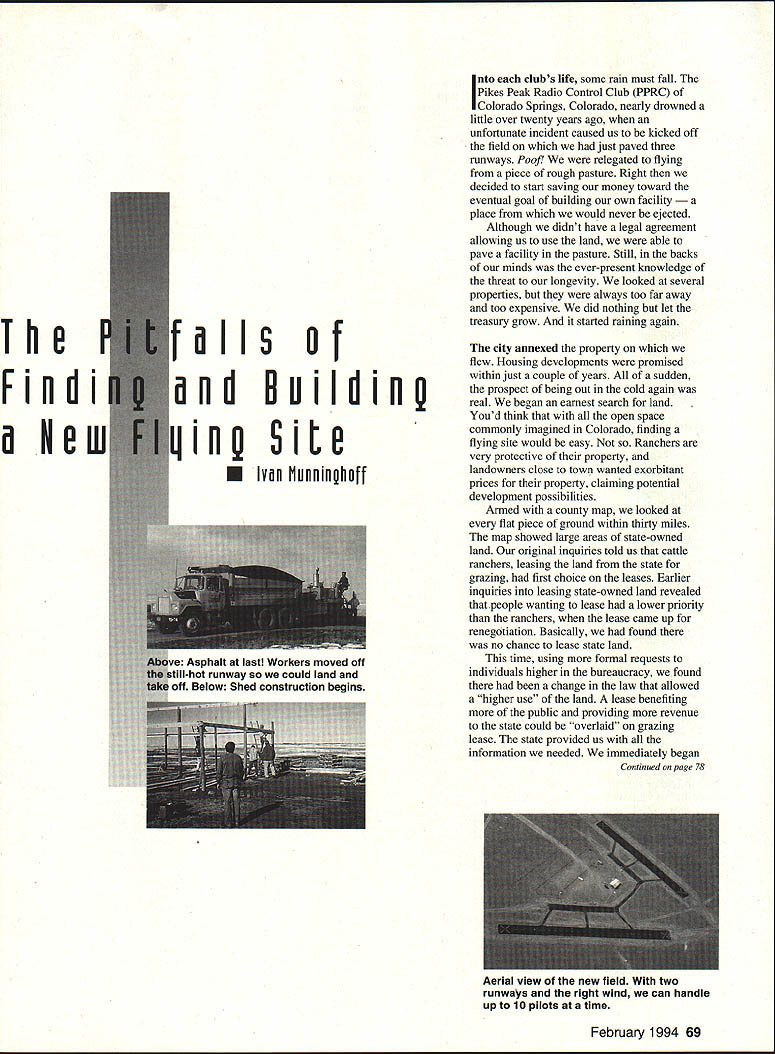
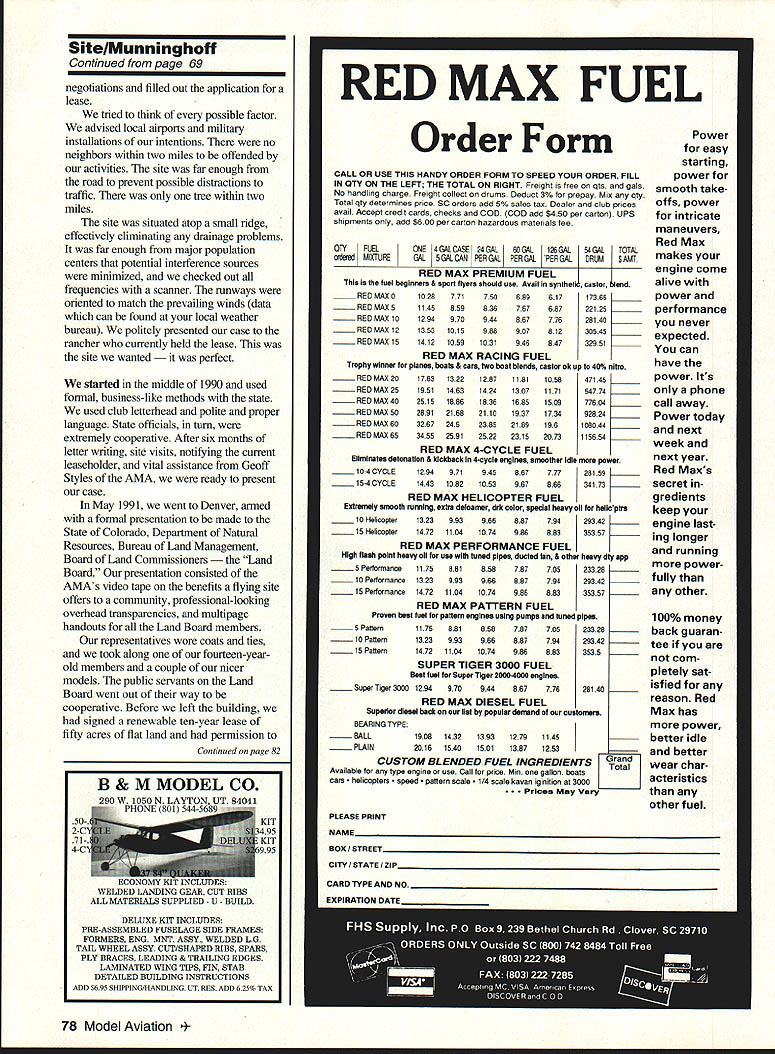
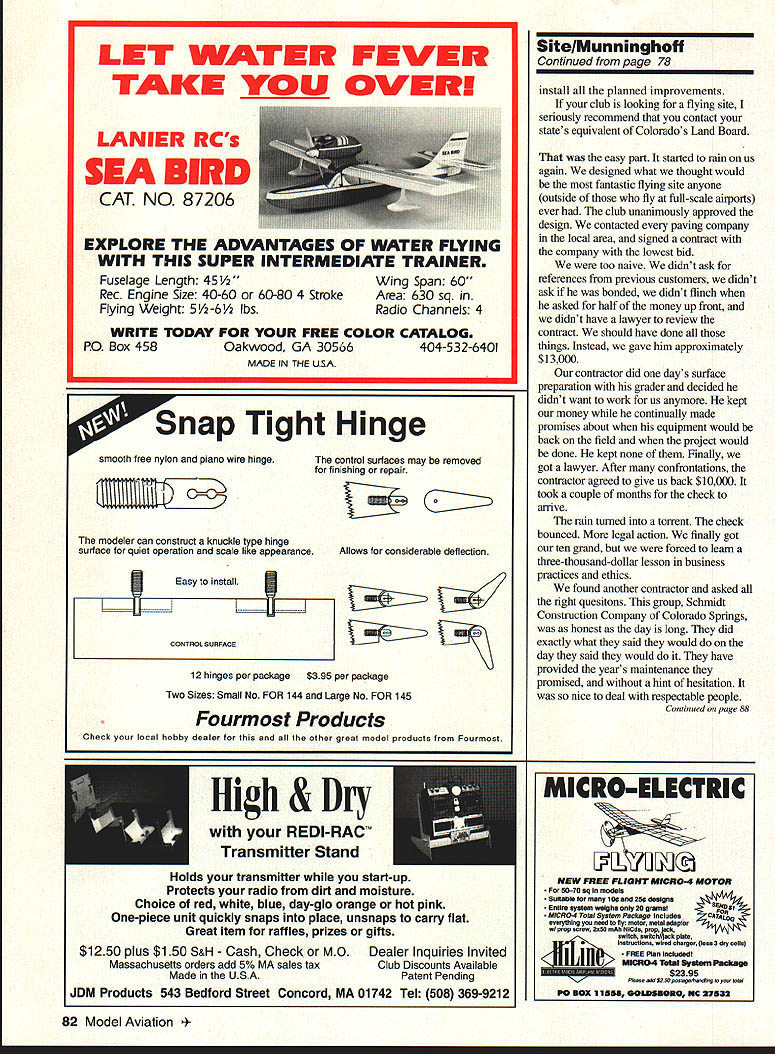
We paved 57,600 square feet of runways, taxiways, and parking ramps. After coordinating with the County Roads Department, we installed a large culvert under our entry to the public highway. Since then, we've added a gate, half a mile of five-strand barbed-wire fence (with private gates for the rancher so he still has access to the remainder of the land) to keep cattle off our runways, bleachers, a shed with lockable storage, flagpoles, protected pilots' boxes, an organized parking area, and many other niceties.
To date, we've spent about $35,000 — just about all the club's treasury. We hosted a couple of Scale Masters Qualifiers and plan to run more than half a dozen contests each year. The work was worth it — you can tell from the pictures what a fantastic place to fly we have.
Lessons Learned
We learned a lot of expensive lessons. For those of you about to embark on a search for a new site, here is a quick summary of things we learned:
- Get a lawyer.
- Ask contractors for references.
- Check potential contractors with the Better Business Bureau.
- Don't deal with a contractor who is not bonded and cannot provide references.
- Never have an individual in the club sign any document without the added phrase "for 'XXXX Club'."
- Reputable paving contractors do not require money up front.
- Monitor all the contractor's activities. Be professional in all project dealings. Get a lawyer.
Postscript
P.S.: It turns out we didn't lose the old field. The building boom quit, and control of the property reverted to the original landowner, who likes having us on his pasture. We have two great fields! At least for the present, the rain has stopped. Come fly with us.
Transcribed from original scans by AI. Minor OCR errors may remain.

