
A Place to Fly
Good rapport with state park and recreational land management people is the key to securing and keeping public land for flying sites.
Gerald Fink
The renovated model airport
With a simple snip of scissors, the taut red ribbon fluttered toward the ground to signal the opening of a beautifully renovated model airport for radio control flying.
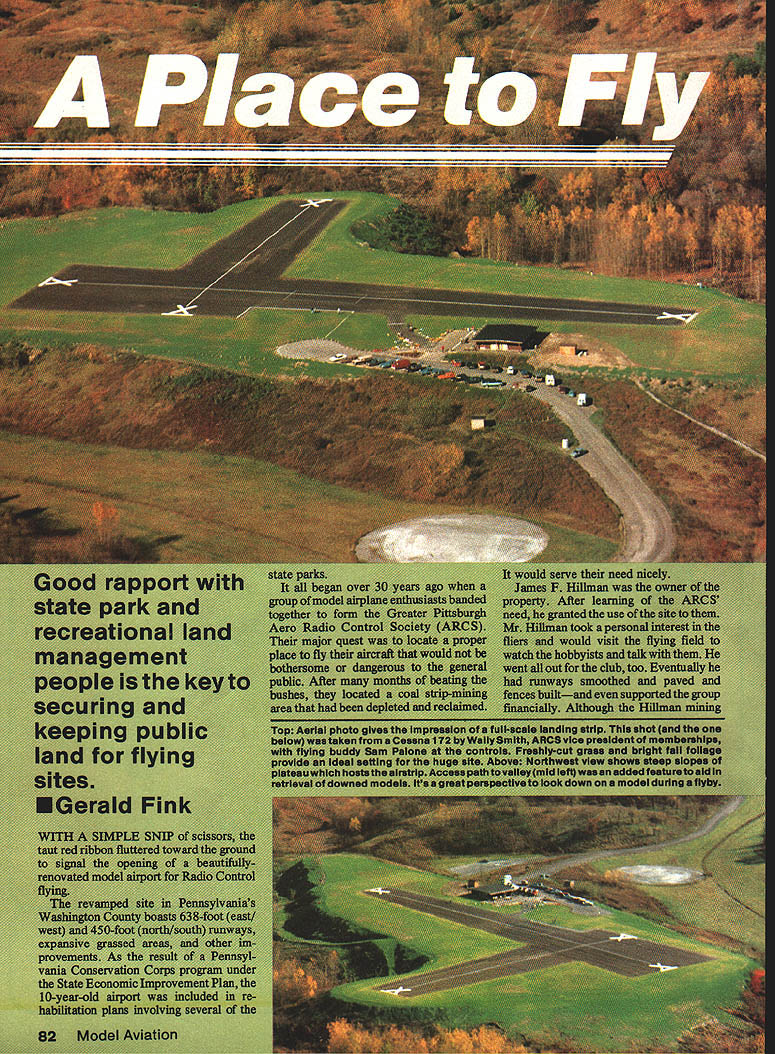
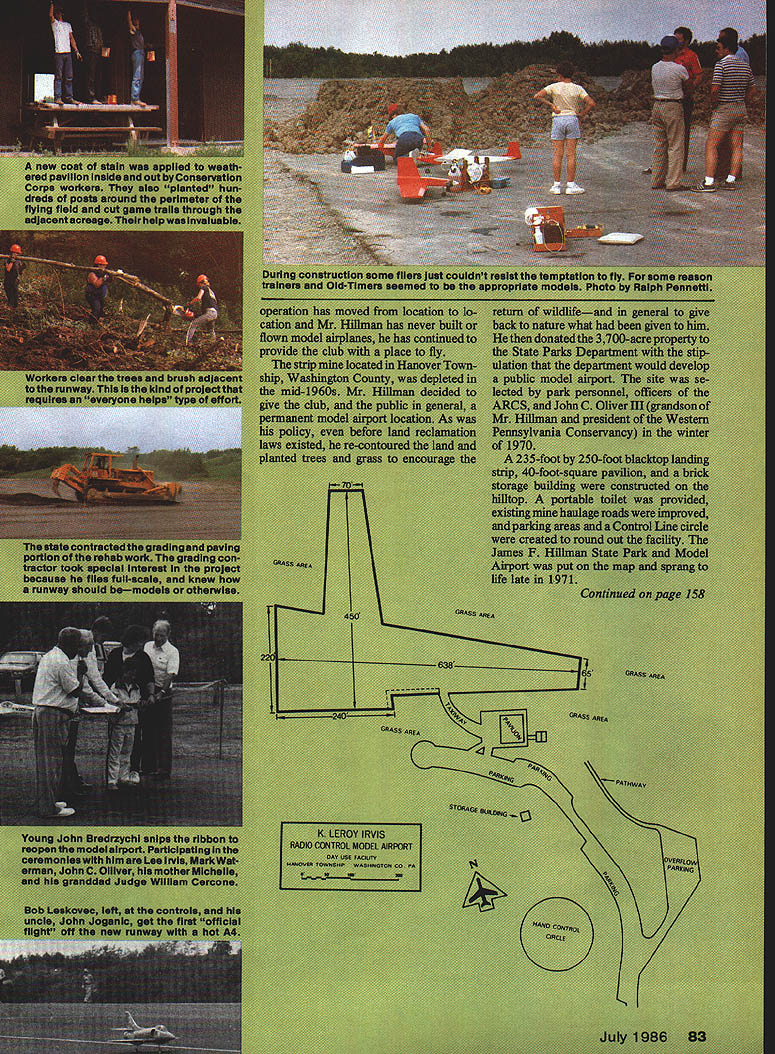
The revamped site in Pennsylvania's Washington County boasts 638-foot (east/west) and 450-foot (north/south) runways, expansive grassed areas, and other improvements. As the result of a Pennsylvania Conservation Corps program under the State Economic Improvement Plan, the 10-year-old airport was included in rehabilitation plans involving several of the state parks.
Origins: finding a place to fly
It all began over 30 years ago when a group of model airplane enthusiasts banded together to form the Greater Pittsburgh Aero Radio Control Society (ARCS). Their major quest was to locate a proper place to fly their aircraft that would not be bothersome or dangerous to the general public. After many months of searching, they located a coal strip-mining area that had been depleted and reclaimed.
The site served their needs nicely. James F. Hillman was the owner of the property. After learning of ARCS' need, he granted use of the site to them. Mr. Hillman took a personal interest in the fliers and would visit the flying field to watch the hobbyists and talk with them. He went all out for the club, too: eventually he had runways smoothed and paved, fences built, and even supported the group financially. Although the Hillman mining operation has moved from location to location and Mr. Hillman has never built or flown model airplanes, he has continued to provide the club with a place to fly.
The strip mine located in Hanover Township, Washington County, was depleted in the mid-1960s. Mr. Hillman decided to give the club, and the public in general, a permanent model airport location. As was his policy, even before land reclamation laws existed, he recontoured the land and planted trees and grass to encourage the return of wildlife—and in general to give back to nature what had been taken. He then donated the 3,700-acre property to the State Parks Department with the stipulation that the department would develop a public model airport. The site was selected by park personnel, officers of ARCS, and John C. Oliver III (grandson of Mr. Hillman and president of the Western Pennsylvania Conservancy) in the winter of 1970.
Facilities and management
A 235-foot by 250-foot blacktop landing strip, a 40-foot-square pavilion, and a brick storage building were constructed on the hilltop. A portable toilet was provided, existing mine haulage roads were improved, and parking areas and a control-line circle were created to round out the facility. The James F. Hillman State Park and Model Airport was put on the map and sprang to life late in 1971.
Administrative responsibility for the model airport was placed in the hands of the superintendent of the nearby Raccoon State Park. Park wardens looked after activities. At the time, a contract/license was drawn up between the state parks and ARCS granting use of the facility for model airplane flying and stipulating responsibility of the club. The contract was to be renewed every two years.
The club was responsible for general maintenance, grass cutting, and similar duties. The site provided liability protection to the state; being a chartered club with the AMA assured that other fliers (non-ARCS) were also AMA members. Additionally, the club had responsibility for providing state usage reports and other information necessary to keep the airport usable, and for maintaining personal contact with local park wardens.
Rehabilitation and improvements (1985)
In the spring of 1985 ARCS learned the field was to be included in a state parks improvement plan. Crews of unemployed young people between the ages of 18 and 21 were hired from the Pennsylvania Conservation Corps to learn marketable job skills such as forestry, heavy equipment operation, surveying techniques, and 10 hours of classroom training per week in carpentry and other trades for those who wished to study toward high school diplomas.
State planners, working with members of ARCS, laid out the improvements and work began in mid-April. The disintegrating landing surface was removed, reprocessed, and used to repair local park roads. The site was completely regraded to eliminate high spots that interfered with aircraft approaches and departures. A new landing strip configuration was installed that will allow fliers to advance as new technologies and larger aircraft become available. A safety fence was erected, a permanent chemical toilet facility was built, and the 40 x 40-foot pavilion was restained and refitted with new doors. A turnaround circle at the end of the drive was created and heavy wood posts were planted around the perimeter to keep vehicles off the runway.
Members of ARCS painted necessary lines on the runway and around the spectator area, and the heavy benches built by the club several years earlier were repaired. The one-year-old transmitter impound rack needed no improving, but the field rules were placed above it for all to see.
Dedication
On August 25, 1985, with all the dedication speeches still on our minds, the red ribbon settled gently on the new black asphalt taxiway, and the first "official" flight took off from the new runway.
Transcribed from original scans by AI. Minor OCR errors may remain.

