
Plane Talk: Great Planes PT-17 Stearman ARF
Dan VanNieuwland
A first-time Giant Scale pilot’s look at a classic favorite
While mowing my lawn on an unusually hot day for early June, I was thinking of how to convince my wife that I had to get the Great Planes PT-17 Stearman. The previous evening I had been waving catalogs and magazines at her like a child with the Sears Wish Book at Christmas.
My wife wasn’t sharing my enthusiasm. Having two boys, she has acquired a skill over the years: she can calmly ignore overly excited children yelling, "Can I have that? Can I have that?" at her. Suddenly my thoughts were interrupted by an unusual sound from above.
I live less than a mile from a small airport and engine noise from above is the norm, but this sounded different. I looked up into the sky, and what flew directly over my head looked like a PT-17 Stearman in the same military color scheme as the Great Planes model. Impossible, I thought. I had to be mistaken, right?
Moments later the lawn mower sat silent in the middle of my yard and I was in my car heading to the local airport. I parked and ran quickly to the chain-link fence parallel to the runway. Slightly out of breath, I scanned the airport for a big, yellow airplane. A bunch of large yellow Cubs caught my eye and I had to tell myself, "Two wings! Two wings, silly!" Still, no biplanes. With a huge sigh I briefly thought, "Senility is coming too quickly." I turned to walk away when that unique sound caught my ear again. I quickly scanned the sky in the direction of the sound, and there it was: a PT-17 Stearman decked out in US Navy garb. Wow! I watched the airplane as it made the downwind leg and then the turn for final approach. The PT-17 looked like it was coming in quite fast for a landing. To my surprise, it went down the length of the runway approximately 15 feet off the ground. My eyes were wide and fixated on the airplane.
As it flew by me, the chest-thumping phat-phat-phat sound of the radial engine hit my ears and reverberated through my body. The airplane pointed skyward and was all too quickly out of sight. I stood in awe. It was an omen; I had to have one.
Full-Scale PT-17
The full-scale airplane is awesome. The pilot, John, was more than happy to answer any questions I had, and he even allowed me to sit in the Stearman. While ogling the aircraft I heard an interesting comment about the pilot position.
In this aircraft the student was typically in the rear seat and the instructor was in the front. This is reversed for most two-seat trainers. The reason for the difference is the open cockpit and the position of the bottom wing. The airflow from the bottom wing tends to hit the rear pilot right in the head. This makes the front position more comfortable and quiet, whereas the rear seat experiences head buffeting and wind noise. When flying alone the pilot is stuck in the back since that position properly balances the airplane.
I thank Damian DeGaizo and everyone at the Aeroflex Flight Academy in Andover, New Jersey, for their help, information, and for allowing photos of their beautiful historic aircraft to be used in this article.
Opening the Box
My wife is a great person—especially when one of her kids is really excited about something. (That’s me.) I received a mighty big box from her and my two boys on Father’s Day. Sure enough, it was the Great Planes PT-17—truly one of the best gifts I have ever received.
My first impression when I opened the box was that the PT-17 was big. The colors grabbed my attention, and the model was well packed. I stared motionless for a while, gaping at the open box. I was thankful that the parts were covered in plastic, preventing any drool from damaging the important components. The pieces were tightly packed, and an additional box contained most of the hardware, engine mount, wheel pants, plywood braces, and other parts.
I found no dings or damaged parts. One thing I noticed during the inspection was that the MonoKote covering was wrinkled on all the components. An iron and a heat gun did a good job of removing most of the creases. The exception was around the ailerons, and those wrinkles were minor. Not being a covering expert, the job Great Planes did is better than I could have done and is quite good overall.
When I laid the pieces out on the floor, the airplane looked enormous. This was my first 1/4-scale airplane, and its size was a bit intimidating. My 9-year-old son pointed out that he thought it was roughly the same size as my aerobatic trainer: a Sig Four-Star 60. He was right; other than the wingspan and fuselage length, they were comparable. Thanks to my son, my intimidation waned.
The kit came with almost everything needed to build the airplane other than the typical building supplies and tools. Included were the dummy pilots and radial engine, wheel covers, scale decals (including rivets), windscreens, and even precut balsa fixture blocks to set the dihedral properly. As I pointed out, the kit came with "almost everything"; the rigging wire was missing. As recommended by the manufacturer, rigging wire is an elastic thread called "beading cord," or "beading elastic," that you can find in stores that sell sewing supplies. The beading cord costs only a few dollars (much less than the $10 indicated in the instructions) but was a bit difficult to find.
The rigging wires add much more than just "minor scale detail." They add character and realism for a low cost and small time investment. Take the time and pay the few dollars to add them; you will be glad you did.
Doing the Last Thing First
After reading through the instructions I decided to perform one step out of sequence: painting the cockpits. This was listed near the end of the assembly process. Personnel at the local hobby shop informed me that the only supplier they knew that sold "brushable" fuelproof flat-black paint didn't carry it anymore. Since spray painting was the way to go, I decided to paint the fuselage before attaching additional parts to it. This was a good decision overall.
I taped and covered the fuselage with newspaper before I painted. I used several light coats of Flat Black LustreKote to the bottom side of the top portion of the cockpit (the part under the windshield) before I painted the cockpit floor. It helps eliminate runs and drips on the cockpit floor if you paint the entire cockpit at one time.
Be careful handling the model around the cockpit area. It seemed that was the place to grab whenever the airplane was moved. The balsa sheeting in that area had no backing and could be easily damaged because of the model's weight.
Specifications
- Model type: RC Sport Scale ARF
- Pilot skill level: Intermediate
- Top wingspan: 71.5 inches
- Bottom wingspan: 69.0 inches
- Wing area: 1,466 square inches
- Length: 57 inches
- Weight (ready to fly): 14–15 pounds
- Engine (recommended): Two- or four-stroke .91–1.20
- Radio (recommended): Four channels (minimum), five servos
- Construction materials: Balsa and plywood
- Finish: MonoKote film covering
Test-Model Details
- Engine used: O.S. FS-120 Surpass III with pump
- Propeller: APC 15 x 8
- Fuel: Approximately 14.5 ounces, 15% nitromethane
- Radio system: Futaba 8U transmitter, Futaba R138DP receiver, Futaba 9202 servos, 1100 mAh 6.0-volt battery
- Ready-to-fly weight: 15.5 pounds
- Flight duration: 10–15 minutes
Pluses and Minuses
- + Looks great.
- + Includes most of the required hardware.
- + Great flying characteristics.
- + Easy assembly.
- + Includes a carrying handle!
- - A few errors in the manual.
- - Landing gear interferes with fuselage (minor wrinkle in covering).
- - Dummy radial engine, look and assembly of pushrod tubes could be improved.
Wing Assembly
Each wing half is permanently joined with plywood braces and epoxy. As on the full-scale PT-17, only the lower wing has ailerons. Putting the wings together was straightforward. The bottom wing has some dihedral and the top wing is straight. The wing halves were permanently secured with plywood wing joiners and epoxy.
The photo and instructions for joining the bottom wing halves did not match. The text instructed the builder to place the supplied block of wood under the wing half flat on the workbench (one is in the photo because of the dihedral). The photo in the instructions showed the block under the wing in the air. I decided to place the block under the wing on the workbench since the instructions were in bold print for this step and the photo in the Super Stearman instructions showed the block under the wing on the workbench, matching the text in both manuals.
I secured the control surfaces using cyanoacrylate hinges. The hinge slots were precut and were wide enough to allow for proper positioning. The hinges fit snugly into the hinge slots, and only two slots needed minor help with a hobby knife. Owing to irregularities between the ailerons and the wing, the control-surface gap was larger than desired but acceptable. You could seal the hinge gap with Cub Yellow MonoKote if you wanted.
The bottom wing was secured to the fuselage by two dowels that were glued into predrilled holes on the leading edge and two nylon wing bolts. The top wing was secured by two pairs of cabanes (supports) in the middle and at each end of the wing. The N struts connecting the top and bottom wing looked good and nicely replicated the full-scale airplane.
The wing was secured to the cabanes by eight 4-40 socket-head screws. If your luck is like mine, if you drop one of these little screws into the grass during assembly, you won't find it no matter how long you look. Keep some spares in your field box.
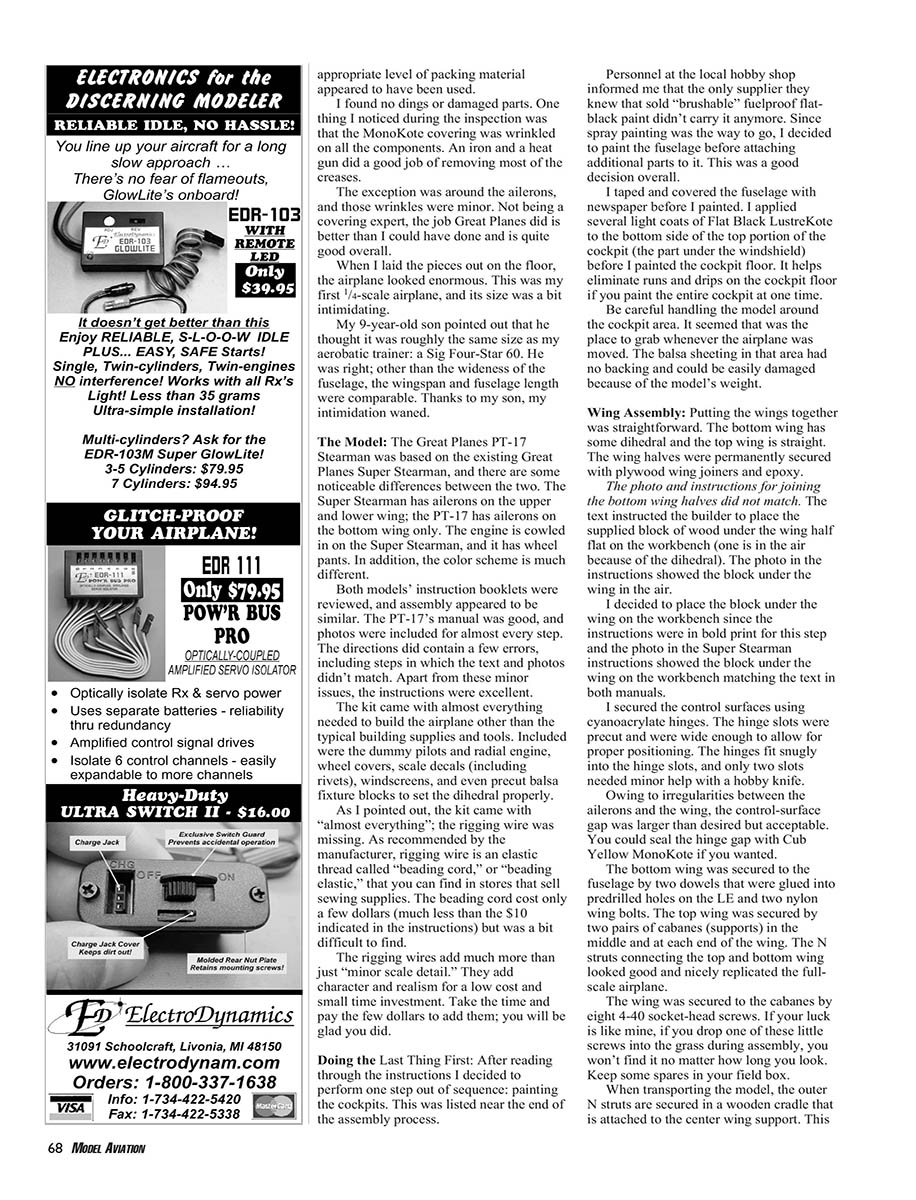
When transporting the model, the outer N struts are secured in a wooden cradle that is attached to the center wing support. This doubles as a storage location for the outboard N struts.
Power System
Mounting the engine and installing the firewall assembly was straightforward. The cowl fit well, although the cowl's "smile"-shaped cutout allows for clearance of the muffler header and requires attention during installation. An O.S. FS-120 Surpass III fit well behind the dummy Continental.
Mounting the Engine
Engine mounting was easy, thanks to the supplied mount and predrilled mounting holes in the firewall. I installed an O.S. FS-120 Surpass III four-stroke, which was on the high end of the recommended range. The engine was mounted inverted, which allowed the exhaust to exit neatly from the bottom of the cowl.
Another nicety of this model is that the appropriate engine thrust and offset was already built into it; no shimming of the engine mount was necessary. So don't worry if the engine looks a bit crooked and off-center.
Engine Cowl and Dummy Radial Engine
The radial engine is the one thing that gives the PT-17 its character. It also gives the model its good looks and a nice level of detail, including the pushrod tubes and the sparkplug wires.
The supplied dummy radial engine looked good; however, it did have a few oddities. The spacing between the cylinders on the dummy engine was large when compared to that on the full-scale airplane. In addition, the rocker covers where the pushrods attached were at an odd angle on the dummy radial. When drilling the holes for the pushrods, I had to angle the drill so they were made at an angle so they connected on the opposite end.
The paint on the cowl looked good and handled flexing well. The cowl was flexed more than it probably should have been during assembly, and the paint stayed on securely with no cracking, flaking, or chipping.
I encountered some difficulty getting the cowl to fit over the engine header. While fitting the cowl the smile-shaped cutout got larger and larger. To add to the concern, my cowl had a much bigger smile than that shown on the photos on the box. It was later determined that the model in the photo had a smaller engine, which was probably the reason for the smaller smile. Cutting the cowl to make it fit just right and look good took patience. Take the time; work on it in spurts if necessary. The result will be a source of pride.
Weight Box and Battery Installation
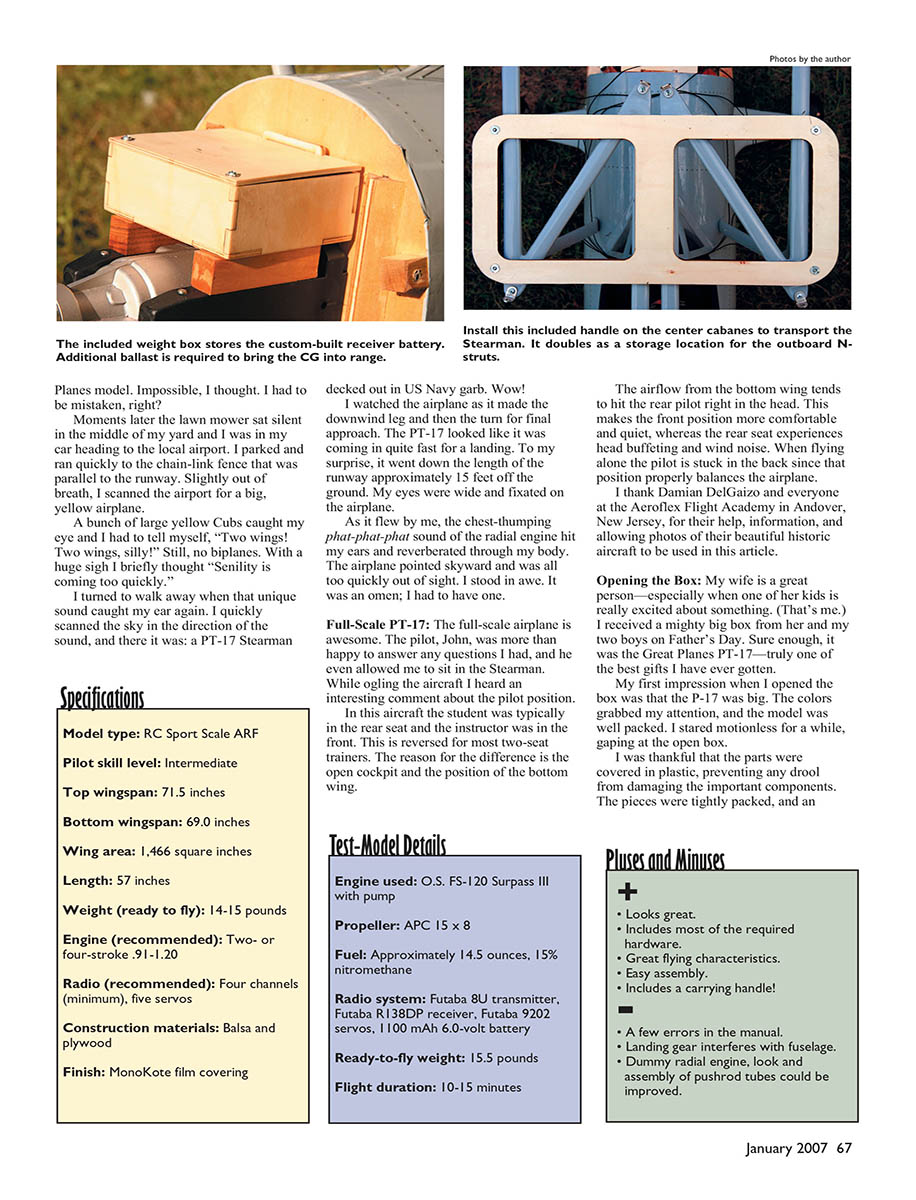
The kit included a weight box made from light plywood that, once assembled, was attached to the engine mount. The instructions mentioned that weight would probably be required in the nose since the model was somewhat short-coupled.
It's safe to say weight will be required if you use the recommended engines. The prototype used for the instructions had an O.S. .91 four-stroke and required 18 ounces of weight. The instructions suggested putting the battery in the weight box to offset some of the lead weight.
I decided to use a 6-volt (five-cell) receiver battery. This usually increases the servos' torque and speed. (Always check the radio-equipment specifications.) Usually a detriment to other models, the larger pack adds slightly more weight, requiring less lead ballast in the weight box.
I assembled, sanded, fuel-proofed, and installed the weight box, and then a problem emerged: it wasn't large enough to hold a five-cell pack. I disassembled the battery pack and rearranged and soldered the cells to fit into the box. The batteries fit, but they were a bit snug once wrapped in foam. Although the current arrangement should be fine, I might install a larger box in the future.
Even with the battery in the weight box and using a 1.20-size engine instead of the O.S. .91 prototype, 9 ounces of weight was still required.
Landing Gear
The landing gear was a solid piece of aluminum held up with 4-inch wheels and matching wheel covers. The strong landing gear was required to carry the 14–15 pounds of weight, and it appears capable of handling the occasional harsh landing. The prepainted landing gear blended beautifully with the rest of the PT-17 and contributed to its character.
A minor problem I noticed was that the landing gear interfered with the fuselage. This caused a small wrinkle in the covering. To correct the problem I added a light-plywood spacer between the fuselage and the landing gear. Once installed, the gap between the fuselage and the gear is unlikely to be noticed unless pointed out. It looks like it should be that way anyway.
After a hard-ish landing during later flying, the foam covering over the metal landing gear was split down the entire length of the leading edge and trailing edge. I repaired the split with epoxy, and subsequent landings have resulted in no additional damage.
Receiver and Servo Installation
Installing the servos and receiver was a breeze with the luxuriously spacious, deep and wide fuselage. Five servos were required: two aileron, one rudder, one throttle, and one elevator. The minimum recommended servo specification was 54 ounce-inch of torque.
I chose the Futaba 9202 coreless servos, which have 76 ounce-inch of torque at 4.8 volts and 98 ounce-inch of torque at 6.0 volts. I placed the receiver switch in the front cockpit, where it is fairly inconspicuous.
The model has a split elevator although the pushrods are connected to one servo. An elevator pushrod is attached to one elevator half, and the other end is connected directly to the servo. The second elevator pushrod is connected to the other elevator half, and the opposite end is attached to the first elevator pushrod with two wheel collars.
The connection using the wheel collars appears to be secure. I pulled, pushed, and poked the control rods vigorously, and there was no slop or play. For added peace of mind I soldered the pushrods together. It took only a few minutes and created added insurance.
Decals
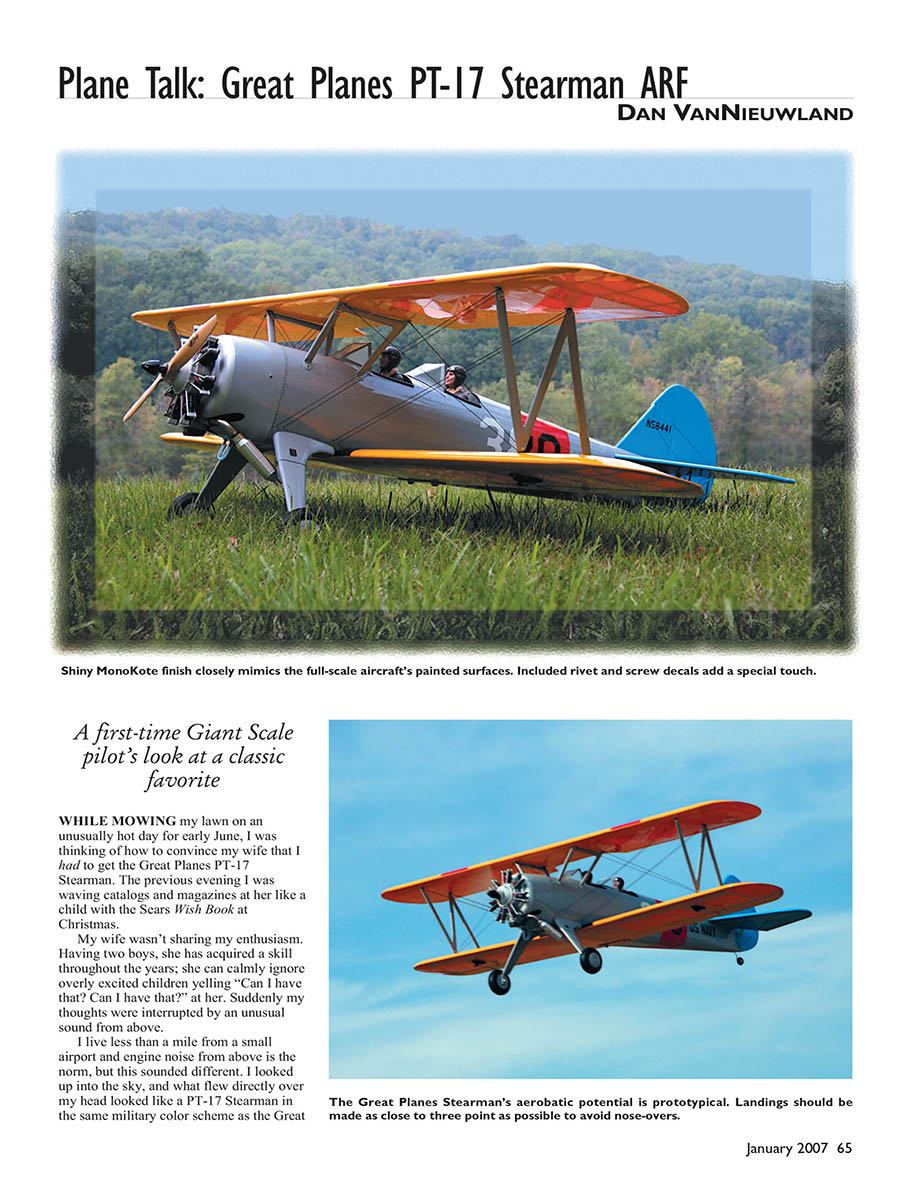
The full-scale PT-17 is a combination of metal panels and fabric-covered sections. Metal panels are located on top of the fuselage from the engine-cowl ending to just behind the rear pilot seat. The model's decal kit included strips of rivets to simulate the metal panels. The rivets didn't take long to add, and they are a tasteful size. From a few yards away they are difficult to even notice, but they look great up close.
Two large circle-and-star decals were included for placement on the top wing. The full-scale airplane has these decals on the underside of the bottom wing as well. I considered purchasing another decal kit to add the stars to the bottom wing, but that would have made the bottom and top wing look identical when inverted. I decided to leave it alone and see how easy it would be to recognize the model's orientation.
Rigging Wires
I installed the wires by drilling holes at points that were clearly specified with photographs in the instructions. To attach the rigging wires I applied thin cyanoacrylate to one end of the thread, making it stiff. Once dry I cut the rigging wire at an angle to make a point.
The thread was easy to insert into the holes, and I secured it with more cyanoacrylate. If I ever need to replace the wires, they can easily be cut, drilled, and replaced.
The rigging wire for the rudder and horizontal stabilizer are permanent and require no assembly at the field. For the wings, both sides of the rigging wires are permanently secured (glued) into the fuselage to make a loop. The opposite end is wrapped around the outer N struts when the PT-17 is assembled.
The photo on the box showed the rigging wire attached to the front of the cabane on one wing and on the rear of the cabane on the opposite wing. As shown in photos of the full-scale airplane, they should both go to the front of the cabane.
Flying
Great Planes advertisements describe the PT-17 as a great first biplane. Since this is my first biplane and I consider myself an intermediate pilot, I'm probably an excellent target customer. I am also comfortable flying and know basic aerobatics.
I waited for a calm, sunny day for the maiden flight. It took a while to get there, but when it arrived the air was filled with excitement—not only mine, but that of a small crowd of club members, my wife, and my two children.
In addition to the normal knee knocking of a first flight, this was also the first time I was piloting the maiden flight. In the past this honor was usually reserved for more experienced club members, quite a few of whom were standing beside me. Their presence was actually calming.
I taxied the PT-17 the length of the grass runway a few times, occasionally adding throttle to observe the response. I also used this extra time to reduce my knee knocking. When that was accomplished I lined the model up on the runway centerline and prepared for takeoff.
I slowly applied throttle and the airplane started to rumble down the runway. Only minor rudder corrections were necessary, and I observed no unexpected behavior. The tail wheel lifted off the ground, and shortly thereafter the PT-17 was in the air at approximately three-quarters throttle. Only slight trim corrections were necessary, and within a minute or two the airplane was flying straight and level. After trimming, my nervousness melted away.
The first flight was mainly a circuit including ovals and figure eights. The PT-17 reacted as expected, with no bad behaviors, and the flying was comfortable. The only unexpected thing was that it flew slower than predicted. I later learned that it was because the model was a bit overpropped.
When some of my fellow club members heard I had a biplane, a common comment was, "Biplanes fly until they don't. Once they stall, the stall is dramatic." With plenty of altitude I cut back the throttle to see when the PT-17 would stall. It did so much later than predicted. Once it happened, I quickly regained control. This experiment greatly reduced my concerns about having the PT-17 stall. Club members commented that it did so much later than aerobatic biplanes they have flown.
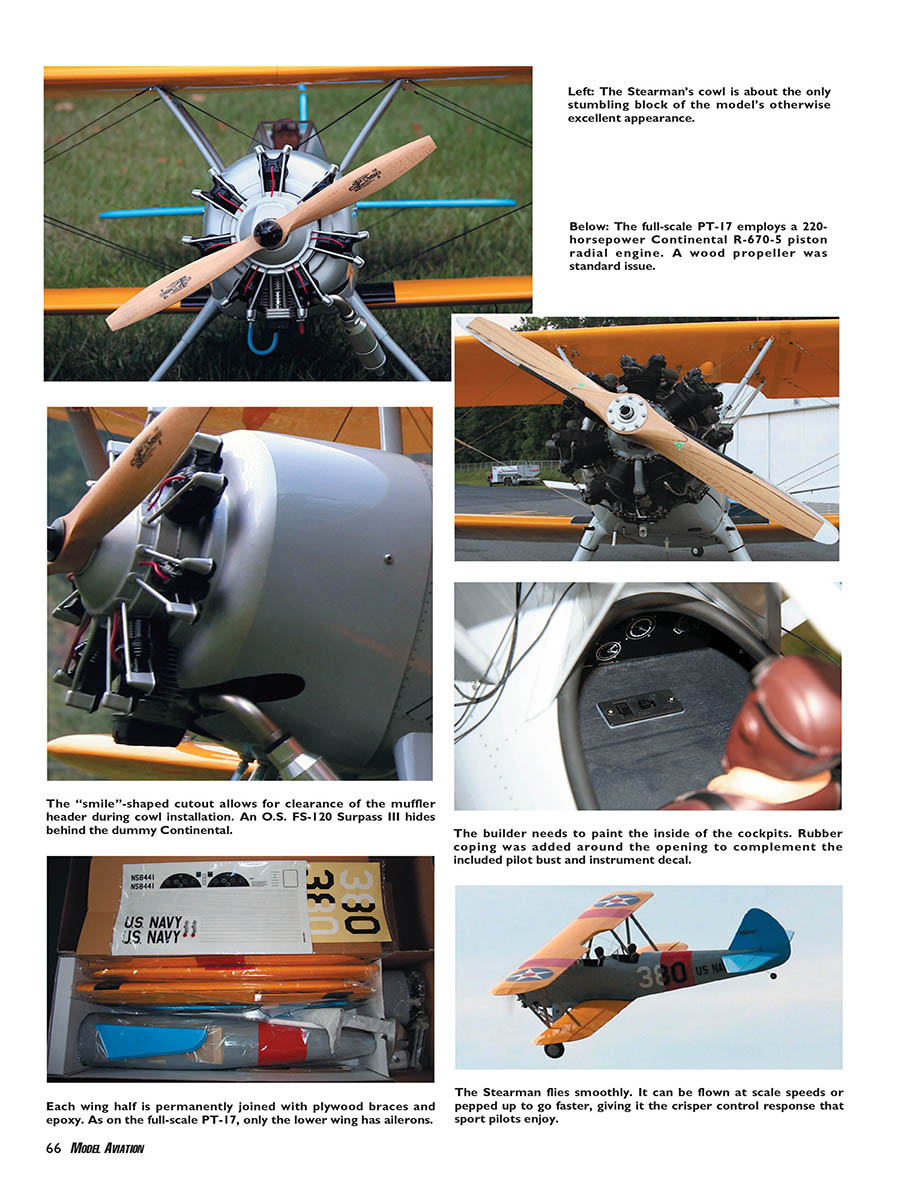
With the time to land approaching I performed a few flybys to get into the rhythm of lining up for landing. The slow and low passes were beautiful. As good as the PT-17 looked on the ground, it looked even better in the air.
With my knees starting to quiver again, I lined up the PT-17 for final. The landing was uneventful other than being a bit fast. I was still a little concerned about the PT-17 stalling at slow speed, and the idle was purposely set slightly high to ensure that the new engine would stay running. Otherwise, the landing was perfect.
With my mind filled with confidence and the PT-17 filled with fuel, I took it into the air for a second flight. It performed beautiful large loops, requiring only the slightest rudder correction. Rolls were equally easy and graceful, with the expected amount of down elevator required while the model was inverted.
Keep in mind that the PT-17 is a scale model—not an aerobatic biplane. It did not perform some advanced maneuvers well. It could execute knife-edge flight for only a short distance, and then its nose would dive and the model would roll out.
In the following days I had the desire to find out why the model flew slower than expected. The engine's manual did not indicate its ideal rpm or show the torque curve. I asked several club members for their opinions, and most of them said the maximum rpm of 8,400 was too low.
I tried several propeller sizes and manufacturers to get the highest rpm. The winning combination was an APC 15 x 8 that reached a maximum of 9,100 rpm. I confirmed with O.S. Engines' tech department that 9,100 rpm is correct and that an increase should be observed once the engine is broken in. At that point a larger propeller may be used.
With a new propeller on its nose, I sent the PT-17 into the air to see if there was a difference. There was, and it was dramatic. The model flew much faster and performed better. The improvements pulled the airplane's speed into my realm of expectations and made the flying experience much more enjoyable.
That flight's landing was a bit hard because of pilot error, but it wasn't too bad. The PT-17 took one large hop before settling onto the runway. After the flight I cleaned and disassembled the airplane and packed it into the car to end a spectacular day.
The PT-17 seems to confirm the belief that it is a great first biplane, and it will probably put a smile on scale-aircraft admirers' faces. The experience from building to flying was enjoyable. Assembly was fairly straightforward, although completing the ARF in the 12–15 hours claimed seems unrealistic to be able to do a good job.
The fit and finish was excellent, with only a few exceptions. Having all the hardware included in the kit was a plus. The flying wires on the wings and the rudder-stabilizer made the PT-17 "pop."
The model's flight characteristics would suit an intermediate pilot who is capable of performing basic aerobatics. The PT-17 is not a good choice for beginners, but it could be a nice third airplane. On the other hand, the PT-17 is not a high-performance aerobatic aircraft. It is a scale military trainer—not a hot air-show flier.
If you are an intermediate pilot who is looking for your first biplane or a more experienced pilot who is looking for a graceful, good-looking scale model, the Great Planes PT-17 is an excellent choice.
MA
Dan VanNieuwland dan@garden.net
Manufacturer/Distributor:
Great Planes Model Distributors Box 9021 Champaign, IL 61826 (217) 398-3630 www.greatplanes.com
Items Used in Review:
- Propeller:
Landing Products 1222 Harter Woodland, CA 95776 (503) 661-0399 apcprop@aol.com www.apcprop.com
- Radio equipment:
Great Planes Model Distributors www.futaba-rc.com
- Engine:
Great Planes Model Distributors www.osengines.com
Additional Resources:
- Model Airplane News magazine (November 2005 issue)
100 E. Ridge Ridgefield, CT 06877 (203) 431-9000 http://modelairplanenews.com/
- Fly RC magazine (November 2005 issue)
650 Danbury Rd. Ridgefield, CT 06877 (203) 431-7787 editors@flyrc.com www.flyrc.com
- R/C Report magazine (July 2005 issue)
Box 1796 Madison, AL 35758 (256) 722-5697 glbanks@rcreport.ws www.rcreport.ws/
Transcribed from original scans by AI. Minor OCR errors may remain.

