

Plane Talk: Hangar 9 27% Extra 260 ARF
BY JEFF TROY
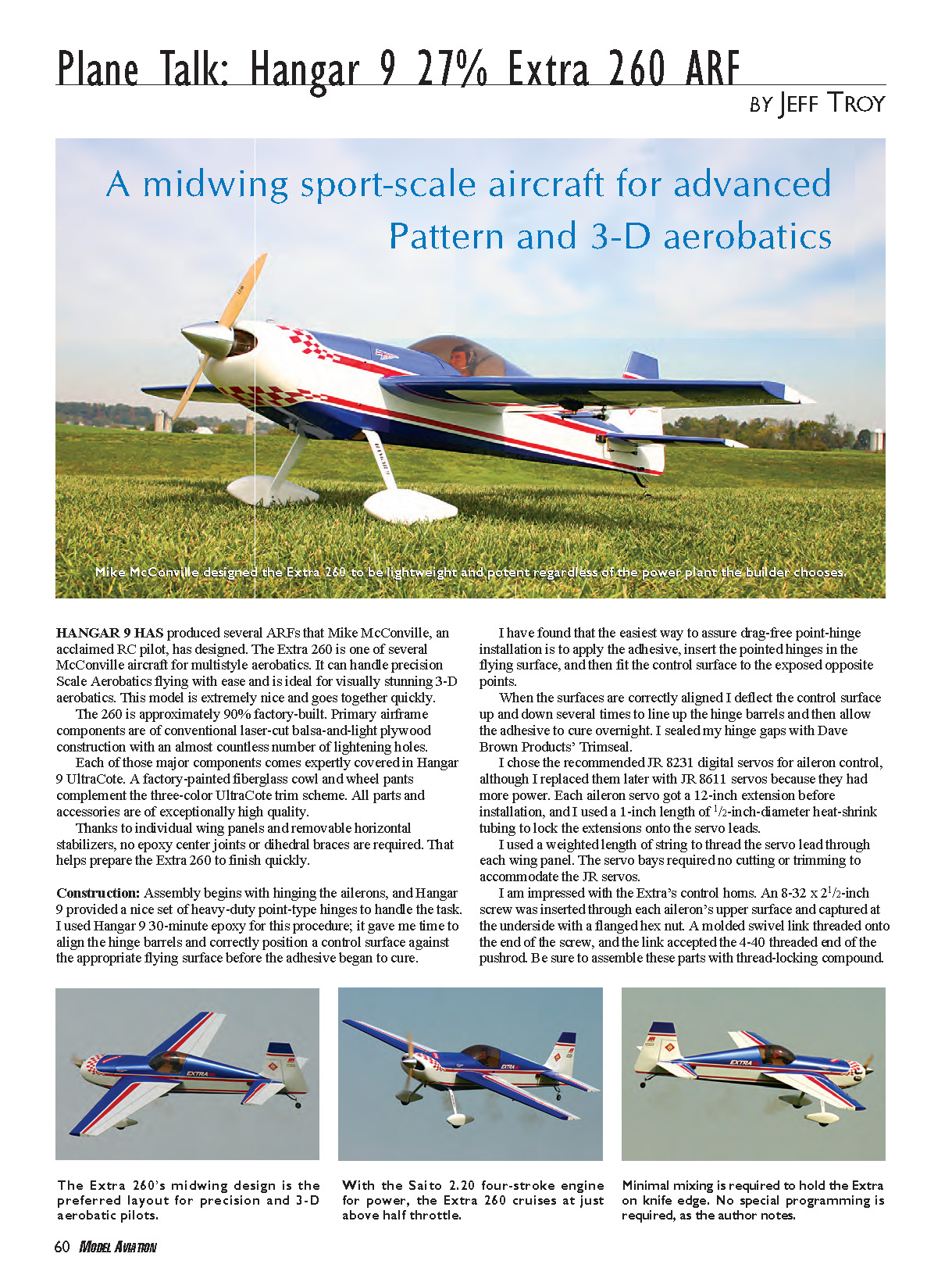
A midwing sport-scale aircraft for advanced Pattern and 3-D aerobatics
Hangar 9 has produced several ARFs that Mike McConville, an acclaimed RC pilot, has designed. The Extra 260 is one of several McConville aircraft for multistyle aerobatics. It can handle precision scale aerobatics flying with ease and is ideal for visually stunning 3-D maneuvers. This model is extremely nice and goes together quickly.
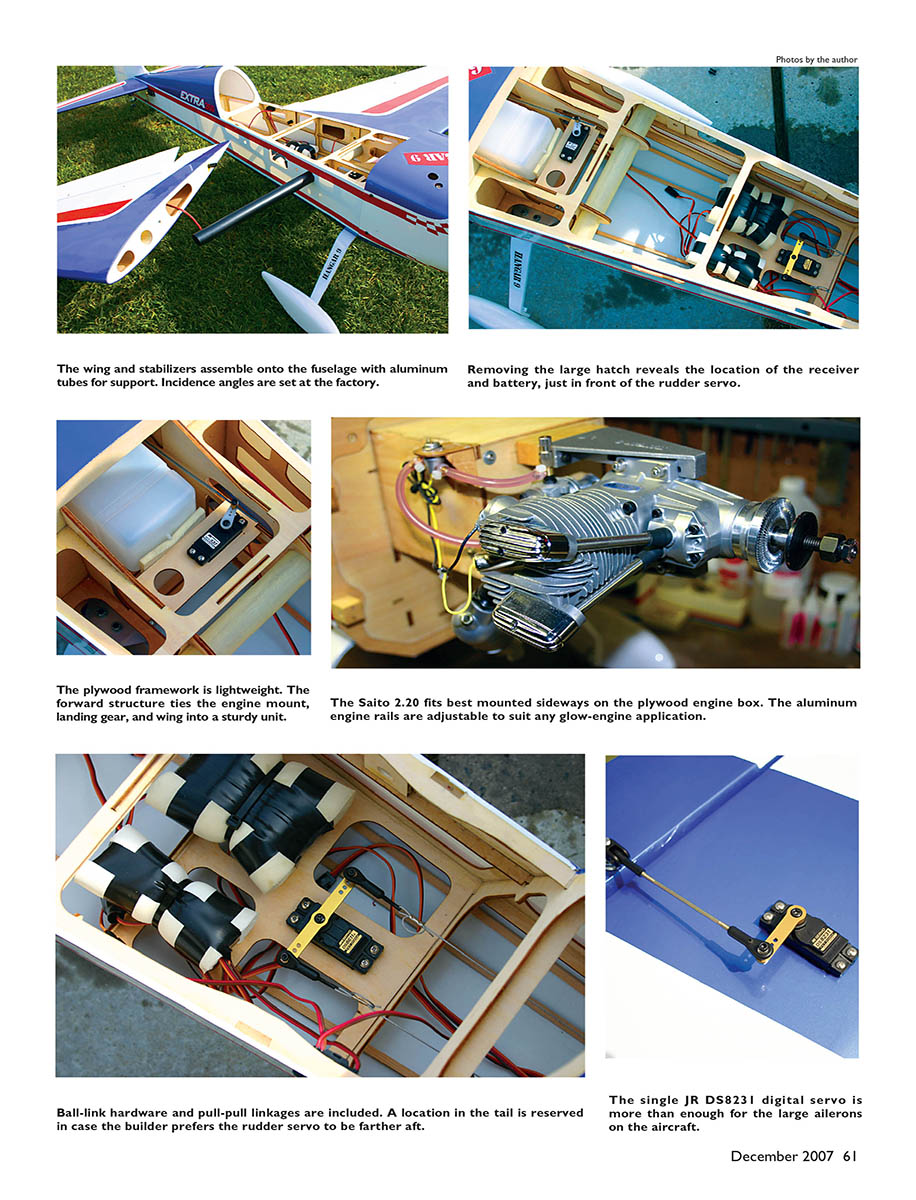
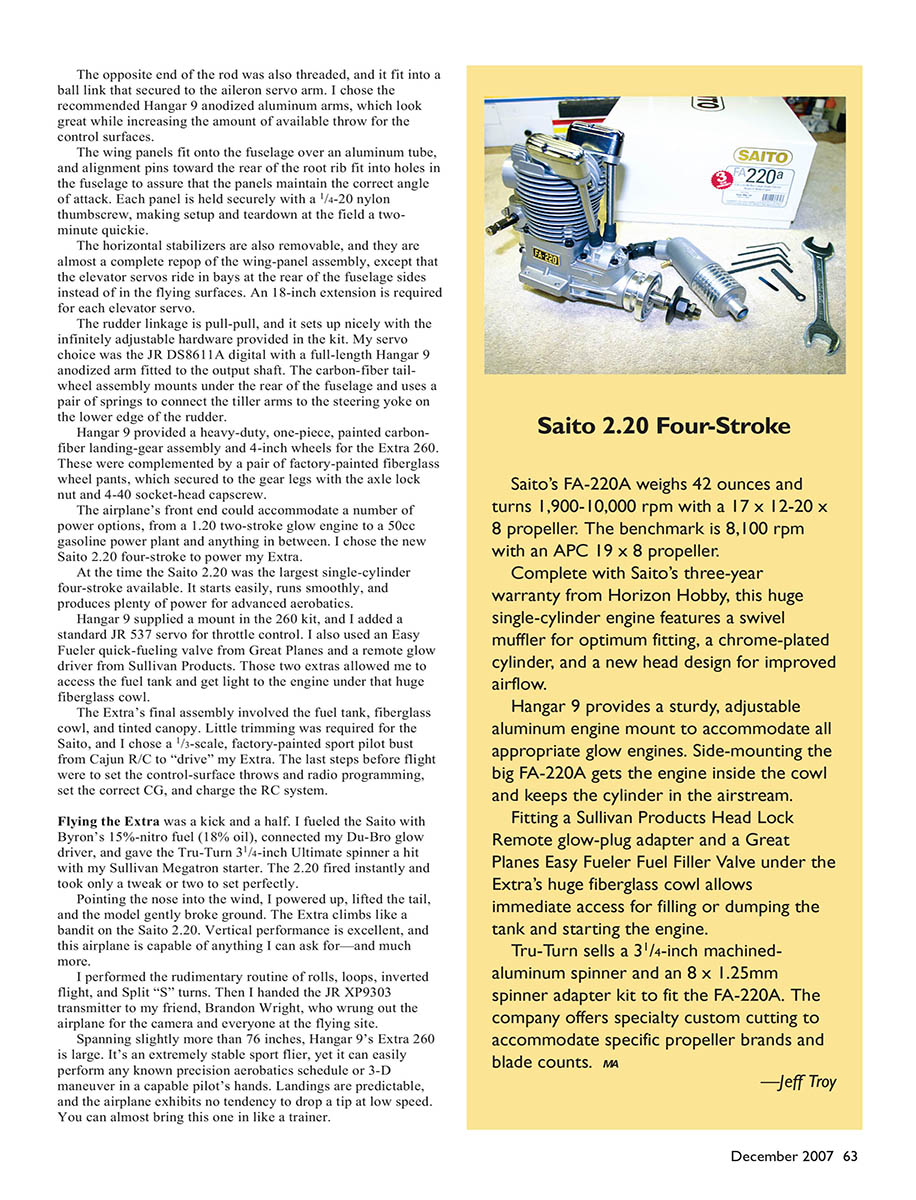
The 260 is approximately 90% factory-built. Primary airframe components are conventional laser-cut balsa and light plywood construction with numerous lightening holes. Each major component comes expertly covered in Hangar 9 UltraCote. A factory-painted fiberglass cowl and wheel pants complement the three-color UltraCote trim scheme. All parts and accessories are of exceptionally high quality.
Thanks to individual wing panels and removable horizontal stabilizers, no epoxy center joints or dihedral braces are required. That helps prepare the Extra 260 to finish quickly.
Construction
Assembly begins with hinging the ailerons. Hangar 9 provided a nice set of heavy-duty point-type hinges to handle the task. I used Hangar 9 30-minute epoxy for this procedure; it gave me time to align the hinge barrels and correctly position a control surface against the flying surface before the adhesive began to cure. I sealed my hinge gaps with Dave Brown Products' Trimseal.
I chose the recommended JR 8231 digital servos for aileron control, although I later replaced them with JR 8611 servos because they had more power. Each aileron servo got a 12-inch extension before installation, and I used a 1-inch length of 1/2-inch-diameter heat-shrink tubing to lock the extensions onto the servo leads. I used a weighted length of string to thread the servo lead through each wing panel. The servo bays required no cutting or trimming to accommodate the JR servos.
I was impressed with the Extra's control horns. An 8-32 x 2-1/2-inch screw was inserted through each aileron's upper surface and captured on the underside with a flanged hex nut. A molded swivel link threaded onto the end of the screw, and the link accepted the 4-40 threaded end of the pushrod. Be sure to assemble these parts with thread-locking compound.
I found the easiest way to assure drag-free point-hinge installation is to apply the adhesive, insert the pointed hinges in the flying surface, and then fit the control surface to the exposed opposite points. When the surfaces are correctly aligned, deflect the control surface up and down several times to line up the hinge barrels and then allow the adhesive to cure overnight.
A midwing sport-scale aircraft for advanced Pattern and 3-D aerobatics, Mike McConville designed the Extra 260 to be lightweight and potent regardless of the power plant the builder chooses. The wing and stabilizers assemble onto the fuselage with aluminum tubes for support. Incidence angles are set at the factory.
Removing the large hatch reveals the location of the receiver and battery, just in front of the rudder servo. The plywood framework is lightweight. The forward structure ties the engine mount, landing gear, and wing into a sturdy unit.
The Saito 2.20 fits best mounted sideways on the plywood engine box. The aluminum engine rails are adjustable to suit any glow-engine application. Ball-link hardware and pull-pull linkages are included. A location in the tail is reserved in case the builder prefers the rudder servo to be farther aft.
The wing panels fit onto the fuselage over an aluminum tube, and alignment pins toward the rear of the root rib fit into holes in the fuselage to assure the panels maintain the correct angle of attack. Each panel is held securely with a 1/4-20 nylon thumbscrew, making setup and teardown at the field a two-minute quickie.
The horizontal stabilizers are removable and are almost a complete reproduction of the wing-panel assembly, except that the elevator servos ride in bays at the rear of the fuselage sides instead of in the flying surfaces. An 18-inch extension is required for each elevator servo.
The rudder linkage is pull-pull and sets up nicely with the infinitely adjustable hardware provided in the kit. My servo choice was the JR DS8611A digital with a full-length Hangar 9 anodized arm fitted to the output shaft. The carbon-fiber tailwheel assembly mounts under the rear fuselage and uses a pair of springs to connect the tiller arms to the steering yoke on the lower edge of the rudder.
Hangar 9 provided a heavy-duty, one-piece, painted carbon-fiber landing-gear assembly and 4-inch wheels for the Extra 260. These were complemented by a pair of factory-painted fiberglass wheel pants, which secure to the gear legs with the axle lock nut and a 4-40 socket-head cap screw.
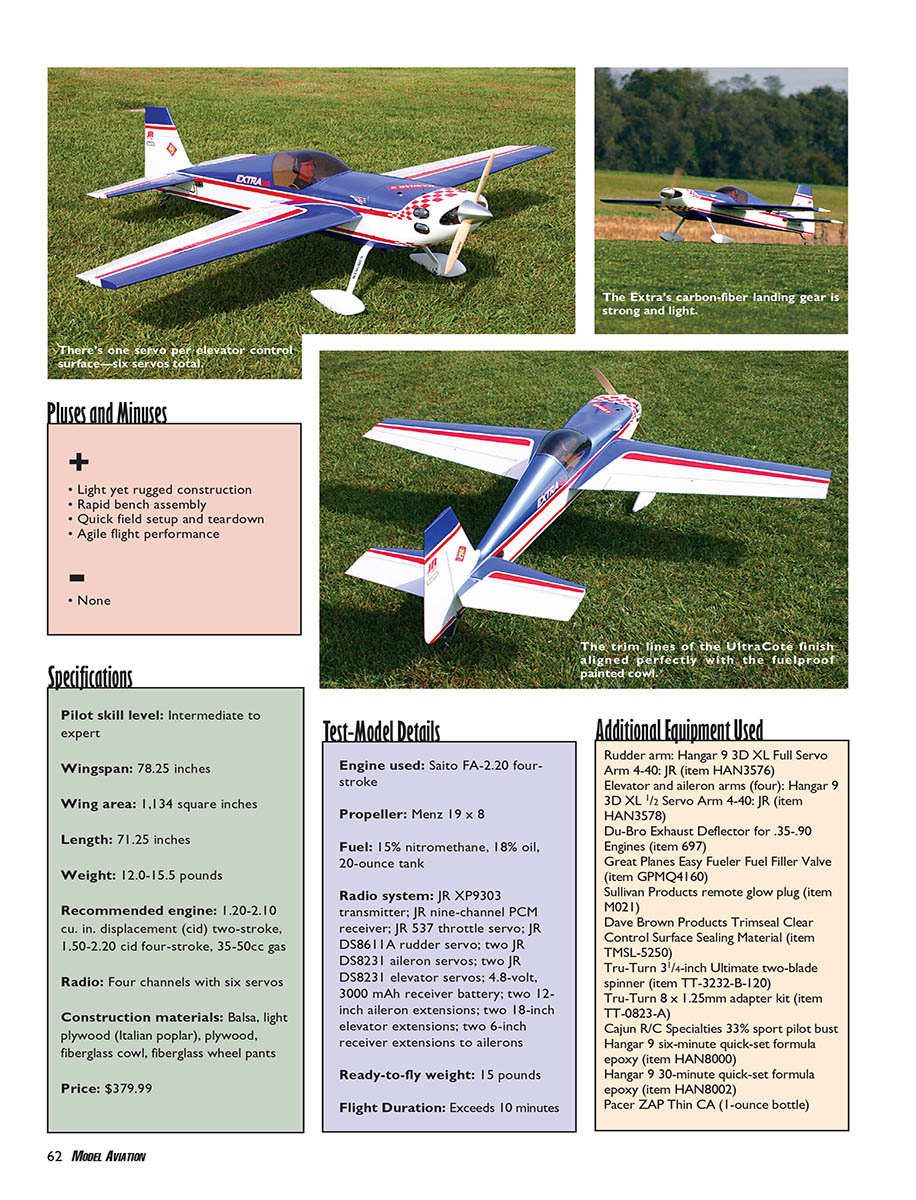
The airplane's front end can accommodate a variety of power options, from a .120 two-stroke glow engine to a 50cc gasoline power plant and anything in between. I chose the Saito 2.20 four-stroke to power my Extra. At the time the Saito 2.20 was the largest single-cylinder four-stroke available. It starts easily, runs smoothly, and produces plenty of power for advanced aerobatics.
Hangar 9 supplied a mount in the 260 kit, and I added a standard JR 537 servo for throttle control. I also used a Great Planes Easy-Fuel quick-fueling valve and a Sullivan Products remote glow driver. Those extras allowed me to access the fuel tank and get light to the engine under the huge fiberglass cowl.
The Extra's final assembly involved the fuel tank, fiberglass cowl, and tinted canopy. Little trimming was required for the Saito, and I chose a 1/3-scale, factory-painted sport pilot bust from Cajun R/C to "drive" my Extra. The last steps before flight were to set the control-surface throws and radio programming, set the correct CG, and charge the RC system.
Flying Impressions
Flying the Extra was a kick and a half. I fueled the Saito with Byron's 15% nitro fuel (18% oil), connected my Du-Bro glow driver, and gave the Tru-Turn 3/4-inch Ultimate spinner a hit with my Sullivan Megatron starter. The 2.20 fired instantly and took only a tweak or two to set perfectly.
Pointing the nose into the wind, I powered up, lifted the tail, and the model gently broke ground. The Extra climbs like a bandit on the Saito 2.20. Vertical performance is excellent, and this airplane is capable of anything I can ask for—and much more.
I performed the rudimentary routine of rolls, loops, inverted flight, and Split-S turns. Then I handed the JR XP9303 transmitter to my friend Brandon Wright, who wrung out the airplane for the camera and everyone at the flying site.
Spanning 78.25 inches, Hangar 9's Extra 260 is large. It's an extremely stable sport flier, yet it can easily perform any known precision aerobatics schedule or 3-D maneuver in a capable pilot's hands. Landings are predictable, and the airplane exhibits no tendency to drop a tip at low speed. You can almost bring this one in like a trainer.
The combination of the Hangar 9 Extra 260, the Saito 2.20 four-stroke, and the JR XP9303 RC system with digital servos on the control surfaces produces a top-shelf model. I've had a great time with mine, and I think most intermediate to advanced RC pilots will enjoy using the 260 to stretch their current skills. It's a nice airplane. MA
Pluses and Minuses
- Light yet rugged construction
- Rapid bench assembly
- Quick field setup and teardown
- Agile flight performance
- None
Specifications
- Pilot skill level: Intermediate to expert
- Wingspan: 78.25 inches
- Wing area: 1,134 square inches
- Length: 71.25 inches
- Weight: 12.0–15.5 pounds
- Recommended engine: 1.20–2.10 cu in two-stroke; 1.50–2.20 cu in four-stroke; 35–50 cc gas
- Radio: Four channels with six servos
- Construction materials: Balsa, light plywood (Italian poplar), plywood, fiberglass cowl, fiberglass wheel pants
- Price: $379.99
Test-Model Details
- Engine used: Saito FA-2.20 four-stroke
- Propeller: Menz 19 x 8
- Fuel: 15% nitromethane, 18% oil; 20-ounce tank
- Radio system: JR XP9303 transmitter; JR nine-channel PCM receiver; JR 537 throttle servo; JR DS8611A rudder servo; two JR DS8231 aileron servos; two JR DS8231 elevator servos; 4.8-volt, 3000 mAh receiver battery
- Extensions: two 12-inch aileron extensions; two 18-inch elevator extensions; two 6-inch receiver extensions to ailerons
- Ready-to-fly weight: 15 pounds
- Flight duration: Exceeds 10 minutes
Additional Equipment Used
- Rudder arm: Hangar 9 3D XL Full Servo Arm 4-40: JR (item HAN3576)
- Elevator and aileron arms (four): Hangar 9 3D XL 1/2 Servo Arm 4-40: JR (item HAN3578)
- Du-Bro Exhaust Deflector for .35–.90 engines (item 697)
- Great Planes Easy-Fuel Fuel Filler Valve (item GPMQ4160)
- Sullivan Products remote glow plug (item M021)
- Dave Brown Products Trimseal Clear Control Surface Sealing Material (item TMSL-5250)
- Tru-Turn 3/4-inch Ultimate two-blade spinner (item TT-3232-B)
- Tru-Turn 8 x 1.25mm adapter kit (item TT-0823-A)
- Cajun R/C Specialties 1/3-scale sport pilot bust (item unknown)
- Hangar 9 six-minute quick-set formula epoxy (item HAN8000)
- Hangar 9 30-minute quick-set formula epoxy (item HAN8002)
- Pacer ZAP Thin CA (1-ounce bottle)
The opposite end of the pushrod was threaded to fit into a ball link that secured to the aileron servo arm. I chose the recommended Hangar 9 anodized aluminum arms, which look great while increasing the available throw for the control surfaces.
Manufacturer/Distributor
Horizon Hobby 4105 Fieldstone Rd. Champaign, IL 61822 (877) 504-0233 www.horizonhobby.com
Products Used in Review
- Du-Bro — Exhaust deflector, glow driver
(800) 848-9411 www.dubro.com
- Sullivan Products — Remote glow plug, Megatron starter
(410) 732-3500 www.sullivanproducts.com
- Tru-Turn — Spinner, adapter kit
(281) 479-9600 www.tru-turn.com
- Dave Brown Products — Trimseal
(513) 738-1576 www.dbproducts.com
- Cajun R/C Specialties — Pilot bust
(337) 269-5177 www.cajunrc.com
Other Review Sources
- Fly RC: January 2006
- Model Airplane News: April 2006
- RCR: April 2006
- RCM&E: September 2006
Transcribed from original scans by AI. Minor OCR errors may remain.

