
Plane Talk: Pacific Aeromodel Edge 540-40 ARF
Steve Ciambrone
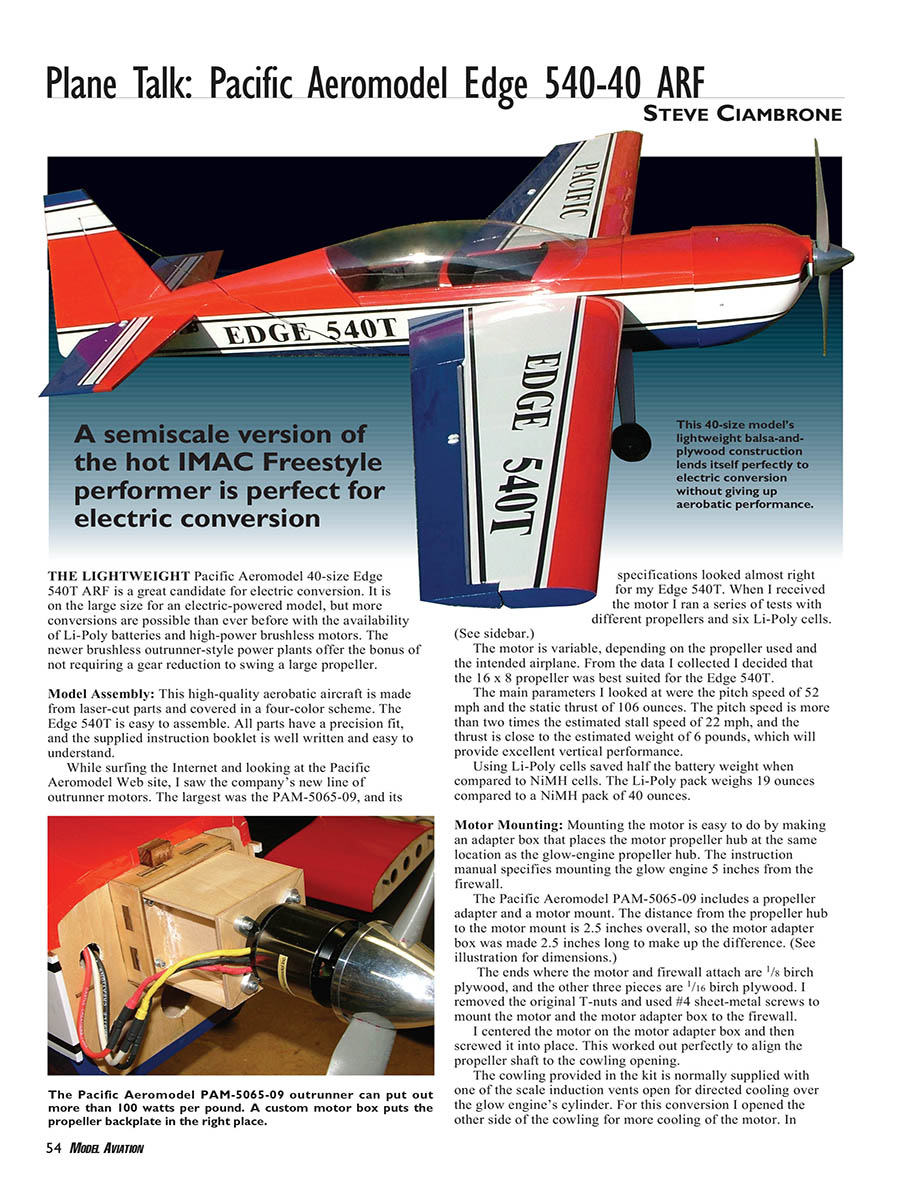
THE LIGHTWEIGHT Pacific Aeromodel 40-size Edge 540T ARF is a great candidate for electric conversion. It is on the large side for an electric-powered model, but more conversions are possible than ever with the availability of Li-Poly batteries and high-power brushless motors. The newer brushless outrunner-style power plants offer the bonus of not requiring a gear reduction to swing a large propeller.
Model Assembly
This high-quality aerobatic aircraft is made from laser-cut parts and covered in a four-color scheme. The Edge 540T is easy to assemble. All parts have a precision fit, and the supplied instruction booklet is well written and easy to understand.
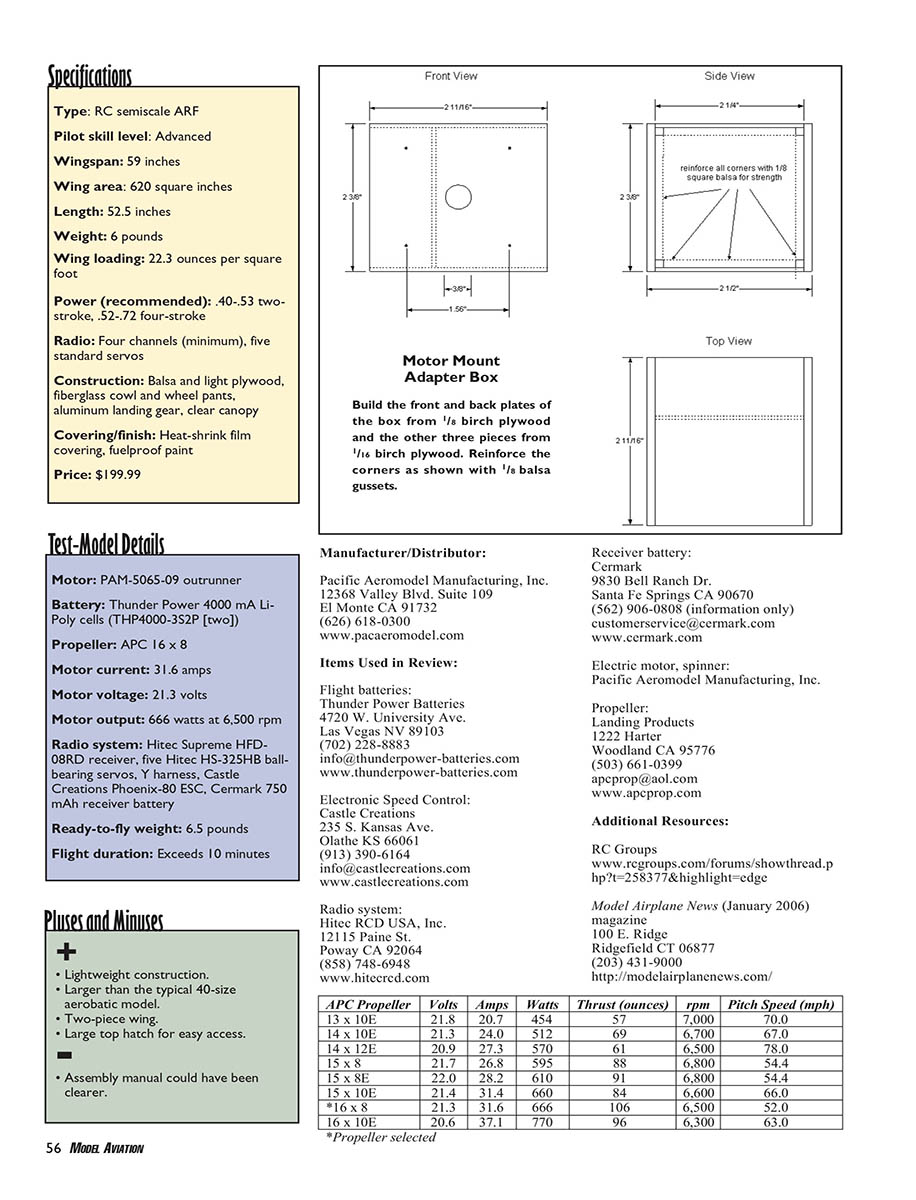
While surfing the Internet and looking at the Pacific Aeromodel Web site, I saw the company’s new line of outrunner motors. The largest was the PAM-5065-09, and when I received the motor I ran a series of tests with different propellers and six Li-Poly cells (see sidebar). The motor performance varies depending on the propeller used and the intended airplane. From the data I collected I decided that the APC 16 x 8 propeller was best suited for the Edge 540T.
The main parameters I looked at were the pitch speed of 52 mph and the static thrust of 106 ounces. The pitch speed is more than two times the estimated stall speed of 22 mph, and the thrust is close to the estimated weight of 6 pounds, which will provide excellent vertical performance.
Using Li-Poly cells saved half the battery weight when compared to NiMH cells. The Li-Poly pack weighs 19 ounces compared to a NiMH pack of 40 ounces.
Motor Mounting
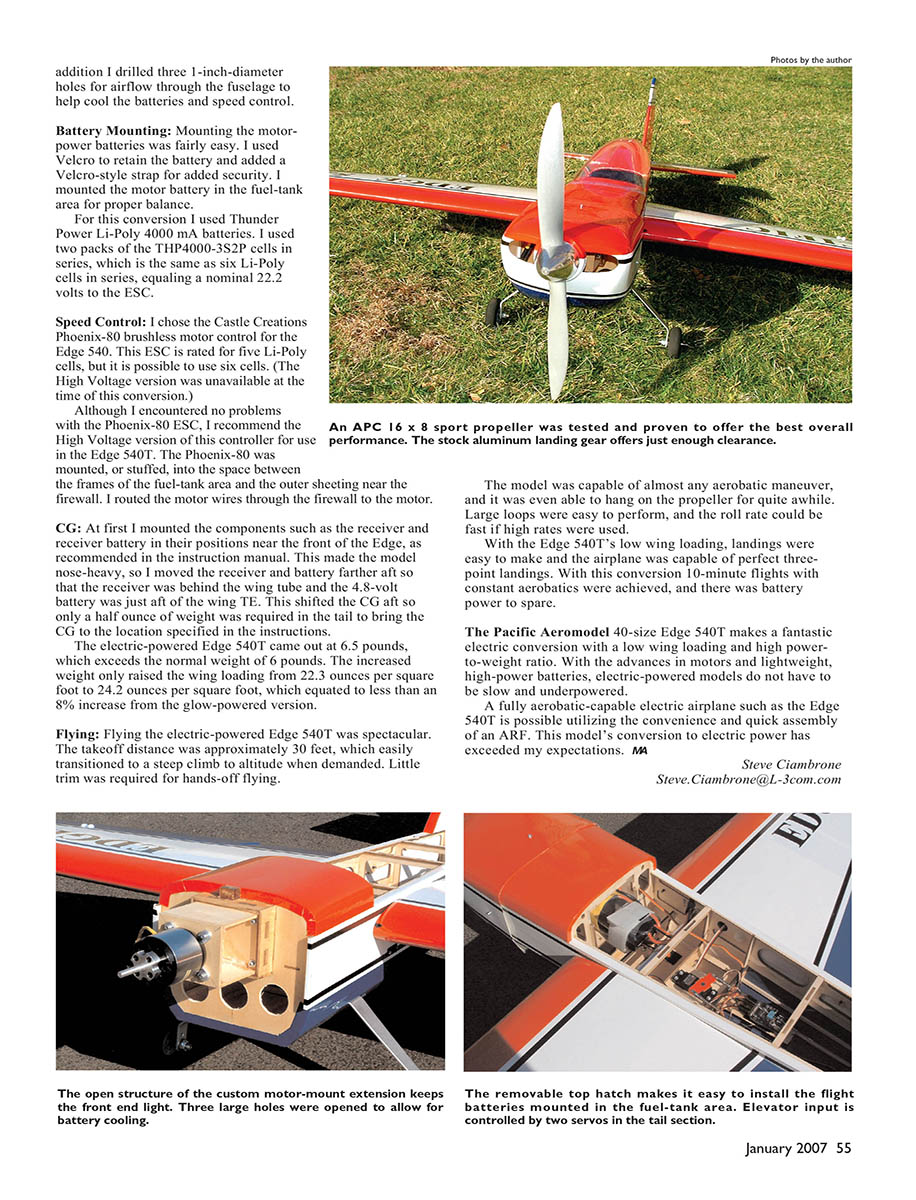
Mounting the motor is easy by making an adapter box that places the motor propeller hub at the same location as the glow-engine propeller hub. The instruction manual specifies mounting the glow engine 5 inches from the firewall. The Pacific Aeromodel PAM-5065-09 includes a propeller adapter and a motor mount. The distance from the propeller hub to the motor mount is 2.5 inches overall, so the motor adapter box was made 2.5 inches long to make up the difference.
The ends where the motor and firewall attach are 1/8-inch birch plywood, and the other three pieces are 1/16-inch birch plywood. I removed the original T-nuts and used #4 sheet-metal screws to mount the motor and the motor adapter box to the firewall. I centered the motor on the motor adapter box and then screwed it into place. This worked out perfectly to align the propeller shaft to the cowling opening.
The cowling provided in the kit is normally supplied with one of the scale induction vents open for directed cooling over the glow engine’s cylinder. For this conversion I opened the other side of the cowling for more cooling of the motor. In addition I drilled three 1-inch-diameter holes for airflow through the fuselage to help cool the batteries and speed control.
Battery Mounting
Mounting the motor-power batteries was fairly easy. I used Velcro to retain the battery and added a Velcro-style strap for added security. I mounted the motor battery in the fuel-tank area for proper balance. For this conversion I used Thunder Power Li-Poly 4000 mA batteries. I used two packs of the THP4000-3S2P cells in series, which is the same as six Li-Poly cells in series, equaling a nominal 22.2 volts to the ESC.
Speed Control
I chose the Castle Creations Phoenix-80 brushless motor control for the Edge 540. This ESC is rated for five Li-Poly cells, but it is possible to use six cells (the High Voltage version was unavailable at the time of this conversion).
Although I encountered no problems with the Phoenix-80 ESC, I recommend the High Voltage version of this controller for use in the Edge 540T. The Phoenix-80 was mounted into the space between the frames of the fuel-tank area and the outer sheeting near the firewall. I routed the motor wires through the firewall to the motor.
CG
At first I mounted the components such as the receiver and receiver battery in their positions near the front of the Edge, as recommended in the instruction manual. This made the model nose-heavy, so I moved the receiver and battery farther aft so that the receiver was behind the wing tube and the 4.8-volt battery was just aft of the wing trailing edge. This shifted the CG aft so only a half ounce of weight was required in the tail to bring the CG to the location specified in the instructions.
The electric-powered Edge 540T came out at 6.5 pounds, which exceeds the normal weight of 6 pounds. The increased weight only raised the wing loading from 22.3 ounces per square foot to 24.2 ounces per square foot, which equated to less than an 8% increase from the glow-powered version.
Flying
Flying the electric-powered Edge 540T was spectacular. The takeoff distance was approximately 30 feet, which easily transitioned to a steep climb to altitude when demanded. Little trim was required for hands-off flying.
The model was capable of almost any aerobatic maneuver, and it was even able to hang on the propeller for quite a while. Large loops were easy to perform, and the roll rate could be fast if high rates were used.
With the Edge 540T's low wing loading, landings were easy to make and the airplane was capable of perfect three-point landings. With this conversion, 10-minute flights with constant aerobatics were achieved, and there was battery power to spare.
The Pacific Aeromodel 40-size Edge 540T makes a fantastic electric conversion with a low wing loading and high power-to-weight ratio. With the advances in motors and lightweight, high-power batteries, electric-powered models do not have to be slow and underpowered. A fully aerobatic-capable electric airplane such as the Edge 540T is possible utilizing the convenience and quick assembly of an ARF. This model's conversion to electric power has exceeded my expectations.
Steve Ciambrone Steve.Ciambrone@L-3com.com
Specifications
- Type: RC semiscale ARF
- Pilot skill level: Advanced
- Wingspan: 59 inches
- Wing area: 620 square inches
- Length: 52.5 inches
- Weight: 6 pounds
- Wing loading: 22.3 ounces per square foot
- Power (recommended): .40-.53 two-stroke, .52-.72 four-stroke
- Radio: Four channels (minimum), five standard servos
- Construction: Balsa and light plywood, fiberglass cowl and wheel pants, aluminum landing gear, clear canopy
- Covering/finish: Heat-shrink film covering, fuelproof paint
- Price: $199.99
Motor Mount Adapter Box
- Build the front and back plates of the box from 1/8-inch birch plywood and the other three pieces from 1/16-inch birch plywood.
- Reinforce the corners with 1/8-inch balsa gussets.
- Make the box 2.5 inches long to position the motor propeller hub at the same location as the original glow-engine propeller hub.
Test-Model Details
- Motor: PAM-5065-09 outrunner
- Battery: Thunder Power 4000 mA Li-Poly cells (THP4000-3S2P) — two packs
- Propeller: APC 16 x 8 (selected)
- Motor current: 31.6 amps
- Motor voltage: 21.3 volts
- Motor output: 666 watts at 6,500–6,800 rpm
- Radio system: Hitec Supreme HFD-08RD receiver, five Hitec HS-325HB ball-bearing servos, Y harness
- ESC: Castle Creations Phoenix-80
- Receiver battery: Cermark 750 mAh
- Ready-to-fly weight: 6.5 pounds
- Flight duration: Exceeds 10 minutes
Pluses and Minuses
- Pluses:
- Lightweight construction
- Larger than the typical 40-size aerobatic model
- Two-piece wing
- Large top hatch for easy access
- Minuses:
- Assembly manual could have been clearer
Manufacturer / Distributor
Pacific Aeromodel Manufacturing, Inc.
- Address: 12368 Valley Blvd. Suite 109, El Monte CA 91732
- Phone: (626) 618-0300
- Web: www.pacaeromodel.com
Items Used in Review
- Flight batteries:
- Thunder Power Batteries
- 4720 W. University Ave., Las Vegas NV 89103
- (702) 228-8883
- info@thunderpower-batteries.com
- www.thunderpower-batteries.com
- Electronic Speed Control:
- Castle Creations
- 235 S. Kansas Ave., Olathe KS 66061
- (913) 390-6164
- info@castlecreations.com
- www.castlecreations.com
- Radio system:
- Hitec RCD USA, Inc.
- 12115 Paine St., Poway CA 92064
- (858) 748-6948
- www.hitecrcd.com
- Receiver battery:
- Cermark
- 9830 Bell Ranch Dr., Santa Fe Springs CA 90670
- (562) 906-0808 (information only)
- customerservice@cermark.com
- www.cermark.com
- Electric motor, spinner:
- Pacific Aeromodel Manufacturing, Inc.
- Propeller:
- Landing Products (APC Propeller)
- 1222 Harter, Woodland CA 95776
- (503) 661-0399
- apcprop@aol.com
- www.apcprop.com
Additional Resources
- RC Groups: www.rcgroups.com/forums/showthread.php?t=258377&highlight=edge
- Model Airplane News (January 2006) magazine
- 100 E. Ridge, Ridgefield CT 06877
- (203) 431-9000
- http://modelairplanenews.com/
Propeller Test Results (APC Propeller)
- 13 x 10E — Volts: 21.8; Amps: 20.7; Watts: 454; Thrust: 57 oz; rpm: 7,000; Pitch Speed: 70.0 mph
- 14 x 10E — Volts: 21.3; Amps: 24.0; Watts: 512; Thrust: 69 oz; rpm: 6,700; Pitch Speed: 67.0 mph
- 14 x 12E — Volts: 20.9; Amps: 27.3; Watts: 570; Thrust: 61 oz; rpm: 6,500; Pitch Speed: 78.0 mph
- 15 x 8 — Volts: 21.7; Amps: 26.8; Watts: 595; Thrust: 88 oz; rpm: 6,800; Pitch Speed: 54.4 mph
- 15 x 8E — Volts: 22.0; Amps: 28.2; Watts: 610; Thrust: 91 oz; rpm: 6,800; Pitch Speed: 54.4 mph
- 15 x 10E — Volts: 21.4; Amps: 31.4; Watts: 670; Thrust: 84 oz; rpm: 6,600; Pitch Speed: 66.0 mph
- *16 x 8 — Volts: 21.3; Amps: 31.6; Watts: 666; Thrust: 106 oz; rpm: 6,800; Pitch Speed: 52.0 mph (selected)
- 16 x 10E — Volts: 20.6; Amps: 37.1; Watts: 770; Thrust: 96 oz; rpm: 6,300; Pitch Speed: 63.0 mph
Transcribed from original scans by AI. Minor OCR errors may remain.

