
Planes Dutch Flew
Alfred Lehmberg
A nostalgic look back at the career of a friend and the extraordinary times, people, and machines intertwined in his life.
It was one of those beautiful spring days in San Antonio, with fluffy cumulo‑cirrus clouds scattered like cotton balls in an intensely blue sky. Seen through the eyes of an 11‑year‑old, the green lawn made the perfect setting: colorful dresses, floppy hats, mothers and girlfriends of the young pilots who had just graduated. As guests made pleasant small talk, the cadets disappeared beyond the somber hangars that shielded their aircraft from view. A young boy listened to the rumbling explosions of aircraft engines as they came to life and imagined them taxiing down the apron toward Duncan Field a couple of miles distant.
At eleven it was easy to imagine myself a stern‑faced warrior, shoving up goggles, a gloved hand casting a quick glance skyward to make sure no Fokker or Pfalz was peeling out of formation to strafe a helpless aircraft. As the rumbling voices of engines changed to a roar, casual talk ceased. Everyone watched the sky. At the first glimpse, sons, friends and sweethearts pulled goggles down over oil‑streaked faces and jammed throttles wide open. With a swift movement, as the machines roared down the runway one could feel the mounting pressure on the stick as the wheels lifted off.
On that spring commencement day in June 1936, J.T. (Jake) Sluder and his wife, Reneé, looked like movie stars to friends and family invited to the graduation at the Air Corps Advanced Flying School, Kelly Field, Texas. J.T.'s brother, Dutch, was a cadet and would become a second lieutenant at graduation. About a year later the policy changed so that graduating cadets immediately became lieutenants.
Early years and first flights
Dutch had attended the University of Texas before entering the Air Corps and had learned to fly years earlier while working at Stinson Field during the summers. He gave friends finely crafted models—a Fokker D‑7, an S.E.5, and a large 24‑inch solid pine Curtiss P‑1—which showed the difference between good and poor workmanship and reflected his early interest in aviation.
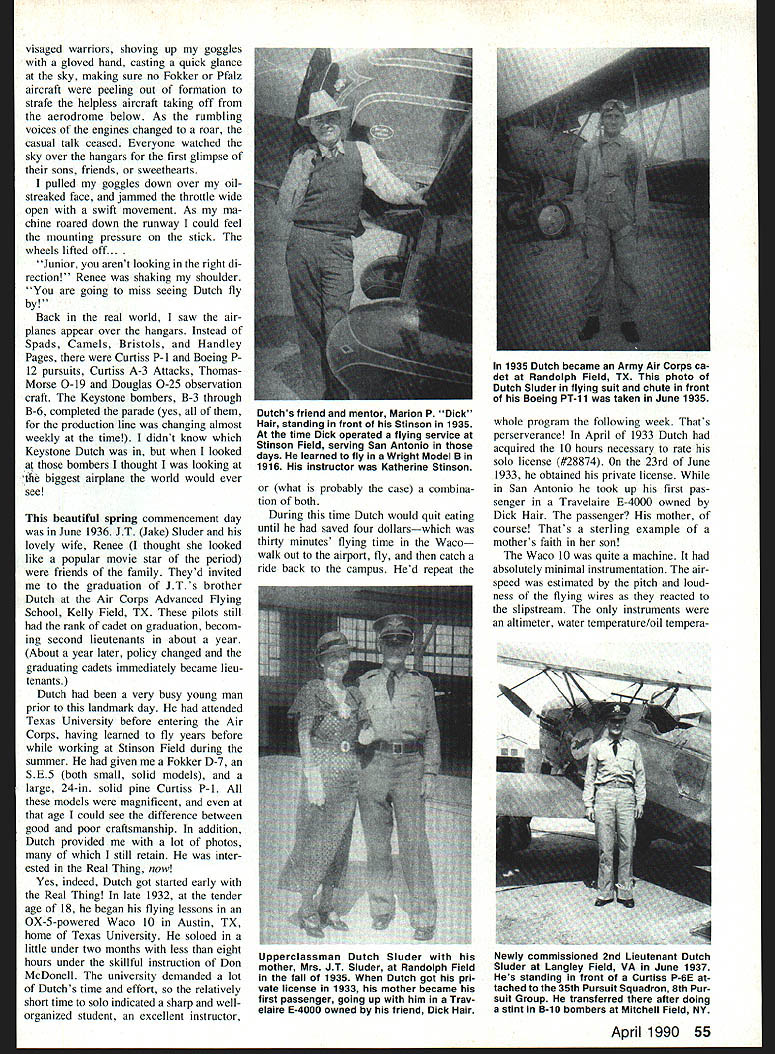
Late in 1932, at age 18, Dutch began flying lessons in an OX‑5‑powered Waco 10 at Austin, Texas. He soloed in a little under two months with less than eight hours of instruction under Don McDonnell. Dutch saved obsessively for flying time—quitting eating until he had four dollars for thirty minutes in the Waco—walking to the airport, flying, and catching a ride back to campus. In April 1933 he reached the ten hours needed and, on 23 June 1933 in San Antonio, obtained Private License No. 28874. His first passenger was his mother, flown in a Travelair E‑4000 owned by Marion P. (Dick) Hair.
The Waco 10 had minimal instrumentation: airspeed judged by pitch and loudness, flying wires reacting to the slipstream, plus an altimeter, water‑temperature and oil‑temperature gauges, and a tachometer.
Shortly after his first solo, Dutch and J.T. Sluder heard of two nearly new Buhl Pups available in Houston. Bought during the Depression for a bargain price, one Pup went to Shelby Krister (NC‑394Y) and the Sluders kept NC‑393Y. The Pup, powered by the low‑powered Szekely engine (about 45 hp), was gentle and spun and recovered nicely; aerobatics had to be preplanned to build speed. Dutch later learned the Hungarian pronunciation of Szekely—"Say‑kai"—from a neighbor who had fled Hungary in 1957.
The brothers fitted lights and a battery to the Pup for night flying. On the evening of 7 September 1933, with airport boundary lights turned on by arrangement, Dutch made a memorable first night flight and practiced power‑off landings at dusk. The Pup survived, as did the daring young aviators.
Stinson Field and early mentors
Marion "Dick" Hair operated a flying service at Stinson Field and had taught Dutch to hang around aircraft, prep them, and get occasional paid rides. Dutch often worked as Hair's line boy in exchange for hangar space and flying time. His friend Dave Hill—later Colonel "Tex" Hill, a top AVG ace—was part of that circle.
A crash of a friend’s Pup later took Dutch's aircraft out of service for a time, making flying hours harder to come by. In 1935 Dutch applied for and received appointment as a cadet at Randolph Field, entering the Army Air Corps in June. Around this time he met and began dating Miss Zimmerman ("Zimmy") at Woodlawn Pool; they married in Galveston three years later.
Military training and early assignments
The cadets at Randolph were placed in "A" Stage (primary training) and divided into Flights A–D. Flights A–C flew Consolidated PT‑3s; Flight D flew the newer PT‑11D, which had brakes and a better instrument panel. When Dutch was assigned to Flight D he became known as "one of the push‑button pilots." After ground school he had three half‑hour dual sessions in the PT‑11D. During one session the instructor simulated a forced landing; Dutch executed a power‑off approach and was soon making solo landings.
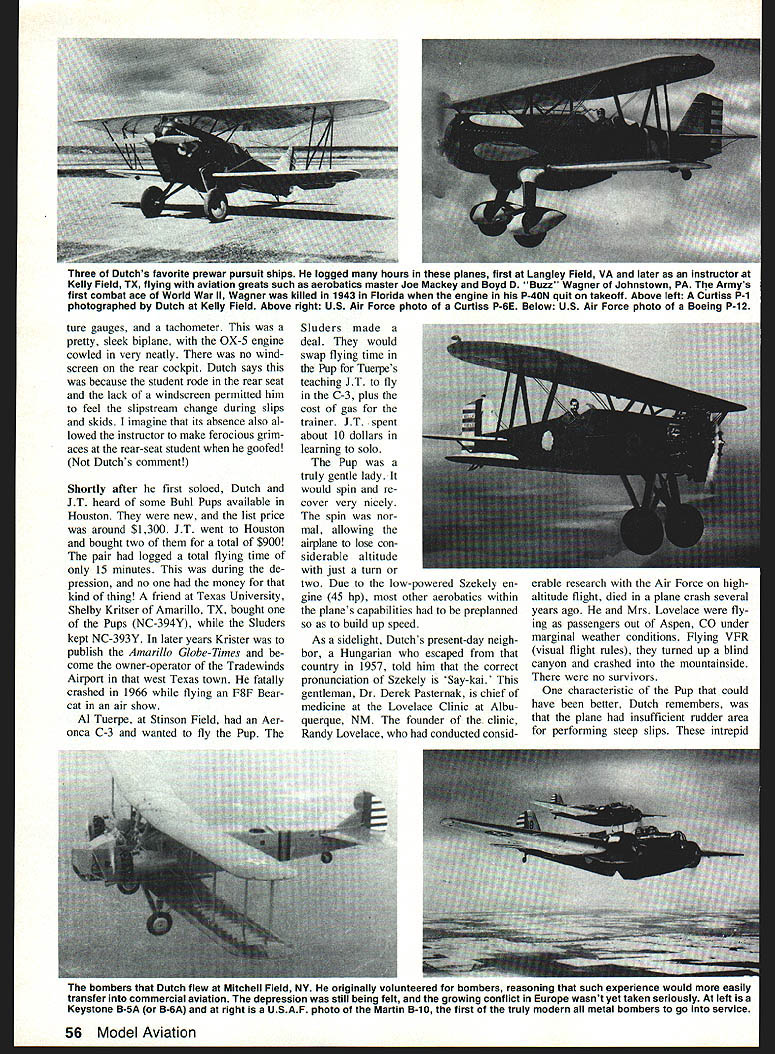
In 1935 Dutch accepted service with Martin B‑10s at Mitchel Field, NY—the first monoplane bomber adopted in any number. Disenchanted with bombardier duties, he arranged a transfer to the 35th Squadron, 8th Pursuit Group at Langley Field, VA, where he flew the P‑6E and P‑8 2A Hawks (often used on dirt fields and stripped of decorative wheel pants). Dutch took an 8mm movie of these utility workhorses.
He received his gold bar in June 1937 and became a commissioned officer. He was soon transferred back to San Antonio and Kelly Field as a flight instructor in the Pursuit Section, receiving his next regular commission in 1939.
Instructors, students and aerobatics
Back at Kelly, Dutch often visited Stinson and would sometimes put on aerobatic displays in the P‑12, his favorite maneuver being a loop with a double snap roll at the top. In 1939, with an accelerated training program underway to correct a pilot shortage, Dutch instructed many civilian pilots given commissions and polished to military standards.
One of his responsibilities was checking out a new lieutenant, Joe Mackey, on aerobatics. Mackey proved a superb performer—an eight‑point roll and an air‑show display that impressed Dutch. Another student was Boyd D. "Buzz" Wagner of Johnstown, PA—later the Army's first flying ace of WWII—who was killed in 1943 while test flying a P‑40N.
In early 1940 Dutch helped open a new flight training section at Brooks Field flying North American BC‑1s (later AT‑6s). In 1942 he was transferred to Mission, Texas.
World War II: Europe, North Africa, and the 325th Fighter Group
Through connections and persistence Dutch obtained an assignment to London where he logged time in Spitfires and Hurricanes before being posted to North Africa. He arrived in Algiers on Christmas Eve 1942 and was assigned to Jimmy Doolittle’s Eighth Air Force Headquarters Operations Section. With little combat experience on staff, Dutch made information‑gathering trips to combat units and logged time in P‑40s, P‑38s, T‑6s and more Spitfire time—one of his favorites.
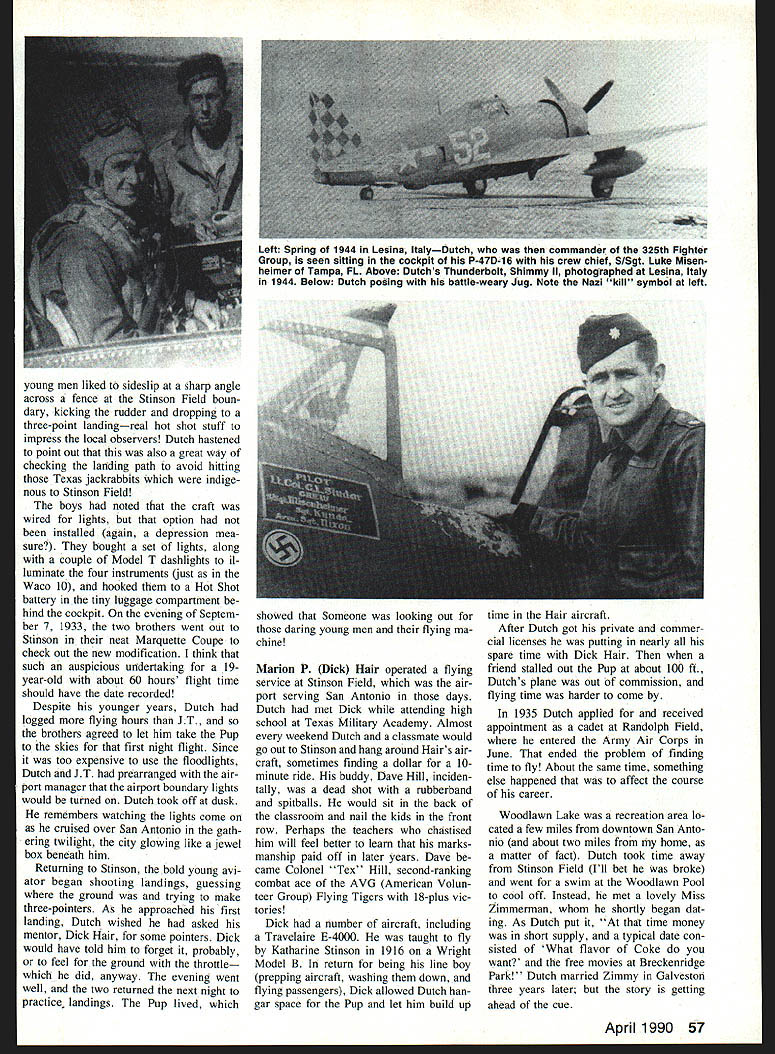
In July 1943 he obtained six weeks TDY with the 325th Fighter Group in Tunisia and flew several combat missions in P‑40s. On his third mission he damaged a Me‑109, an action that earned more respect from wary squadron mates. The P‑40s were soon replaced by P‑47s, and Dutch later applied to transfer to the 325th after arranging promotions that removed rank obstacles. The 325th escorted President Roosevelt to the Cairo Conference, moved from Sollum, Tunisia to Foggia, Italy in December 1943, and Dutch was assigned command of the group in early April 1944.
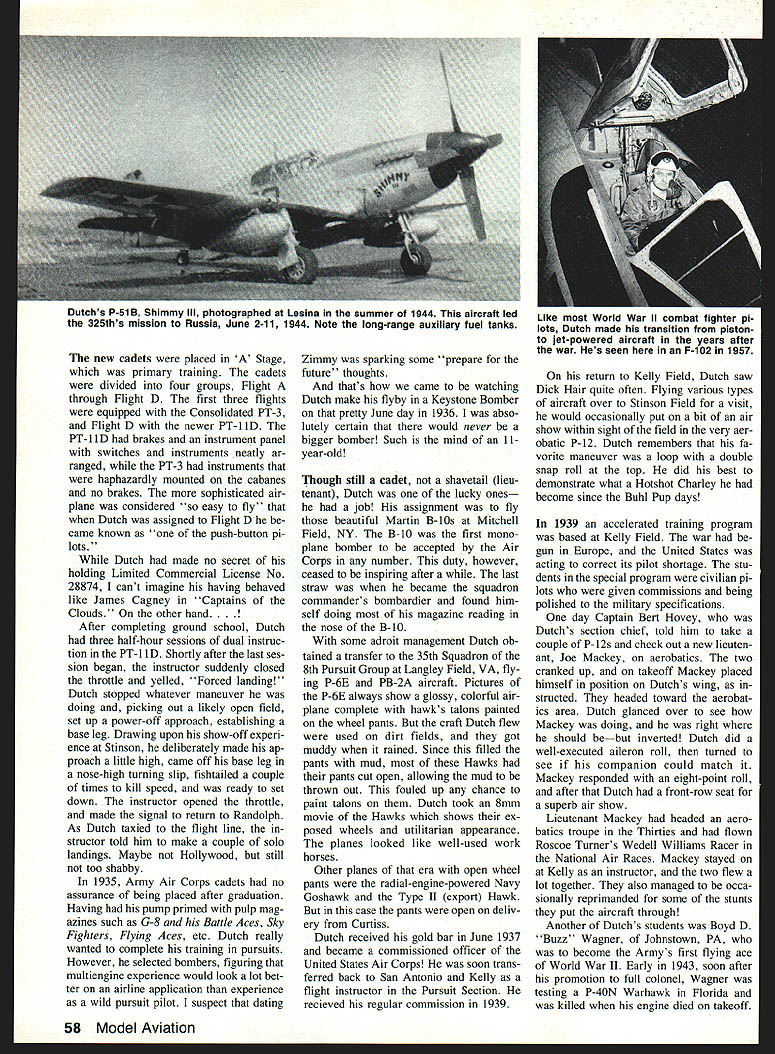
In Africa the 325th destroyed 133 enemy aircraft in P‑40s. In Italy the group added 152 more. In late May the P‑47 was replaced by the P‑51B and C Mustangs, which were used through V‑E Day. The final tally for the 325th was 529 enemy aircraft destroyed, plus 56 probables and 88 damaged (not including aircraft destroyed on the ground).
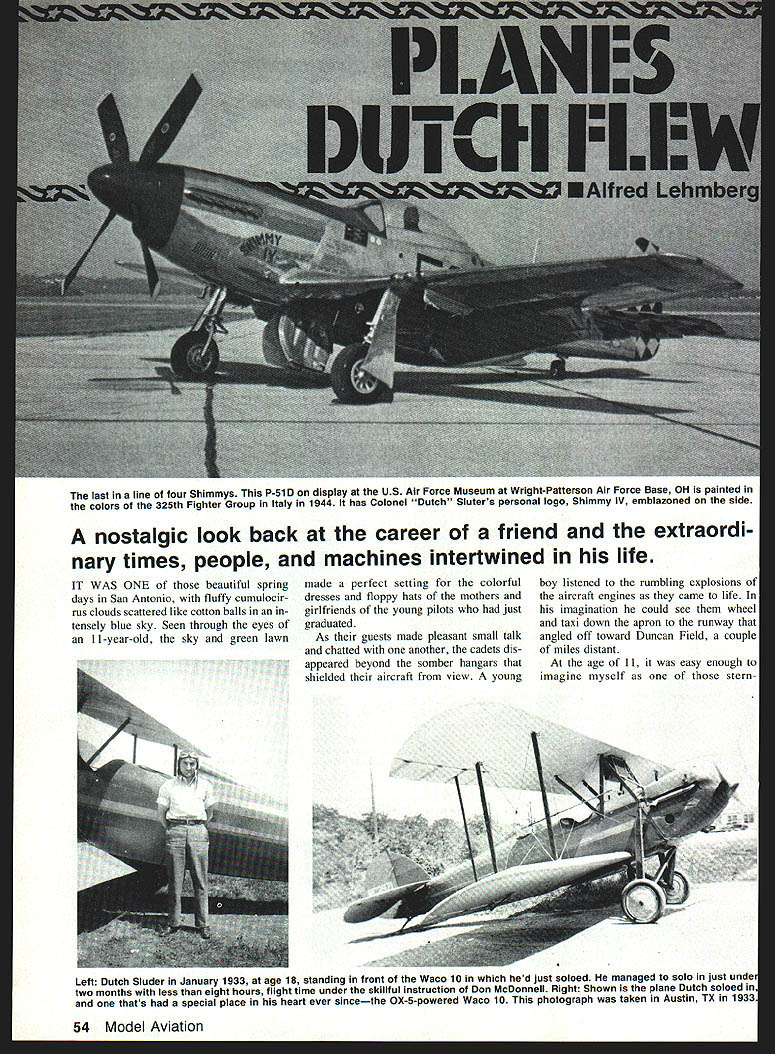
Dutch named his personal Mustang "Shimmy" (a combination of the first two letters of his daughter's name and the last four of his wife's name). The P‑51 on display at the Wright‑Patterson Air Force Museum is a replica of Shimmy IV. The basic 325th markings included a red nose, a yellow‑and‑black checkered tail, and a large number on the fuselage; Dutch's number was 52. The top ace of the 325th was Herschel H. "Herky" Green with 18 victories.
Dutch was promoted to full colonel and returned to the United States in September 1944, having flown 61 combat missions.
Postwar career and retirement
After the war Dutch held a variety of staff and command assignments: duty at the Pentagon, the Air War College, service in Alaska, senior advisor to the Ohio Air National Guard, duty with the Air Defense Command at Thule, Greenland, and commander of the Detroit Air Defense Sector. He retired from the Air Force in 1965 after 30 years of active duty, having served in the Army Air Corps, Army Air Forces, and the United States Air Force.
After retirement he tried real estate briefly, then worked as a line pilot for a company under contract to the Atomic Energy Commission hauling highly classified freight that required a "Q" clearance. The operation was demanding and eventually suffered a fatal accident attributed in part to pilot exhaustion. In 1978 the FAA grounded Dutch after a diagnosis of vertebro‑basilar insufficiency. By then he had 46 years of flying to look back on. He turned to scratch‑building beautiful scale models of three milestone aircraft: the Waco 10, the Buhl Pup, and the Boeing P‑12.
At age 72 Dutch kept active: he walked the golf course at Kirtland Air Force Base several times a week and took his time—he joked about waiting for senior citizens to collect their thoughts and find their balls.
Family and personal notes
Dutch’s brother J.T. became a respected general aviation pilot in San Antonio—flight instructor, charter pilot—and later moved into ranching. The nickname "Dutch" was given when he was learning to talk; the family said he sounded more like a Dutchman than an American. His wife Zimmy preferred her nickname; she shared Dutch’s career and endured the anxieties of being a wartime spouse. She is described as a truly fine woman.
Their daughter Shari lives in Tustin, CA and works as a senior contracts negotiator and administrator with Parker‑Hannifin Industries. Their son Jim lives in Dallas and works with Atlantic Richfield; poor eyesight prevented him from flying, but he is an accomplished pistol competitor with many trophies.
Dutch and Zimmy live in Albuquerque, NM and travel frequently, attending many Air Corps and Air Force gatherings where veterans from many nations swap stories—sometimes of the same engagement, sometimes from opposite sides.
Much of Dutch’s story has been omitted for lack of space, including vivid accounts of the 325th’s trip to Russia and other episodes. The author expresses hope these will be told another day.
Aircraft flown
During his long aviation career Dutch flew a very large variety of civilian and military aircraft. The lists below include nearly every type he piloted.
- Civilian aircraft included:
- Aero Commander 520
- Aeronca C‑3
- Beech Baron, Bonanza, Twin Bonanza, Beech 18
- Beech Queen Air
- North American Mentor (T‑34)
- Cessna 172, 182, 206, 320
- Bellanca Viking (300)
- Buhl Pup
- Curtiss Fledgling and Curtiss Robin (OX‑5)
- De Havilland Moth and Twin Otter
- Douglas DC‑3
- Fairchild 22
- Fleet (Warner)
- Piper Aztec, Comanche, Navajo, Tri‑Pacer
- Rearwin Jr.
- Spartan C‑3
- Travelair E‑4000
- Waco 10 (OX‑5)
- Military aircraft included:
- Beech AT‑7, AT‑11, C‑45 (Beech 18 family)
- Boeing B‑17
- Boeing P‑12 variants (B, C, D, E, F)
- Cessna AT‑8, AT‑17, U‑3A
- Consolidated PT‑3, PT‑11C, PT‑11D, BT‑7, PB‑2A
- Consolidated‑Vultee A‑5A
- Convair F‑102A, TF‑102A, F‑106B
- Curtiss‑Wright AT‑9
- Curtiss A‑3B, A‑1Q; O‑1G, O‑39, O‑52; P‑1C; P‑6; P‑36 (A, C)
- All major variants of the Curtiss P‑40
- Douglas BT‑2, A‑26B, B‑18, B‑17A, C‑47A (B, D), C‑54D; O‑25A, O‑35, O‑43
- De Havilland L‑20A
- Fairchild PT‑19A, C‑61A
- Hawker Hurricane I
- Fokker C‑14A
- Keystone B‑3A, B‑4A, B‑5A, B‑6A
- Lockheed T‑33A
- P‑47, P‑51 (including P‑51B/C)
- P‑38, Spitfire, Hurricane (earlier theater experience)
- Many other trainer and transport types encountered in service
Even accounting for overlapping designations and family lines (for example, several Beech and Curtiss types share basic airframes), it is an impressive list for one man and one career.
Writing this article was something of a nostalgia trip. Dutch was a knight of the skies in the eyes of an 11‑year‑old—and fifty‑one years later, he still is.
Transcribed from original scans by AI. Minor OCR errors may remain.

