
POGO
If you'd like to break free of the look-alike kits, this Formula I RC Pylon job is one of the best ever. The article is recommended reading for all Pylon devotees.
Harold deBolt
IT HAS BEEN awhile since I have come forth with a Formula I design, but after a year or so of effort, I now have a new, exciting one. I do not know yet whether it will break any records but I am certain that the Pogo is a different approach to Formula I, boasting of new features that are not only interesting but comparatively superior! To say the least, I believe the effort was worth the reward of satisfaction that the Pogo has brought me. As one modeler to another, I think you would be happy with Pogo, too.
One of the outstanding problems in all modeling is the tendency to drift into ruts as far as design is concerned, by all of us winding up building and flying very similar aircraft. For example, look at other RC events, and control-line and free-flight. At least with Formula I, we each have the opportunity to build unique aircraft and still remain on an equal basis aircraft-wise. However, lately we find the courses cluttered more and more with look-alikes that detract from the vast potential of our exciting sport. Probably one of the causes of this is the fact that Formula I is now old enough that most of the well-known type planes have been weeded out and substantiated by our leading experts, then flown and reflown to the hilt!
The average modeler tends to follow in the expert's footsteps by also building and flying the same models over and over again in the hope to attain the winners' circle himself someday. All well and good; but in doing so, one loses an aspect of importance in himself: individuality ... the determination to speculate, persevere and conquer new horizons. I guess you could say that what we need is "new blood" in the form of full-scale racers to base our designs on.
For a good many years there were no full-scale racers being built or raced, the older racers filling the need. However, in the past few years several newly designed racers were developed, not only pleasing to look at but, fortunately for model racers, possessing excellent potential. Among these are a series of related designs by George Owl which have been very successful in full-scale racing. All of the designs show a sound knowledge of basic aerodynamics with the added flair that gives greater performance. Such an ideal combination makes for a winner in any field. Although all of the Owl designs use the same fundamental, solid, aerodynamic layout, I find each one different because of individual ingenious ideas or design principle, used in an effort to build a "better mousetrap" and thus go faster.
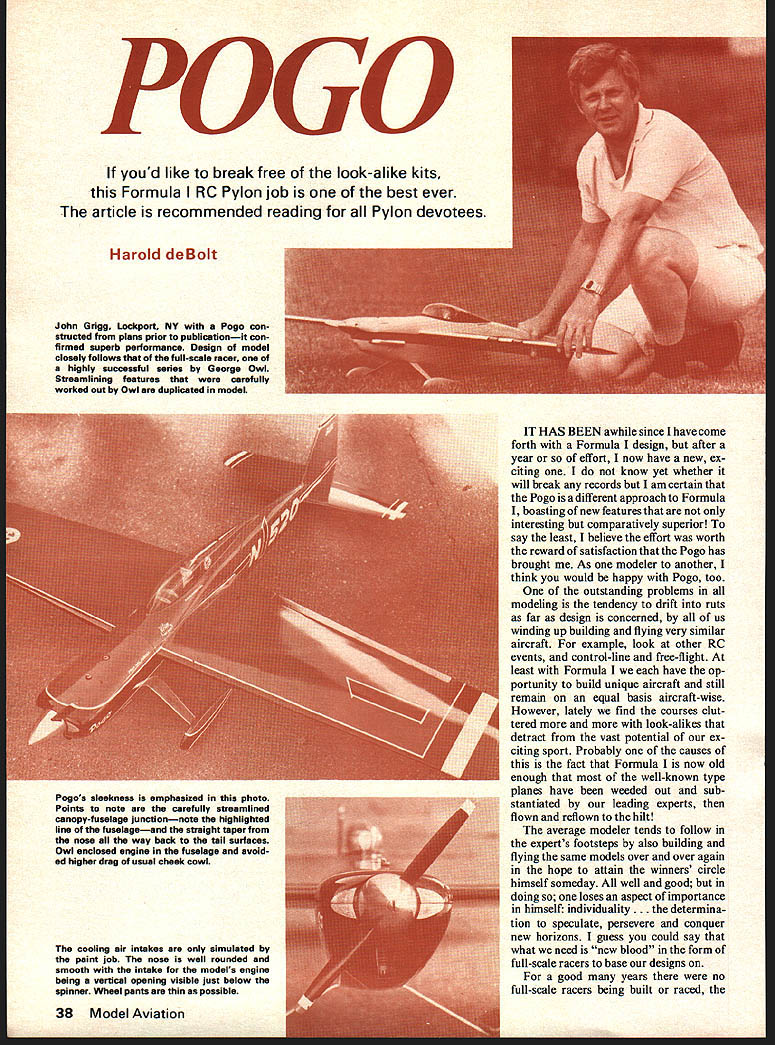
In my search of a new model design I liked what I saw in the Owl racers, my only problem being which one to choose. Probably, before I run the course of this phase I shall wind up giving them all a try. To start, I chose Owl's first of the series simply because it fit our models very easily. In addition, he used an old idea for streamlining which has been proven over and over again. Not much change can be done with a wing and a tail beyond what we normally have now, but when it comes to the fuselage, that is a different story. In the Pogo, George went back to basics which many other designers overlook in their layouts. The three fundamentals of streamlining are smoothness of line, cleanliness (no bumps or protrusions), and a minimum of wetted area (amount of surface exposed). George Owl did his utmost to accomplish these goals, and statistics have proven the Pogo to be an effort of excellence.
The Pogo has a neat wing and tail layout which one would find difficult to improve upon. Scrutinizing the fuselage, it is readily apparent that this is where dexterity was concentrated. Owl used basic design principles to full capacity, resulting in a design very pleasing to the eye as most good things tend to be. Starting with the engine cowl, he abandoned the usual "cheeks" in preference to a tight-fitting smooth cowl without protrusion. The slight bit of additional frontal area only enhanced the owl's smoothness and cleanliness, which is 2/3 of the drag formula and a majority in anyone's book!
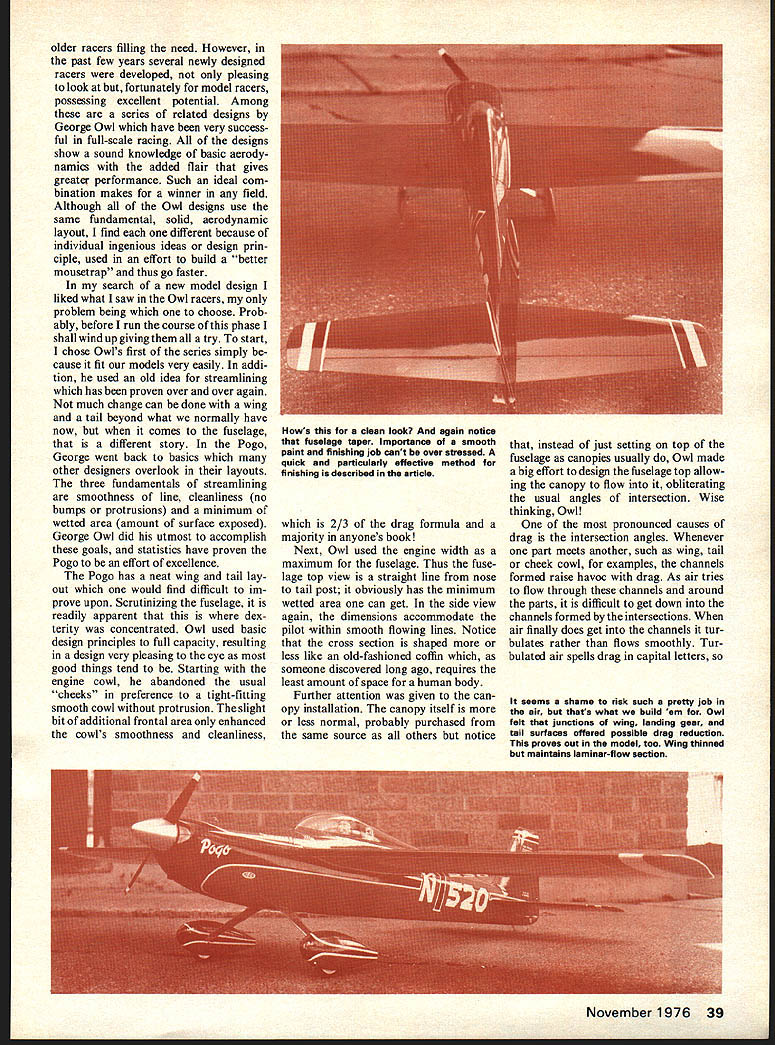
Next, Owl used the engine width as a maximum for the fuselage. Thus the fuselage top view is a straight line from nose to tail post; it obviously has the minimum wetted area one can get. In the side view again, the dimensions accommodate the pilot within smooth flowing lines. Notice that the cross section is shaped more or less like an old-fashioned coffin which, as someone discovered long ago, requires the least amount of space for a human body.
Further attention was given to the canopy installation. The canopy itself is more or less normal, probably purchased from the same source as all others but notice that, instead of just setting on top of the fuselage as canopies usually do, Owl made a big effort to design the fuselage top allowing the canopy to flow into it, obliterating the usual angles of intersection. Wise thinking, Owl!
One of the most pronounced causes of drag is the intersection angles. Wherever one part meets another, such as wing, tail or cheek cowl, for example, the channels formed raise havoc with drag. As air tries to flow through these channels and around the parts, it is difficult to get down into the channels formed by the intersections. When air finally does get into the channels it turbulates rather than flows smoothly. Turbulated air spells drag in capital letters, so it seems a shame to risk such a pretty job in the air, but that's what we build 'em for. Owl felt that junctions of wing, landing gear, and tail surfaces offered possible drag reduction. This proves out in the model, too. Wing thinned but maintains laminar-flow section. There is no running article text on this scanned page to extract — it contains only the Pogo plan drawings and labels (plans/diagram text and a page footer). No narrative continuation appears on this page.
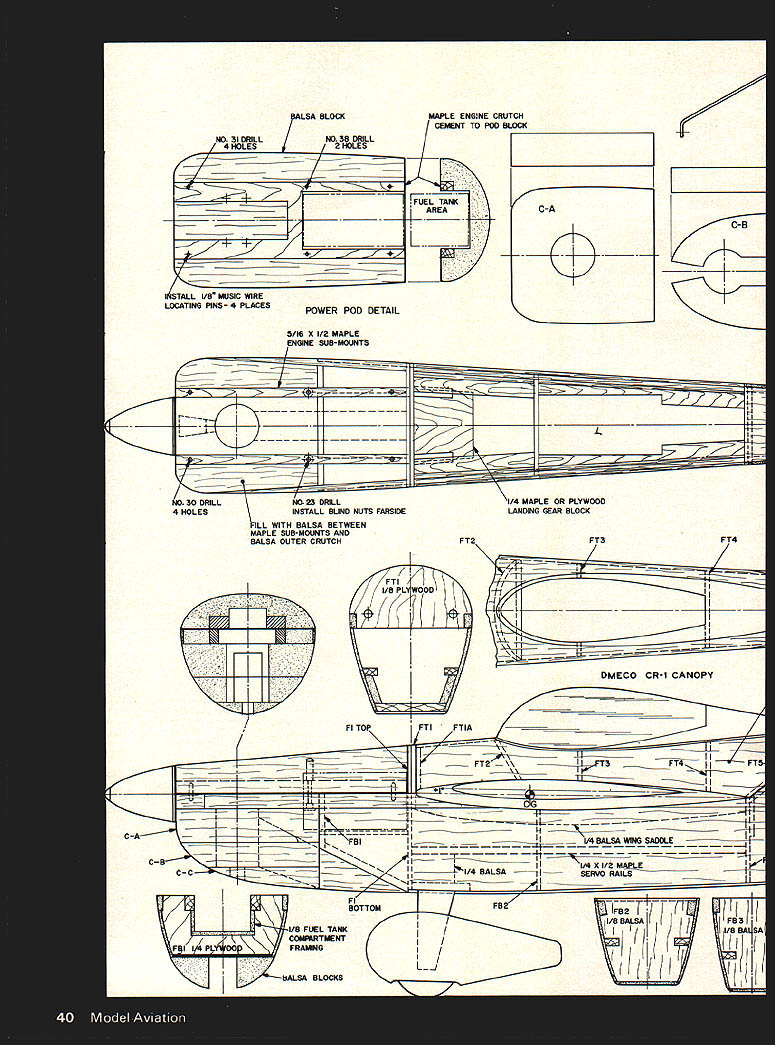
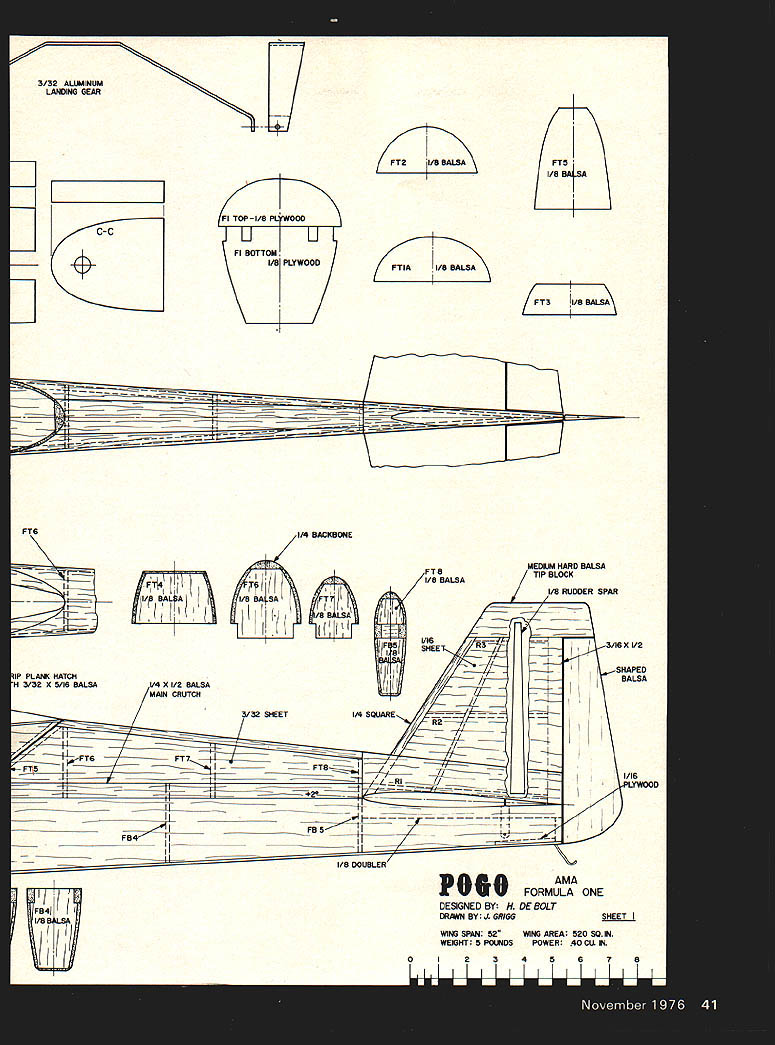
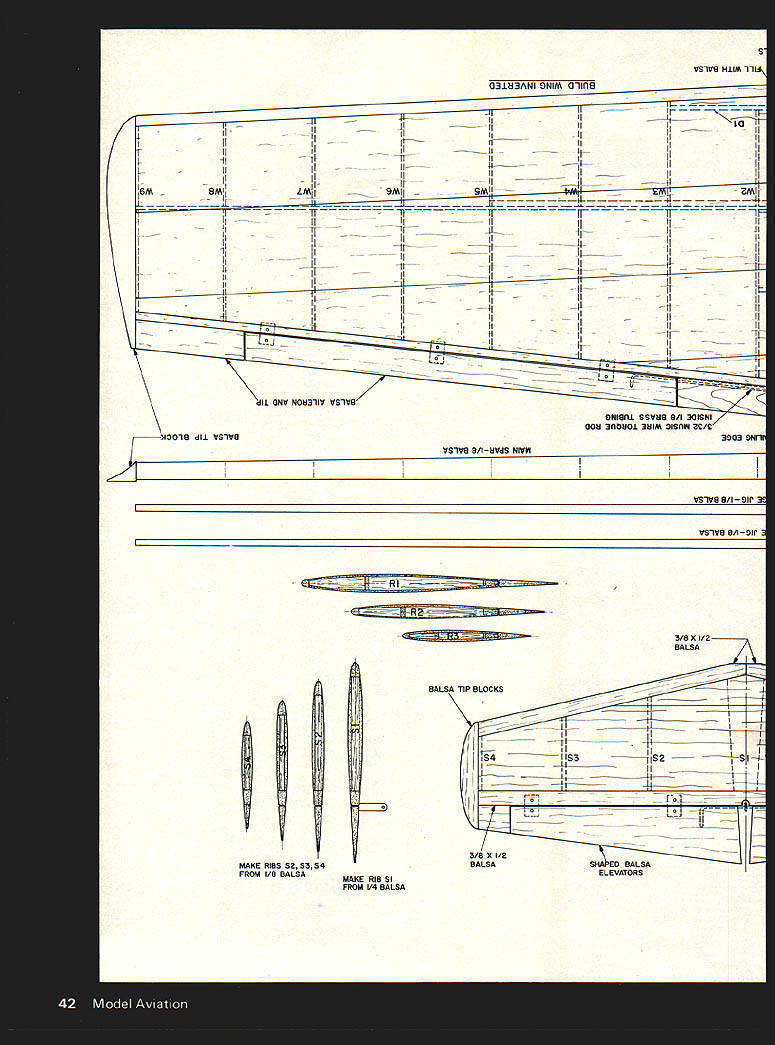
Pogo
AMA Formula One
Designed by: H. De Bolt Drawn by: J. Grigg Sheet 1
Wing span: 52" Wing area: 520 sq. in. Weight: 5 pounds Power: .40 cu. in.
3/32 aluminum landing gear
FT1 Top - 1/8 plywood FT1 Bottom - 1/8 plywood FT1A - 1/8 balsa FT2 - 1/8 balsa FT3 - 1/8 balsa FT5 - 1/8 balsa FT6
1/4 backbone 1/8 sheet 1/4 square 1/8 doubler
1/16 plywood 3/16 x 1/2 shaped balsa 1/8 rudder spar Medium hard balsa tip block 1/4 x 1/2 balsa main crutch BUILD WING INVERTED
BALSA AILERON AND T/E
BALSA TIP BLOCK
MAIN SPAR - 1/8 BALSA
3/8 X 1/2 BALSA
MAKE RIBS S2, S3, S4 FROM 1/8 BALSA
MAKE RIB S1 FROM 1/4 BALSA
R1
R2
R3
BALSA TIP BLOCKS
3/32 MUSIC WIRE TORQUE ROD INSIDE 1/8 BRASS TUBING
SHAPED BALSA ELEVATORS
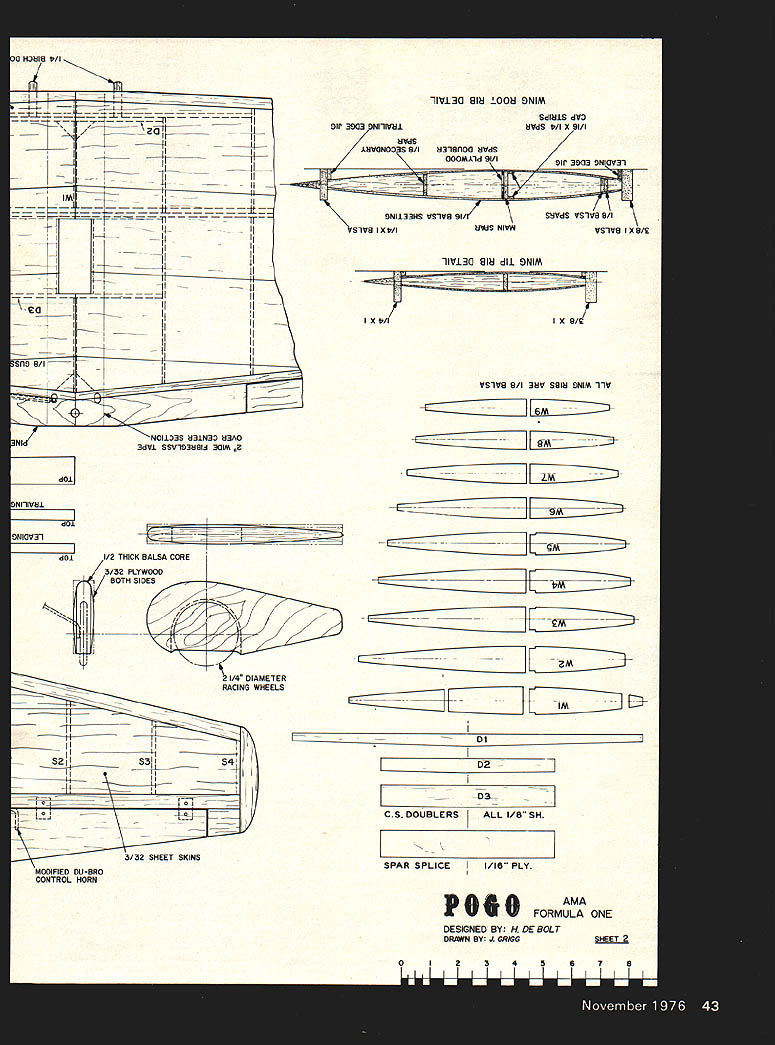
Pogo
WING ROOT RIB DETAIL
WING TIP RIB DETAIL
ALL WING RIBS ARE 1/8 BALSA
W9 W8 W7 W6 W5 W4 W3 W2 W1
D1 D2 D3
C.S. DOUBLERS ALL 1/8" SH.
SPAR SPLICE 1/16 PLY.
1/2 THICK BALSA CORE
3/32 PLYWOOD BOTH SIDES
2 1/4" DIAMETER RACING WHEELS
3/32 SHEET SKINS
S2 S3 S4
MODIFIED DU-BRO CONTROL HORN
BALSA TIP BLOCKS
POGO AMA FORMULA ONE DESIGNED BY: H. DE BOLT DRAWN BY: J. GRIGG SHEET 2
Pogo
the fewer intersections you have, the cleaner and better the air flows. The Owl design is very clean in this respect, removing the cheek cowl, canopy design and even the landing gear intersection with the fuselage. When it comes to a little additional engineering that separates an outstanding airplane from a good one, Owl racers are first rate, for George Owl did a thorough job in this respect!
The Pogo design is an excellent place to start, to achieve a model Formula I not only different but superior in many ways. Of course, with most models we have problem areas, but the way we handle these problems when working with full-scale designs means all the difference between winning or losing races.
Over the years I have come across new ideas for methods of making models work better, and these are all here in my Pogo design. First, you will notice that the Pogo is not "minimum" in size. Normally, this would violate the basic design principle of using no more than is necessary to get the job done; however, with experience, I have learned that a 5-lb. weight limit is too high a minimum for a Formula I aircraft. It is practical, of course, to keep a model's size down to a minimum for the least drag possible within the rules, but remember that an aircraft flies on its wing. If there is not enough lift, the engine power must carry the weight. If the lift is too little, more speed is lost through improper use of power than one could ever hope to gain through what drag reduction there might be. This has been realized thoroughly by many of us who have flown Formula II a great deal. A Formula II aircraft is roughly 1/3 larger than a Form I, yet with use of the same equipment they have proven to be equally as fast. One has to wonder why this should be. In my research of recent Formula I designs, I find they are going faster and faster, although engine power has not increased drastically, nor much else improved greatly. Wing area has expanded considerably, in many cases over 12%, a large increase for such small models. Apparently the message is out, for designers have taken advantage of what has been proven by Formula II aircraft.
The Pogo design takes full advantage of this fact, allowing plenty of wing area with a thinner version of the proven laminar-flow airfoil. At least the frontal area has been kept rather equal, even though wetted area has increased along with a big increase in lift. What you will notice in flying with more area is that the model slips easily through pylon turns, almost accelerating, while smaller models drag through them.
Now look at the front view of the fuselage. All you see is very clean, with no protrusions. Rear exhaust engines did away with the nasty need of an exhaust stack coming out the side, a boon to another design feature which I use. Every modeler needs a properly engineered pressure-type cowl system for his engine, allowing the engine to run cooler and, without expanding on theory, reduces cowling drag. With a rear exhaust, this principle reaches its ultimate, for the engine exhaust duct is now combined with the cooling exhaust, resulting in a cleaner airplane with reduced drag.
The Pogo design, using my power pod, has advantages most anyone can appreciate. Although a bit more work is required when designing and building, this pays off many fold when racing. The removable pod serves as a very solid mount for the engine, meaning maximum performance from the powerplant with the least vibration. Secondly, it allows immediate access to the complete power unit. Remove the pod and you have everything connected with your power unit right in your hand, so you can inspect it just as if it were in the workshop. Troubleshooting and maintenance is a breeze as a result.
Similarly, the wing removes with just a half turn of the Camloc fastener, requiring only seconds to open up the entire RC equipment for easy inspection. The removable wing also allows for easier transportation. It is readily understood why these accessibility features can be a great asset in winning races. Irksome little problems
Pogo/deBolt
between heats can make losers out of winners simply because a thorough inspection of most models uses up too much time. So often, just being able to run consistently well in every heat, is far more important to winning than having the fastest model!
Another basic fact in obtaining speed and performance is weight. Excess weight has never done anything but eat up power, causing loss of speed, along with other performance. While the Pogo is a very rugged design, much attention was given to the structure to keep weight down, with satisfying results. With weight being at the very minimum, no problems should be encountered other than having enough to meet the rules! Frankly, it would make for better performance if the rule weight requirements were reduced. We could easily build a lighter aircraft just as strong but faster performance-wise. Obviously, anyone interested in Formula I models reaches a point where he does not need step-by-step instructions to assemble. Often, the best of us welcome hints on procedure with a new design, so I will do my utmost to help on that score.
The Pogo wing and tail are both built up with true airfoils in them. This is a bit unusual for the tail but to obtain maximum efficiency a true airfoil is required and used in the Pogo. All surfaces are simple sheet-covered balsa for strength, simplicity and lightness. Both the wing and the stabilizer assemble on a flat board with the top side down, thus the airfoil taper provides the necessary dihedral. If desired, the top sheeting can be glued together and cut to outline shape. It then can be blocked and sanded on the board to fit the airfoil before commencing to assemble.
The basic fuselage structure is a crutch on the thrust line. Assembly is started by laying out the crutch and adding the bottom bulkheads to it. Assembly is continued until the entire bottom portion (minus the engine cowling) is completed before the crutch is removed from the bench. After the crutch assembly is removed, the wing and stabilizer are cut in. Next, the engine-pod crutch is cemented to the fuselage sub-mounts and the engine installed on the crutch. The pod block can be added. Now the crutch is put in place on the fuselage and the cowl blocks are installed. Add the top bulkheads and covering and finish the rest of the structure as you please.
The covering and finish are important. A method I have found to be quick, durable and most acceptable is to cover the model (except the front of the fuselage) with Silkspan paper. This tends to hold the balsa together and cover the grain. The forward portion of the fuselage gets a lot of wear and tear, so 3/4-oz. glass cloth and resin does the best job there.
The finish itself is minimum but results should be good. Apply one coat of clear dope to cement the paper down well, one coat of K&B filler to fill the pores, and one coat of each color to finish (Hobbypoxy or Superpoxy). A coat of clear adds a final touch, sealing all decals, etc. This finish procedure is about the quickest I have seen, promising a durable, satisfying job.
There is not much that can be said about flying the Pogo except that it is a perfect joy to handle, without any peculiar habits. Simply use no more control movement than necessary to get the turns you want and you will find that all else comes naturally. The Pogo tends to float in the glide, due to low wing loading, so plan on a bit longer landing approach if you are not familiar with this type of aircraft.
Having built the Pogo, you can be proud of owning a different Formula I to have fun with. I wish you the best of luck racing it, for in my estimation, you have chosen a winner.
Transcribed from original scans by AI. Minor OCR errors may remain.

