
Polly
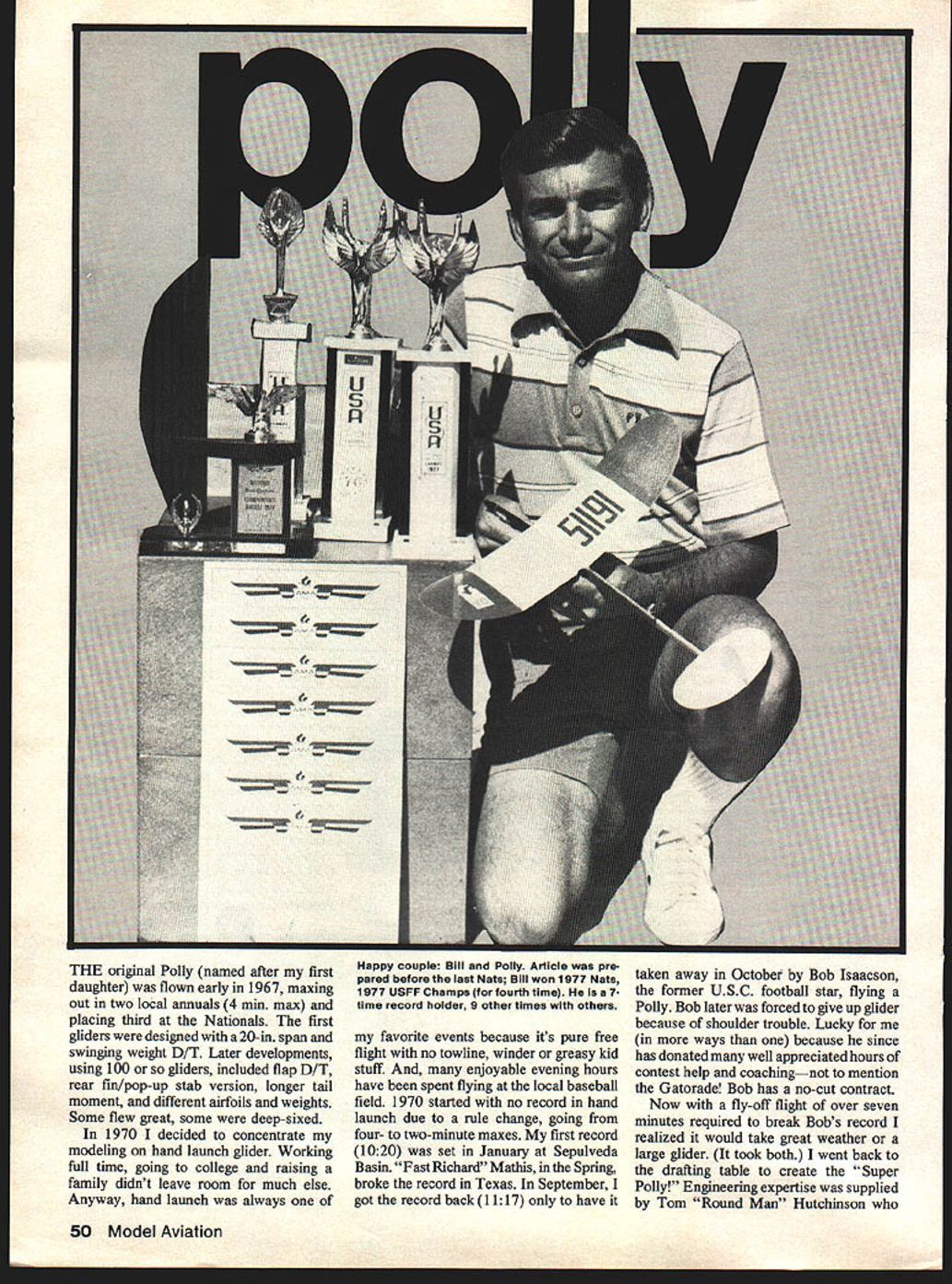
The original Polly (named after my first daughter) was flown early in 1967, maxing out in two local meets (4 min. max) and placing third at the Nationals. The first gliders were designed with a 20-in. span and swinging-weight D/T. Later developments, using about 100 gliders, included flap D/T, rear fin/pop-up stab versions, longer tail moment, and different airfoils and weights. Some flew great; some were deep-sixed.
In 1970 I decided to concentrate my modeling on hand-launch gliders. Working full time, going to college and raising a family didn't leave room for much else. Hand launch was always one of my favorite events because it's pure free flight with no towline, winder or greasy kid stuff. Many enjoyable evening hours have been spent flying at the local baseball field.
1970 started with no record in hand launch due to a rule change, going from four- to two-minute maxes. My first record (10:20) was set in January at Sepulveda Basin. "Fast Richard" Mathis broke the record in the spring in Texas. In September I got the record back (11:17) only to have it taken away in October by Bob Isaacson, the former USC football star, flying a Polly. Bob later was forced to give up glider flying because of shoulder trouble. Lucky for me (in more ways than one) he has since donated many well-appreciated hours of contest help and coaching—not to mention the Gatorade! Bob has a no-cut contract.
With a fly-off flight of over seven minutes required to break Bob's record, I realized it would take great weather or a large glider. It took both. I went back to the drafting table to create the "Super Polly." Engineering expertise was supplied by Tom "Round Man" Hutchinson, who calculated it would take a 24-in. wingspan, 5-in. chord, 59.31 sq. in. of black tissue on the wing, orange tips, and a few other details I can't now recall.
Everything went exactly as planned. On a great October day at Taft the Super Polly made its one and only official flight. It was one of those soft, non-drifting thermals which held Polly directly overhead for an O.O.S. 18-minute flight!
The 22-minute record held only through the end of the year since the rules were again changed, doing away with the unlimited fly-off in favor of continuous 2-minute fly-off flights. Polly has been consistent under the new rules. I set records in 1971 (13:43), 1972 (14:34), 1973 (18:42) and 1974 (20:00).
At last, the version presented here sums up the effort to best meet my demands for competition flying. The hefty balsa fuselage gives rigidity for maximum launch altitude and also provides the necessary finger-grip surface for consistent launches. The planform of the flying surfaces, when not sanded too thin, is not prone to warping (I have never been able to keep square-cornered balsa surfaces flat). The designed-in durability coupled with the reliable D/T allows for many "full-grunt" launches in thermal conditions while adjusting or practice flying.
Now I build Polly by the numbers, with no design changes in mind. But I do wonder: does Lee Hines still believe the wing shape is backwards? (Hines professed that at the victory dinner after I had just raised my National Record to 22 minutes in 1970.) Anyway, the secret is out! Consistency is the name of the game, Polly is the name of the plane—and a cannon for a right arm helps!
Construction
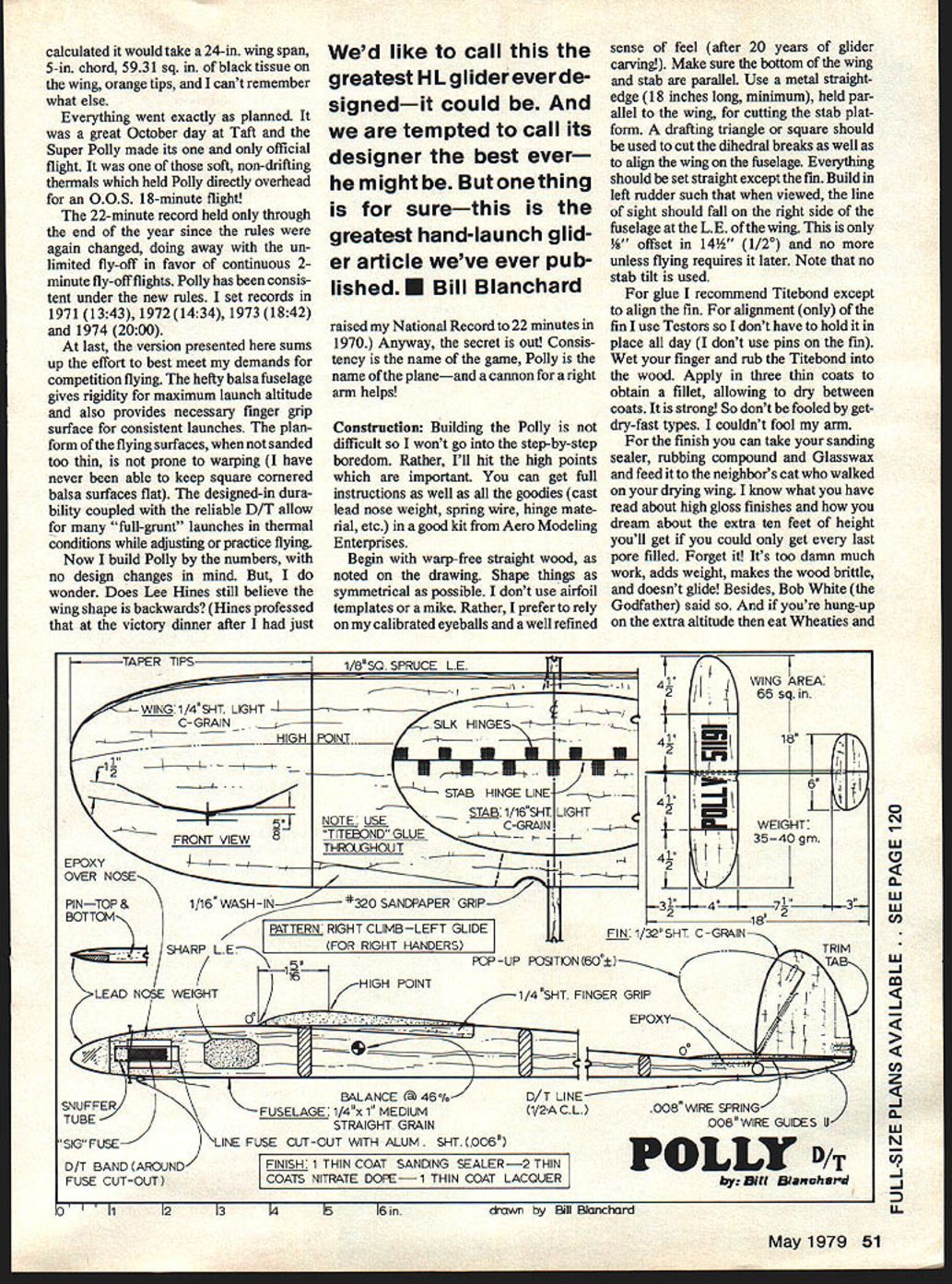
Building the Polly is not difficult, so I won't go into step-by-step boredom. Rather, I'll hit the high points that are important. You can get full instructions as well as all the goodies (cast lead nose weight, spring wire, hinge material, etc.) in a good kit from Aero Modeling Enterprises.
Begin with warp-free, straight wood as noted on the drawing. Shape things as symmetrical as possible. I don't use airfoil templates or a micrometer; I prefer to rely on calibrated eyeballs and a well-refined sense of feel after 20 years of glider carving. Make sure the bottom of the wing and the stab are parallel.
Tools and alignment
- Use a metal straightedge (18 inches long minimum), held parallel to the wing, for cutting the stab platform.
- Use a drafting triangle or square to cut the dihedral breaks and to align the wing on the fuselage.
- Everything should be set straight except the fin.
Yaw and fin
- Build in left rudder such that, when viewed from behind, the line of sight should fall on the right side of the fuselage at the leading edge of the wing. This is only about 1/8" offset in 14 1/2" (approximately 1/2°). Do not exceed this unless flying requires it later.
- Note: no stab tilt is used.
Glue and fillets
- I recommend Titebond for structural glue joints. For temporary alignment of the fin I use Testors so I don't have to hold it in place all day (I don't use pins on the fin).
- Wet your finger and rub the Titebond into the wood joint. Apply three thin coats to obtain a fillet, allowing each coat to dry between applications. It is strong—so don't be fooled by get-dry-fast types.
Finish
- Forget obsessive high-gloss sanding sealer work. It adds weight, can make the wood brittle, and doesn't noticeably improve glide. Bob White (the Godfather) agreed: if you're hung up on the extra altitude, eat Wheaties and lift weights!
Flight Adjustment
Comments on the trim assume a right-hander: Polly is set up to launch to the right and glide left. You should have built in the rudder offset and wash-in as shown on the plan. Set the glider a little nose-heavy to start with; this allows you to file off weight later instead of having to add messy clay, and it forces you to start flying with too much incidence rather than too little.
- Hand-glide and shim the back of the stab up (I use sheets of drafting vellum) to get a level glide.
- If you have a glide circle, fine. If not, bend in a little more rudder trim, but go easy.
- Give a straight-ahead level toss just hard enough to see if the glider will climb and start left. This checks incidence (required for roll-out) and some turn (so it doesn't go straight into the backstop).
For a normal launch, heave about 75% effort (so you don't tweak your tendons). Launch right sidearm and up at about a 30° angle. If you started with too much nose weight and incidence, the glider will fly loopy and safe and be ready for fine tuning.
Fine tuning is personal and depends on your arm. Basically, file off nose weight, remove one shim (from the back of the stab) at a time, and adjust rudder trim in combination until the looping tendency is gone. The amount of incidence you end up with will depend on your arm strength. Do not trim too close to 0°-0° with no margin of safety—an "off" launch with 0°-0° won't roll out, whereas an "off" launch that still rolls out into a thermal can still score a max.
Contest Flying
Showing up on game day with less-than-seasoned, poorly trimmed gliders is not acceptable to me. My dues are paid well in advance on the practice field. Bob White's law states you can tell the serious fliers by the degree of their suntans! During the six weeks prior to the Nats there were 15 practice sessions. The last four were spaced four days apart to coincide with indoor and outdoor at the Nats. On indoor day I had my winning scores on the board before the sealer was dry on some other flier's gliders. Score one for preparation!
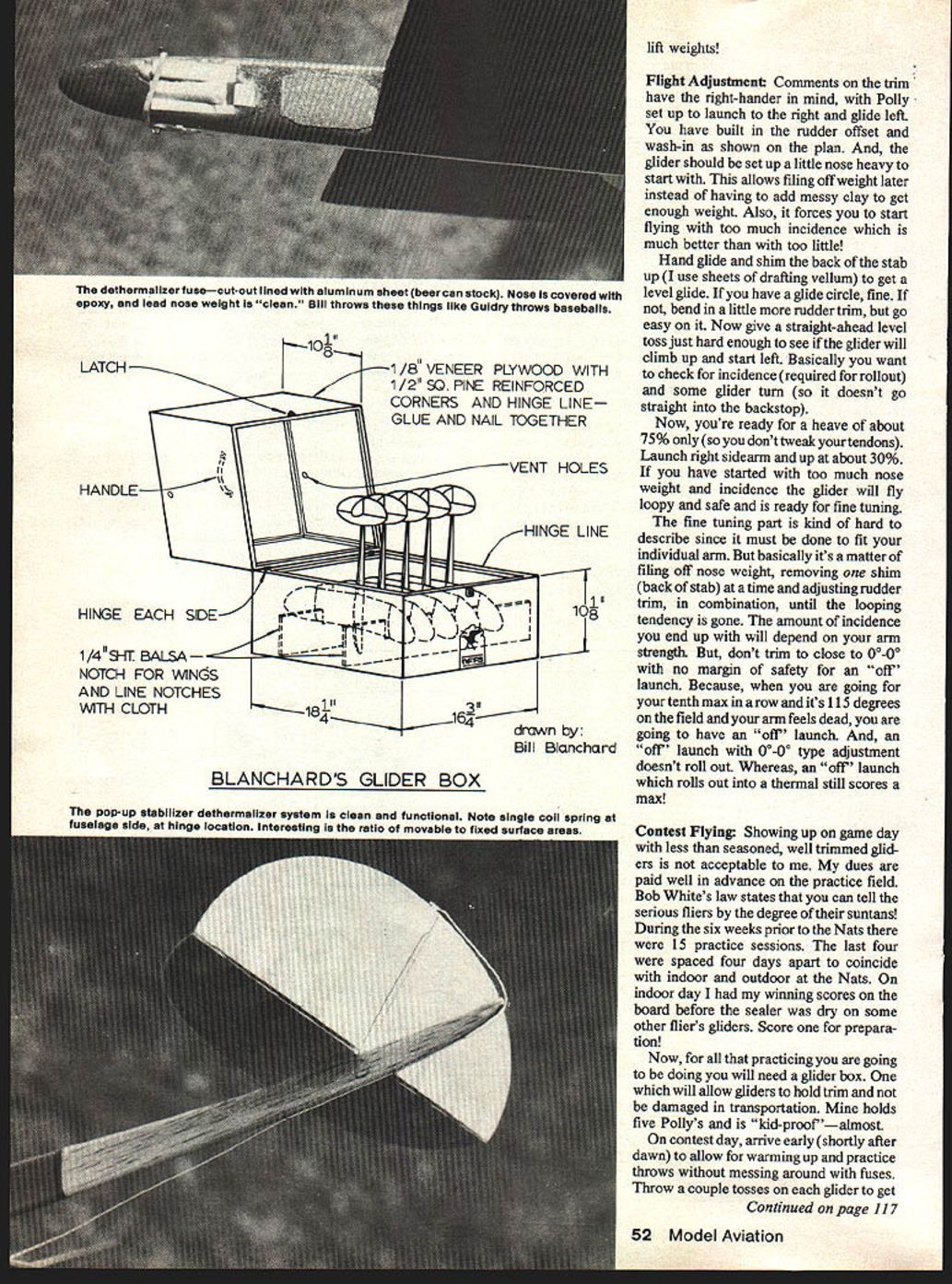
You will need a glider box that allows gliders to hold trim and not be damaged in transport. Mine holds five Polly's and is "kid-proof"—almost.
On contest day, arrive early (shortly after dawn) to allow for warming up and practice throws without messing around with fuses. Throw a couple of tosses on each glider to get confidence in feel and trim, but don't waste your arm. If you find one has changed and doesn't look right, forget it—that's why you have five.
If you have properly prepared, you can watch the weather while others are trimming and throwing out their arms. Be ready at the first signs of lift. Be aware of other models, streamers, bubbles, fluffies, dust and the "feel" of the air. It can be a tactical advantage to have the first max on the board, providing it didn't take six attempts to get it. The first max is usually not as important as the last—so be patient.
Competing in hand launch, it pays to know your competition. In other free-flight events the limits are towline length, motor run and rubber weight. With hand launch it's physical ability. The Free Flight Champs was an excellent example of one-on-one tactical flying.
After five maxes, "Fast Richard" Mathis and I were even up. His strategy was to try to get me to fly first as his goat. Being the crafty Texan he is, he said he wanted to go home and had been in the hot sun too long. He said he was tired of placing second at the Champs and would eat his hat if he didn't win. But friends, I wasn't tired (or proud) and wasn't even going to fly first. At the same time? Yes! But first? Never! I knew I could out-gun "Fast." When last seen, "Fast" was telling his father, "That little guy doesn't look like he could throw a glider."
Anyway, the secret's out. Consistency is the name of the game. Polly—the name, the plane—and a cannon-right arm helps.
Transcribed from original scans by AI. Minor OCR errors may remain.

