
Portable Frequency Pin Board
Jim Faassen
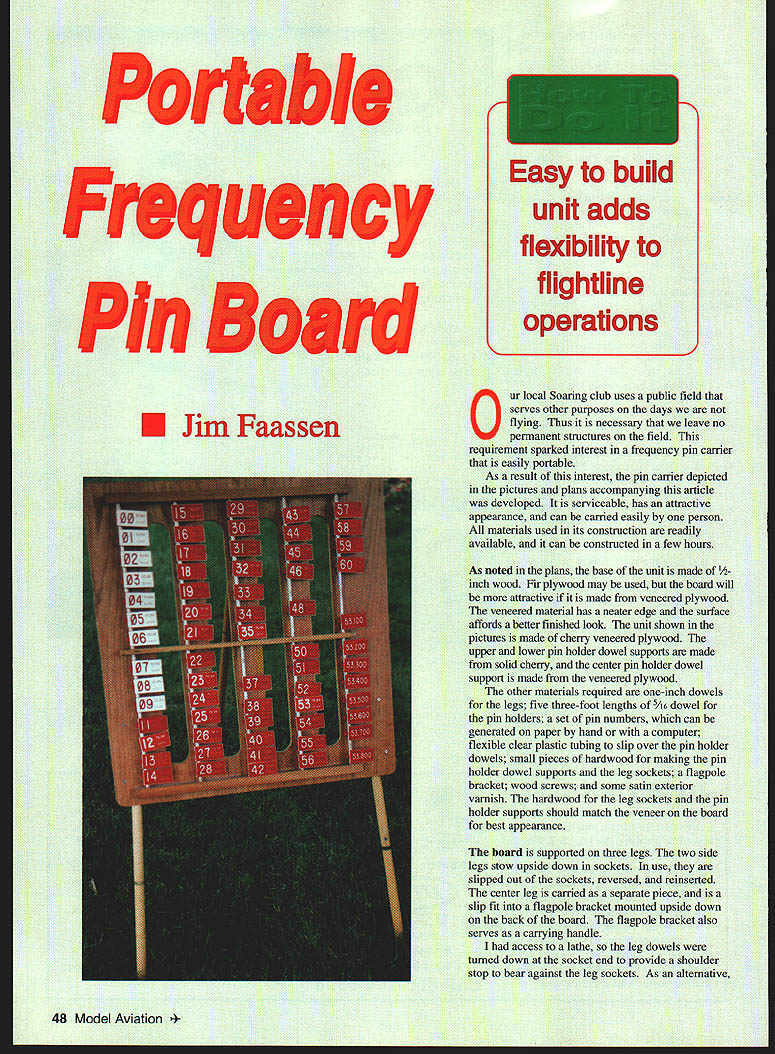
Our local Soaring club uses a public field that serves other purposes on the days we are not flying. Because we must leave no permanent structures on the field, a portable frequency pin carrier was developed. The unit described here is serviceable, attractive, and easily carried by one person. All materials are readily available and it can be constructed in a few hours.
Materials
- 1/2-inch plywood for the base (fir plywood may be used). Veneered plywood is preferred for a neater edge and better finished appearance (the pictured unit is cherry veneered plywood).
- Solid hardwood for upper and lower pin-holder dowel supports (cherry used in the pictured unit).
- Veneered plywood for the center pin-holder dowel support (to match the board).
- One-inch dowels for the legs.
- Five 3-foot lengths of 3/4-inch dowel for the pin holders.
- Flexible clear plastic tubing (soft flexible PVC) sized for a close slip fit over the pin-holder dowels.
- Spring-loaded clothespins to hold channel tags.
- Channel tags (see Dimensions below) or paper labels for channel numbers.
- Small hardwood pieces for leg sockets and pin-holder supports (match veneer for best appearance).
- Flagpole bracket (mounted upside down on the back of the board; doubles as carrying handle).
- Wood screws (use flathead screws, countersunk so heads do not show on the back).
- Wood glue and adhesive (3M 77 works well for paper numbers).
- Satin exterior varnish.
Dimensions and Tags
- Channel-number labels are spaced on 1-3/4-inch centers along the pin-holder dowels.
- The board is designed for channel tags mounted on spring-loaded clothespins. (Sources differ slightly on tag size; one set of notes lists 2-1/2 × 1-1/4 inches, another lists 2-7/8 × 1-3/8 inches. Use labels/tags that fit your clothespins and spacing.)
Construction
Base and Supports
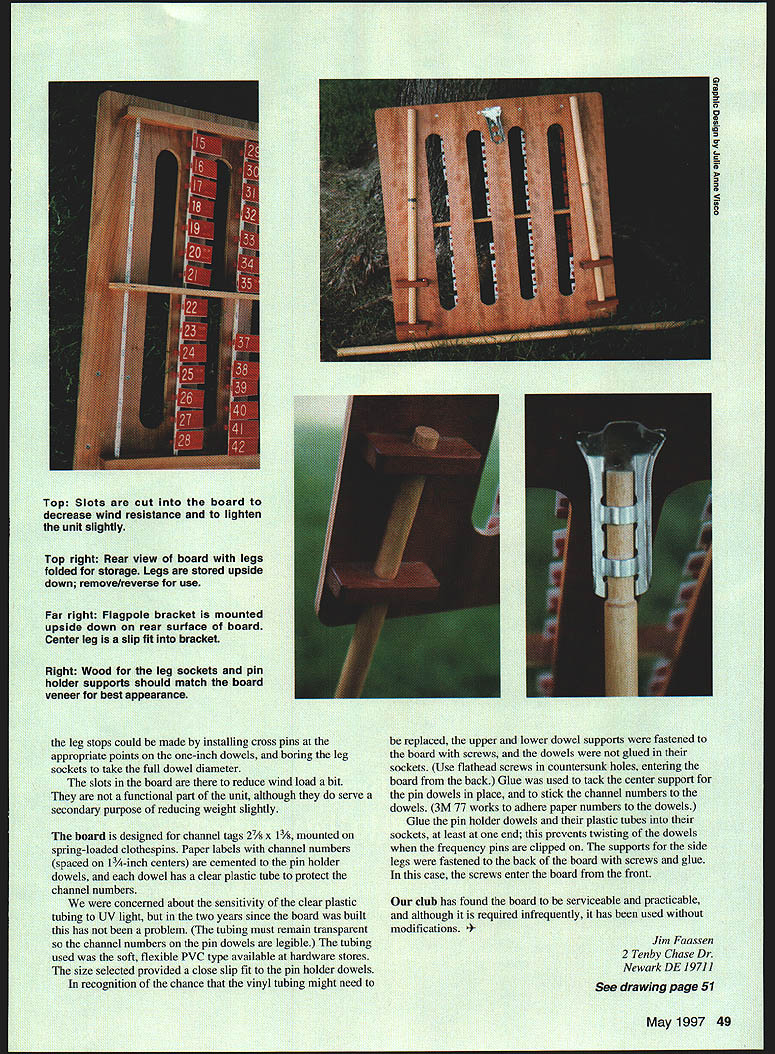
- Cut the base from 1/2-inch plywood. Cut slots in the board to reduce wind load and slightly reduce weight (the slots are not functional but do reduce wind resistance).
- Fasten the upper and lower pin-holder dowel supports to the board with countersunk flathead screws.
- Glue the pin-holder dowels into their sockets. Tack the center support pin dowels with glue as needed.
Pin Holders and Labels
- Space paper channel-number labels on the pin-holder dowels at 1-3/4-inch centers and cement them to the dowels (3M 77 adhesive works well).
- Slip clear plastic tubing over the dowels to protect the channel numbers. Glue the tubing to the dowels at least at one end to prevent twisting and to keep labels aligned.
- Attach spring-loaded clothespins to the dowels (or supports) to hold channel tags.
Legs and Leg Sockets
- The board is supported on three legs:
- Two side legs stow upside down in sockets on the board. For use, remove them, reverse, and reinsert.
- The center leg is carried separately and is a slip fit into the flagpole bracket mounted upside down on the back of the board (the bracket also serves as a carrying handle).
- If you have access to a lathe, turn the leg dowels down at the socket end to provide a shoulder stop that bears against the leg sockets. As an alternative, make leg stops by installing cross pins at the appropriate points on the one-inch dowels.
- Bore the leg sockets to take the full dowel diameter.
Fastening and Finish
- Use flathead screws, countersunk, so the screw heads do not show on the back of the board.
- Glue was used to tack the center support pin dowels and to stick the channel numbers to the dowels.
- Glue the pin-holder dowels to the plastic tubes at least at one end to prevent dowel twisting.
- Frequency pins are clipped to the supports on the side legs and the pins/supports are fastened to the back of the board with screws and glue. Take care that case screws do not penetrate the front of the board.
- Finish with satin exterior varnish.
Use and Maintenance
- The flexible PVC tubing used protects the paper channel numbers and must remain transparent for legibility. PVC tubing is available at hardware stores; select a soft type for an easy slip fit.
- Vinyl tubing may degrade with UV exposure and could require replacement over time. In one example, no problem was observed after two years, but consider periodic inspection and replacement as needed.
Notes
- The slots in the board reduce wind load and weight but are not required for functionality.
- Hardwood for leg sockets and pin-holder supports should match the veneer for the best appearance.
Faassen 2 Tenby Chase Dr. Newark, DE 19711
See drawing, page 51.
Transcribed from original scans by AI. Minor OCR errors may remain.

