
Powder and Paint
By John Spalding and Hobie Steele
With remarkably little extra work, many popular kits can be customized to look like attractive real aircraft — without affecting performance.
A little powder and a little paint make a gal what she ain't... especially if she's a fine kit design customized to look like a more exciting real bird.
If you want a good flying, nice-looking sport airplane, build a well-designed kit carefully, paint it attractively, and enjoy a great sport flyer. I like just a little more from my sport models, and anyone who says he doesn't love it when his peers gather 'round his new model at the flying field with admiring oohs and aahs is fooling only himself. It's great to have fellow modelers compliment your workmanship and resourcefulness. You need not be a super craftsman to have a truly outstanding model — all it takes is a little thought and prior planning before you start to butcher the old balsa.
Customize, don't redesign
The word that best sums up my feeling is "customize." That doesn't mean you need to change a good designer's basic layout. If you're sharp enough to actually change a design fundamentally, you should design your own and leave the "stock" ships alone. Very few kit aircraft can be improved by basic design changes. They're set up that way for a reason, and modifications of the basics inevitably result in decreased performance.
My suggestion is that by slight changes in profile, together with the proper color and trim combinations, an "ordinary" sport job can be made to look like something entirely different — excitingly different. Sport bipes can become "scale." Ordinary kits can acquire the eye appeal of antique or modern military fighters. All it takes is a bit of imagination and attention to detail. Don't worry about fussy details like working doors or operating instruments. The kind of detail I'm talking about is profile, color, and military or civilian markings.
Remember: never fool around with airfoils, moment arms, angles of incidence, and such. These are carefully planned by the designer to make that particular aircraft perform properly. Any changes here will surely result in a ship that performs improperly, and you may well end up with a great-looking plane that will never fly right.
Planning and modifications
With that settled, what can be safely done to make that next model the hottest-looking number at the local pasture? It's going to take a bit of looking, but what you need are 3-views of a scale type with the same general proportions as the kit you plan to build. A friend with oodles of profile publications and three-views collected over the years can be a real help. The local library is also a good source; you can usually photocopy your choice 3-view without tying up the book.
Start with basics like wing "quantity" and location:
- Monoplane or biplane
- Shoulder, high, or low wing
- Tapered or constant chord
- Straight or swept back
Next, look for fuselage moments, landing gear locations, etc. Your new "scale" doesn't need to be exactly like the real one — just give the overall effect of the full-scale bird. We're not talking about competition here, just sport modeling carried a bit beyond the ordinary.
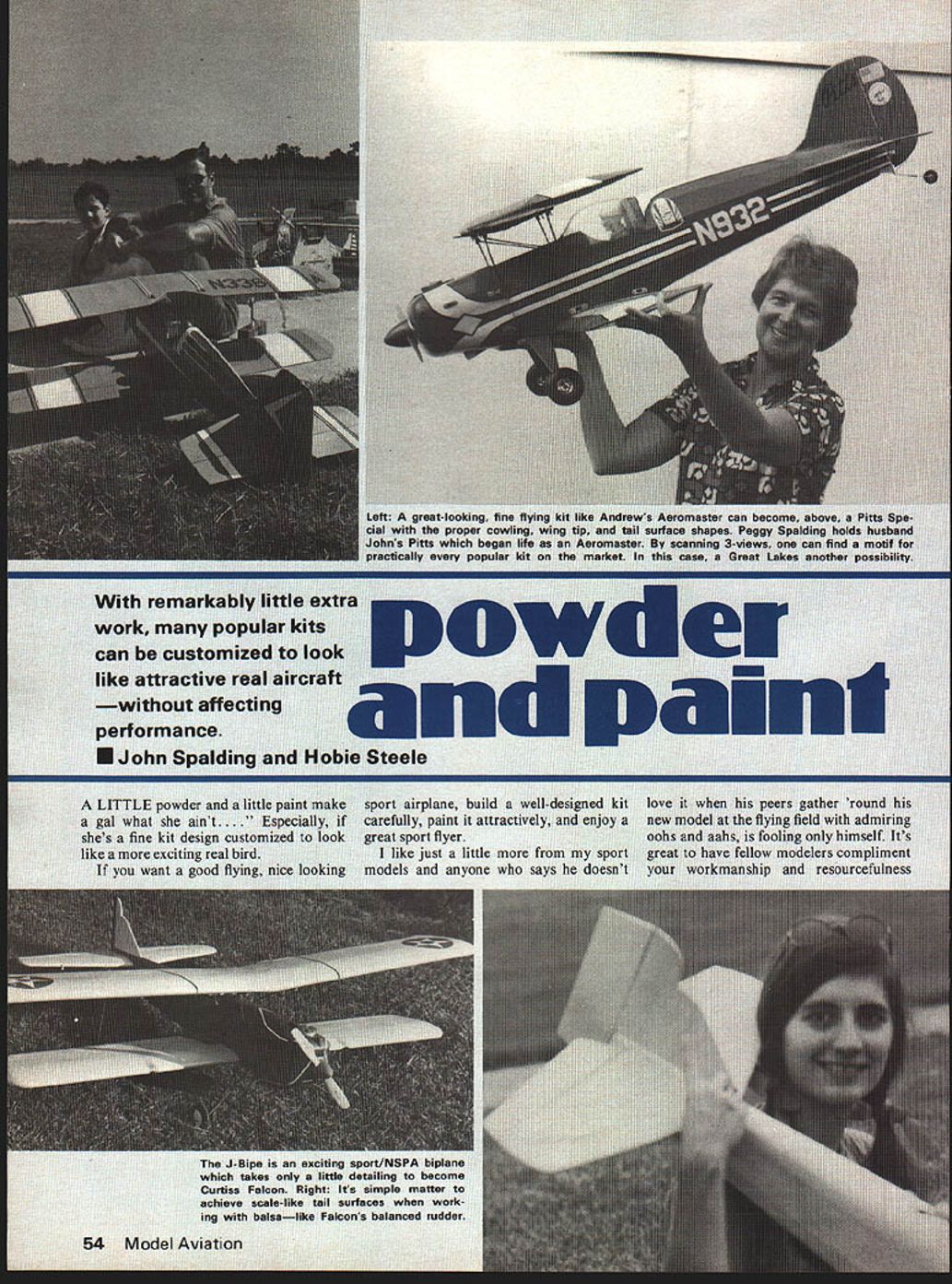
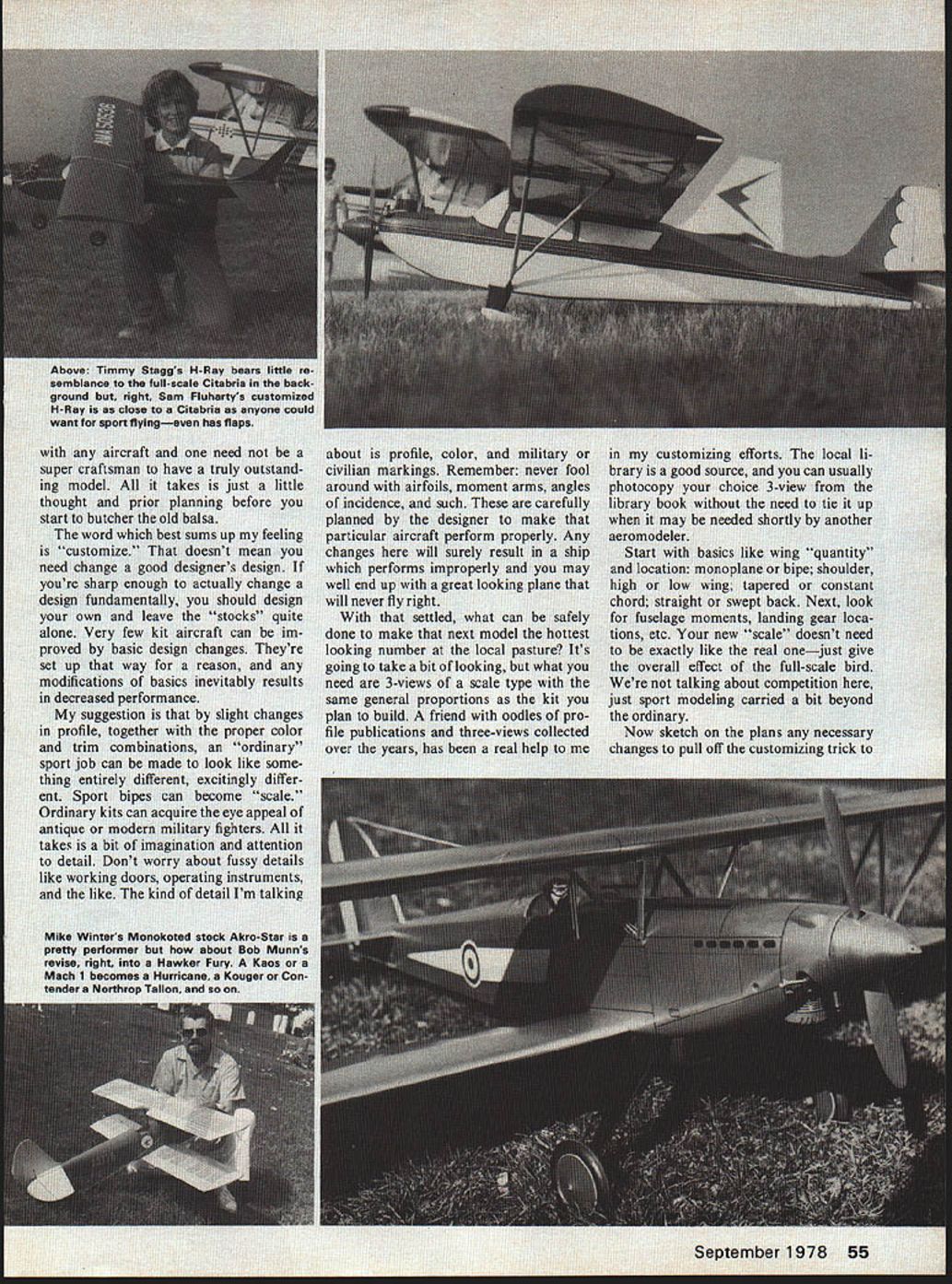
You can obtain the maximum advantage with minimum modifications. The Aeromaster can become a Pitts Special with only a cowling change. With the J-Bipe, modifications in cowling and vertical fin (without changing fin area), plus color and insignia, make the neatest Curtiss P-1A you've ever seen. A "stock" Aeromaster we once saw is for all the world a scale Curtiss Falcon — most of the illusion is in color and trim. I've seen Kwik Fli's made into Mustangs with little modification other than the underwing radiator, and Trainermasters that looked like Me 109s.
Paint, trim, and examples
You have to paint or Monokote anyhow, and the proper trim and insignia are what really do the trick. It's no problem as long as you choose a readily recognized full-scale color scheme. The Pitts, for example, would lose a lot of admiration points in any combination except the usual red and white with black pinstripes. Olive drab fuselage and yellow wings would make most any bipe a pre‑WWII Army trainer or, with armament, a fighter. Substitute blue for olive and you've got the Navy version. Just be sure what you're doing existed or looks like it could have existed, and you've got it!
Proctor's Antic isn't anything, really, but it's everything an early monoplane ought to be. The model is an example of a "factory customized" kit which looks like a vintage anything. Miss Vintage and the Early Bird Bipe follow the same general rule for such "scale."
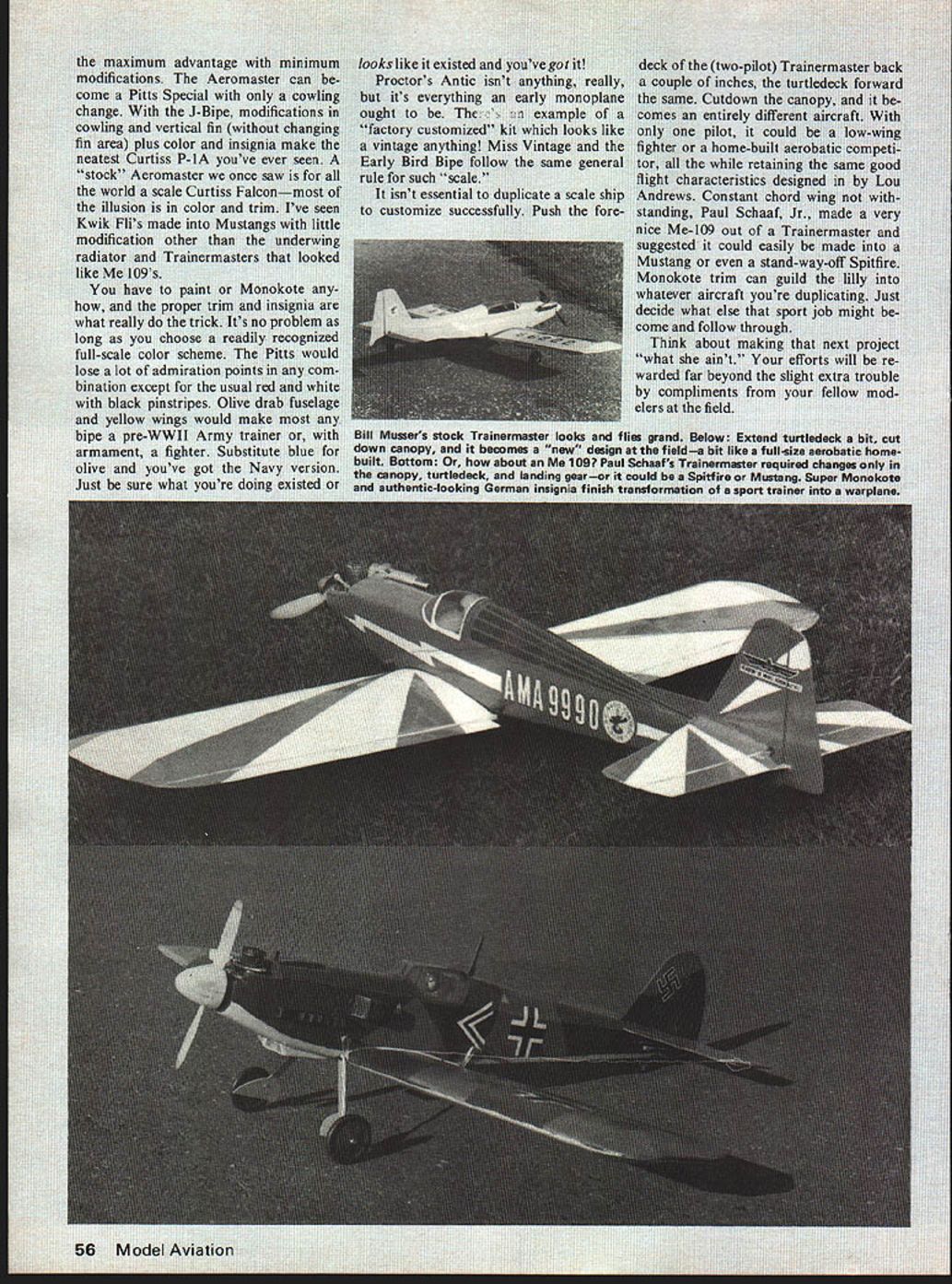
It isn't essential to duplicate a scale ship to customize successfully. Push the foredeck of the (two‑pilot) Trainermaster back a couple of inches and the turtledeck forward the same; cut down the canopy, and it becomes an entirely different aircraft. With only one pilot, it could be a low‑wing fighter or a home‑built acrobatic competitor, all the while retaining the same good flight characteristics designed in by Lou Andrews. Constant chord wing notwithstanding, Paul Schaaf, Jr., made a very nice Me 109 out of a Trainermaster and suggested it could easily be made into a Mustang or even a stand‑off Spitfire. Monokote trim can gild the lily into whatever aircraft you're duplicating. Just decide what else that sport job might become and follow through.
Think about making that next project "what she ain't." Your efforts will be rewarded far beyond the slight extra trouble by compliments from your fellow modelers at the field.
Transcribed from original scans by AI. Minor OCR errors may remain.

