
Power Switch: Spektrum DX7
A seven-channel, full-range, spread spectrum radio-control system
BY STEVE KALUF
Approximately 18 months ago a new company—Spektrum—came onto the radio-control market with the first production 2.4 GHz system using spread spectrum technology for surface use.
Roughly six months later Spektrum introduced the first production system for aircraft using the 2.4 GHz band and spread spectrum technology. That unit was designed for park-size models only. In a short amount of time the DX6 became popular with those flying electric-powered models. The system has a nice range of features but was lacking the ability to fly larger models.
In October 2006 Spektrum introduced the new "full range" DX7 system at the iHobby Expo in Chicago, Illinois, and many have hailed it as evolutionary. The DX7 is capable of flying any size model, whether fixed- or rotary-wing.
To understand why the introduction of this full-range system is so evolutionary, you need to understand more about the 2.4 GHz band and spread spectrum. Model Aviation has published two articles about the technology, the most recent of which was in the December 2006 issue. I encourage you to read both articles, but for now I'll review a bit so you can understand why the technology employed by the DX7 works so well.
The 2.4 GHz band has a fairly short wavelength; as such the antennas are short. The shorter wavelengths are more easily blocked by objects such as big battery packs, mufflers, engines, and other components that could be found in large models. When you put a receiver (that has a short antenna) in a model with these larger components, they could easily block the signal from the transmitter. I will cover how the DX7 and its AR7000 receiver get around this problem in a bit.
DX7 Advantages
So what are the advantages of using a spread spectrum system in the 2.4 GHz band? To begin with, you never have to worry about frequency control again. You simply turn on the system and go fly. Additionally, 2.4 GHz is well above the frequency range at which most interference (noise) is generated. Most of the noise models and their various parts (including speed controls and motors) generate is below 300 MHz. This means 2.4 GHz is virtually immune to this type of interference. When you couple this with the added security of spread spectrum, you end up with a system that, for all practical purposes, is immune to outside interference.
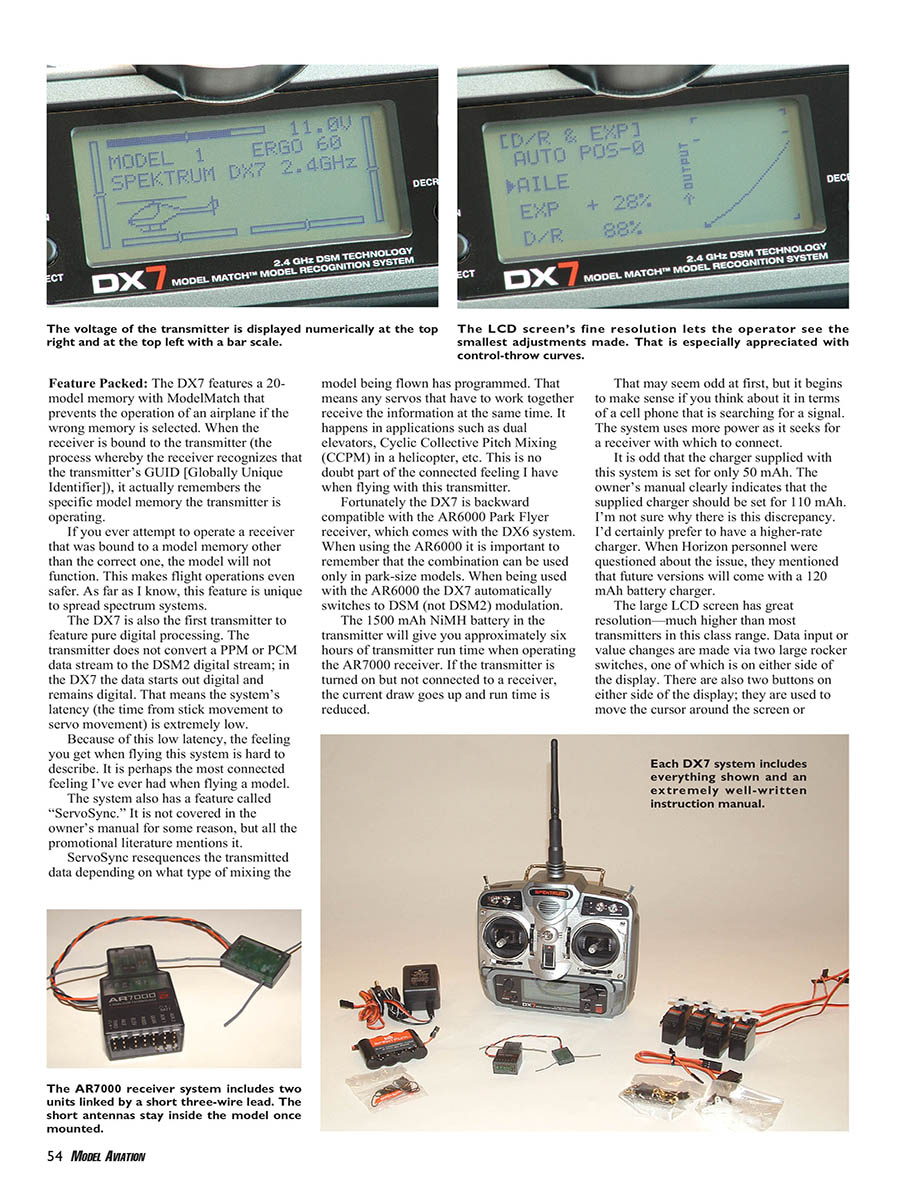
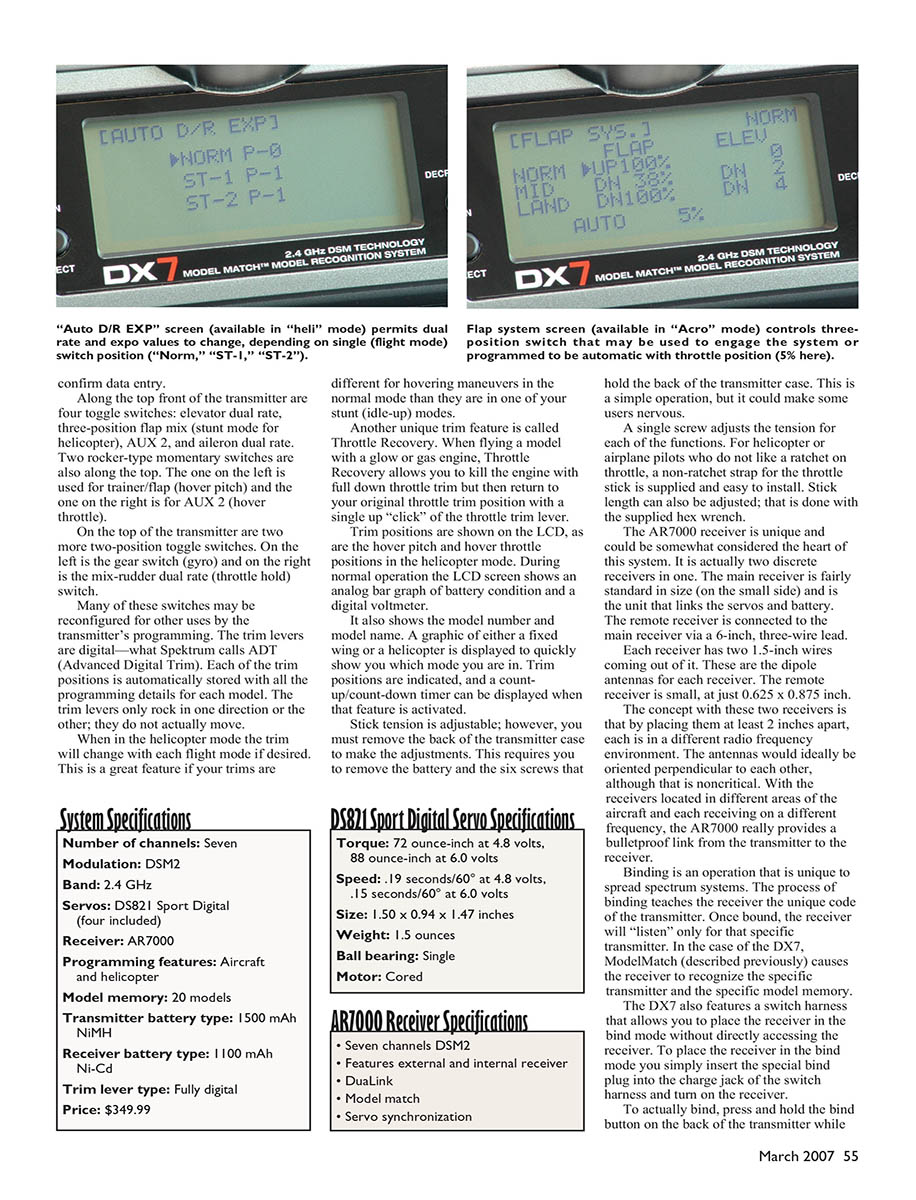
The DX7 is sold as a complete system. It includes the transmitter, AR7000 receiver, 1100 mAh 4.8-volt Ni-Cd receiver battery pack, 1500 mAh NiMH transmitter battery, four DS821 digital servos, switch harness, servo mounting hardware and output arms, dual wall charger, bind plug, and hex wrench for adjusting the transmitter stick height.
The system uses Spektrum's trademarked DSM2 (Digital Spectrum Modulation, second generation) DualLink technology. The original DX6 uses the first generation (DSM) of this technology. The DX7 transmits on two frequencies at the same time, and the AR7000 receiver is actually two discrete receivers connected by a cable that receive those frequencies simultaneously.
Feature Packed
The DX7 features a 20-model memory with ModelMatch that prevents the operation of an airplane if the wrong memory is selected. When the receiver is bound to the transmitter (the process whereby the receiver recognizes the transmitter's GUID—Globally Unique Identifier), it actually remembers the specific model memory the transmitter is operating. If you attempt to operate a receiver that was bound to a different model memory, the model will not function. This makes flight operations even safer.
The DX7 is also the first transmitter to feature pure digital processing. The transmitter does not convert a PPM or PCM data stream to the DSM2 digital stream; in the DX7 the data starts out digital and remains digital. That means the system's latency (the time from stick movement to servo movement) is extremely low. Because of this low latency, the feeling you get when flying this system is hard to describe — it is perhaps the most "connected" feeling I've ever had when flying a model.
The system also has a feature called ServoSync. While not covered in the owner's manual, promotional literature describes ServoSync as resequencing the transmitted data depending on the type of mixing the model has programmed. That ensures servos that must work together receive the information at the same time, useful for applications such as dual elevators or CCPM helicopter mixing. This contributes to the connected feeling in flight.
Fortunately the DX7 is backward compatible with the AR6000 Park Flyer receiver, which comes with the DX6 system. When using the AR6000 it is important to remember that the combination can be used only in park-size models. When paired with the AR6000 the DX7 automatically switches to DSM (not DSM2) modulation.
The 1500 mAh NiMH battery in the transmitter will give you approximately six hours of transmitter run time when operating the AR7000 receiver. If the transmitter is turned on but not connected to a receiver, the current draw goes up and run time is reduced. That may seem odd at first, but it makes sense if you think of it like a cell phone searching for a signal: the system uses more power as it seeks a receiver to connect with.
It is odd that the charger supplied with this system is set for only 50 mA while the owner's manual indicates the supplied charger should be set for 110 mA. I'm not sure where this discrepancy comes from. I'd certainly prefer a higher-rate charger. When Horizon personnel were questioned about the issue, they mentioned that future versions will come with a 120 mA battery charger.
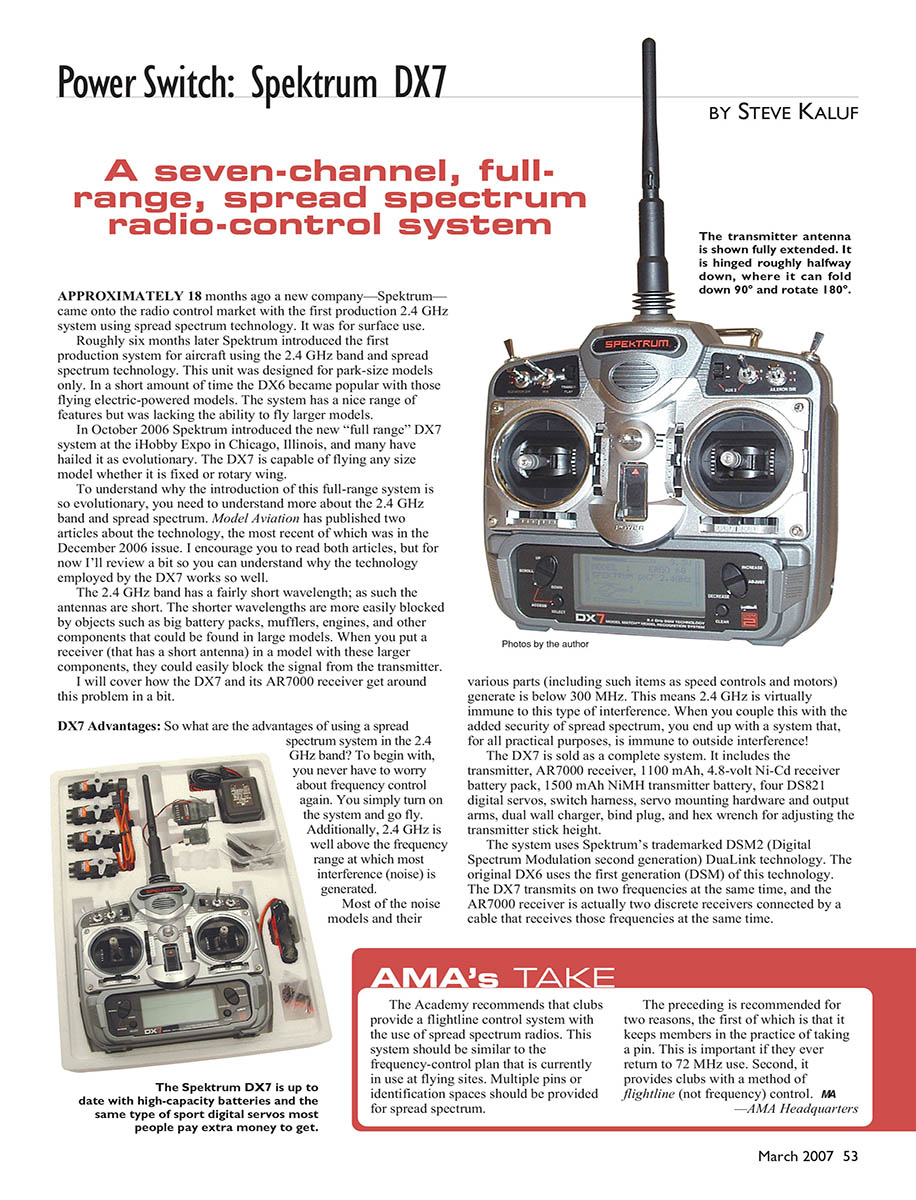
The large LCD screen has excellent resolution—much higher than most transmitters in this class. Data input or value changes are made via two large rocker switches, one on either side of the display. There are also two buttons on either side of the display; they are used to move the cursor around the screen or to enter and confirm data.
Along the top front of the transmitter are four toggle switches: elevator dual rate, three-position flap mix (stunt mode for helicopter), AUX 2, and aileron dual rate. Two rocker-type momentary switches are also along the top: the left one is used for trainer/flap (hover pitch) and the right one for AUX 2 (hover throttle). On the top of the transmitter are two more two-position toggle switches: on the left is the gear switch (gyro) and on the right is the mix-rudder dual rate (throttle hold) switch. Many of these switches may be reconfigured for other uses by the transmitter’s programming.
The trim levers are digital—what Spektrum calls ADT (Advanced Digital Trim). Each trim position is automatically stored with all the programming for each model. The trim levers rock in one direction or the other; they do not physically slide. When in helicopter mode the trims can change with each flight mode if desired, which is great when your hovering trims differ between normal and idle-up modes.
Another unique trim feature is called Throttle Recovery. When flying a model with a glow or gas engine, Throttle Recovery allows you to kill the engine with full down throttle trim but then return to your original throttle trim position with a single up “click” of the throttle trim lever.
Trim positions, hover pitch, and hover throttle positions are shown on the LCD in helicopter mode. During normal operation the LCD screen shows an analog bar graph of battery condition and a digital voltmeter. It also shows the model number and model name and displays a graphic of either a fixed wing or a helicopter to indicate which mode you are in. A count-up/count-down timer can be displayed when that feature is activated.
Stick tension is adjustable; however, you must remove the back of the transmitter case to make the adjustments. This requires removing the battery and the six screws that hold the back of the case. It is a simple operation but may make some users nervous. A single screw adjusts the tension for each function. For pilots who do not like a ratchet throttle, a non-ratchet strap for the throttle stick is supplied and is easy to install. Stick length can also be adjusted with the supplied hex wrench.
The AR7000 receiver is unique and could be considered the heart of the system. It is actually two discrete receivers in one. The main receiver is fairly standard in size—on the small side and thin—and contains the servo and battery leads. The remote receiver is connected to the main receiver via a 6-inch, three-wire lead. Each receiver has two 1.5-inch wires coming out of it; these are the dipole antennas for each receiver. The remote receiver is very small, about 0.625 x 0.875 inch.
The concept with these two receivers is that by placing them at least 2 inches apart, each is in a different radio-frequency environment. The antennas are ideally oriented perpendicular to each other, although that is not critical. With the receivers located in different areas of the aircraft and each receiving on a different frequency, the AR7000 provides a very robust link from the transmitter to the receiver.
Binding is an operation unique to spread spectrum systems. The process of binding teaches the receiver the unique code of the transmitter. Once bound, the receiver will "listen" only for that specific transmitter. In the case of the DX7, ModelMatch causes the receiver to recognize the specific transmitter and the specific model memory. Binding also sets the fail-safe positions: the stick and switch positions the transmitter is in during binding are established as the fail-safe positions. Anytime you make a programming change to the system, it's a good idea to rebind it to ensure the fail-safe settings are correct.
The DX7 features a switch harness that lets you place the receiver in bind mode without directly accessing the receiver. To place the receiver in bind mode, plug the charge jack of the switch harness into the receiver and turn on the transmitter. To actually bind, press and hold the bind button on the back of the transmitter while turning the transmitter on. The two LEDs on the AR7000 receivers that begin blinking when you power up will stop blinking and stay lit when the binding process has completed.
The DX7 has a nice variety of features for fixed-wing aircraft and helicopters. There are no sailplane-specific preprogrammed mixes; however, there are more than enough programmable mixes to handle almost any sailplane function.
The menu structure in the DX7 is easy to understand. You can view the menu as a list in one mode or you can scroll through each of the functions individually. I tend to use the scroll method more than the list method.
Two programming levels exist. The top level is the System Setup Mode, which you access by holding down the SCROLL rocker and SELECT button while turning on the transmitter. In System Setup Mode you can:
- Choose the model you want to fly.
- Name the model.
- Pick the model type (ACRO or HELI).
- Reset the model to factory default settings.
- Reset the integral timer.
- Turn the trainer function on or off and select its mode of operation.
- Select dual rate switches.
- Choose the wing type (FLAPERON, V-TAIL, DELTA) or helicopter swashplate type (standard, 180° CCPM, 120° CCPM, 90° CCPM).
- Access Input Select (which determines how Aux 2 will be used or selects the switch input that gyro gain will use).
- Enable or disable Throttle Recovery.
The Function mode is accessed by holding down the SCROLL and SELECT buttons when the transmitter is already powered up. The aircraft's main programming functions are accessed from this menu.
The SCROLL rocker switch moves you backward or forward through each menu. The SELECT button moves the cursor, the ADJUST button changes values, and the CLEAR button is typically used to lock in a value.
Programming features available in ACRO mode include:
- Dual and exponential rates
- Servo reversing
- Subtrims
- Travel adjust
- Elevator-to-flap mixing
- Aileron-to-rudder mixing
- Servo monitor screen
- Count-up/count-down timer
- Six programmable mixes
- Differential and flap system
HELI mode programming includes:
- Dual and exponential rates
- Servo reversing
- Subtrims
- Travel adjust
- Swashplate mixing
- Throttle hold
- Throttle curve (Normal, Stunt 1, Stunt 2)
- Pitch curve (Normal, Stunt 1, Stunt 2, Hold)
- Servo monitor screen
- Count-up/count-down timer
- Three programmable mixes
- Gyro sensing
- Revo mix
Dual and exponential (expo) rates are programmed from the same screen. Expo is shown on the display, which is a great aid in seeing how the expo rate you set will affect stick sensitivity.
In helicopter mode you have five-point pitch and throttle curves available. In airplane mode, preprogrammed mixes make popular forms of mixing easy to accomplish. The flap program allows you to set 3° of flaps and couple the elevator to those positions to control pitch changes. You can also set an automatic landing system that will activate the flaps with elevator compensation at any point you select based on the position of the throttle stick.
Helicopter mode gives you the ability to set up automatic dual or exponential rates based on flight mode. With this feature, the flip of a switch changes dual and expo rates as well as other parameters.
One item I really like in helicopter mode is that if you power up with throttle hold on or with the flight-mode switch in any mode other than normal, the main display will warn you. The display will not return to normal until the switches are returned to the normal (and safe) positions. This is a great safety reminder to help prevent hot starts.
The DX7 is a super system I’ve really enjoyed flying. I’ve gotten used to not having to wait on a channel at large events. I also find it to be one of the safest systems I have ever used. In almost five months I haven’t experienced a single problem — not a bump, not an issue.
The instruction manual is extremely well laid out. I wished for additional programming examples from time to time, but they are not really needed. In fact, you could easily program this transmitter without the manual; it is that easy.
The DX7 system is available for a street price of $349.99, which is not bad considering what all it includes. I plan to fly with the DX7 for many years to come. It is worth your serious consideration.
MA — Steve Kaluf skaluf@modelaircraft.org
System Specifications
- Number of channels: Seven
- Modulation: DSM2
- Band: 2.4 GHz
- Servos: DS821 Sport Digital (four included)
- Receiver: AR7000
- Programming features: Aircraft and helicopter
- Model memory: 20 models
- Transmitter battery type: 1500 mAh NiMH
- Receiver battery type: 1100 mAh Ni-Cd
- Trim lever type: Fully digital
- Price: $349.99
DS821 Sport Digital Servo Specifications
- Torque: 72 oz-in at 4.8 volts; 88 oz-in at 6.0 volts
- Speed: 0.19 s/60° at 4.8 volts; 0.15 s/60° at 6.0 volts
- Size: 1.50 x 0.94 x 1.47 inches
- Weight: 1.5 ounces
- Ball bearing: Single
- Motor: Cored
AR7000 Receiver Specifications
- Seven channels DSM2
- Features external and internal receiver
- DualLink
- ModelMatch
- Servo synchronization
Distributor
Horizon Hobby, Inc. 4105 Fieldstone Rd. Champaign, IL 61822 (217) 352-1913 www.horizonhobby.com
Other Published Resources
- Model Airplane News, February 2007
- Fly R/C, February 2007
- Model Aviation, December 2006
Transcribed from original scans by AI. Minor OCR errors may remain.

