
Prelude to Kiev
The Eighth World Aerobatics Championships will be held in Russia on July 25–August 3. What ships are in contention? How are they judged? What are the latest Aresti figures for judging? These and many other questions are answered in this roundup.
Don Berliner Photos by Don Berliner and Dick Stouffer
IN OLDEN DAYS, when life was so much simpler, a few guys would stand around and watch pilots doing impromptu maneuvers in their Taperwing Wacos and Ryan trainers. Then they would talk it over and decide who had flown best and who hadn't. The winner got the trophy and the cash, and everyone else grumbled. It wasn't a very precise way of judging an aerobatic contest, but it was the best they had.
And it was also a wide open opportunity for bias, and for building up the reputation of a pilot the judges liked, and for discouraging newcomers. But, as long as aerobatic championships carried about as much prestige as professional wrestling titles, not very many people lost sleep over it. It was more show than sport, anyway.
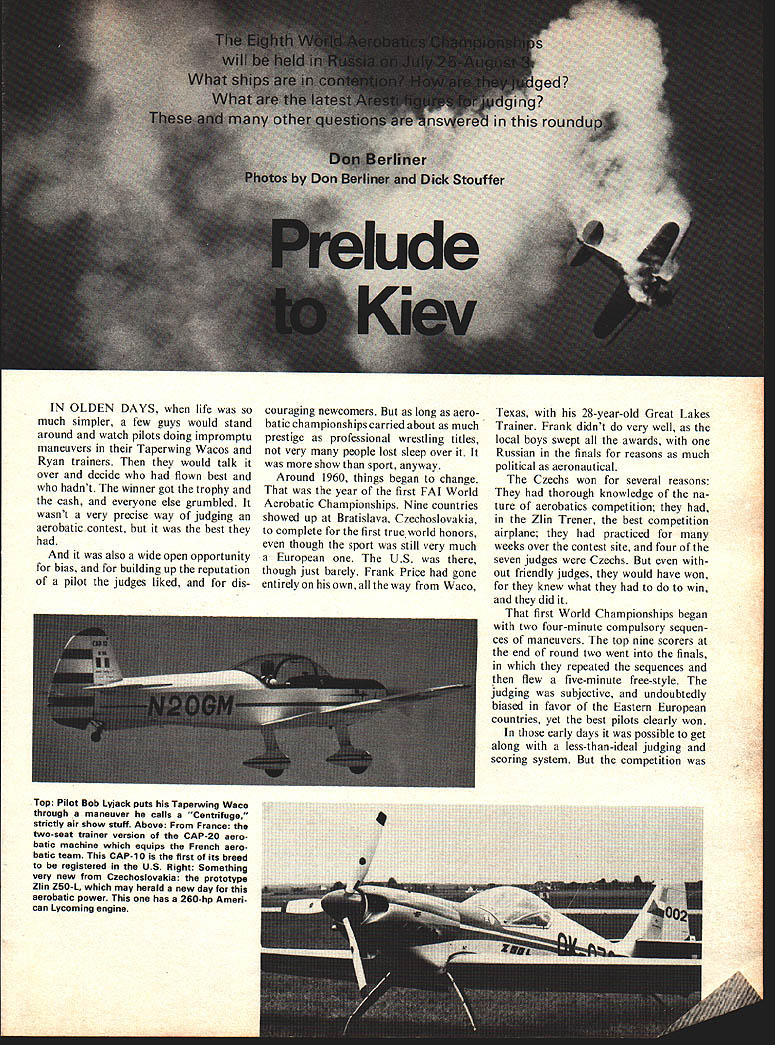
Around 1960, things began to change. That was the year of the first FAI World Aerobatic Championships. Nine countries showed up at Bratislava, Czechoslovakia, to compete for the first true world honors, even though the sport was still very much a European one. The U.S. was there, though just barely. Frank Price had gone entirely on his own, all the way from Waco, Texas, with his 28-year-old Great Lakes Trainer. Frank didn't do very well, as the local boys swept all the awards, with one Russian in the finals for reasons as much political as aeronautical.
The Czechs won for several reasons: they had thorough knowledge of the nature of aerobatics competition; they had, in the Zlin Trener, the best competition airplane; they had practiced for many weeks over the contest site, and four of the seven judges were Czechs. But even without friendly judges, they would have won, for they knew what they had to do to win, and they did it.
That first World Championships began with two four-minute compulsory sequences of maneuvers. The top nine scorers at the end of round two went into the finals, in which they repeated the sequences and then flew a five-minute free-style. The judging was subjective, and undoubtedly biased in favor of the Eastern European countries, yet the best pilots clearly won.
In those early days it was possible to get along with a less-than-ideal judging and scoring system. But the competition was developing and would have to move in the direction of greater organization and discipline, much to the displeasure of those who preferred the wide-open atmosphere.
The man to solve the problem came along: Spanish Count Jose Aresti, an experienced Bucker Jungmeister pilot, an unusually well-organized thinker who wasn't afraid of large, complex problems. Out of the increasing chaos he created an organized system to lead aerobatics out of the dark ages and into an open arena everyone could compete in. Knowledge — not chance — would decide winners; skill and hard work would permit. Aresti did this by inventing a new language everyone could understand regardless of what language his parents taught him at home.
Moreover, the growing vocabulary of aerobatic slang, which differs from country to country, was replaced by a series of symbols; for example, the maneuver Americans call hammerhead stall (hammerhead turn) is known to the British as a stall turn, to the French as renversement or tombée d'aile, to the Spanish as caída de ala, and to the Russians as povorot na vertikal'tsi i gorke. Imagine the confusion at an international meet, people from many countries trying to discuss a simple maneuver, perhaps realizing they were talking about the same thing. Thanks to Aresti's Aerocryptographic System, a hammerhead can be drawn thusly in a few quick lines on the chalkboard, and pilots all over the world can point out areas of trouble and quickly discover problems far less serious than they seemed in the hopeless babble of different tongues.
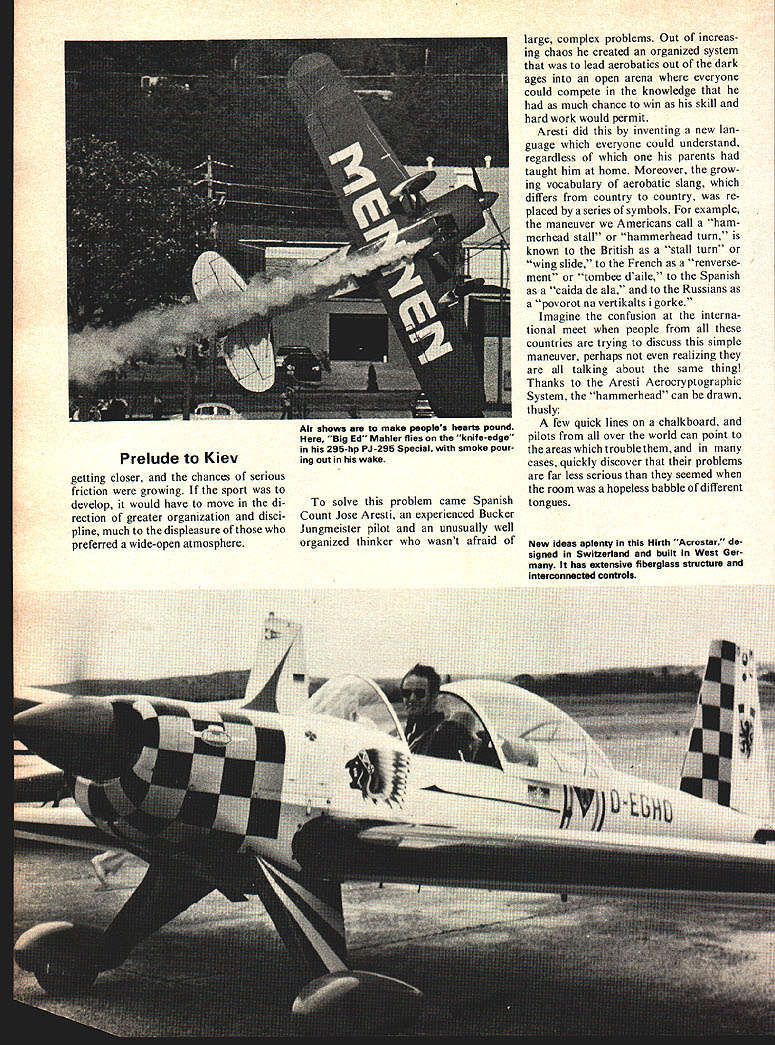
New ideas aplenty. Hirth Acrostar, designed in Switzerland and built in West Germany, has extensive fiberglass structure and interconnected controls. Air shows make people's hearts pound. Big Ed Mahler flies knife-edge in the 295-hp PJ-295 Special, smoke pouring out in the wake.
The second thing Aresti did grouped maneuvers into a few families that competitions could be based on — a systematic coverage of the funny things airplanes can do. A rather helter-skelter approach makes it look like aerobatics is nothing but a lot of flip-flops in the sky. Rhyme and reason catalogued several thousand combinations of maneuvers in the following groups:
- Family I — Line: lines plus angles. Vertical 45° climbs, dives, horizontal flight; rolls can be added for variety.
- Family 2 — Horizontal turns: 90°, 180°, 270°, 360° turns generally seen in Sportsman competition.
- Family 3 — Vertical turns (currently used).
- Family 4 — Spins: upright, inverted, flat spins.
- Family 5 — Hammerhead turns.
- Family 6 — Tail slides, whip stalls.
- Family 7 — Loops: can be round, triangular, square, six- and eight-...
Prelude to Kiev
getting closer, and the chances of serious friction were growing. If the sport was to develop, it would have to move in the direction of greater organization and discipline, much to the displeasure of those who preferred a wide-open atmosphere.
To solve this problem came Spanish Count Jose Aresti, an experienced Bucker Jungmeister pilot and an unusually well organized thinker who wasn't afraid of large, complex problems. Out of increasing chaos he created an organized system that was to lead aerobatics out of the dark ages into an open arena where everyone could compete in the knowledge that he had as much chance to win as his skill and hard work would permit.
Aresti did this by inventing a new language which everyone could understand, regardless of which one his parents had taught him at home. Moreover, the growing vocabulary of aerobatic slang, which differs from country to country, was replaced by a series of symbols. For example, the maneuver we Americans call a "hammerhead stall" or "hammerhead turn," is known to the British as a "stall turn" or "wing slide," to the French as a "renversement" or "tombée d'aile," to the Spanish as a "caída de ala," and to the Russians as a "povorot na vertikaltsi i gorke."
Imagine the confusion at the international meet when people from all these countries are trying to discuss this simple maneuver, perhaps not even realizing they are all talking about the same thing! Thanks to the Aresti Aerocryptographic System, the "hammerhead" can be drawn, thusly:
A few quick lines on a chalkboard, and pilots from all over the world can point to the areas which trouble them, and in many cases, quickly discover that their problems are far less serious than they seemed when the room was a hopeless babble of different tongues. The second thing Aresti did was group maneuvers into a few "families," so that competitions could be based on a systematic coverage of all the funny things airplanes can do, rather than on a helter-skelter approach which makes it look like aerobatics is nothing but a lot of flip-flops in the sky, without rhyme or reason. He catalogued several thousand combinations of maneuvers into the following groups:
Family 1—Line, and lines plus angles. Vertical and 45° climbs and dives, and horizontal flight, to which can be added a variety of rolls.
Family 2—Horizontal turns. 90°, 180°, 270° and 360° turns, seen generally in Sportsman competition.
Family 3—Vertical turns. Not currently in use.
Family 4—Spins. Upright, inverted and flat spins.
Family 5—Hammerhead turns.
Family 6—Tail slides or whip stalls.
Family 7—Loops. Can be round, triangular, square, six- or eight-sided; and inside or outside, or double (figure-eight).
Family 8—Rolls. Slow, barrel, hesitation and snap; around a circle or loop.
Family 9—Half-loop plus half-roll. Combinations include the Immelmann, split-S, half-Cuban-eight and these casually called "humpty-bump" and "fish-hook."
To further systematize aerobatics, and to relieve the judges of the impossible task of trying to decide if they should give more points for a hard maneuver done poorly or an easy one done well, Aresti assigned a K-factor (or degree of difficulty) to each maneuver. Thus a 90° horizontal turn has a K-factor of "1", while an inverted 360° turn with two slow rolls to the outside of the circle has a K-factor of "43." With each judge scoring the maneuver on a 0-to-10 scale, a perfect performance of the first would be worth only 10 points, while a mediocre job of flying the second (scored 5) would be worth 215 points.
The judges are still the key to modern aerobatics, though the Aresti System has made it a lot easier for them to be fair. If they are currently qualified, and if they have not taken up biased jobs with dedication, then the scores they produce will be representative of the flying they have seen. If, on the other hand, they are unqualified or biased or have been chosen for social or political reasons, then the sport will suffer because the wrong pilots will get the trophies.
It's a constant battle to keep the judging abreast of the flying, because the flying improves steadily as the competition gets tougher, and as more and more pilots get airplanes capable of flying through even the most difficult of maneuvers.
Back before World War II, there were few aerobatic contests and no true aerobatic airplanes, at least by modern standards. The airplanes seen in competition were the same Wacos and Great Lakes and Monocoupes that were used for air shows. They could do most of today's maneuvers, though not in so little airspace, and rarely with the same kind of precision. The same was true in Europe: The British flew de Havilland Tiger Moths, the French flew Morane parasols and the Germans flew Bucker Jungmeisters and Jungmanns. And they all flew mainly for the crowd.
After the war, they picked up where they left off. We had lots of Stearman trainers to add to the remaining pre-war stunt planes. The Canadian and British chipped in with surplus de Havilland Chipmunks, while the French had a lot of Belgian-designed Stampe biplanes.
But then, in the mid-1950's, the Czechoslovakian Zlin Treners and Akrobats began to appear in large numbers. They were designed for modern aerobatics, and saw almost yearly improvements to keep them at the top. Almost every country in Eastern Europe had Zlins, and so did a lot of Western countries. The mark became the standard by which all others were measured. Their only rival in Europe was the Yak-18, a modified Russian Air Force trainer which only the Russians used.
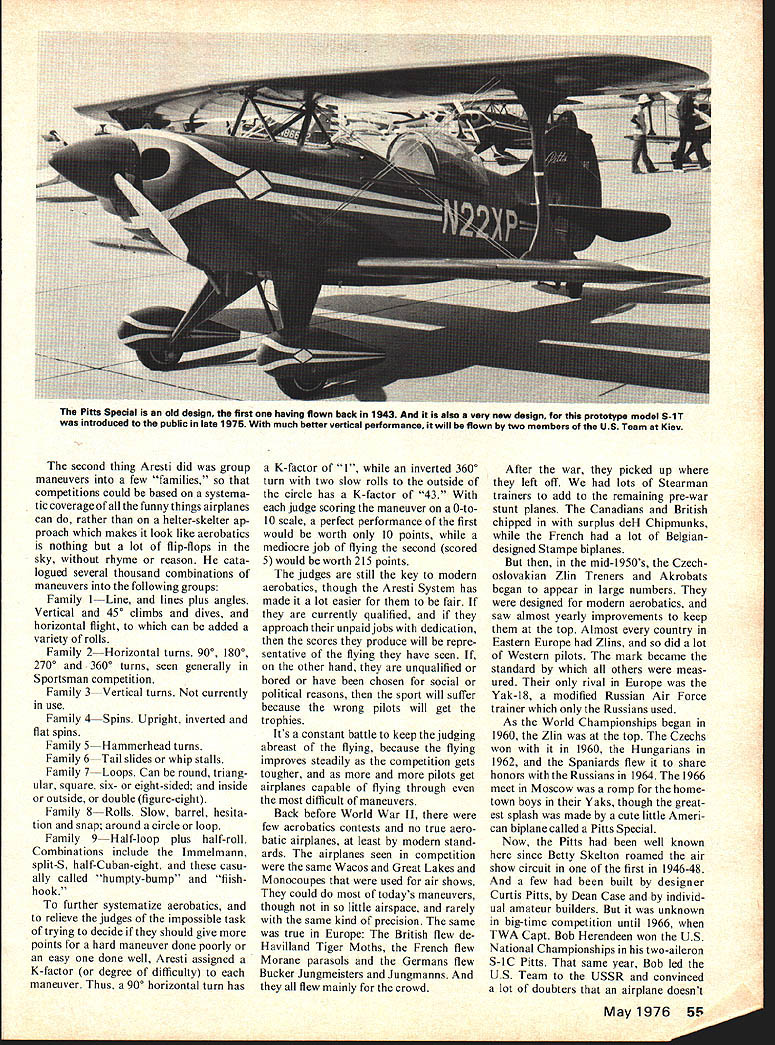
As World Championships began about 1960, the Zlin was at the top. The Czechs won, as they did in 1960, the Hungarians in 1962, and the Spaniards flew it to share honors with the Russians in 1964. The 1966 meet in Moscow was a romp for the home team with their Yaks, though the greatest splash was made by a cute little American biplane called a Pitts Special.
Now, the Pitts had been well known ever since Betty Skelton worked the air show circuit in one of the first in 1946-48. And a few had been built by designer Curtis Pitts, by Dean Case and by individual amateur builders. But it was unknown in big-time competition until 1966, when TWA Capt. Bob Herendeen won the U.S. National Championships in his two-aleron S-1C Pitts. That same year, Bob led the U.S. Team to the USSR and convinced a lot of doubters that an airplane doesn't
Prelude to Kiev
have to be big to be good.
He didn't come close to winning, but Herendeen made the world sit up and take notice of his tiny two-winger. It was not a modified trainer, but a true acrobatic airplane which was rapidly growing in popularity and benefiting from the experience of an increasing collection of pilots flying it for sport and for competition. It would soon become the symbol of American acrobatic supremacy.
As the pressure of competition rose, it brought forth more specialized airplanes. In particular, the need for ever greater vertical performance was foremost in the minds of pilots and designers. And this led directly to the second major version of the Pitts—the Type S-1S—with its power output up to 180 hp, wings having symmetrical airfoils for inverted and outside flight, and ailerons on both upper and lower wings for faster rolling.
This so-called "round-wing" Pitts bowed in during the 1968 World Championships in East Germany, where Herendeen nailed down the best finish of any American to that time (third out of 48) and might have won except for the unfortunate lack of diplomatic relations between the host country and the U.S. which would have placed the East Germans in an embarrassing position.
But the world had gotten notice of the Pitts Special and of pilots who could fly it through maneuvers tighter and quicker than anything else then in action. The nimble little craft was better suited to flying in the "aerobatic box" than any Zlin or Yak, and it would be many years before the others caught on. The "box" is a rectangular glob of air in which all maneuvers must be flown; any excursions outside the boundaries bring penalties.
For Unlimited and International competition, the "box" is 1,000 meters (3,300 ft.) long, 800 meters (2,600 ft.) wide, has a ceiling of 1,000 meters and a floor of 100 meters, giving it a height of 900 meters (2,950 ft.). In U.S. contests, the lower-skill categories have higher floors for safety; Sportsman and Intermediate pilots must stay above 1,500 ft., and Advanced pilots must stay above 1,000 ft.
Once the Pitts began to show its foreign rivals just how a good airplane can fly around the "box," others began to search for ways to do as well or better. For some, the solution was still more modifications to their aging trainers. For others, it was an entirely new airplane. And for still others, it was the simple method of buying or building their own Pitts Specials, even though this was an admission of American superiority.
The first, and still the most interesting new airplane was the Hirth "Acrostar," designed in Switzerland and first built in West Germany in 1970. It is loaded with novel ideas. The wings have fiberglass spars and ribs and are very thick airfoil with a blunt leading edge. The control system (adapted from aeromodel techniques) has interconnected elevator, ailerons and flaps. The relatively small airplane has a potent 220-hp Franklin engine, giving it a power loading as good as any.
In the Eighth World Aerobatics Championships, to be held July 25–August 3 near Kiev, Ukraine, U.S.S.R., Acrostars will be on the Swiss, West German and Spanish teams. Wider acceptance has been held back by the airplane's stability problems and the manufacturer's financial problems. Still, it is a machine to be reckoned with, having been the mount of the 1974 European Champion and the 1975 runner-up.
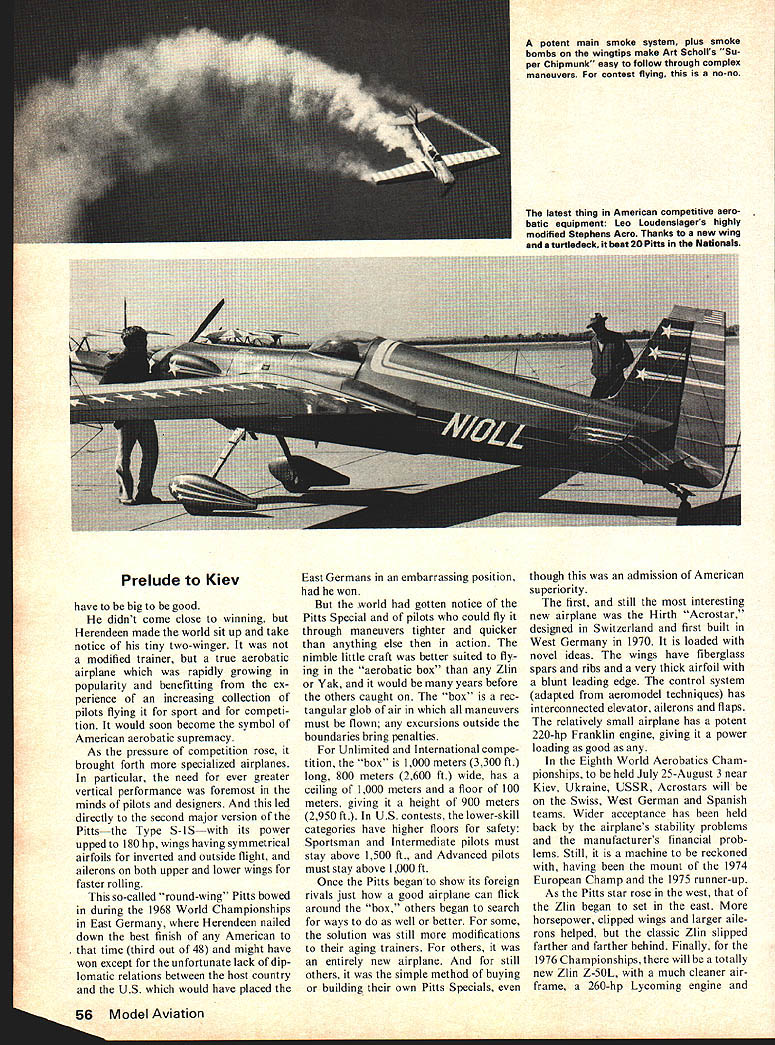
The Pitts star rose in the west, while that of the Zlin began to set in the east. The Zlin's power, clipped wings and larger ailerons helped, but the classic Zlin slipped farther and farther behind. Finally, for the 1976 Championships, there will be a totally new Zlin Z-50L, with a much cleaner airframe, a 260-hp Lycoming engine and
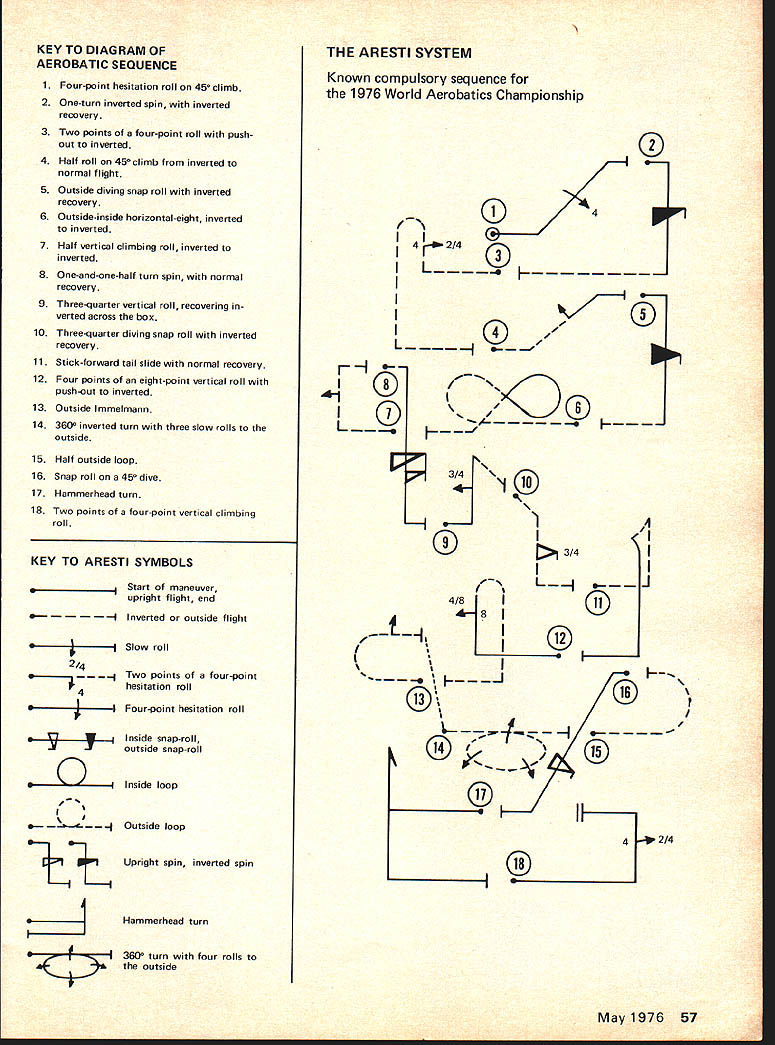
KEY TO DIAGRAM OF AEROBATIC SEQUENCE
- Four-point hesitation roll on 45° climb.
- One-turn inverted spin, with inverted recovery.
- Two points of a four-point roll with push-out to inverted.
- Half roll on 45° climb from inverted to normal flight.
- Outside diving snap roll with inverted recovery.
- Outside-inside horizontal-eight, inverted to inverted.
- Half vertical climbing roll, inverted to inverted.
- One-and-one-half turn spin, with normal recovery.
- Three-quarter vertical roll, recovering inverted across the box.
- Three-quarter diving snap roll with inverted recovery.
- Stick-forward tail slide with normal recovery.
- Four points of an eight-point vertical roll with push-out to inverted.
- Outside Immelmann.
- 360° inverted turn with three slow rolls to the outside.
- Half outside loop.
- Snap roll on a 45° dive.
- Hammerhead turn.
- Two points of a four-point vertical climbing roll.
KEY TO ARESTI SYMBOLS
- Start of maneuver, upright flight, end
- Inverted or outside flight
- Slow roll
- Two points of a four-point hesitation roll
- Four-point hesitation roll
- Inside snap-roll, outside snap-roll
- Inside loop
- Outside loop
- Upright spin, inverted spin
- Hammerhead turn
- 360° turn with four rolls to the outside
THE ARESTI SYSTEM
Known compulsory sequence for the 1976 World Aerobatics Championship
Prelude to Kiev
simpler fixed spring-steel landing gear. Yet, while it has a power-to-weight ratio comparable to the Pitts and Aerostar, it still has 28-ft. wings which will be a handicap when trying to stay within the confines of the "box."
The French have been trying for several years to develop a first-rate airplane of their own, but haven't done very well. They organized the last World Championships, in 1972, and hoped to win with their new CAP-20, a sophisticated development of the Piel "Emeraud" homebuilt. The airplane had too little power and too much bulk to go flitting around the "box" with the Pitts and others. Still, the two-place CAP.10 trainer version became a success and so the French have proceeded to refine the design. The latest CAP.201 has more power, less weight and shorter wings, and so could be a contender.
The big mystery, as you might guess, is the Russians. They pushed their big Yak-18's around the "box" for years, with amazing success. But there is just so much that can be done to keep an old airplane competitive, and now the word is out that it will be replaced by the totally new Yak-50, about which almost nothing is known. In line with centuries-old Russian practice, this purely sporting machine is being kept as secret as the latest high-altitude spy plane.
In the face of all this frantic development, it would be very foolish for American designers to rest on their laurels, even though the standard Pitts S-1S is probably better than any of the under-developed ones. Rather than take a chance on being surprised, however, Curtis Pitts has come up with a new version of his popular biplane, the Type S-1T. First seen at the 1975 U.S. Nationals, it is expected to be flown by at least two members of the U.S. Team in '76. With a foot greater length, another 20 hp and a constant-speed propeller, and lots of small aerodynamic changes, it appears to offer some real improvement. In particular, it has an amazing ability to execute a complex vertical maneuver and then fly off the top under full control.
Along with five Pitts on the U.S. Team (two S-1S, one light-weight S-1S and two S-1T) will be the Stephens Acro monoplanes of current U.S. Champion Leo Loudenslager (LOUD-en-Slager). This graceful airplane combines the power-to-weight ratio of a Pitts with the pleasant-to-judge slim lines of the European machines. It isn't known yet if this Stephens is better than the Pitts, or if Loudenslager is better than the Pitts pilots, but he did beat 20 of them at one time, and that must mean something.
The proof of the pudding will come in the 10-day meet in the USSR. Fifteen teams of 3-5 men and a lesser number of women will fly three sequences of maneuvers, and the leaders will fly a fourth. The sequences for everyone will be: (1) Known-Compulsory, which was announced in November, 1975; (2) Free, which each pilot designs for himself in accordance with rules governing variety and overall difficulty, and (3) Unknown-Compulsory, which will be revealed 24 hours before it is to be flown and which cannot be practiced in advance. At the end of these flights, the top three scorers on each team will be combined to determine team scores and the Team Champion.
The top one-third of the men and the top one-half of the women will then fly the Four-Minute Free-Style Sequence, in which the Aresti Catalog is thrown out and such uncontrolled maneuvers as the "tomecvak" may be flown in a wide-open demonstration of each pilot's imagination and creativity. At the end of this, the Men's and Women's Individual World Champions will be determined.
In 1972, the Championship Team was the American, the Men's World Champion was Charlie Hillard, of Ft. Worth, Tex., and the Women's World Champion was Mary Gaffaney, of Miami, Fla. It will take 200 flights under the most severe mental and physical pressure, in the heart of the Soviet Union, to determine if the Yanks can repeat.
Aerobatic Team
If the U.S. Aerobatic Team is to stand any chance of winning the 1976 World Championships, it must first get there. To get six pilots, 10 support persons and six airplanes from the USA to a small airfield outside Kiev will take close to $100,000, in addition to priceless hard work.
The hard work can be counted on, but the money which is or will be sought is an emotional victory is quite another matter. The U.S. Team will be short of the European Teams get heavy government support. The U.S. Team is entirely on its own.
We have pilots as talented and experienced as any in the world. We have pilots who are proven winners. And we have a training and selection system which has brought us to the top. It would be a shame if all this stayed on the west side of the Atlantic while others are flying for the championships.
If you want to do your part in this exciting effort, send your contributions to: Aerobatic Club of America, P.O. Box 401, Roanoke, Texas 76262.
Transcribed from original scans by AI. Minor OCR errors may remain.

