
Product Review
Tom Sullivan tmsullivan@fuse.net
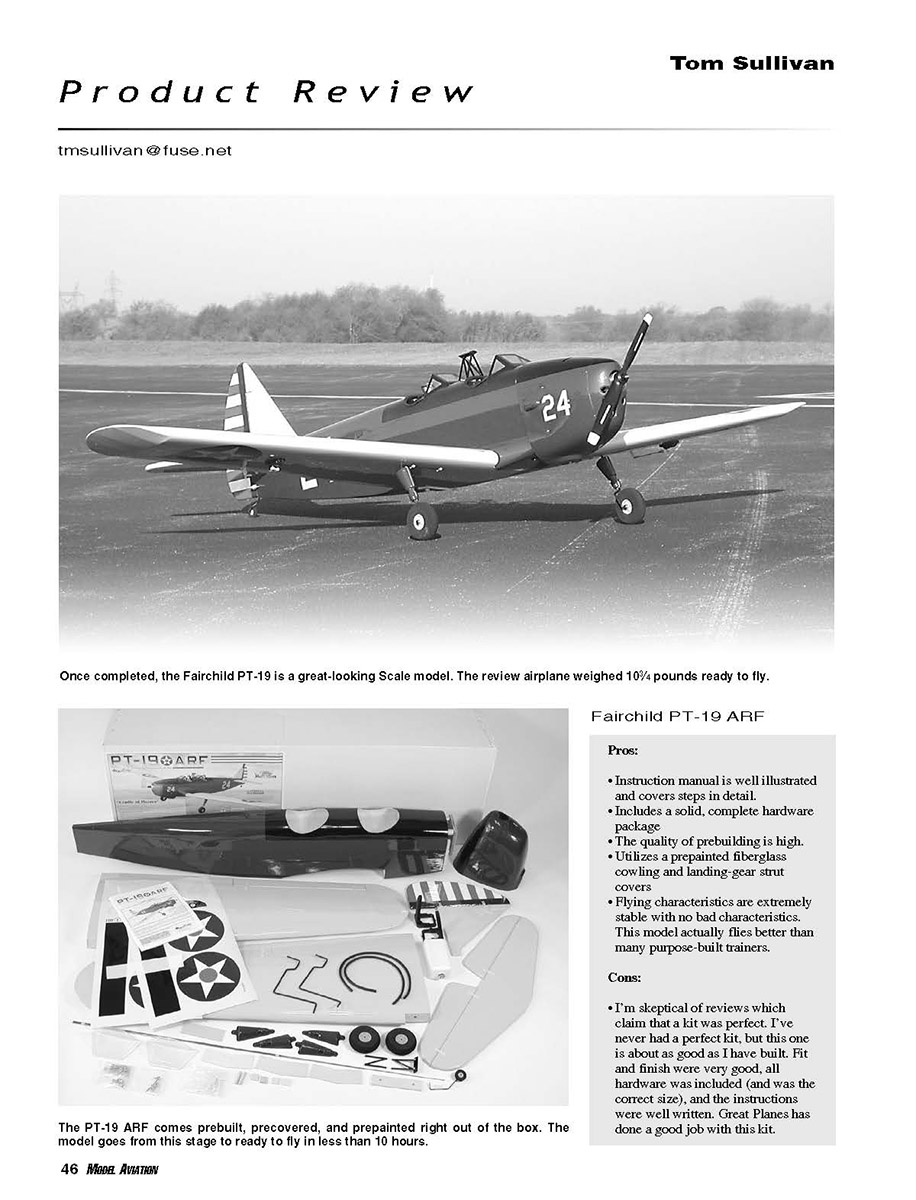
The Fairchild PT-19 was one of a handful of primary trainer designs that were the first stop on the way to becoming a combat pilot. It was designed to be inexpensive, simple to maintain, and, most of all, easy to fly. The aircraft was forgiving, featured interchangeable parts, and was built from largely nonstrategic materials (wood and fabric).
First Impressions
When I opened the box, several things instantly caught my eye. The first was the high quality of the finish. All parts are finished and painted in dark blue and yellow.
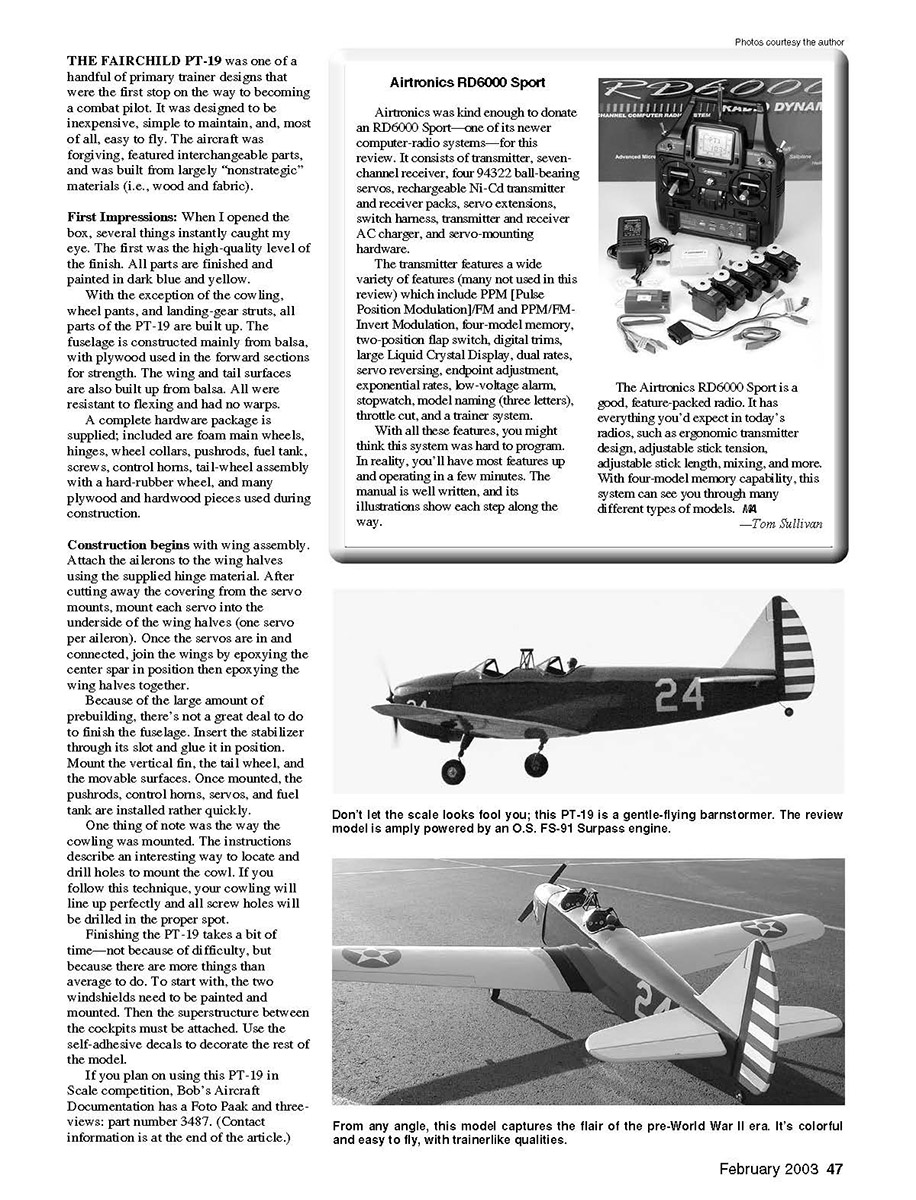
With the exception of the cowling, wheel pants, and landing-gear struts, all parts of the PT-19 are built up. The fuselage is constructed mainly from balsa, with plywood used in the forward sections for strength. The wing and tail surfaces are also built up from balsa. All were resistant to flexing and had no warps.
A complete hardware package is supplied; included are:
- foam main wheels
- hinges
- wheel collars
- pushrods
- fuel tank
- screws
- control horns
- tail-wheel assembly with a hard-rubber wheel
- various plywood and hardwood pieces used during construction
Construction
Construction begins with wing assembly. Attach the ailerons to the wing halves using the supplied hinge material. After cutting away the covering from the servo mounts, mount each servo into the underside of the wing halves (one servo per aileron). Once the servos are in and connected, join the wings by epoxying the center spar in position and then epoxying the wing halves together.
Because of the large amount of prebuilding, there’s not a great deal to do to finish the fuselage. Insert the stabilizer through its slot and glue it in position. Mount the vertical fin, the tail wheel, and the movable surfaces. Once mounted, the pushrods, control horns, servos, and fuel tank are installed rather quickly.
One thing of note was the way the cowling is mounted. The instructions describe a simple technique to locate and drill holes to mount the cowl. If you follow this technique, your cowling will line up perfectly and all screw holes will be in the proper spot.
Finishing
Finishing the PT-19 takes a bit of time — not because of difficulty, but because there are more items than average to complete. To start with, the two windshields need to be painted and mounted. Then the superstructure between the cockpits must be attached. Use the self-adhesive decals to decorate the rest of the model.
If you plan on using this PT-19 in scale competition, Bob’s Aircraft Documentation has a Foto Paak and three-views: part number 3487. (Contact information is at the end of the article.)
Flying
After setting the throws to those recommended in the manual and checking the center of gravity, the model balanced right on the money and we were ready to go fly.
After fueling and a preflight check to make sure all servos were operating in the correct directions, I fired up the O.S. FS-91 Surpass engine and it quickly came to life. After a brief recheck, I taxied the model out slowly. Taxiing the PT-19 is a breeze; it's a big model with a wide, strong landing gear, and there is plenty of ground clearance, making grass maneuvering a snap.
For the first takeoff I lined the model up into the wind and throttled up. The PT-19 was airborne in approximately 20 feet at only half throttle. The model climbed with authority, and I made a few left-handed patterns to dial in the trims. It needed a bit of down-trim and a few clicks of right aileron.
It flew predictably and extremely stably — smooth and trainer-like. Axial rolls, barrel rolls, and point rolls are smooth and barnstormer-like. Loops, Immelmanns, figure eights, etc., are done easily. Single snaps take a bit of time, but holding the snap for more than one rotation increases rotation speed and tightens the snap. Spins took roughly three-quarters of a rotation to pull out of once the controls were released.
Keep in mind this is not a pattern model; it is a reproduction of a design developed before World War II. Slow-speed flight is surprisingly predictable. The model maintains good control even when slowing to stall speed. Stalls are slow and gentle, with a slight nose drop to the right.
First landings were slow, smooth, and predictable. Anyone should be able to grease this model in for perfect, no-bounce main-gear landings.
It's been a few months, and the PT-19 still hasn't shown any bad habits. I was skeptical about using the O.S. 91 in a model this size, but I found myself flying around at half throttle, using three-quarters throttle only when barnstorming.
The PT-19 is a quick-building, good-looking, solid-flying design. It can be seriously considered as a trainer. It is relaxing to fly, and its large, high-visibility color scheme makes it easy to see in even hazy conditions.
Fairchild PT-19 ARF — Pros and Cons
Pros:
- Instruction manual is well illustrated and covers steps in detail.
- Includes a solid, complete hardware package.
- The quality of prebuilding is high.
- Utilizes a prepainted fiberglass cowling and landing-gear strut covers.
- Flying characteristics are extremely stable with no bad tendencies. This model actually flies better than many purpose-built trainers.
Cons:
- I’m skeptical of reviews that claim a kit is perfect. I’ve never had a perfect kit, but this one is about as good as I have built. Fit and finish were very good, all hardware was included (and was the correct size), and the instructions were well written. Great Planes has done a good job with this kit.
Contact information
Great Planes Model Distributors Box 9021 Champaign, IL 61826-9021 www.greatplanes.com/airplanes/gpma1301.html
Specifications
- Stock number: GPMA1301
- Wingspan: 82½ inches
- Wing area: 1,027 square inches
- Weight: 10¾ pounds (ready to fly)
- Length: 64¼ inches
- Engine required: .61–.91 two-stroke (10–15 cc) or .91–1.20 four-stroke (15–20 cc)
- Radio required: Four-channel with five standard servos
Products used / referred to in this review
- RD6000 Sport radio system: Airtronics
1185 Stanford Ct. Anaheim, CA 92805 (714) 978-1540 Fax: (714) 978-1540 www.airtronics.net
- O.S. FS-91 Surpass engine: Great Planes Model Distributors
Box 9021 Champaign, IL 61826 www.osengines.com/
- Master Airscrew 14 x 8 propeller: Windsor Propeller
Box 250 Rancho Cordova, CA 95741 www.masterairscrew.com
- 1/6 standard pilot: Williams Bros.
1119 Los Olivos Ave., Unit #3 Los Osos, CA 93402 (805) 534-1307 Fax: (805) 534-1366 www.williamsbrosinc.com
- Bob’s Aircraft Documentation:
3114 Yukon Ave. Costa Mesa, CA 92626 (714) 979-8058 Fax: (714) 979-7279 www.bobsairdoc.com
Transcribed from original scans by AI. Minor OCR errors may remain.

