
Product Review
David Adams E-mail: flyingadams@yahoo.com
MOST OF YOU have probably built kits, paying little attention to the instructions—especially with ARFs. You might refer to them in a critical area, but most kits these days are self-explanatory. Now imagine putting together one of the more aerobatic models with no instructions whatsoever. That's what you have with the Diablotin Mini from Esprit Model.
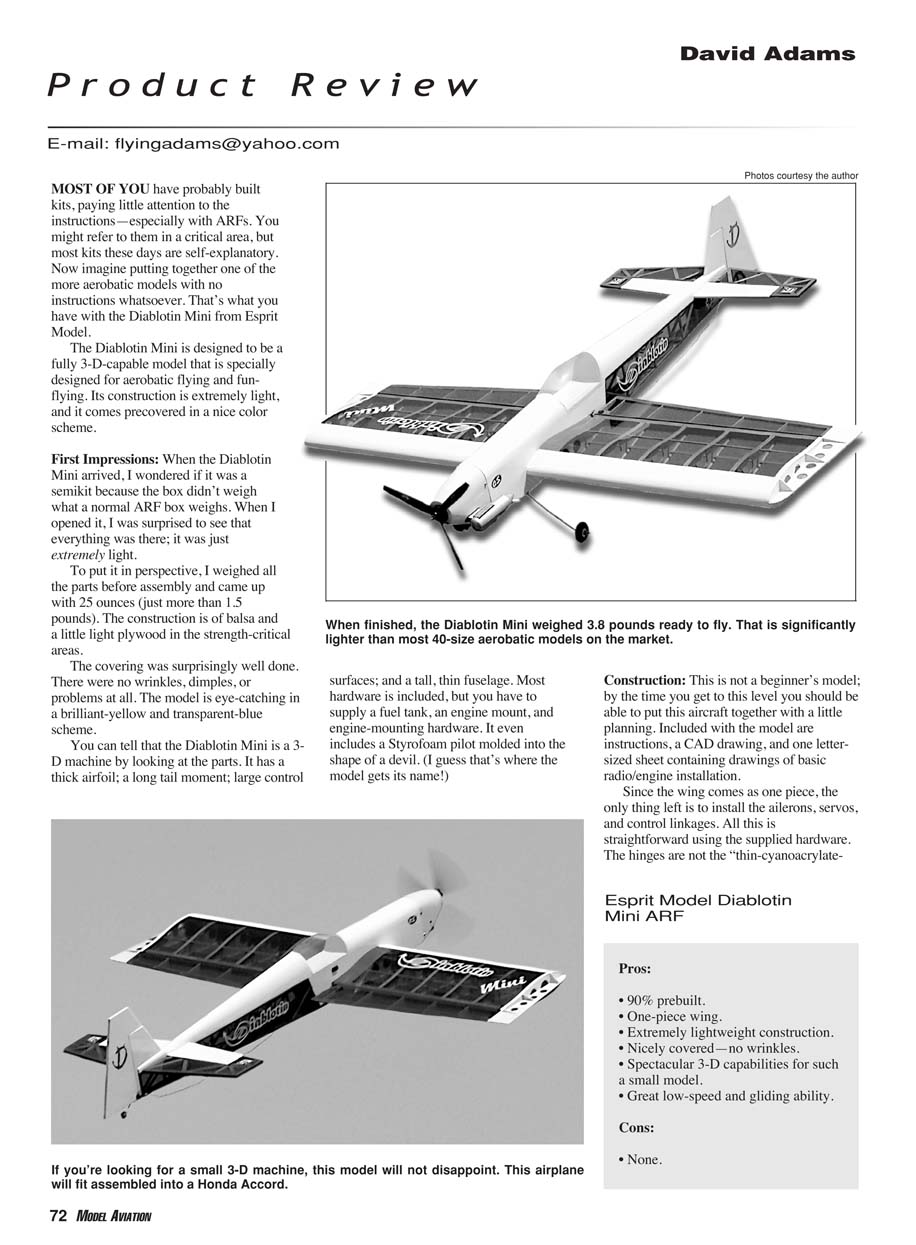
The Diablotin Mini is designed to be a fully 3-D-capable model specially designed for aerobatic flying and fun-flying. Its construction is extremely light, and it comes precovered in a nice color scheme.
First Impressions
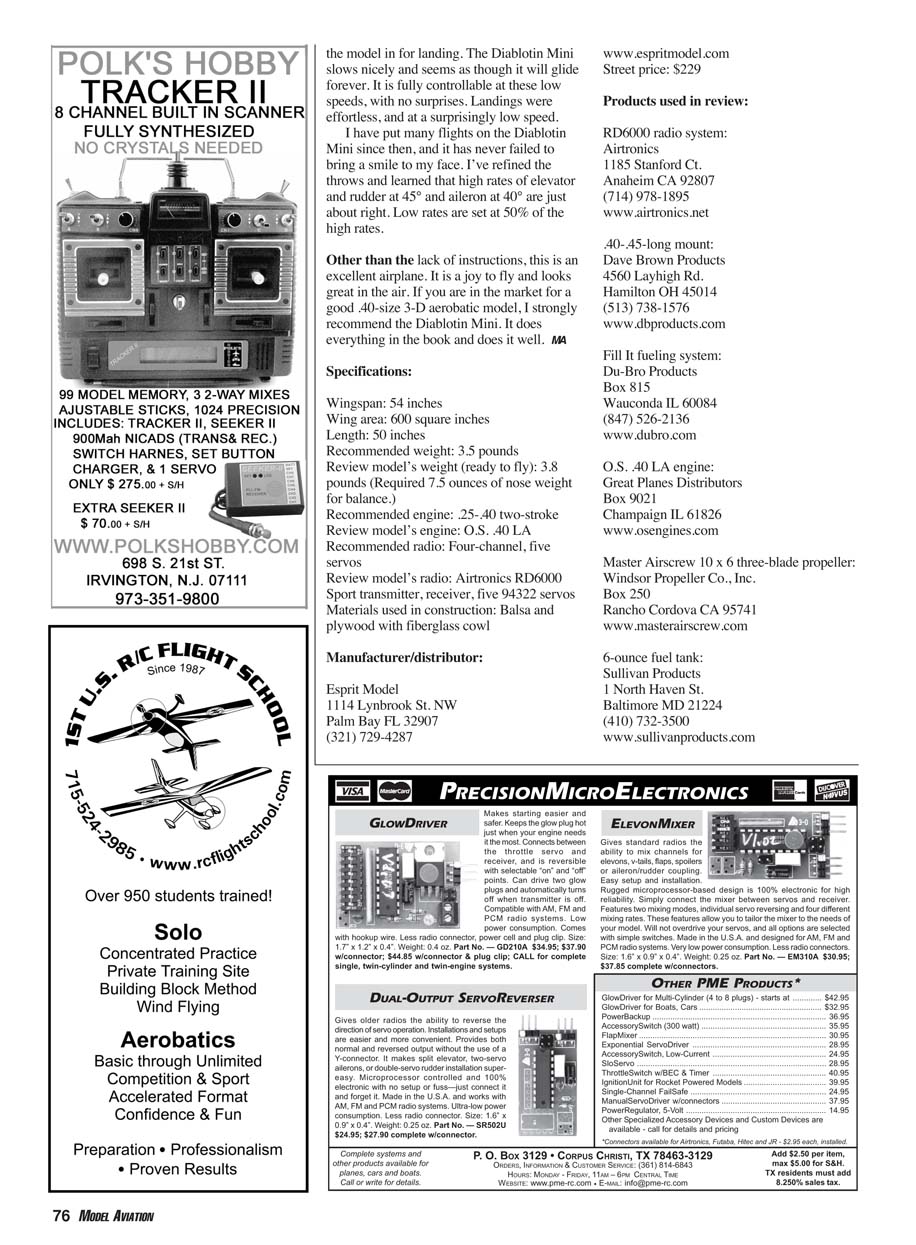
When the Diablotin Mini arrived, I wondered if it was a semikit because the box didn't weigh what a normal ARF box weighs. When I opened it, I was surprised to see that everything was there; it was just extremely light.
To put it in perspective, I weighed all the parts before assembly and came up with 25 ounces (just more than 1.5 pounds). The construction is of balsa and a little light plywood in the strength-critical areas.
The covering was surprisingly well done. There were no wrinkles, dimples, or problems at all. The model is eye-catching in a brilliant yellow and transparent blue scheme.
You can tell that the Diablotin Mini is a 3-D machine by looking at the parts. It has a thick airfoil; a long tail moment; large control surfaces; and a tall, thin fuselage. Most hardware is included, but you must supply a fuel tank, an engine mount, and engine-mounting hardware. It even includes a Styrofoam pilot molded into the shape of a devil (I guess that's where the model gets its name).
Construction
This is not a beginner's model; by the time you get to this level you should be able to put this aircraft together with a little planning. Included with the model are instructions, a CAD drawing, and one letter-sized sheet containing drawings of basic radio/engine installation.
Since the wing comes as one piece, the only things left are to install the ailerons, servos, and control linkages. All this is straightforward using the supplied hardware. The hinges are not the thin-cyanoacrylate-glue type that are common these days; you should pin or epoxy them in. The hinge slots are precut, and everything lined up well.
The cutouts for the servos are small, intended for lightweight servos. I didn't have that type available, so I ended up enlarging the holes by roughly 1/8 inch to accommodate Airtronics standard servos. As mentioned, the fuselage is a long, thin design. Because of this, the servos for the elevator and rudder are mounted under the stabilizer. You'll need a couple of 24-inch servo lead extensions to reach up to the receiver compartment. One nice thing is that the lower part of the fuselage is covered in the transparent blue, so you'll be able to guide the leads through the fuselage construction quite easily.
I epoxied the stabilizer and vertical fin into place (I know that's backward from what's normal, but it was easier for my large hands to operate that way). I attached the elevators, rudder, and landing gear. The main gear consists of two prebent rods that are held in place with straps.
The Diablotin Mini calls for a .25- to .40-size two-stroke engine (or electric power). I used an O.S. .40 LA engine and mounted it to the firewall using a Dave Brown Products .40-.45 long mount. It lined up quite well with the fiberglass cowl and required just a few cutouts for the muffler, carburetor, and needle-valve access. I used a Du-Bro Fill-It fueling system to hook up the Sullivan Products 6-ounce tank to the engine.
I completed the radio installation by installing the receiver, battery, and switch harness. I moved the receiver battery as far forward as possible for balance — under the fuel tank. The only other thing needed was a Y harness for the two aileron servos.
To complete the Diablotin Mini, I trimmed the vacuum-formed canopy and glued it into position. Then I cleaned the entire airplane and attached the pressure-sensitive decals.
After everything was complete, I attached the wing and checked the balance. Showing quite tail-heavy, the model took 7.5 ounces of nose weight to balance properly. Even after all the added weight, it was only slightly heavier than recommended. (With miniservos [Hitec HS-85BB] in the tail, no additional nose weight is required.)
Esprit Model Diablotin Mini ARF
Pros:
- 90% prebuilt.
- One-piece wing.
- Extremely lightweight construction.
- Nicely covered—no wrinkles.
- Spectacular 3-D capabilities for such a small model.
- Great low-speed and gliding ability.
Cons:
- None.
Flying
With everything ready to go and a good night's charge behind me, it was off to the field for some fun!
I used a three-blade propeller for two reasons: the first was ground clearance with the short landing gear, and the second was that I am a fan and use them when I can.
I performed a quick range check, fueled up the model, and started the engine. After a few needle adjustments, it was time to taxi. The Diablotin Mini taxis quite well on pavement, but it will not taxi on anything taller than a well-manicured golf green. Its short gear and small wheels are designed for flat surfaces.
Turning into the wind, I throttled up and away it went. Takeoff was short (approximately 40 feet) and climbout was effortless. I needed a bit of left aileron and a couple clicks of down trim for hands-off flight.
I performed a few patterns so I could get used to the model and grab a few photos. There were no surprises. After the photos, I kicked in the high rates and it was time to see what the Diablotin could do.
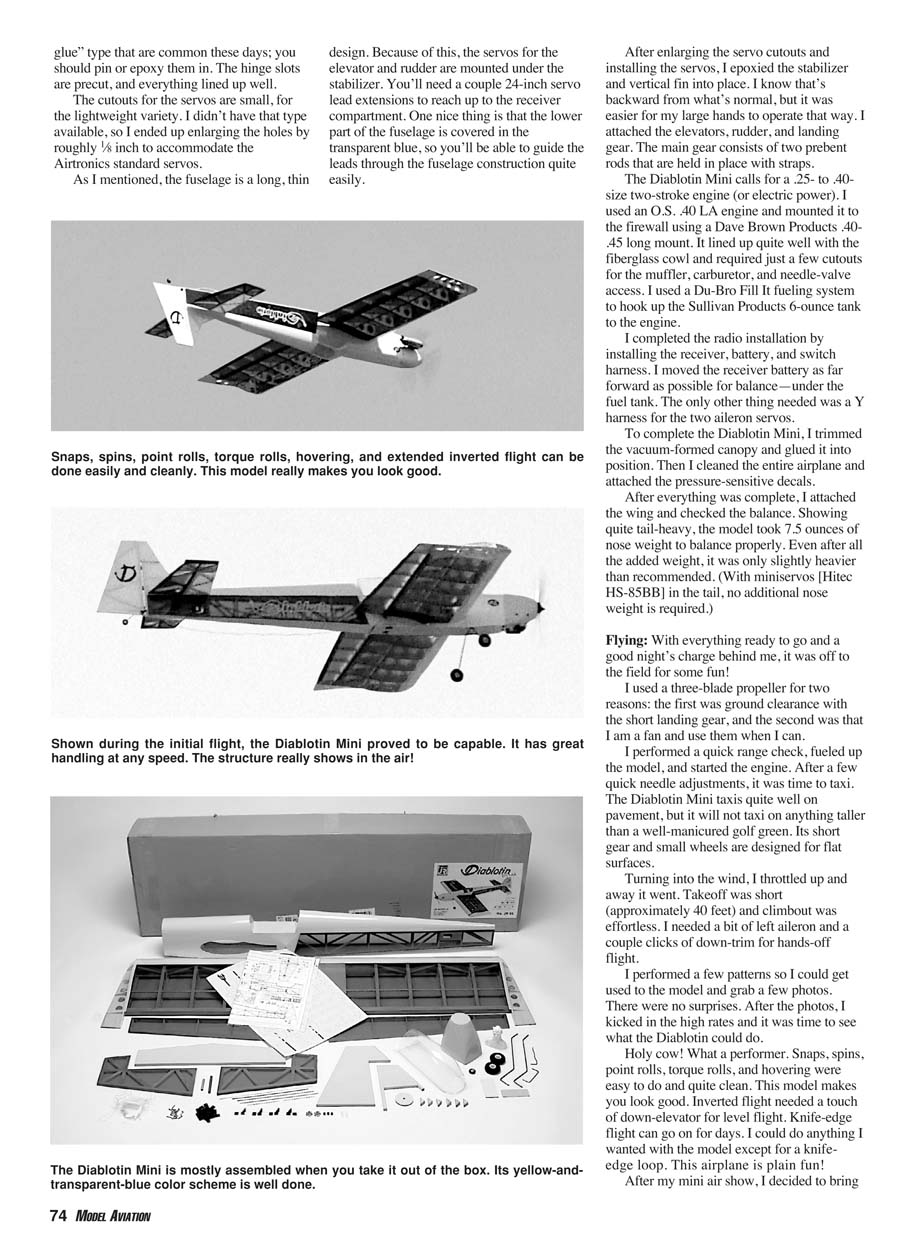
Holy cow! What a performer. Snaps, spins, point rolls, torque rolls, and hovering were easy to do and quite clean. This model makes you look good. Inverted flight needed a touch of down elevator for level flight. Knife-edge flight can go on for days. I could do anything I wanted with the model except for a knife-edge loop. This airplane is plain fun!
After my mini air show, I brought the model in for landing. The Diablotin Mini slows nicely and seems as though it will glide forever. It is fully controllable at these low speeds, with no surprises. Landings were effortless and at a surprisingly low speed.
I have put many flights on the Diablotin Mini since then, and it has never failed to bring a smile to my face. I’ve refined the throws and learned that high rates of elevator and rudder at 45° and aileron at 40° are just about right. Low rates are set at 50% of the high rates.
Other than the lack of detailed instructions, this is an excellent airplane. It is a joy to fly and looks great in the air. If you are in the market for a good .40-size 3-D aerobatic model, I strongly recommend the Diablotin Mini. It does everything in the book and does it well. MA
Specifications:
- Wingspan: 54 inches
- Wing area: 600 square inches
- Length: 50 inches
- Recommended weight: 3.5 pounds
- Review model’s weight (ready to fly): 3.8 pounds (required 7.5 ounces of nose weight for balance)
- Recommended engine: .25-.40 two-stroke
- Review model’s engine: O.S. .40 LA
- Recommended radio: Four-channel, five servos
- Review model’s radio: Airtronics RD6000 Sport transmitter, receiver, five 94322 servos
- Materials used in construction: Balsa and plywood with fiberglass cowl
Manufacturer/distributor:
Esprit Model 1114 Lynbrook St. NW Palm Bay, FL 32907 (321) 729-4287 www.espritmodel.com
Street price: $229
Products used in review:
- RD6000 radio system: Airtronics, 1185 Stanford Ct., Anaheim, CA 92807; (714) 978-1895; www.airtronics.net
- .40-.45 long mount: Dave Brown Products, 4560 Layhigh Rd., Hamilton, OH 45014; (513) 738-1576; www.dbproducts.com
- Fill It fueling system: Du-Bro Products, Box 815, Wauconda, IL 60084; (847) 526-2136; www.dubro.com
- O.S. .40 LA engine: Great Planes Distributors, Box 9021, Champaign, IL 61826; www.osengines.com
- Master Airscrew 10x6 three-blade propeller: Windsor Propeller Co., Inc., Box 250, Rancho Cordova, CA 95741; www.masterairscrew.com
- 6-ounce fuel tank: Sullivan Products, 1 North Haven St., Baltimore, MD 21224; (410) 732-3500; www.sullivanproducts.com
Transcribed from original scans by AI. Minor OCR errors may remain.

