
Product Review
tmsullivan@mac.com Tom Sullivan
HobbyZone Firebird XL
Pros:
- Comes 99.9% prebuilt
- Two-channel radio, motor, propeller, battery, and charger included
- Assembles in less than 10 minutes using no tools
- Goes from the box to flying in three hours
- Stable flight performance
Cons:
- Included charger would benefit from an LED to indicate charging
- Transmitter batteries are not included (requires eight AA cells)
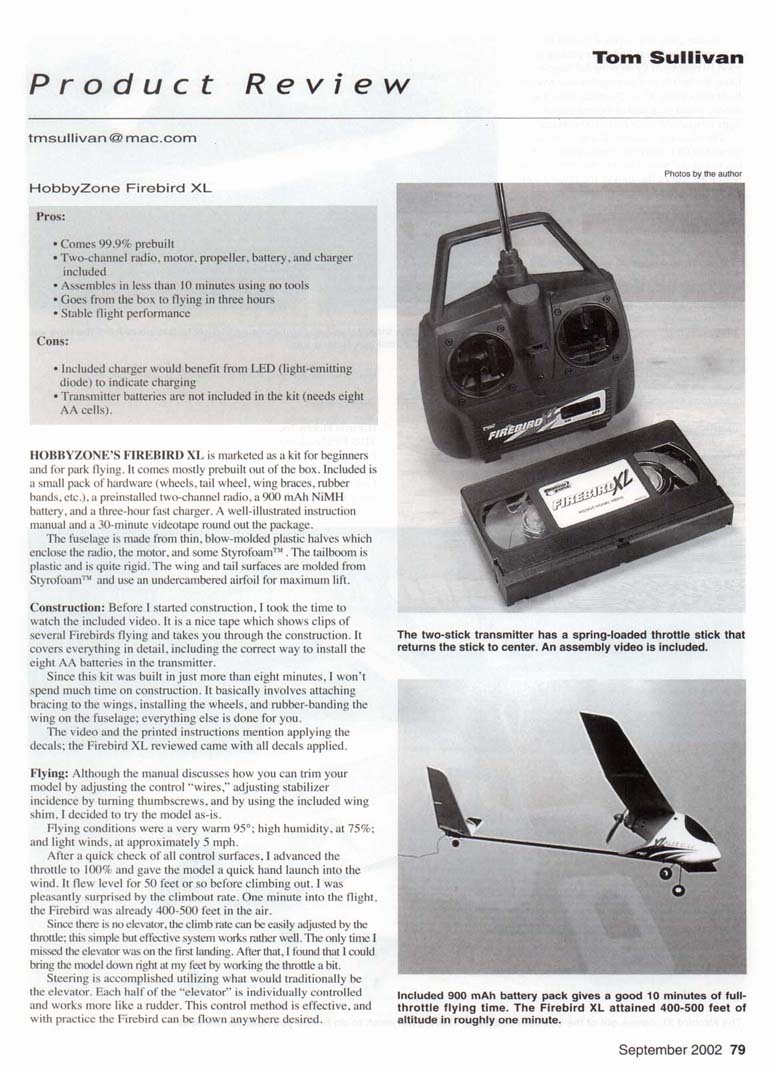
HobbyZone's Firebird XL is marketed as a kit for beginners and for park flying. It comes mostly prebuilt out of the box. Included is a small pack of hardware (wheels, tail wheel, wing braces, rubber bands, etc.), a preinstalled two-channel radio, a 900 mAh NiMH battery, and a three-hour fast charger. A well-illustrated instruction manual and a 30-minute videotape round out the package.
The fuselage is made from thin, blow-molded plastic halves which enclose the radio, the motor, and some Styrofoam. The tailboom is plastic and is quite rigid. The wing and tail surfaces are molded from Styrofoam and use an undercambered airfoil for maximum lift.
Construction
Before I started construction, I took the time to watch the included video. It is a nice tape that shows clips of several Firebirds flying and takes you through the construction. It covers everything in detail, including the correct way to install the eight AA batteries in the transmitter.
Since this kit was built in just more than eight minutes, I won't spend much time on construction. It basically involves attaching bracing to the wings, installing the wheels, and rubber-banding the wing on the fuselage; everything else is done for you.
The video and the printed instructions mention applying the decals; the Firebird XL reviewed came with all decals already applied.
Flying
Although the manual discusses how you can trim your model by adjusting the control "wires," adjusting stabilizer incidence by turning thumbscrews, and by using the included wing shim, I decided to try the model as-is.
Flying conditions were warm (95°F), with high humidity (75%) and light winds (approximately 5 mph).
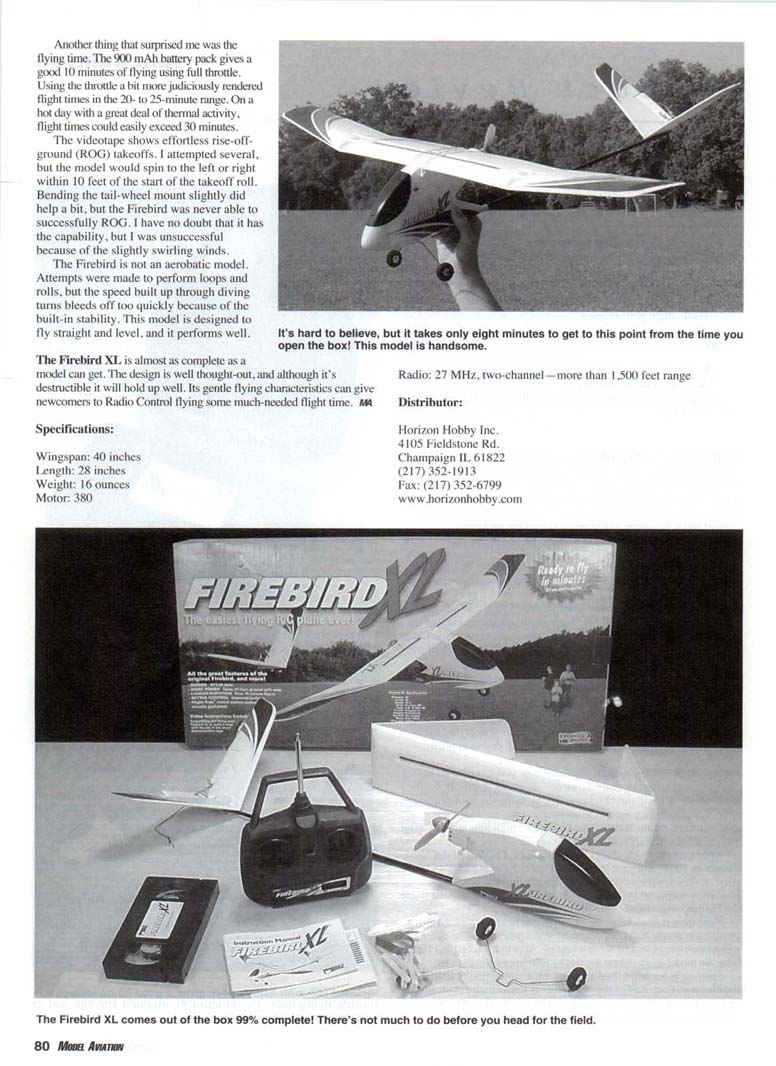
After a quick check of all control surfaces, I advanced the throttle to 100% and gave the model a quick hand launch into the wind. It flew level for 50 feet or so before climbing out. I was pleasantly surprised by the climbout rate. One minute into the flight, the Firebird was already 400–500 feet in the air. Since there is no elevator, the climb rate can be easily adjusted by the throttle; this simple but effective system works rather well. The only time I missed the elevator was on the first landing. After that, I found that I could bring the model down right at my feet by working the throttle a bit.
Steering is accomplished using what would traditionally be the elevator. Each half of the "elevator" is individually controlled and works more like a rudder. This control method is effective, and with practice the Firebird can be flown anywhere desired.
The Firebird is not an aerobatic model. Attempts were made to perform loops and rolls, but the speed built up through diving turns bleeds off too quickly because of the built-in stability. This model is designed to fly straight and level, and it performs well.
The Firebird XL is almost as complete as a model can get. The design is well thought-out, and although it's somewhat destructible it will hold up well. Its gentle flying characteristics can give newcomers to radio control flying some much-needed flight time.
Specifications
- Wingspan: 40 inches
- Length: 28 inches
- Weight: 16 ounces
- Motor: .380
- Radio: 27 MHz, two-channel — more than 1,500 feet range
Distributor
Horizon Hobby Inc. 4105 Fieldstone Rd. Champaign, IL 61822 (217) 352-1913 Fax: (217) 352-6799 www.horizonhobby.com
Transcribed from original scans by AI. Minor OCR errors may remain.

