

Hangar 9 Twist 3D 40 ARF
Tom Sullivan E-mail: tmsullivan@fuse.net
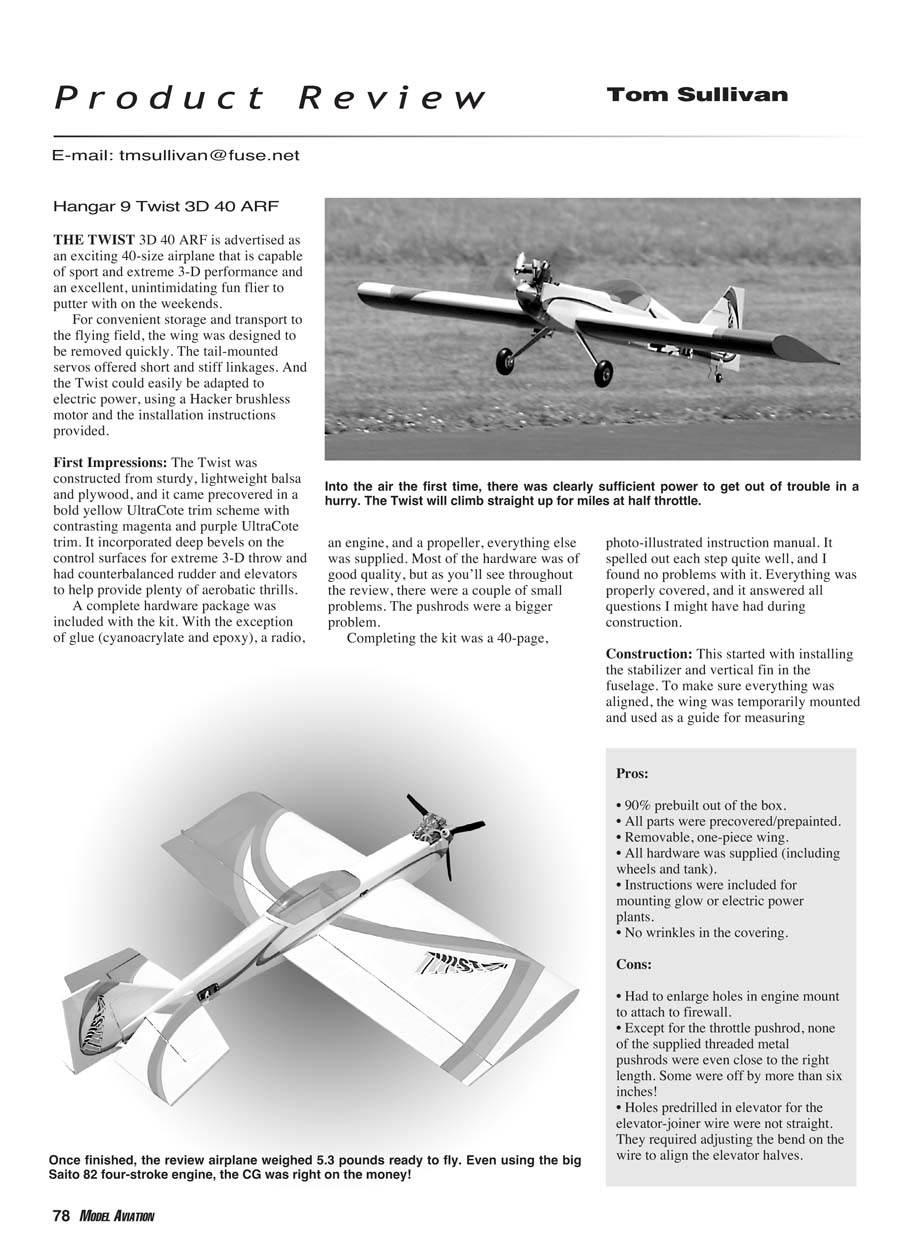
The Twist 3D 40 ARF is advertised as an exciting 40-size airplane capable of sport and extreme 3-D performance, as well as an unintimidating fun flier for weekend flying. For convenient storage and transport, the wing is removable. The design uses tail-mounted servos for short, stiff linkages and can be adapted to electric power using a Hacker brushless motor and the provided instructions.
First Impressions
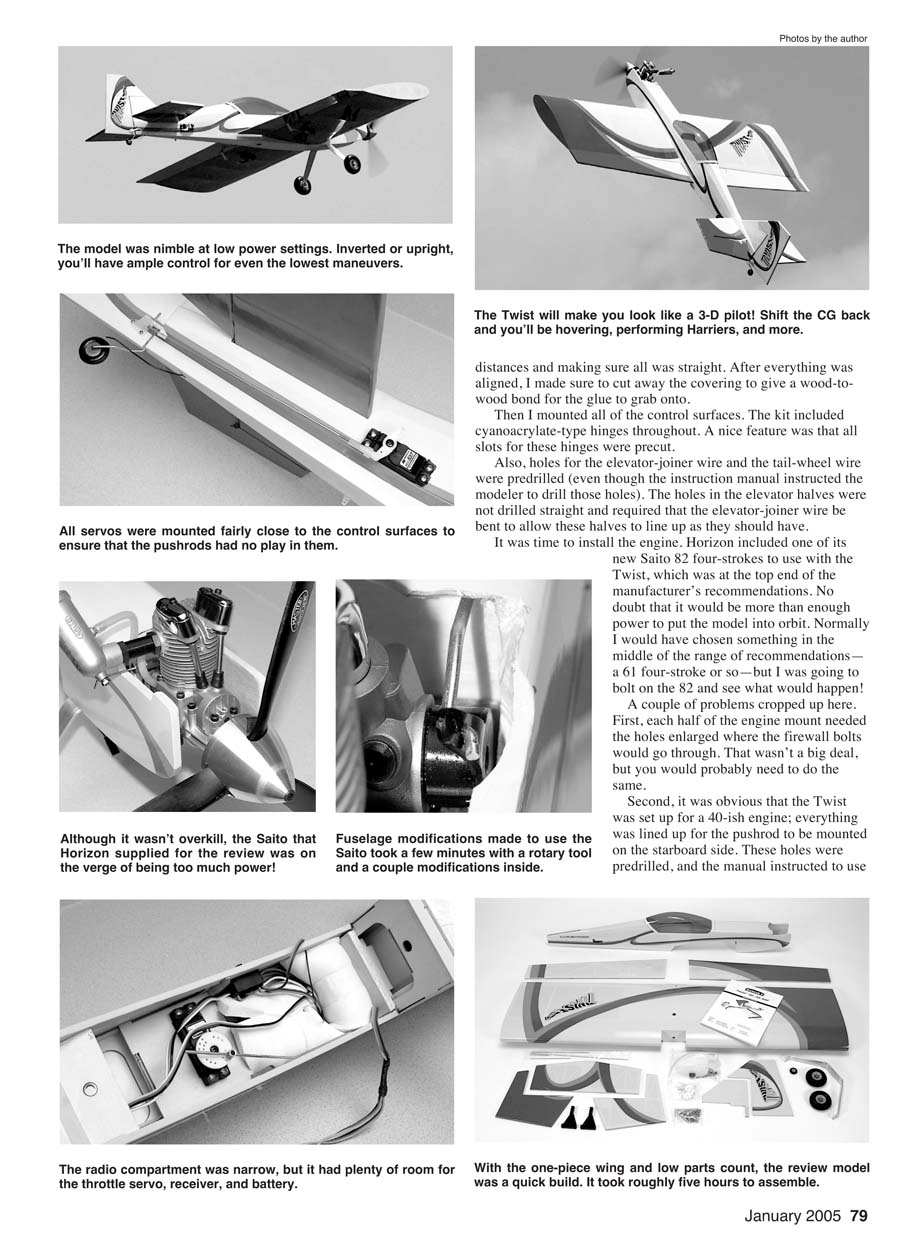
The Twist is constructed from sturdy, lightweight balsa and plywood and arrives precovered in a bold yellow UltraCote scheme with magenta and purple trim. It incorporates deep bevels on the control surfaces for extreme 3-D throws and has counterbalanced rudder and elevators for aerobatic performance.
A complete hardware package is included; aside from glue (cyanoacrylate and epoxy), a radio, an engine, and a propeller, everything else is supplied. Most hardware is good quality, but there are a couple of small problems—most notably the pushrods.
A 40-page, photo-illustrated instruction manual is provided. It clearly spells out each step, covers the build thoroughly, and answered all questions I had during construction.
Construction
I began by installing the stabilizer and vertical fin in the fuselage. To ensure alignment I temporarily mounted the wing and used it as a guide for measurements. I cut away covering at the joints to ensure wood-to-wood glue bonds, then mounted the control surfaces.
The kit uses cyanoacrylate-type hinges throughout and all hinge slots were precut. Holes for the elevator-joiner wire and the tail-wheel wire were predrilled (even though the manual instructed the modeler to drill them). The predrilled holes in the elevator halves were not straight and required bending the elevator-joiner wire slightly to allow the halves to line up correctly.
Engine installation: Horizon included a Saito 82 four-stroke for the review. This is at the top end of the recommended range and provides ample power. Two issues arose: the engine-mount halves needed their firewall-bolt holes enlarged, and when installing the larger Saito 82 the throttle pushrod location had to be moved to the port side. Minor trimming of the engine mounts and a bit of fuselage sheeting removal were required to allow the carburetor arm to operate freely.
I assembled the supplied fuel tank; all necessary hardware and fuel lines to reach the carburetor and muffler were included. Foam was needed to take up space between the tank and fuselage walls.
Radio installation required five standard servos; I used JR 537s which fit the precut holes. The elevator and rudder servos are mounted far aft in the fuselage, providing short, slop-free pushrods, but I needed a couple of 12-inch servo-lead extensions. Two aileron servos are mounted on the underside of the wing; I fished the wires through the wing using a weight-on-a-string.
Control linkages and pushrod hardware were installed and all control horns were mounted using the typical three-screw layout (I drilled these holes myself). The biggest problem became apparent here: except for the throttle pushrod, none of the supplied threaded metal pushrods were the correct length. The aileron pushrods were short by more than 2 inches, and the elevator and rudder pushrods were short by more than 6 inches. I substituted Du-Bro threaded rods to solve the issue.
A nice feature: the fuselage includes a preinstalled nylon tube to route the radio antenna through the model and keep it protected.
Pros
- About 90% prebuilt out of the box.
- All parts precovered and prepainted.
- Removable, one-piece wing.
- All hardware supplied (including wheels and fuel tank).
- Instructions included for mounting glow or electric power plants.
- No wrinkles in the covering.
Cons
- Engine-mount holes needed enlarging to attach to the firewall.
- Except for the throttle pushrod, supplied threaded metal pushrods were far from correct lengths (some off by more than six inches).
- Predrilled holes in the elevator for the elevator-joiner wire were not straight and required bending the joiner wire for alignment.
Finishing Touches
I assembled and mounted the landing gear and tail wheel, glued the canopy in place, and completed the remaining assembly. The finished review airplane weighed 5.3 pounds ready to fly, which is at the low end of the recommended range even with the large Saito 82 installed. The CG measured 4.5 inches back from the wing leading edge, within the manual’s recommended 4–5 inches.
Flying
After charging batteries and performing a range check, the Saito 82 started easily. Taxiing was not a problem—even through somewhat tall grass the engine pulled the model with no trouble. I used a three-blade propeller with the Saito 82 to increase ground clearance.
Takeoff was brisk; the Twist rocketed down the runway and climbed out quickly. After a few trim passes, the airplane proved extremely predictable and easy to fly. At 20% power there was more than enough to maintain altitude and perform low-level aerobatics.
At full throttle the Twist had tons of speed and excellent vertical performance—able to accelerate straight up for long distances. Control response was crisp thanks to the beveled control surfaces and large throws. Stalls were predictable and easily controlled with power. The model hovered well and transitioned through torque rolls and tumbles with authority. Full 3-D maneuvers were easily accomplished with the review control settings.
Aerobatics such as loops, snaps, and rolls were performed with authority. On high rates the roll rate was very fast. Knife-edge flight introduced a fair amount of adverse yaw, requiring coordinated aileron and elevator input for course correction.
On low rates with low power the Twist showed stable slow-speed characteristics and gentle stalls. The light wing loading and oversized control surfaces allowed for impressive 3-D maneuvers—hovers, Harriers, knife-edge loops, and climbing flat spins were all possible. With the Saito 82 the model could do tight 10-foot loops and high-speed runs without issue. It hovered and torque-rolled down to head-high.
I wouldn’t necessarily have chosen the Saito 82 as my first choice; a 61–65 four-stroke would likely be a better match. Still, the 82 provided abundant power and excellent performance.
On a scale of 1 to 10, I rate the Twist a strong 8.5. There were a few minor build issues, but once airborne it was a lot of fun to fly.
Specifications
- Wingspan: 47.75 inches
- Wing area: 748 square inches
- Length: 48.5 inches
- Recommended weight: 5.0–6.0 pounds
- Model’s ready-to-fly weight: 5.3 pounds
- Recommended engine: .40–.46 two-stroke or 56–82 four-stroke
- Engine used: Saito 82 (Horizon Hobby supplied it for the review)
- Recommended radio: Four channels with five servos
- Radio used: JR 6102 transmitter, R770S receiver, and five JR 537 servos
- Construction: Balsa and plywood built-up wing, fuselage, and control surfaces
Manufacturer/Distributor
Horizon Hobby Inc. 4105 Fieldstone Rd. Champaign, IL 61822 (877) 504-0233 www.horizonhobby.com Street price: $99.99
Products used in review
- JR 8103 radio system; Saito 82 four-stroke engine — Horizon Hobby Inc.
- 13 x 6 Master Airscrew three-blade propeller — Windsor Propeller Co., Inc., Box 250, Rancho Cordova, CA 95741, www.masterairscrew.com
- Vortech 2.25-inch spinner — Dave Brown Products, 4560 Layhigh Rd., Hamilton, OH 45013, www.dbproducts.com
- 12-inch threaded pushrods and R/C protective foam rubber — Du-Bro Products, Box 815, Wauconda, IL 60084, www.dubro.com
Transcribed from original scans by AI. Minor OCR errors may remain.

