
A Professional Approach to Finding and Keeping a Flying Field
It had been an ideal RC flying site — a near‑perfect field close to most members' homes, situated on farmland near Levittown. The Aerobugs club had rented it for almost five years. When we learned the field had been sold to a developer, the initial reaction was panic and depression. Spirits plunged and questions like "What do we do?" and "How long do we have?" were heard everywhere.
As club president, I shared the discontent, but I also knew that dwelling on the past or being overwhelmed by feelings was unprofitable and dangerous. Too many clubs go into a tailspin after losing a site, which prolongs the search for a new one. While the club hangs in limbo without a field, members drop out — and the club may dissolve. It was important to avoid that outcome by taking charge of the situation.
A few members and I who had management and sales experience agreed we needed decisive action: set priorities, determine goals, and draw up a plan. Using this approach, we'd achieve our objective in the shortest possible time.
In less than two months after initiating a massive clubwide effort, we were flying off a new field on a beautiful private farm with a suitable access road in Jacksonville, N.J. Two executive board members had spotted the farm and approached the farmer/owner about renting it for RC flying. The owner proved an excellent landlord; we've been happily using the new site — about 30 minutes from the typical Aerobugs member — for about nine months.
I'm writing this so other clubs facing a similar dilemma may benefit from our management‑oriented plan and experience.
First Steps
To convince members we were taking action, our first step was to distribute the AMA booklet on forming, acquiring, and keeping flying sites. The AMA material — ideas, guidelines, sample proposals, case histories — proved enormously helpful during every stage of our search.
The executive board decided a professional, sales‑oriented approach would form the basis of our plan. We determined how much we could spend, reviewed prior field costs, and analyzed what other clubs were paying. The objective was to offer a price attractive to landowners yet affordable to the club.
Budget and Priorities
- Annual dues were $40, paid by 84 members; money was a major consideration.
- We settled on an annual offer of $2,500, using grass mowing as a bargaining tool: if mowing were included we'd have a very good deal; if it cost more than past expenses, mowing might not be attractive.
- Members were willing to support a dues increase if necessary to cover costs.
We decided to keep our search broad and pursue options in three categories of land:
- Private farmland (potential rental fields)
- Public lands (local and state parks, school fields)
- Industrial sites/premises that might offer long‑term permanency
Public lands were worth pursuing despite the time lag inherent in political channels. Industrial land can be promising, but it is often harder to find the right contact and usually requires lawyers for liability issues. Private farmland often offered the greatest probability of long‑term use, especially isolated farms owned by long‑term owners rather than speculators.
Search Methods and Organization
We formulated a multistep plan and mobilized members for immediate action. Key tactics included:
- Sending letters and the AMA booklet to state and local political officials, followed by phone calls and persistent follow‑up.
- Mass mailings: flyers and letters to real estate offices and targeted areas.
- Cold calls and in‑person visits to farms: asking permission to walk the property and leaving a professional package for the owner.
- Classified ads and contacts with farmer granges, farm equipment dealers, and state park departments.
We assigned responsibility for specific leads. Each contact person reported weekly to designated officers, which built accountability. Follow‑up proved crucial: it shows determination and prevents leads from going cold.
We also offered incentives to keep momentum. For example, we offered a $500 reward for information leading to acquiring a new field.
Approaching Landowners: The Package and Presentation
We prepared a professional package to present to private landowners:
- A cover letter outlining who we were and what we wanted
- A simple, short sample lease
- A certificate of insurance
- A short list of references
- A local newspaper article describing the club's activities
Presenting the package in person often paid dividends. When meeting owners we:
- Brought members who could explain the sport, operate radios, and show models
- Stressed safety practices and club rules
- Offered proof of insurance and a hold‑harmless agreement
- Emphasized that only AMA members would use the field (for one lease, the owner held our AMA membership list as assurance)
We favored leasing rather than buying. Leases can be written for specific periods with renewal options and present less financial commitment to landowners. One farmer agreed to lease his field with the club responsible for mowing; the lease included a 60‑day termination provision if the owner decided to sell, which gave reasonable security while protecting the owner's rights.
Industrial and Public Sites
Industrial sites:
- Can be easy to spot but hard to contact the right person.
- Will likely involve dealing with company legal departments over liability and insurance.
- May offer stability but often lack long‑term security depending on business plans.
Public sites:
- Require navigating political and bureaucratic processes, which can take years.
- Can yield very long‑term security if secured.
- Demand persistence, diplomacy, and consistent follow‑up.
The Six‑Step Management System
To obtain a new field quickly, use basic management principles combined with a sales approach. Our system:
1. Determine your objective
Decide what you need: field size, noise limitations, access, topography, and the geographic area where members live. Scout maps and countryside and get input from members. Ask everyone to keep their eyes open while traveling.
2. Make a plan
Develop a multi‑objective plan based on what you need and how much you can pay. Keep many irons in the fire: government, industrial, and private land in several geographic areas. Use direct contact, direct mail, advertising, and contacts with farm organizations and local governments. Build a system to gather and prioritize leads.
3. Organize
Identify and use member skills: salespeople for major leads, members with typing/copying for mailings, retired members to scout areas, etc. Assign scouts and contact persons, and require weekly reports. Build accountability so people follow through.
4. Implement the plan
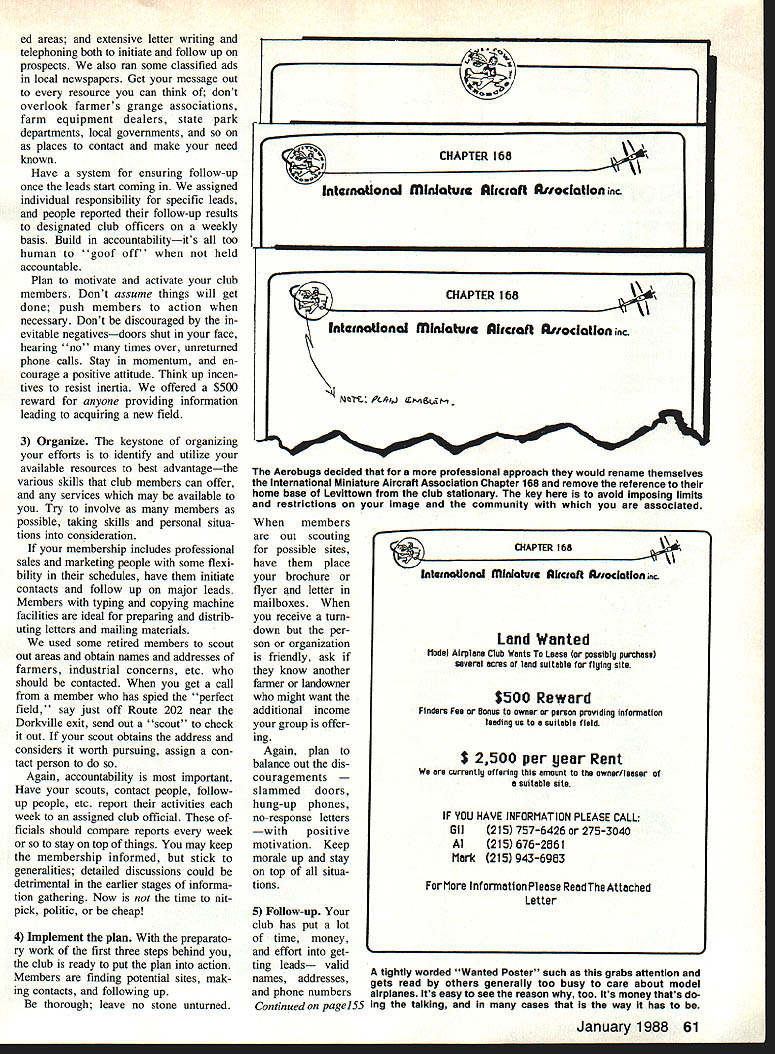
Put the work into action: scouts check fields, contact persons follow up, brochures get distributed, and members pursue referrals. Avoid limiting your image — we temporarily used the name "International Miniature Aircraft Association Chapter 168" on some stationery to appear more formal and avoid local baggage.
5. Follow up
Don't burn leads. Ensure all contacts receive letters, calls, and follow‑up visits. Sales is a numbers game: persistence yields success.
6. Modify your objective and/or plan
Be flexible. If the price isn't right or new areas open up, adjust the plan and return to step one as needed. Continuous improvement shortens time for future projects.
Presenting a Professional Image
When dealing with community members, business people, or politicians:
- Dress appropriately: jacket and tie for business or political meetings; neat casual for farmers.
- Speak politely, clearly, and slowly.
- Be courteous and professional — remember you are requesting a favor and asking them to tolerate noise and inconvenience.
- Your club name projects an image; consider alternative stationery or names for different audiences.
- If prior site‑owners were cooperative, ask them for letters of introduction or recommendation.
Legal and Insurance Considerations
- Insure your club and provide owners with proof.
- Consider consulting an attorney: in Pennsylvania we found a land‑use statute granting owners immunity from liability if they allow others to use their land for recreational purposes at no charge. Legal advice can uncover valuable protections and options.
- Expect to deal with liability concerns, especially with industrial land; be prepared to negotiate insurance and hold‑harmless agreements.
Keeping the Owner Informed and Involved
Once you have a site:
- Maintain a good relationship with the owner: invite them to events, keep them informed of activities, and be responsive to concerns.
- Use mowing or other services as bargaining tools when negotiating.
- Keep the field maintained and demonstrate that the club is organized and responsible.
Lessons Learned
- Be professional. Present a complete package.
- Follow up. Be persistent with phone calls and letters.
- Involve many members in the search.
- Use mowing as a bargaining item.
- Insure your club and provide the owner with proof.
- Keep the owner informed and involved.
- Keep accurate records of contacts and responses.
- Be willing to adjust plans and remain flexible.
Closing
Searching for a new flying site requires time, coordination, and work, but a well‑thought‑out plan and mobilized membership will get results. The process can be exciting and satisfying. As you gain experience dealing with landowners and agencies, future projects will move faster.
For more guidance, the AMA booklet Getting and Keeping Flying Sites (available from the AMA Public Relations Department) is a valuable resource.
Most of all, remain calm, act professionally, keep members informed and active — and Keep 'em Flying!
Transcribed from original scans by AI. Minor OCR errors may remain.

