
Profile: Brad Lang
Jim Haught
Pattern or Pitts, T-6 or 757, this Bumblebee loves to fly
Bumblebees aren't supposed to be able to fly, but this one has flown more than most.
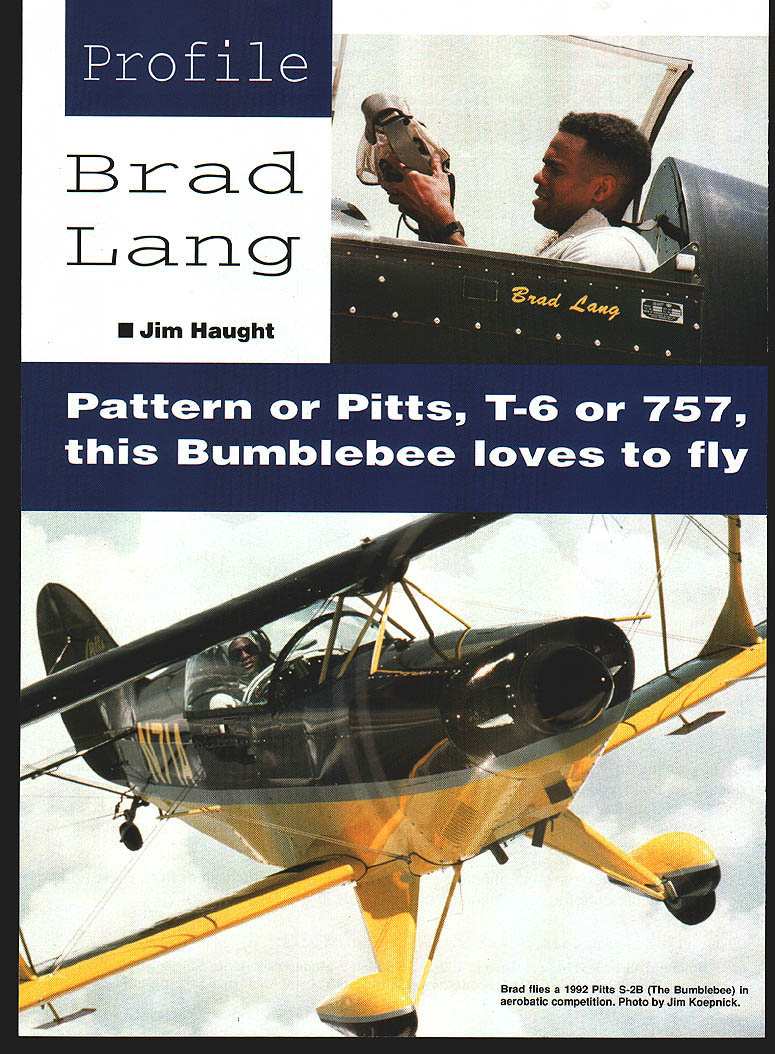
From Pattern models to commercial airliners to full-scale aerobatic aircraft, Brad Lang (aka "The Bumblebee," after the paint scheme on his full-scale Pitts S-2B) has covered quite a bit of the aircraft spectrum. The 40-year-old Lang is a First Officer for Delta Air Lines based in southern California; he has qualified for the full-scale Advanced World Aerobatics Championships, held in Mnichovo Hradiste, Czech Republic; and he has flown radio-control models—primarily in Aerobatics—for more than 20 years.
We felt that this unusual trifecta of aircraft accomplishments would be of interest to our readers, and Brad took time out from a busy practice schedule for the following interview.
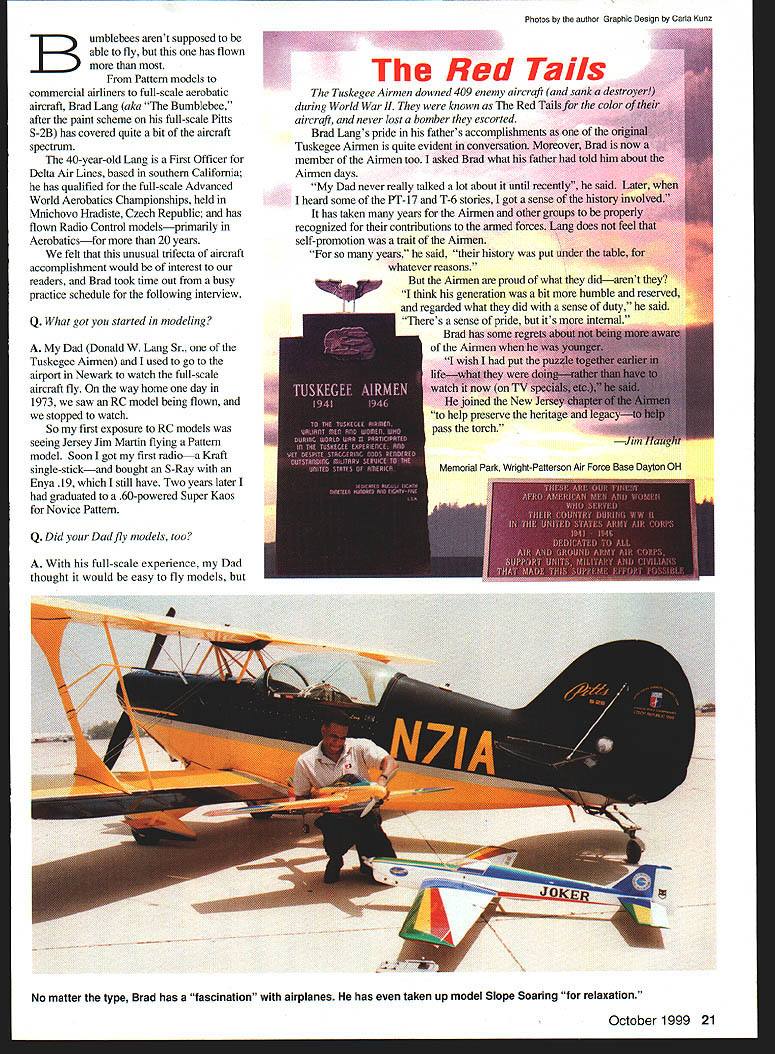
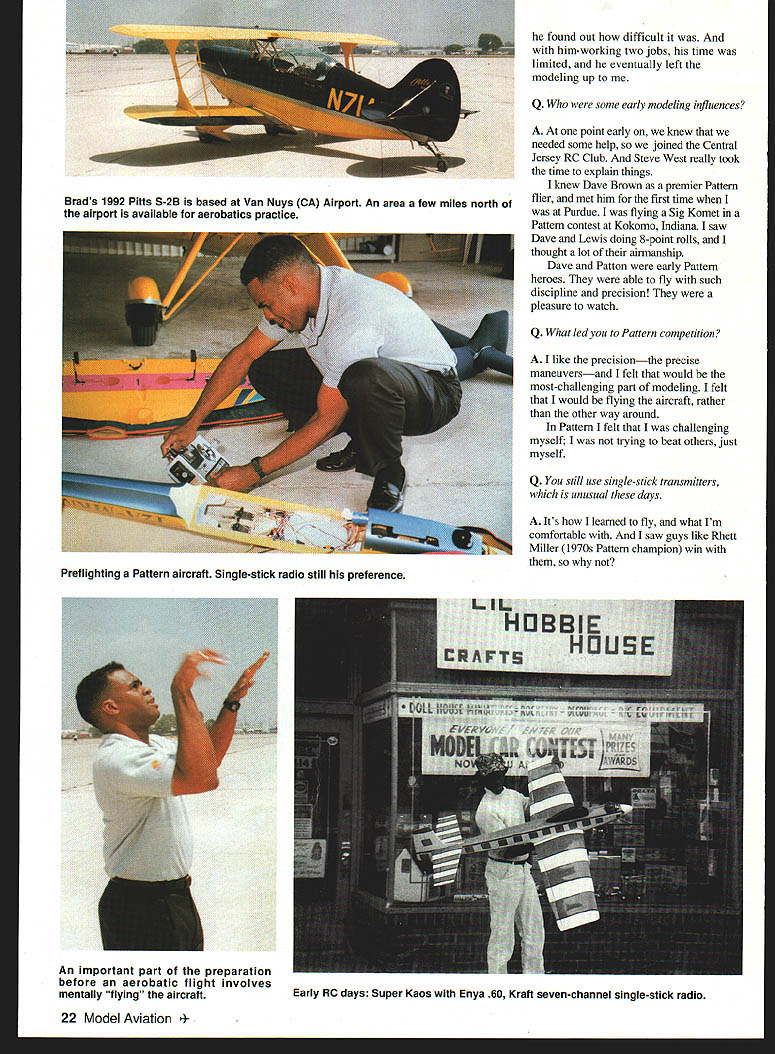
Q. What got you started in modeling? A. My Dad (Donald W. Lang Sr., one of the Tuskegee Airmen) and I used to go to the airport in Newark to watch full-scale aircraft fly. On the way home one day in 1973 we saw an RC model being flown, and we stopped to watch. My first exposure to RC models was seeing Jersey Jim Martin flying a Pattern model. Soon I got my first radio—a Kraft single-stick—and bought an S-Ray with an Enya .19, which I still have. Two years later I had graduated to a .60-powered Super Kaos for Novice Pattern.
Q. Did your Dad fly models, too? A. With his full-scale experience, my dad thought it would be easy to fly models, but he didn't stick with it. He found out how difficult it was, and with him working two jobs his time was limited, so he eventually left the modeling up to me.
Q. Some early modeling influences? A. From an early age I knew I needed some help and joined the Central Jersey R/C Club. Steve West really took the time to explain things. I knew Dave Brown, a premier Pattern flier; I met him the first time at Purdue flying a Sig Komet. At a Pattern contest in Kokomo, Indiana, I saw Dave Lewis doing 8-point rolls and thought a lot about airmanship. Dave Patton and others were early Pattern heroes — able to fly such disciplined precision was a pleasure to watch.
Q. What led you to Pattern competition? A. I liked the precision—the precise maneuvers—and felt it would be the most challenging part of modeling. I felt it would be about flying the aircraft rather than about beating others; Pattern was challenging myself to fly better than I had before.
Q. Do you still use single-stick transmitters? That's unusual these days. A. I learned to fly with what I'm comfortable with. I saw guys like Rhett Miller, the 1970s Pattern champion, win using single-stick radios. A single-stick radio is still my preference.
An important part of preparation before an aerobatic flight involves mentally flying the aircraft.
Q. You fly models, a Pitts, and commercial aircraft — how do the aircraft types compare? A. The principles of flight are the same physically. Understanding what's happening to the vehicle is important regardless of type. The big difference, though, is you're on the ground flying a model—no G-forces affecting you. That's a big problem to overcome when you move to full-scale aerobatics. I work on building up G-tolerance by running, speed skating and other activities, and by doing less-complicated maneuvers first. After a layoff it takes about a month to build up. There's a mental component too: feeling prepared mentally to withstand Gs is the most important and most difficult part.
Q. Describe the full-scale flight scoring. A. The breakdown is:
- 40% Known sequence (given to pilots the previous year)
- 40% Freestyle (difficulty — maneuvers must add up to a minimum; there is a maximum number of maneuvers that can be flown)
- 20% Unknown sequence (never seen before being flown)
It's like a 3-D chess match — five flights: Known, Freestyle, and three Unknowns.
Q. How do you prepare for the Unknown — or can you? A. It's a little like improvisation in music. You hope you don't hit the wrong note.
Q. What makes the best pilots stand out? A. Personality — pop right off the line, accelerate vertical quickly, and try to make everything crisp with sharpness. Flying highly accurately with crispness and style is what appeals to the judges and leads to success.
Q. Does flying models help visualize successful full-scale maneuvers? A. Yes. Hammerheads, loops, rolls, 45-degree lines — Pattern flying helps. In full-scale competition I worked with a spotter who was always critiquing; coaches recently began using videotape, and it helps verify what the coach is saying about your flying.
Q. What's the future for your aerobatic career? A. I want to add my own style and continue developing my aerobatic flying. First, I want to be successful in Advanced (this was my first year on the team). Then I'd like the challenge of making the Unlimited team. I'll continue to fly in competition as long as I can keep the freshness of it.
Q. How long will you continue to fly in competition? A. As long as I can keep the freshness of it. I look at guys like Clint McHenry, who won the full-scale Nationals, and Ed Hurt, who's one of the oldest Pattern fliers around yet still has vitality. Flying is fascinating in all its forms; being in an aircraft above the ground is uniquely beautiful.
Q. You have a secondary interest in warbirds. What is their appeal? A. I like T-6s and Mustangs because of the Tuskegee Airmen (see sidebar). I checked out in a T-6 when I was in Texas. I'd like to own or part-own one someday. There's nothing quite as dynamic as a big radial. These aircraft can be used as excellent educational tools, too.
Q. How important is it to you that flying is an activity you and your father have shared? A. It helped give me a sense of direction and added to our relationship. It was another way to cement the bond between parent and child.
Q. Any advice for current or future pilots? A. Have the picture in your mind: "I think I can do this." Use visual imagery—make a picture in your mind of where you want to be. Many Unlimited pilots use maneuvers perfected by Hanno Prettner (former Pattern World Champion) and others. Modelers can learn a lot from attending full-scale events—it can give them new ideas.
For more information on the United States Aerobatic Teams, check the United States Aerobatic Foundation web site at www.usaf-aerobatics.org.
The Red Tails
The Tuskegee Airmen downed 409 enemy aircraft (and sank a destroyer!) during World War II. They were known as the Red Tails for the color of their aircraft, and they never lost a bomber they escorted.
Brad Lang's pride in his father's accomplishments as one of the original Tuskegee Airmen is evident in conversation. Brad is now a member of the Airmen, too. When asked what his father had told him about the Airmen days, Brad said: "My Dad never really talked a lot about it until recently." Later, when I heard some of the PT-17 and T-6 stories, I got a sense of the history involved.
It has taken many years for the Airmen and other groups to be properly recognized for their contributions to the armed forces. Lang does not feel that self-promotion was a trait of the Airmen. "For so many years," he said, "their history was put under the table, for whatever reasons."
"But the Airmen are proud of what they did—aren't they?" I asked. "I think his generation was a bit more humble and reserved, and regarded what they did with a sense of duty," Brad replied. "There's a sense of pride, but it's more internal."
Brad has some regrets about not being more aware of the Airmen when he was younger. "I wish I had put the puzzle together earlier in life—what they were doing—rather than have to watch it on TV specials, etc."
He joined the New Jersey chapter of the Airmen "to help preserve the heritage and legacy—to help pass the torch."
— Jim Haught
Transcribed from original scans by AI. Minor OCR errors may remain.

