
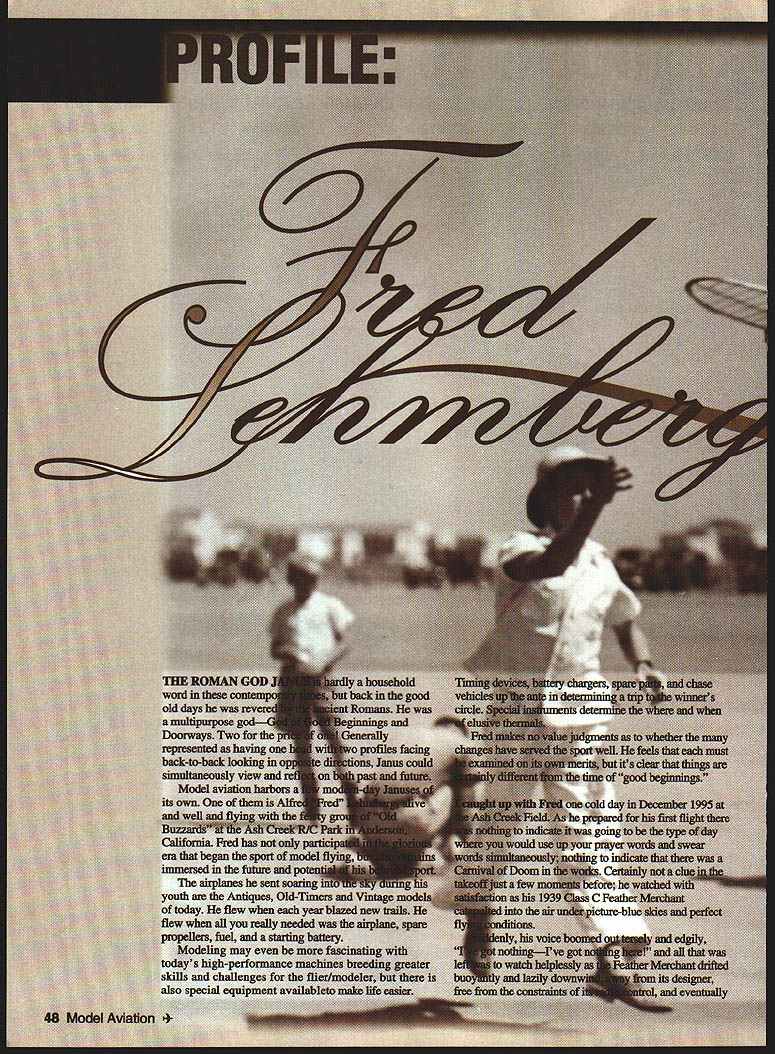
Profile: Fred Lehmberg
THE ROMAN GOD JANUS is hardly a household word in these contemporary times, but back in the good old days he was revered by the ancient Romans. He was a multipurpose god—God of Beginnings and Doorways. Generally represented as having one head with two profiles facing back-to-back, Janus could simultaneously view and reflect on both past and future.
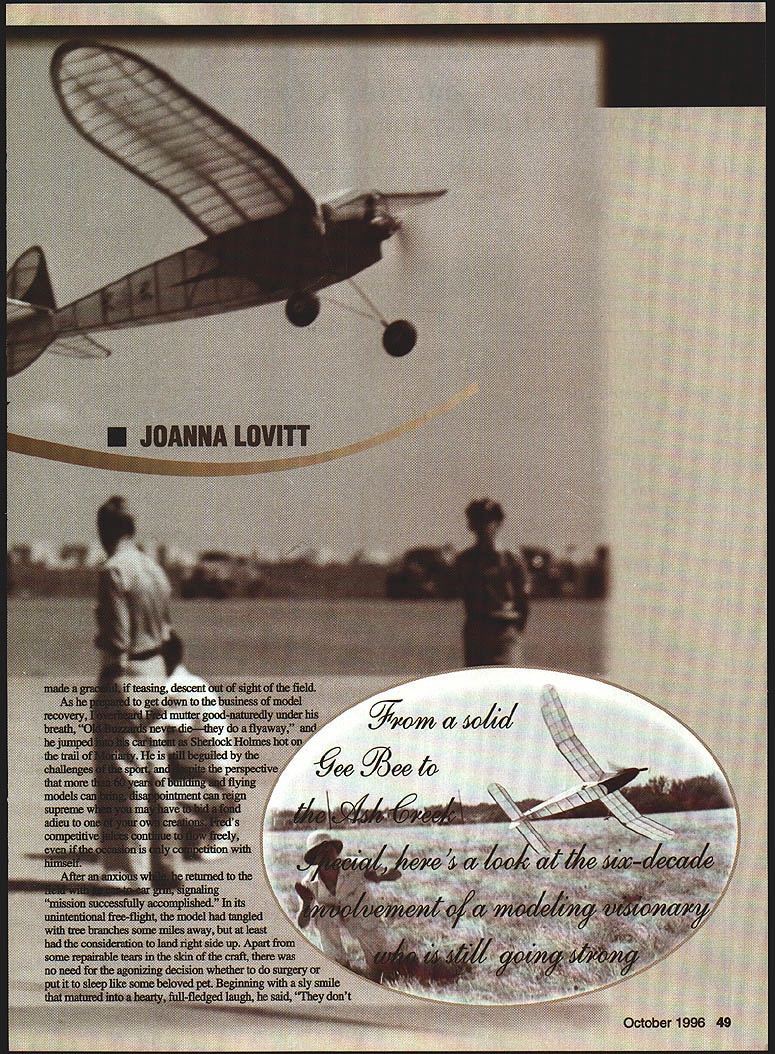
Model aviation harbors a very modern-day Janus of its own. One of them is Alfred "Fred" Lehmberg, who lives and flies with the feisty group of "Old Buzzards" at the Ash Creek R/C Park in Anderson, California. Fred has not only participated in the glorious era that began the sport of model flying, but remains immersed in the future and potential of the sport.
Early years and first flights
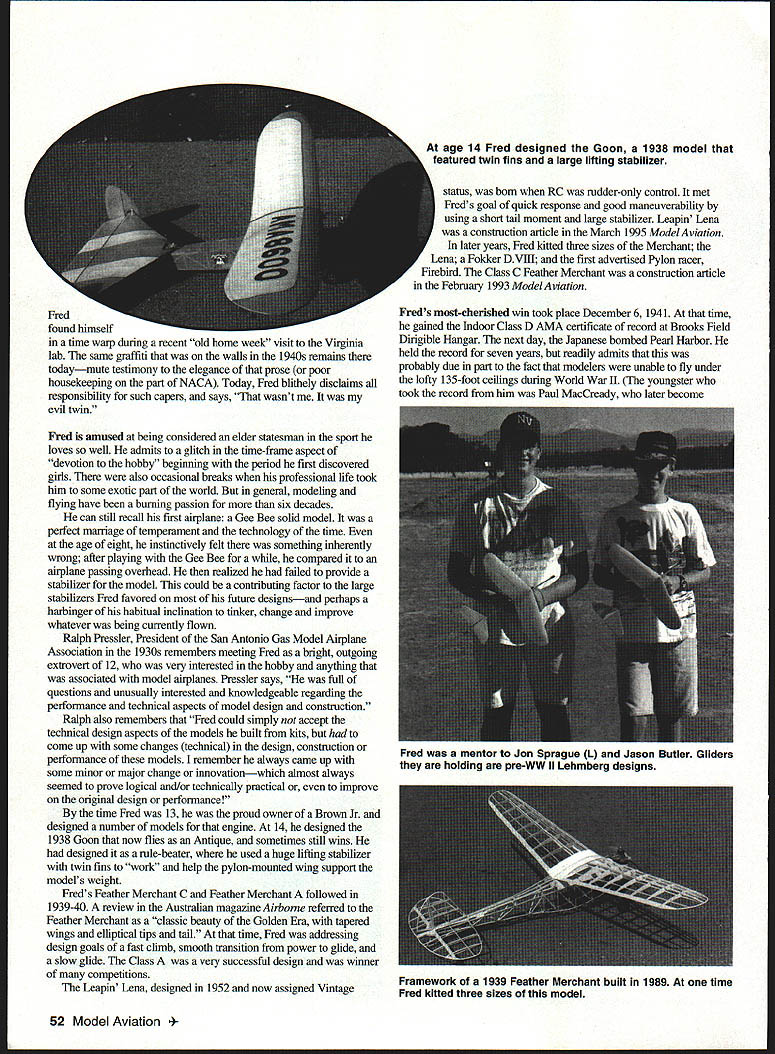
Fred cut his competitive teeth flying against the big boys of the San Antonio Gas Model Airplane Association at the tender age of 12. He was born in San Antonio in 1924. By 13 he owned a Brown Jr. engine and designed a number of models for it. At 14 he designed the 1938 Goon, a rule-beating model with a huge lifting stabilizer and twin fins; it now flies as an Antique and sometimes still wins.
His Feather Merchant C and Feather Merchant A followed in 1939–40. An Australian magazine, Airborne, called the Feather Merchant "a classic beauty of the Golden Era, with tapered wings and elliptical tips and tail." At that time Fred aimed for a fast climb, smooth transition from power to glide, and a slow glide. The Class A was a very successful design and won many competitions.
Fred's most cherished win took place December 6, 1941, when he gained the Indoor Class D AMA certificate of record at Brooks Field Dirigible Hangar. The next day, the Japanese bombed Pearl Harbor. He held the record for seven years; the youngster who later took the record was Paul MacCready, who became famous for the man-powered Gossamer Albatross.
NACA, World War II and early professional life
At 18, in early 1942, Fred answered Uncle Sam's invitation to participate in research at Langley Field, Virginia, for the National Advisory Committee for Aeronautics (NACA). Positions were open to young people between 16 and 25 who could show proof of having won recognized model-airplane contests and who knew how to handle woodworking tools.
He began in the Dynamic Model Shop building models for the Free-Flight Tunnel, then became a tunnel technician, and later was placed in the Engineering Section designing models for the tunnels. Anecdotes from that era include small wartime improvisations: when a colleague's cigarette caused tiny holes burned in a Fairchild 22 model, Fred made little red tissue disks (like the patching used on aircraft) and doped them in place so the model could fly on.
Career, writing and other pursuits
Fred wore many hats in the sciences. He worked in geophysics for Schlumberger Well Surveying Corporation in the United States, Canada, and Venezuela; he worked as a thermodynamicist for Aerojet in Sacramento, California; and he retired as a weapon-systems engineer with the U.S. Navy. He has authored more than 50 articles in leading American hobby magazines on historical, documentary, technical, and construction topics.
From 1983–1987 he wrote an eye-catching series in Model Builder: "Planes an' Facts" and "Chickum Tracks." These columns blended humor, pop culture, and scholarship and used barnyard characters—Chickums, Sylvestor, Wallaby Willie and others—to offer fresh insights into complex topics, from the Sopwith Camel to the effect of molecular weight on air density.
Fred is also a novelist: he has written three fantasy novels seeking publication, using the genre to explore deeper scaffolding of spiritual quests.
Designs, kits and notable models
Fred designed and kitted a number of models over the decades:
- The Feather Merchant series (Class A and Class C), popular in the late 1930s and early 1940s.
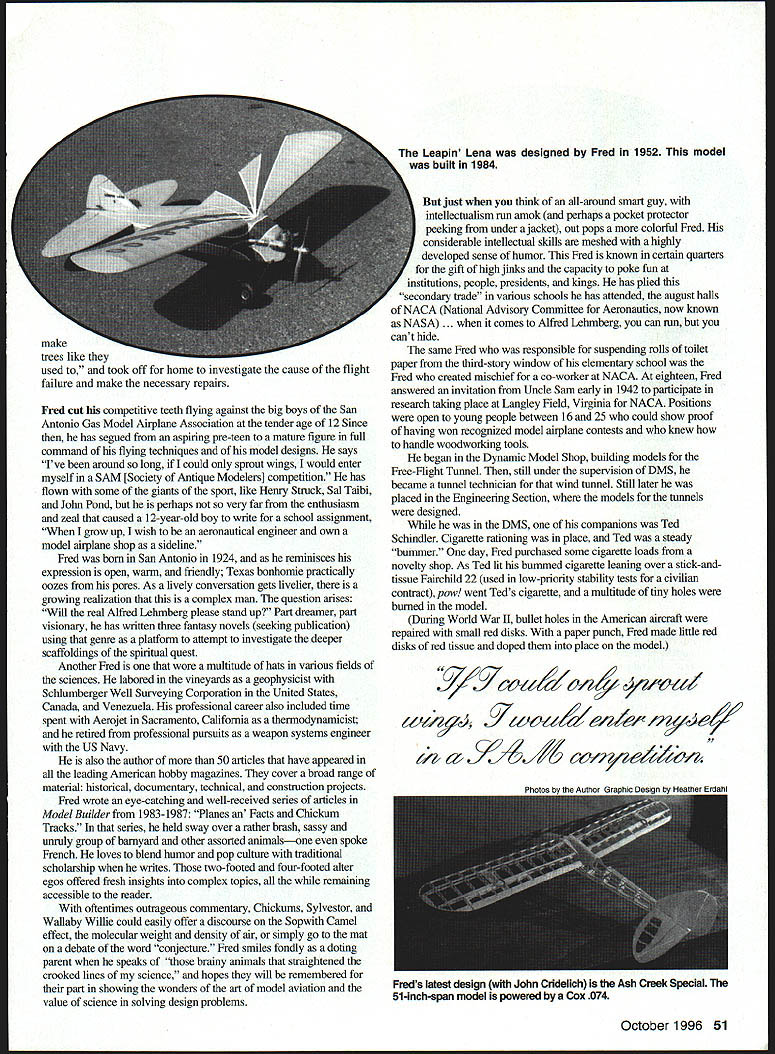
- Leapin' Lena, designed in 1952 (later assigned Vintage status); built in 1984 and featured as a construction article in Model Aviation (March 1995). Lena used a short tail moment and large stabilizer to provide quick response and maneuverability in rudder-only RC.
- A Fokker D.VIII, the first advertised pylon racer Firebird, and three sizes of the Merchant.
The Class C Feather Merchant appeared as a construction article in Model Aviation (February 1993). One memorable contest win had Fred’s Leapin’ Lena beating Henry Struck’s Sea Cat at Westport, Connecticut—a day that still “warms the cockles” of his heart.
Club work, contests and mentoring
While working, raising a family with his wife Twyla (together for nearly 50 years), and continuing model activity, Fred also found time to organize. He masterminded and was Contest Director of the First Annual Westchester County Model Airplane Meet, sponsored by the Westchester County Airport and the Rotary Club of White Plains, New York—one of the largest East Coast meets, drawing an appreciative crowd.
Fred’s club at Ash Creek has a strong student-pilot program and a school program. He mentored Jon Sprague (15) and Jason Butler (14), starting them with hand-launched gliders he designed prior to World War II; he was delighted with their quick progress.
Views on the sport and its future
Fred makes no simple value judgments about changes in the hobby. He observes that modern equipment—timing devices, battery chargers, special instruments for finding thermals and chase vehicles—has raised the ante. He prefers to judge each change on its merits. He favors rubber-powered models and Free Flight, though his attention has centered on RC in recent years. "Indoor rubber is the ultimate in delicate manipulation," he says, "but Outdoor rubber is more fun."
He worries about recruiting the next generation: “Sometimes it seems as if interest and devotion to the sport is handed down from father to son, like some peerage. That’s hardly enough to keep the sport healthy and robust. The kids of today have so many sources of diversion… Somehow, we must find a way to capture the mind, heart and imagination of today’s youngsters and recruit them into the fold.”
Fred believes the sport offers much to young people: a proving ground for challenging limits; it cultivates risk-taking, perseverance, humility, and camaraderie. He is a staunch supporter of the AMA Museum (a Life Patron), which he regards as the best, most complete museum of its type in the world and a vital link in the continuity and future health of model aviation.
Personality and legacy
Fred is a complex man: part dreamer, part visionary, intellectual with a highly developed sense of humor. He is known for high jinks and the capacity to poke fun at institutions and people. Stories of youthful mischief follow him—suspending rolls of toilet paper from a third-story school window and playing pranks at NACA. During a recent "old home week" visit to the Virginia lab, he found the same graffiti on the walls that had been there in the 1940s; he joked, "That wasn't me. It was my evil twin."
At home in the shop and at the field, Fred's intelligence is matched by generosity in mentoring and storytelling. He hopes his writing and designs will be remembered for showing the art of model aviation and the value of science in solving design problems.
Later years and current activity
In December 1995 I caught up with Fred at Ash Creek Field on a cold day. As he prepared for his first flight, his 1939 Class C Feather Merchant lifted off into picture-blue skies, but soon he called out, "I've got nothing — I've got nothing here!" The model drifted downwind and flew away. Fred quipped afterward, "Old buzzards never die — they do a flyaway," and retrieved the plane a few miles away tangled in tree branches but landed right side up and repairable.
At 71 Fred was retired but busy. He was working on a controversial article about the downwind turn and had recently partnered with John Cridelich to design and build an Ash Creek Special: a 51-inch-span model powered by a Cox .074 with a shoulder wing and de Havilland-style tail and 5 1/4 inches of dihedral—gentle in theory, though no one had yet dared test-fly it.
I recently saw Fred again at the club field. The smell of burning castor oil and the humming of engines filled the air. As Fred took his turn on the runway, he turned with his patented grin, gave a thumbs-up, and prepared to orchestrate another pattern of beauty in his playground in the sky.
Joanna Lovitt 342 Springer Redding, CA 96003
Transcribed from original scans by AI. Minor OCR errors may remain.

