
Project Pluto
By Carl Crackel, Jr.
With winter just a few months away, it's time to prepare activities to carry your club through the flightless months. This building/contest project by the Lafayette Esquadrille Control Line Club of St. Louis, MO, was great for rekindling waning interest and encouraging new members.
Background
The question "What can we do to maintain interest and encourage new members throughout the winter months?" has vexed many modelers. To strengthen membership involvement, the Lafayette Esquadrille sponsored a building contest. The club found from past records (1960s–1970s) that such projects are a proven method of reviving modeling interest.
A committee was chosen to head the project and to develop the rules, select a model, and organize fabrication and distribution of kits.
Contest Rules
The committee agreed on four contest rules:
- Each participant must be a dues-paying member.
- Each participant must build the same basic model.
- Completion of the model entry must be by March 15.
- Kits will be provided free of charge to each participant.
Model Selection
The committee considered several models. Important selection criteria were:
- The model could be constructed within the time limitation.
- The model offered optional variations to suit each builder’s taste.
- Cost would be affordable since club funds would purchase the kits.
Past club projects had used the Fokker D7, Fokker E3 Eindecker, and the Sopwith Camel. The Sterling Ringmaster was considered but proved too expensive per kit.
Ultimately, the committee selected the Pluto after discovering Dave Horvath’s Model Aviation article (August 1979, Plan No. 273). The Pluto offered unlimited construction possibilities for Sport, Stunt, and Slow Combat configurations and matched the contest requirements.
Kit Production
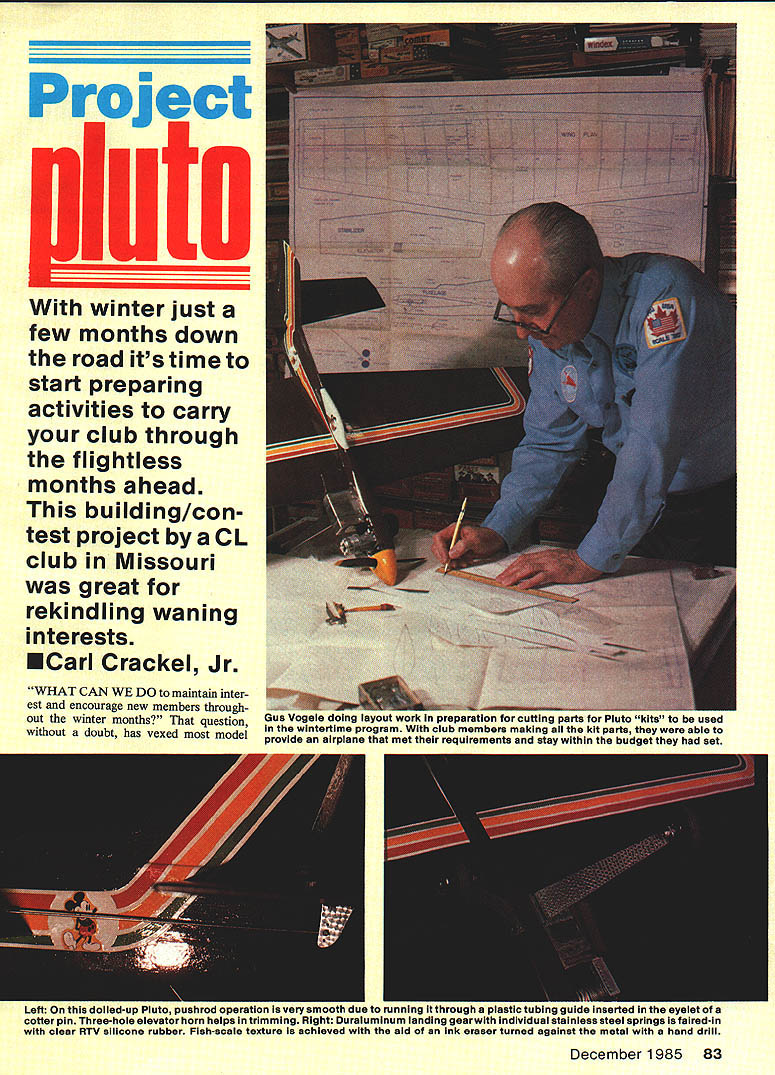
Because the Pluto was not available commercially in kit form, the club decided to make the needed kits in-house.
- A bill of materials was prepared after obtaining the Pluto construction drawing.
- Club members with drill presses, jigsaws, and other shop equipment fabricated parts, helping to reduce cost and involving more members in the project.
- Required parts included fuselage halves, engine mounts, rib patterns, leading and trailing edges, tail parts, and sheet-aluminum landing gear.
- Each kit cost about $8 to produce.
Each kit contained the fabricated parts, an abbreviated assembly drawing, a full-size pattern for the wing ribs, and a Xerox copy of the Model Aviation article. Builders were to supply the remaining hardware needed to complete the model.
Distribution and Building
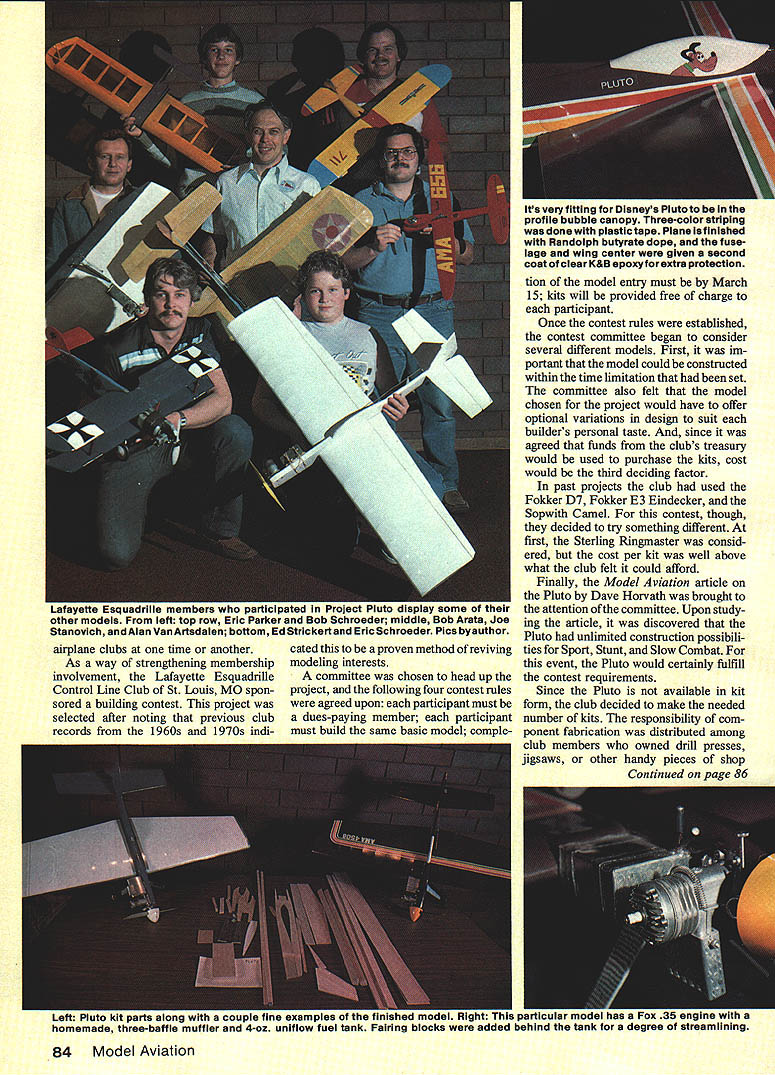
A total of 12 kits were produced and distributed to participating members. Builders finished their Plutos in a variety of configurations (Sport, Stunt, and Slow Combat) and applied personal color and construction schemes.
Common finishing methods included:
- MonoKote-covered wings with epoxy-painted fuselages.
- Butyrate dope over silkspan coverings.
- Various fuel-tank designs and accessory details chosen by each builder.
Entries were to be judged on workmanship and overall attractiveness of the finished model.
Judging
To ensure fair and impartial judging, the club enlisted an experienced individual outside the membership. Bob Underwood, then AMA District VI vice-president, served as the judge.
After careful examination, a winner was chosen.
Results
- Winner: Dennis Hughes, judged winner for his red-and-white finish and outstanding workmanship.
- Prize: A brand-new Fox .35 Stunt engine.
Although Dennis won the contest, every participant benefited: the project provided winter activity, inspired group involvement, and produced models that handled and flew very well when the flying season arrived.
Conclusion
The Pluto Project proved to be a successful winter event that stimulated membership activity and interest. If your club suffers from winter blues, consider organizing a club-sponsored building contest — it can revive enthusiasm and involve members both competitive and supportive.
Transcribed from original scans by AI. Minor OCR errors may remain.

