
Project Snapshot on the Road
It seems that most hobby projects become more complex with time. The beginner who is satisfied with a two- or three-channel radio is soon eager to work with five or six channels. Models and equipment often become more involved and expensive. But along with the extra time and money goes a greater satisfaction when a more challenging project is completed. Sometimes, however, the extra time and expense goes for things you cannot buy at a hobby shop.
Last year I traded in my car for a station wagon so I could carry several Snapshot models and still have room for my wife, Dawn, to accompany me on trips. This year we decided to take a look at something even bigger. Since plans for the second year of Project Snapshot required several thousand miles of travel, it wasn't difficult to see my wife's dream of owning a motor home in a favorable light. I could imagine the upper bay full of models and equipment—sort of an airport on wheels. The main problem was finding a way to afford it, but we finally located a used "mini" motor home that would be less expensive to buy and gas up. Now Project Snapshot could go on the road with room to spare. Perhaps there would be a few fewer "dings" in the wings as we no longer had to unload Snapshot from the station wagon at each night's stop.
Motor home outfitting and trips
We purchased the motor home in early spring and began outfitting it with wing racks and fuselage tie-downs for two Snapshot models and a Bobcat for fun flying. Spare parts from plugs to servos were gathered and stored so I had a mini workshop wherever I traveled. An outlet strip powered the battery chargers. We made an effort to keep the models and equipment out of the remainder of the motor home so we could enjoy it without stepping over hobby items.
The motor home, like other hobbies, required time and money. After a number of adjustments and repairs were made we took short trips to nearby flying fields to check out our vehicle and supplies. Figuring out how to operate the appliances proved to be an adventure—our previous owner had gone without running water until a camper showed him the water pump switch. We had the opposite problem: the water ran fine but we soon learned there was more fresh water available than room to store it.
We developed a checklist for the motor home like the ones used for Snapshot flights. This prevents problems like driving off with the electric cord still hooked up, or driving with no safety catch on the refrigerator door. With our camping skills improved, we set out on our first long trip to Ohio.
We didn't realize it when we started but our biggest challenge on that trip would be getting home. We bought our motor home just before the gas crisis. Try driving a motor home over 1,000 miles at five gallons a stop. Actually, the gas mileage was not much worse than the station wagon so we did all right. If you must sit in a gas line, I would certainly recommend a motor home: with all the comforts of home you can fix dinner, make your bathroom stops, or take a nap while you wait. As a result of the gas problems, we pursued only one of our remaining out-of-state projects. Later projects concentrated on finding nearby places to photograph.
Snapshot 3 — design and equipment
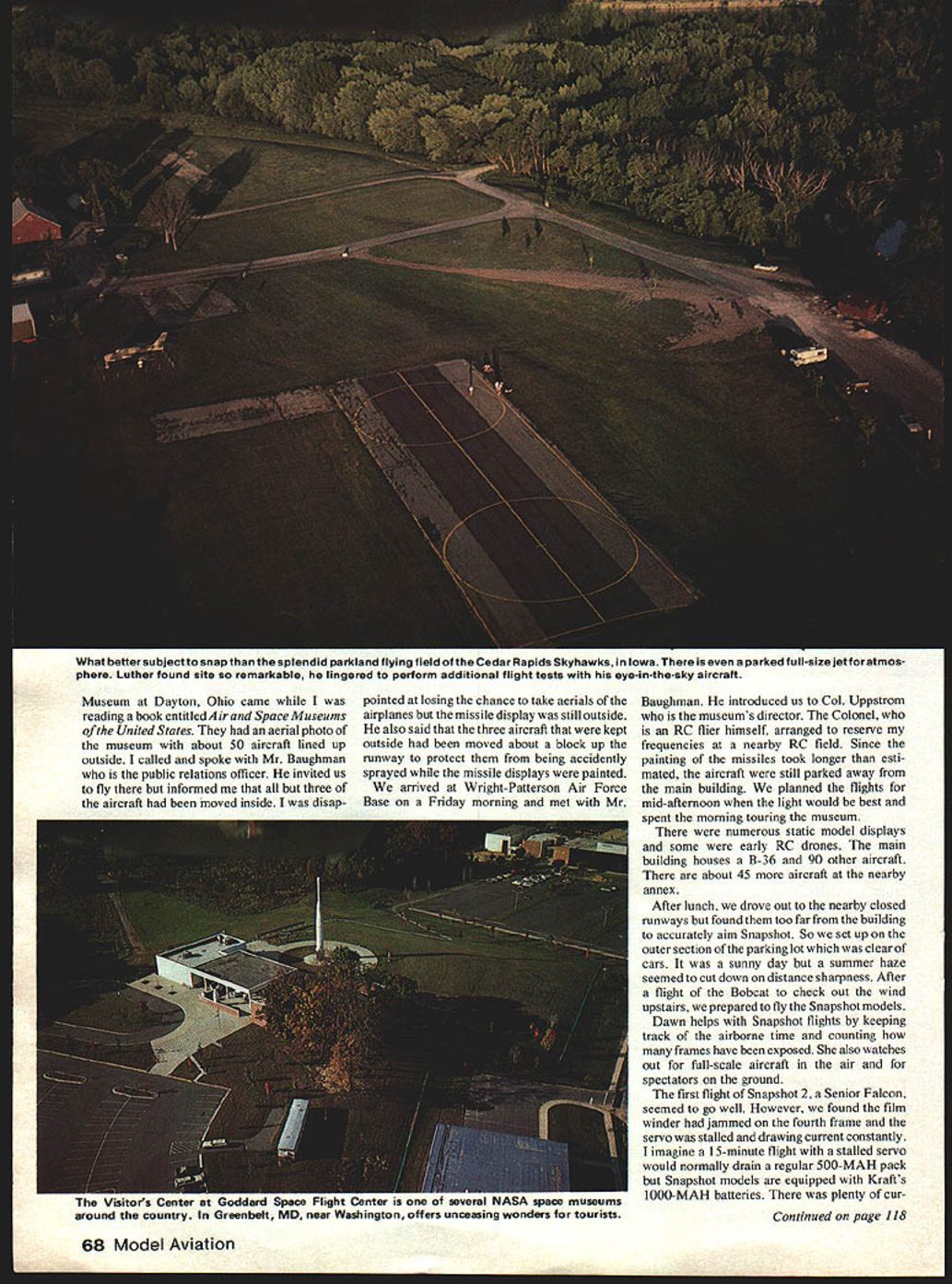
Project Snapshot, first published in 4-color in the June 1979 issue, was a landmark feature distinguished by incredible photographs taken from a model and by the techniques of camera planes and aerial photography. For this year we left Snapshot 1 at home and used a new model, Snapshot 3. Its design is basically the same as Snapshot 1 but considerably lighter and, I think, more attractive. It handles better than the first Snapshot because of its lighter wing loading; there was little difficulty during initial test flights getting used to the new model. The floating-style landing carries the same interchangeable camera pack as previous models. Snapshot 2, a modified Senior Falcon, was flown its second year and took many of the photos.
Snapshot 3 specifications and equipment:
- Engine: HP .61 Silver Star
- Fuel: carries 20 ounces of fuel
- Radio: Kraft 5-C with a modified fifth channel trip for the camera
- Servos: seven servos of four different types
- Frequency: radios replaced with Krafts on the 53 MHz band after earning my ham license
Glow plug extension modification
Because last year's problem with pusher models drawing the glow plug clip toward the prop, I installed an extension cable that lets me attach the battery clip near the front of the model. Alligator clips attached to the engine cables run through the model to a modified glow plug mounted near the receiver switch. The glow plug was drilled out and a piece of plastic tubing pressed into the center as an insulator. A 2-56 bolt was threaded into the tubing until it extended 3/16 inch above the glow plug head. Cables attached to the center bolt allow the plug to be started by the typical glow plug clip used on other models. The best part is being able to reach under the wing around the prop to pull the clip off.
Wright-Patterson Air Force Museum (Dayton, Ohio)
The idea of photographing the Air Force came when I learned, from a book entitled Air and Space Museums of the United States, that about 50 aircraft were lined up outside the museum. I called and spoke with Mr. Baughman, the public relations officer, who invited us to fly. He informed us that three aircraft had been moved inside, which was disappointing because we lost the chance to take some aerials, but the airplane and missile displays were still outside.
We arrived at Wright-Patterson on a Friday morning and met Mr. Baughman. He introduced us to Col. Uppstrom, the museum's director. The Colonel, who is an RC flier himself, arranged to reserve my frequencies at a nearby RC field. Since the painting of some missiles took longer than estimated, the aircraft were still parked away from the main building. We planned the flights for mid-afternoon when the light would be best and spent the morning touring the museum.
After lunch we drove to nearby closed runways but found them too far from the building to accurately aim Snapshot. So we set up on the outer section of the parking lot which was clear of cars. It was a sunny day but a summer haze seemed to cut down on distance sharpness. After a flight of the Bobcat to check the wind, we prepared to fly the Snapshot models.
Dawn helps with Snapshot flights by keeping track of airborne time and counting how many frames have been exposed. She also watches out for full-scale aircraft and for spectators on the ground.
The first flight of Snapshot 2, the Senior Falcon, seemed to go well, but the film winder jammed on the fourth frame and the servo stalled, drawing current constantly. I imagine a 15-minute flight with a stalled servo would normally drain a regular 500-mAh pack, but Snapshot models are equipped with Kraft 1000-mAh batteries, so there was plenty of current available. I went left for a safe landing; I believe that shows the large batteries are well worth the extra weight and money. While Snapshot 2 was on fast charge, we flew Snapshot 3.
By the end of the second flight the fire department was on hand—not for an emergency, just curious about the models. One of the base personnel drove by to tell us we were not at the correct flying site and he was trying to help by pointing the way. Dawn explained that we had permission from the Colonel and he responded, "Well, he's the boss so this must be the right place."
Snapshot 2 was recharged and I exchanged camera packs for a third flight. I generally take at least two full rolls at each site. I had hoped to take photos later that evening to get dramatic shadow effects from the missiles, but clouds moved in so we decided to call it a day.
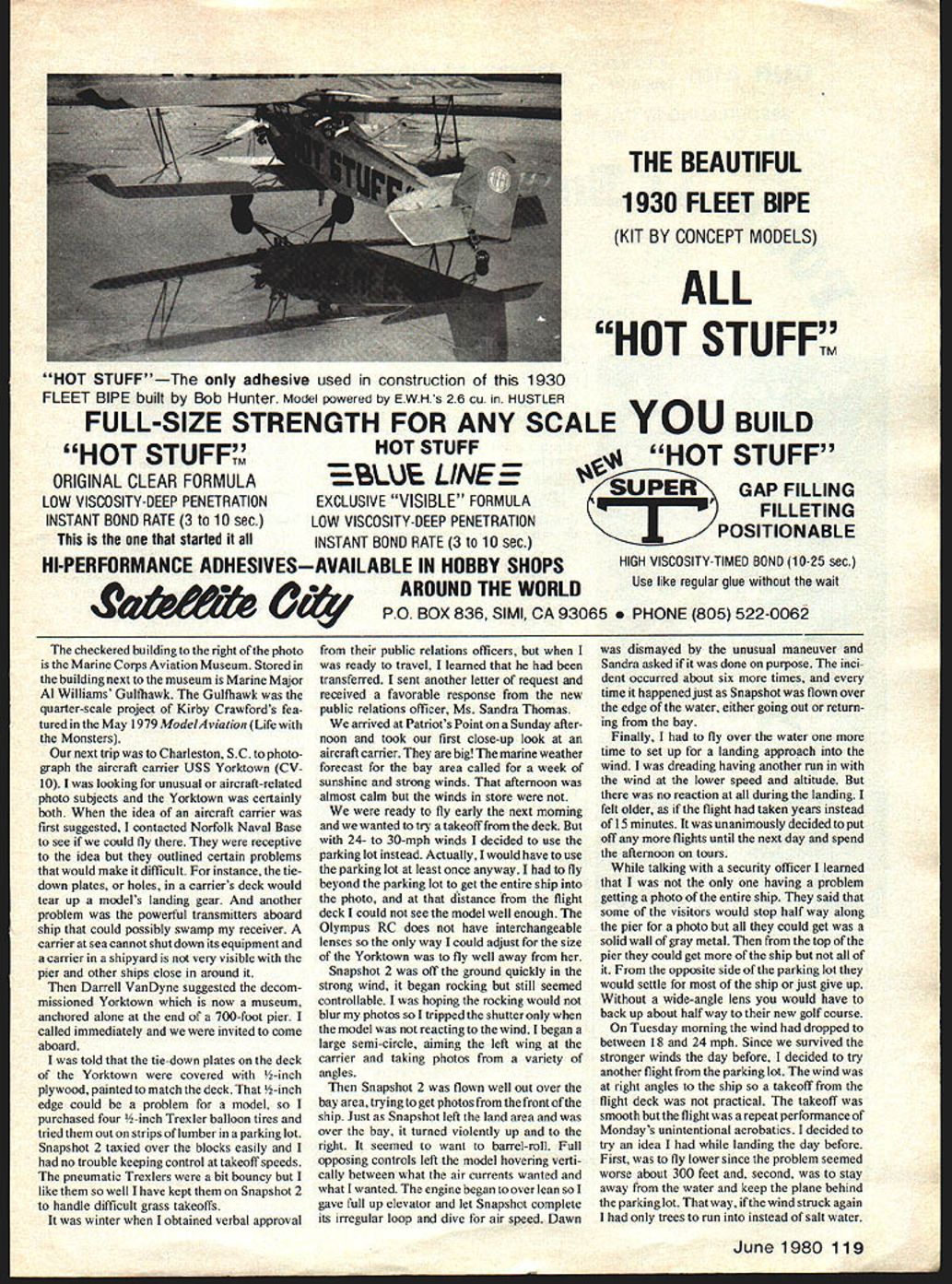
The photo chosen from this visit is actually of the back of the museum: from that angle the XB-70, B-52, and B-29 sit nicely into the upper right corner. If you look closely you can see the yellow lift used to paint the missiles.
Cedar Rapids, Sig Manufacturing, and local flying
The next day we drove to Cedar Rapids, Iowa to visit Dawn's grandmother. While taxiing Snapshot 3 in the driveway, Earl Yanecek, a neighbor and model builder, stopped to talk. He offered to show me the Cedar Rapids RC flying site. Instead of a borrowed acre of farm land I found a paved runway on open park land with a full-size jet display nearby and no fences or crowded baseball diamonds to fly over. I spent most of the afternoon flying Snapshot 3 and learning to land with better precision. I was so used to the first Snapshot sinking like lead that it took time to get used to Snapshot 3's excellent glide.
Later that week we visited Sig Manufacturing Company in Montezuma, Iowa. Maxey Hester, the plant manager, gave us a tour. We enjoyed talking with employees and learning about their role in producing model kits. Their kits were prominent in our show team this past year. Our thanks to Hazel and Glen Sigafoose and the rest of the company for their hospitality.
Cedarville College and a campsite encounter
As we returned from Iowa, Dawn asked me to stop at Cedarville, Ohio so she could see changes at Cedarville College where she had graduated. We arrived on a Saturday during a break with very few people on campus, so after our tour I decided to try a flight. We took off from the new chapel's parking lot, heading out over the lake. For a spontaneous flight, it went very well. We sent several slides to the college and they plan to use them in their yearbook.
At our campsite the following evening I heard a familiar sound like a model helicopter. A fellow camper flying RC helicopters had driven in from the West Coast for a local contest. His camper was also a hobby workshop and loaded with helicopters. He remembered the previous Snapshot article and showed me photos he had taken from his RC helicopter that had been printed in a newspaper article. As I traveled I found that modelers take aerial photos many different ways.
National Geographic, Virginia Air Show Squadron, and Quantico
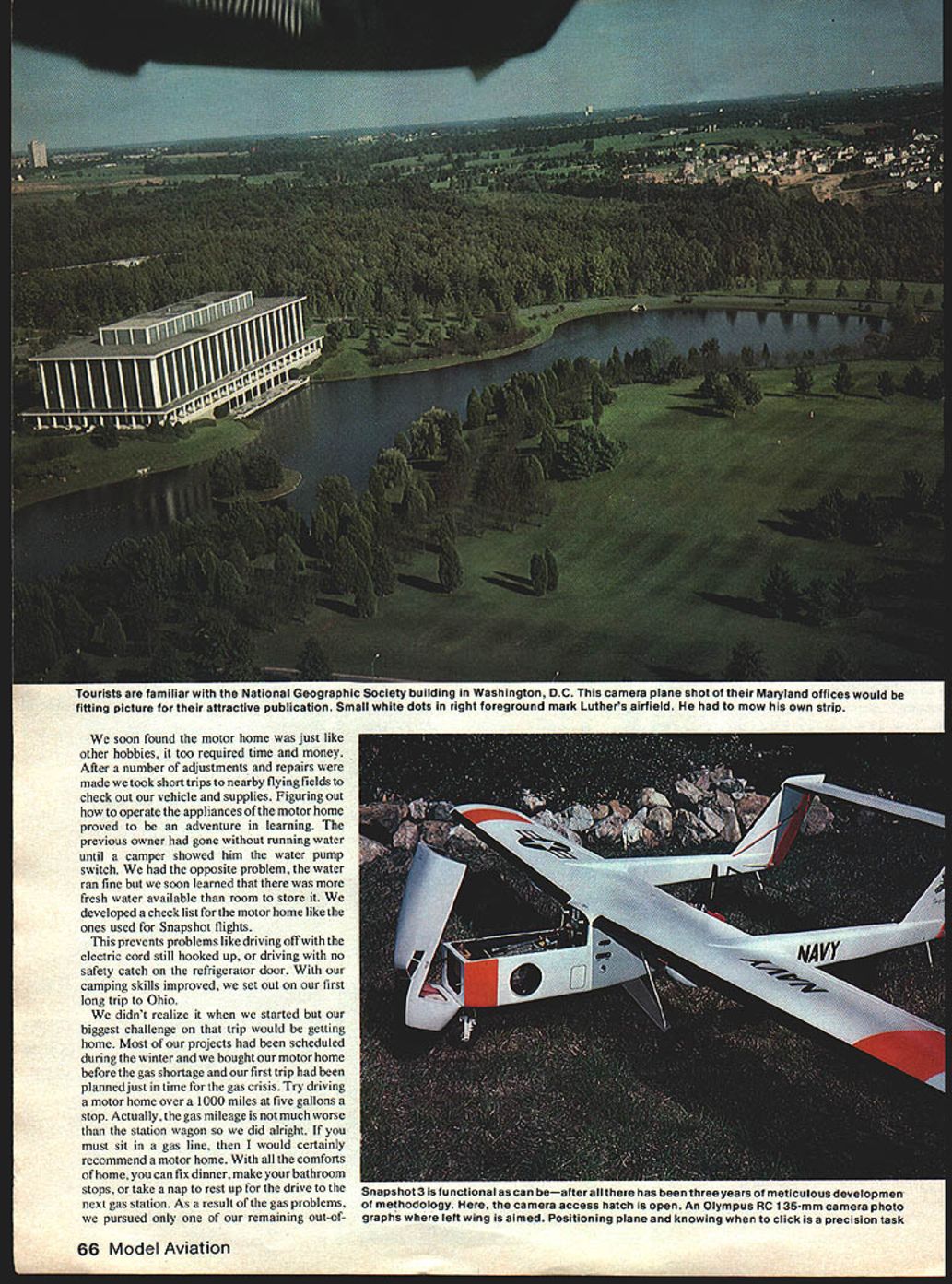
For most of last summer we flew at nearby sites as members of the Virginia Air Show Squadron. This was our team's first year and we were working on AMA sanction requirements. Several shows were for corporate picnics at a park in Maryland. While traveling there I noticed the very attractive office building of the National Geographic Society and decided to inquire about flying. They were agreeable, only asking that we fly on weekends so as not to distract employees.
We decided to take off from the front lawn between the lake and the fence. The grass was thick and mowed high but there was absolutely no wind that day. After two hours of cutting grass with the prop, I finally got out my lawn mower and mowed a takeoff strip. By this time the plane was bright green and there was grass inside the camera bay. The mowing helped just enough, and Snapshot 2 managed to break clear of the ground on the third try. The flight went well and the ducks and geese by the lake did not seem bothered.
The Virginia Air Show Squadron was invited to perform at the NVRC/USMC Scale Rally at Quantico, Virginia. John Preston was the CD and liked to call it an "uncontest"—just fly and enjoy hobby talk. I flew Snapshot 2 during the morning and Snapshot 3 as part of the air show. The checkered building to the right of one photo is the Marine Corps Aviation Museum. Stored in the building next to the museum is Marine Major Al Williams' Gulfhawk, a quarter-scale project of Kirby Crawford's.
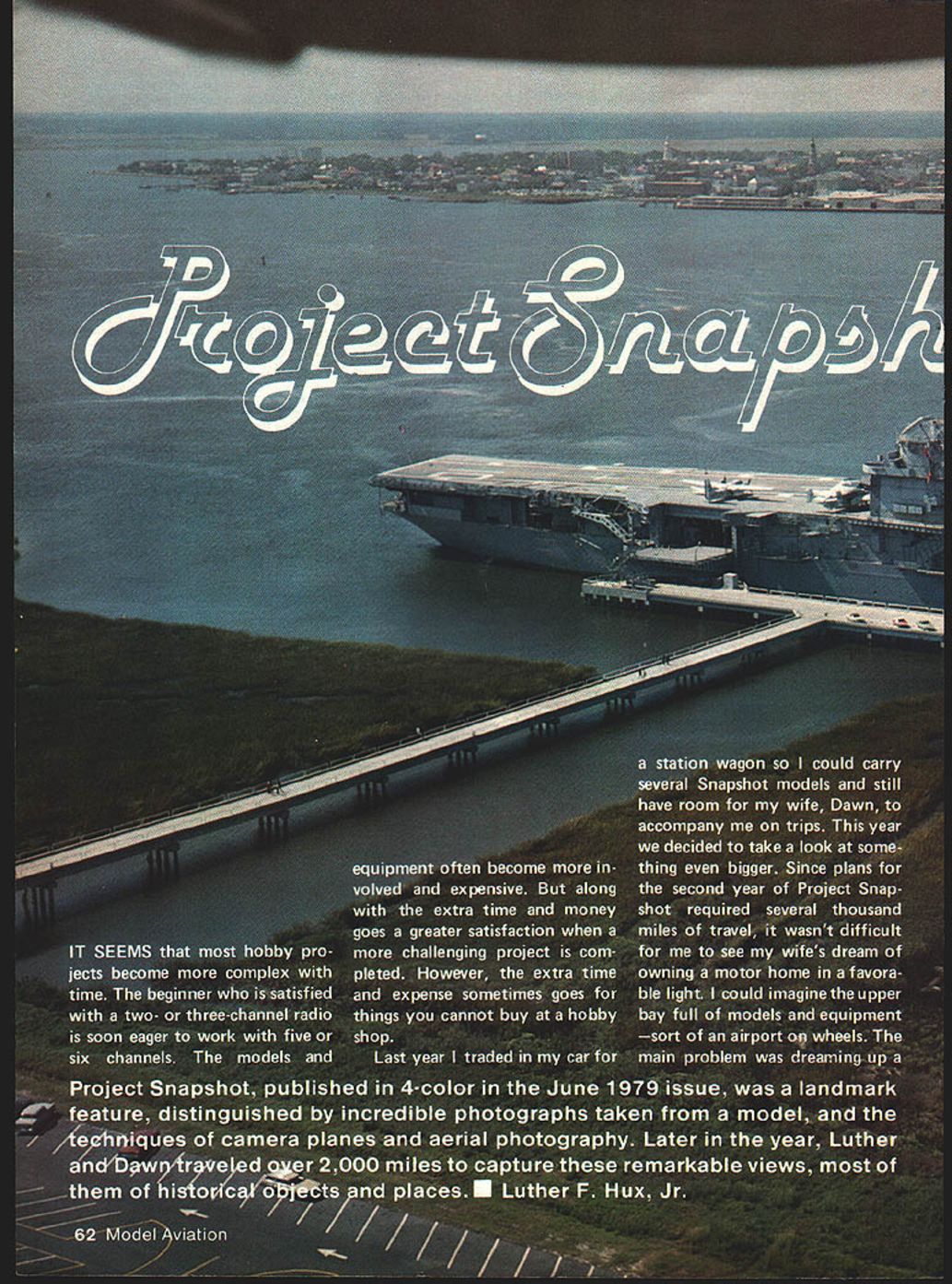
USS Yorktown (Patriots Point, Charleston, S.C.)
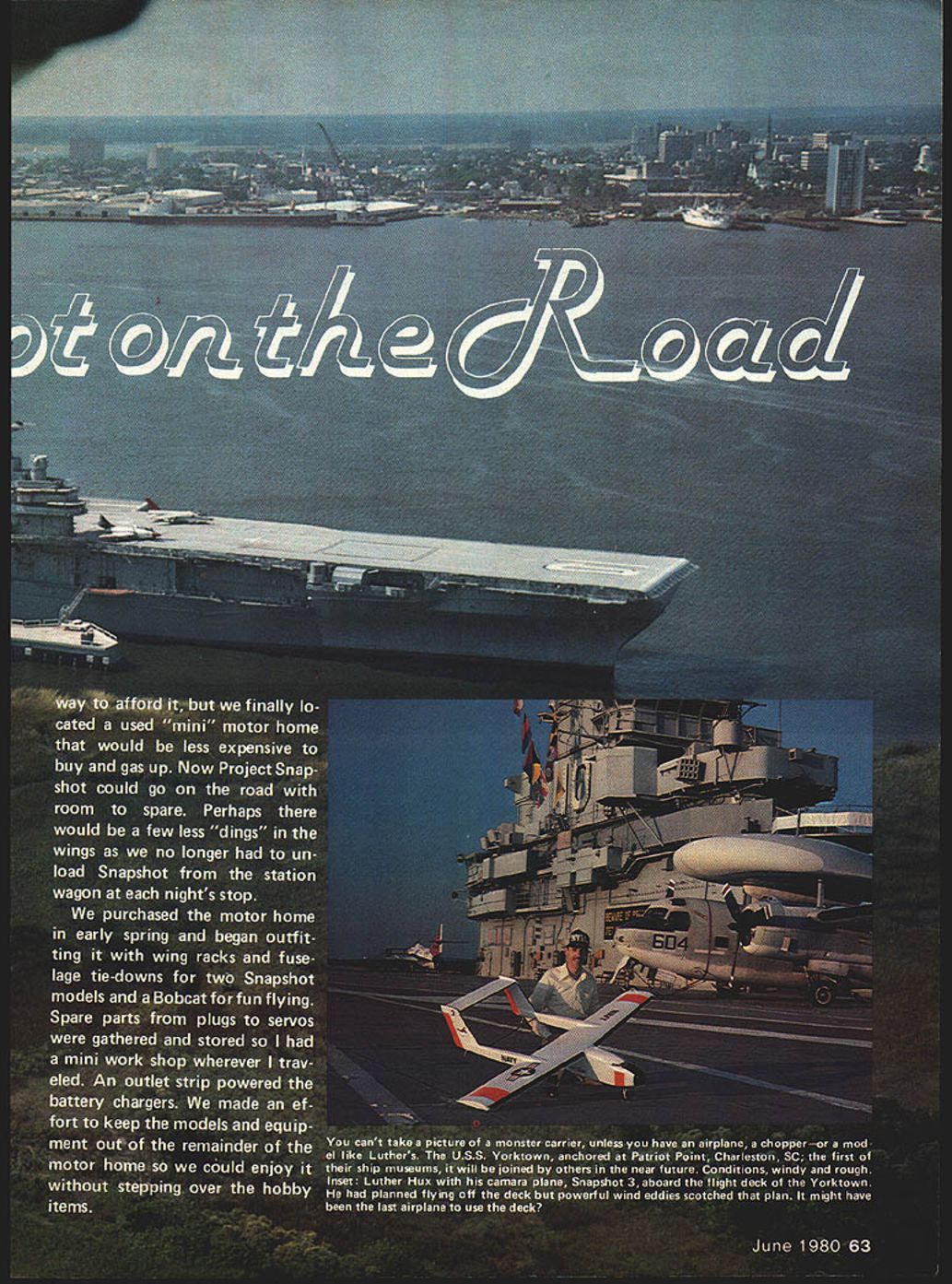
Our next trip was to Charleston to photograph the aircraft carrier USS Yorktown (CV-10). I contacted Norfolk Naval Base about flying near a carrier. They were receptive but outlined problems: tie-down plates in a carrier deck could tear up a model's landing gear, and powerful transmitters aboard ship could swamp my receiver. A carrier at sea cannot shut down equipment and a carrier in a shipyard is often obscured by piers and other ships.
Then Darrell VanDyne suggested the decommissioned Yorktown now a museum, anchored alone at the end of a 700-foot pier. I called and we were invited aboard. I was told the tie-down plates on the deck were covered with 1/2-inch plywood painted to match the deck. That 1/2-inch edge could be a problem, so I purchased four 1-inch Trexler balloon tires and tried them in a parking lot. Snapshot 2 taxied over the blocks easily and had no trouble at takeoff speeds. The pneumatic Trexlers were a bit bouncy but handled difficult grass takeoffs well; I have kept them on Snapshot 2.
We arrived at Patriot's Point on a Sunday and took our first close-up looks. The marine weather forecast called for sunshine and strong winds. That afternoon was almost calm but the winds in store were not. We planned to fly early the next morning and try a deck takeoff, but with 24–30 mph winds I decided to use the parking lot instead. I had to fly beyond the parking lot to get the entire ship into the photo, and from the deck I could not see the model well enough. The Olympus RC does not have interchangeable lenses, so to adjust framing I had to fly well away from the Yorktown.
Snapshot 2 lifted quickly in the strong wind and began rocking. I tripped the shutter only when the model was steady. Making a large semicircle and aiming the left wing at the carrier, I took photos from a variety of angles. Then, when flying over the bay, Snapshot 2 turned violently up and to the right as if wanting to barrel-roll. Full opposing controls found the model hovering vertically between the air currents and my inputs. The engine began to over-lean so I gave full up elevator and let Snapshot complete its irregular loop and dive to regain airspeed. The incident occurred about six more times, always as Snapshot crossed over the water.
Finally I had to fly over the water one more time to set up for a landing into the wind. There was no reaction during the landing. It felt like the flight had taken years instead of 15 minutes. We unanimously decided to put off further flights until the next day and spent the afternoon on tours.
While talking with a security officer I learned others had trouble photographing the entire ship: from many vantage points you could only get a solid wall of gray metal. Without a wide-angle lens you would have to back up a very long way to include the whole ship.
On Tuesday morning the wind dropped to 18–24 mph. Since we survived the stronger winds, I tried another flight from the parking lot. The flight repeated the previous day's unintentional acrobatics. I decided to fly lower (the problem seemed worse around 300 feet) and stay over land behind the parking lot, so if the wind struck again there would be trees rather than salt water. I launched in high wind and trimmed Snapshot to give me enough up elevator at full throttle to counteract wind shear. After a few uneventful passes I set the camera to take a single picture and my radio momentarily went dead—a "null" in the receiver. I coasted out and recovered control. The remaining flights were okay and I got the photos I wanted.
We stayed until Thursday hoping to fly from the deck if the wind calmed and aligned better. We spent much of the time touring the ship; it really is like a city afloat with many exhibits and a theater in the forward hangar deck. The signal flags in the flight-deck photo appear to hang in calm air, but they were sheltered by the superstructure from a 25-mph wind that even made posing with Snapshot 3 difficult. After four days of waiting, I had promised Dawn a few days at the beach, so we settled for the film we had and left the Yorktown.
Sherman Fairchild Technology Center (Germantown, Maryland)
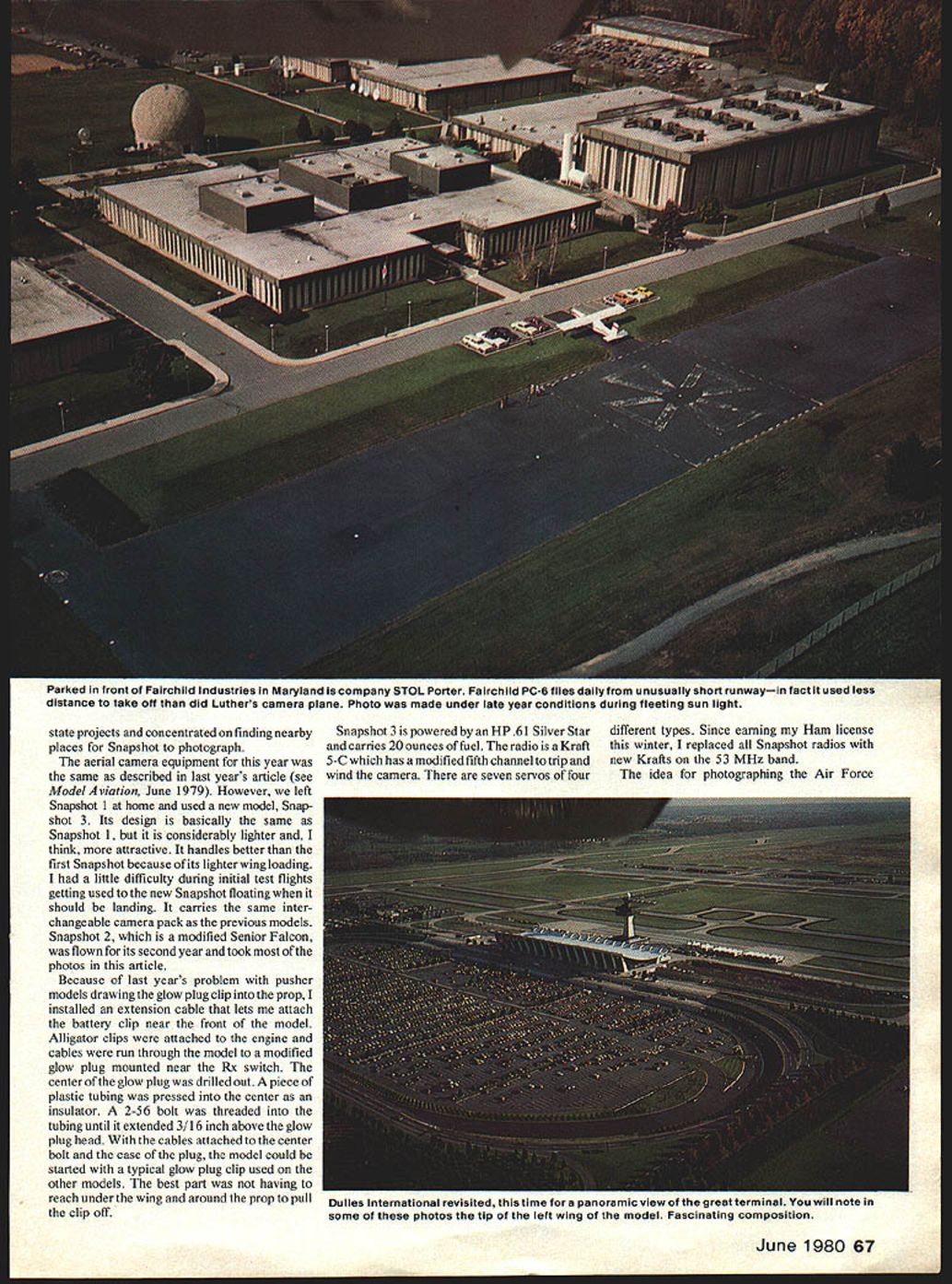
Our next assignment was the Sherman Fairchild Technology Center in Germantown, Maryland. We had noticed an airplane parked in front of their building on a previous trip and called to inquire. I learned the Fairchild Porter, an STOL aircraft, took off and landed at the front door daily. When I requested permission to fly there I was referred to Bill Loudon in public relations. Bill is a long-time AMA member and an RC flier familiar with Project Snapshot. Since the Porter is only at the office on weekdays, we scheduled our flights for a lunch break.
The week following the Yorktown adventure was cold, windy and cloudy, but by Friday the sky cleared though a cold 20-mph wind remained. Time was running out for photos before the leaves fell, so we decided to fly. As we drove to Fairchild, clouds moved in and by arrival it was almost totally overcast and about 45 degrees. We set up and kept a lookout for breaks in the clouds.
As soon as the sun reappeared, Snapshot 2 took off and began to circle for photos. A bus pulled up in front of the Porter blocking the view; when employees asked the driver to pull around back the sun went behind clouds again, making the first roll unusable. When the sun returned Snapshot was quickly reloaded and got about 20 photos before disappearing again.
The Porter pilot had mail to deliver but stayed until we were finished. Then he demonstrated the airplane's unusual abilities: he taxied backward from his parking space, and at the end of the runway the Porter took off in about 350 feet even with cargo. With only a bag of mail aboard and a 20-mph wind, the takeoff was surprising—Snapshot lifted off at nearly the same point and climbed steeply.
Bill gave me a book about Fairchild Industries. Sherman Fairchild's interest in photography led him to develop aerial camera innovations and to design the FC-1 monoplane in 1920 to complement his cameras—an early aerial photography plane.
Goddard Space Flight Center (NASA) and the Visitor's Center
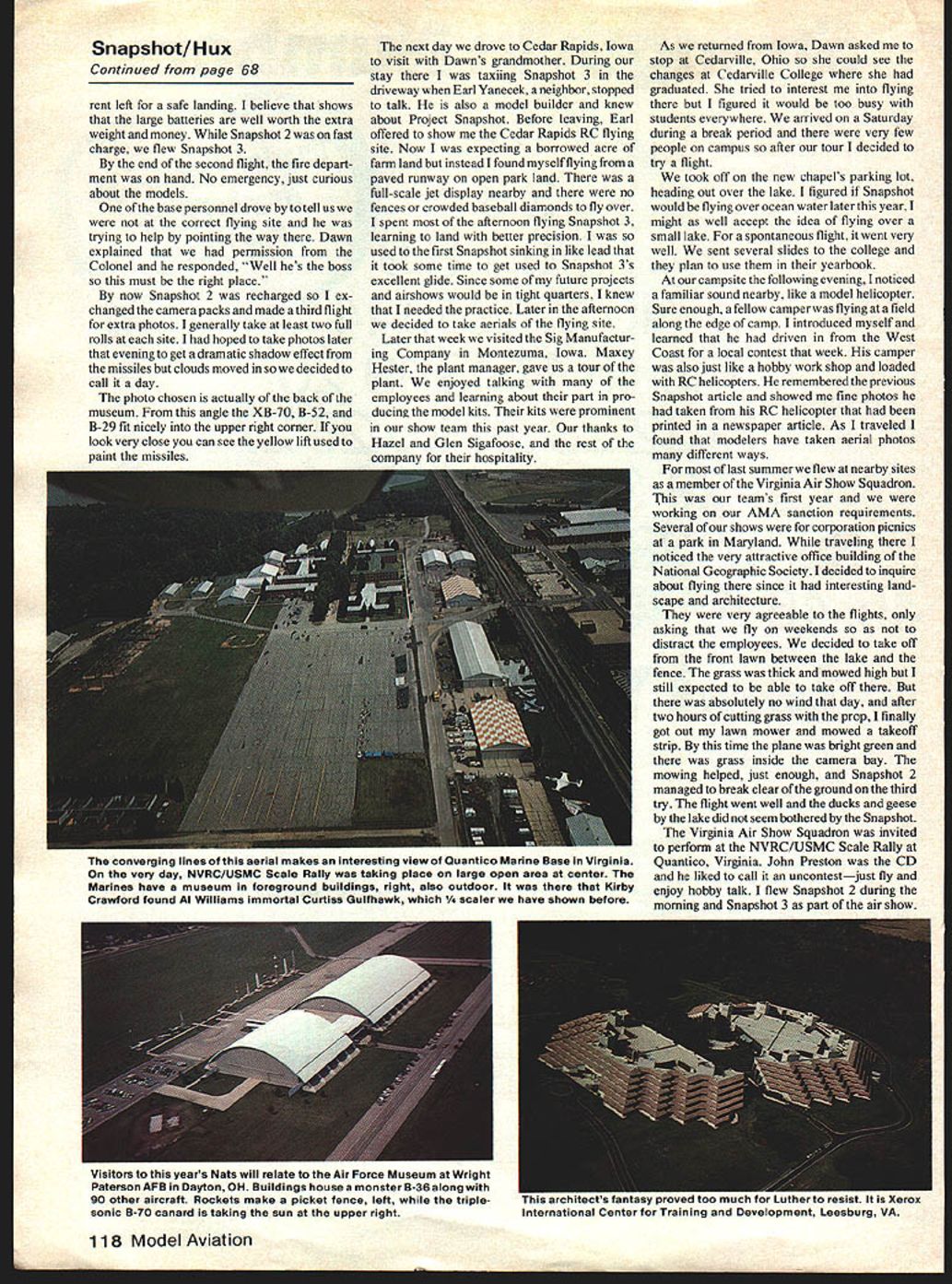
The next morning we were up early to travel to Goddard Space Flight Center. We were scheduled to fly at the Goddard Visitor's Center before it opened at 10 a.m. Glenn Pearson, who manages the Visitor's Center, was interested in Project Snapshot and arranged clearance to fly at the NASA complex.
Glenn flies model rockets and has taken aerial photos from model rockets using a camera nose cone available at their gift shop. He admits a lack of control over what the rocket photographs but does get good photos of the launch area. Model rockets have been flown at the Visitor's Center every first and third Sunday afternoon since 1976 and the center has been involved in rocket programs since 1964. I talked with a member of the rocket club who has taken movies from rockets—a collection of movies taken throughout the United States and several cities around the world.
After selecting a takeoff strip and discussing restricted areas, we set up. A mild breeze came up the hill from behind the Visitor's Center. Taking off toward the hill's edge reminded me of the aircraft carrier—guaranteed airspeed when the hill runs out.
The flight was very smooth but the landing proved interesting. I made four landing approaches with the nose high, expecting Snapshot 2 to sink as it usually did. But at the edge of a stall there was no altitude loss. I guessed a very strong thermal action in the early morning striking the empty parking lot. Finally I flew through the thermal and forced Snapshot onto the ground, letting the grass slow it down.
We then joined arriving visitors and toured the exhibits. NASA plans to use a Snapshot photo in their next brochure.
Xerox International Center and Leesburg
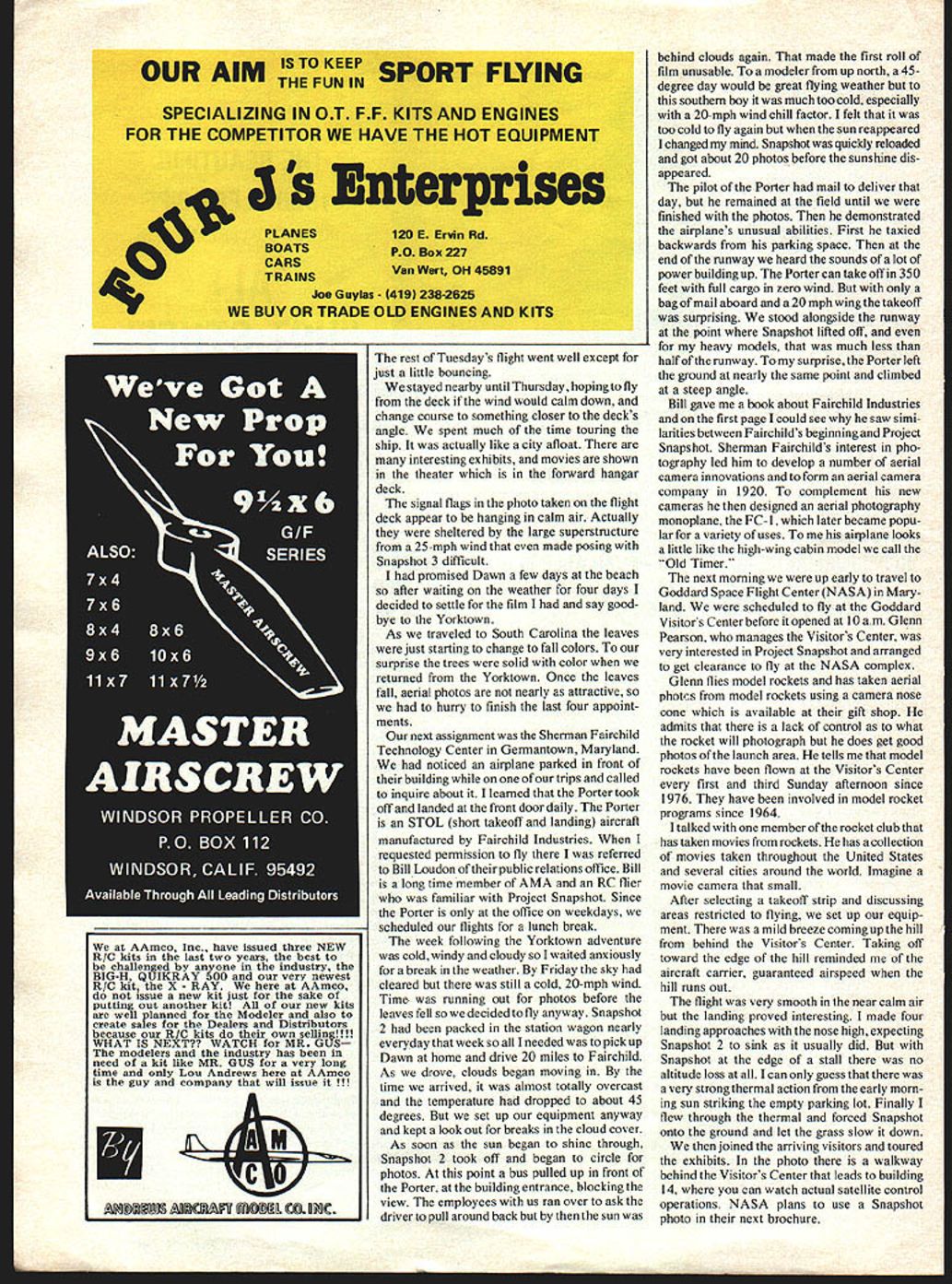
That afternoon we drove to the Xerox International Center for Training and Management Development near Leesburg, Virginia. Chuck Thomas, our airshow team manager who occasionally flies RC there, had no problem getting approval for Snapshot.
When we arrived a slight haze was setting in but it did not postpone the flights. Chuck stopped traffic for an uphill takeoff and landing on the road. Shortly after takeoff we were surrounded by students curious about the model. After landing we were photographed by several students carrying cameras; they were quite surprised when I removed Snapshot's cameras and explained that I had photographed them already.
Dulles International — final flights
The following day we flew the last flight for the season at Dulles International Airport. We had arranged several times to film construction progress on the terminal additions but rain or haze kept us away. Last year we used the heliport for takeoff, but this year I decided to change the angle of view and take off on the other side of the terminal where the AMA Trans-Am Relay Race began. The operations officer was in radio contact with the tower and gave us clearance for takeoff. The flight went well and Snapshot flew so realistically I'm sure many people did not realize it was a model.
The taxi parking lot is surrounded on three sides by trees so my landing approach over the middle row had to be quite high. Snapshot 2 sank well this time but the touchdown was about 30 feet from the end of the pavement. I jammed the brakes on and actually jammed the wheels completely. Snapshot 2 slid and turned to a stop like a patrol car setting up a roadblock. I reached down, unjammed the brakes and taxied back to the car thankful it had happened. There was a drainage ditch about three feet from the edge of the pavement. In the photo, the heliport is the short strip to the right of the tower which was last year's takeoff point.
Wrap-up and thanks
With the last four sites photographed in less than 48 hours, I felt that Snapshot and I had earned a rest. Dawn was pleased with Project Snapshot completing two years of flying without a crash. Now it's time to think about places to fly next summer. We are looking into the possibility of flying Snapshot for construction-sequence photos or postcard work; that might help pay for some film processing, long-distance calls, and gasoline. Dawn is trying to find a castle or mansion with beautiful gardens to photograph next spring.
I can recommend the museums and sites we photographed; they are interesting and well worth visiting. Until next year, enjoy the view from "up there."
Transcribed from original scans by AI. Minor OCR errors may remain.

