
PROJECT THAT THREE-VIEW
Bill Hannan
Introduction
Whether your specialty is Peanuts, control-liners, Jumbos, or "Monster" RC models, you will eventually be faced with the problem of enlarging 3-view drawings or plans. Traditional methods have included the use of grid lines, proportional dividers, pantographs, and photostats. All are workable, but each has disadvantages. This article reviews those methods, some optical alternatives, and practical tips for producing accurate enlargements for model building.
Traditional enlargement methods
Grid system
The grid system involves drawing squares on the original small plan and proportionately larger ones on the proposed enlargement. By numbering the grid lines, you can transfer the relative locations of shapes to the desired size. The disadvantage is that it relies heavily on "eyeball" measuring, which is not always precise.
Proportional dividers
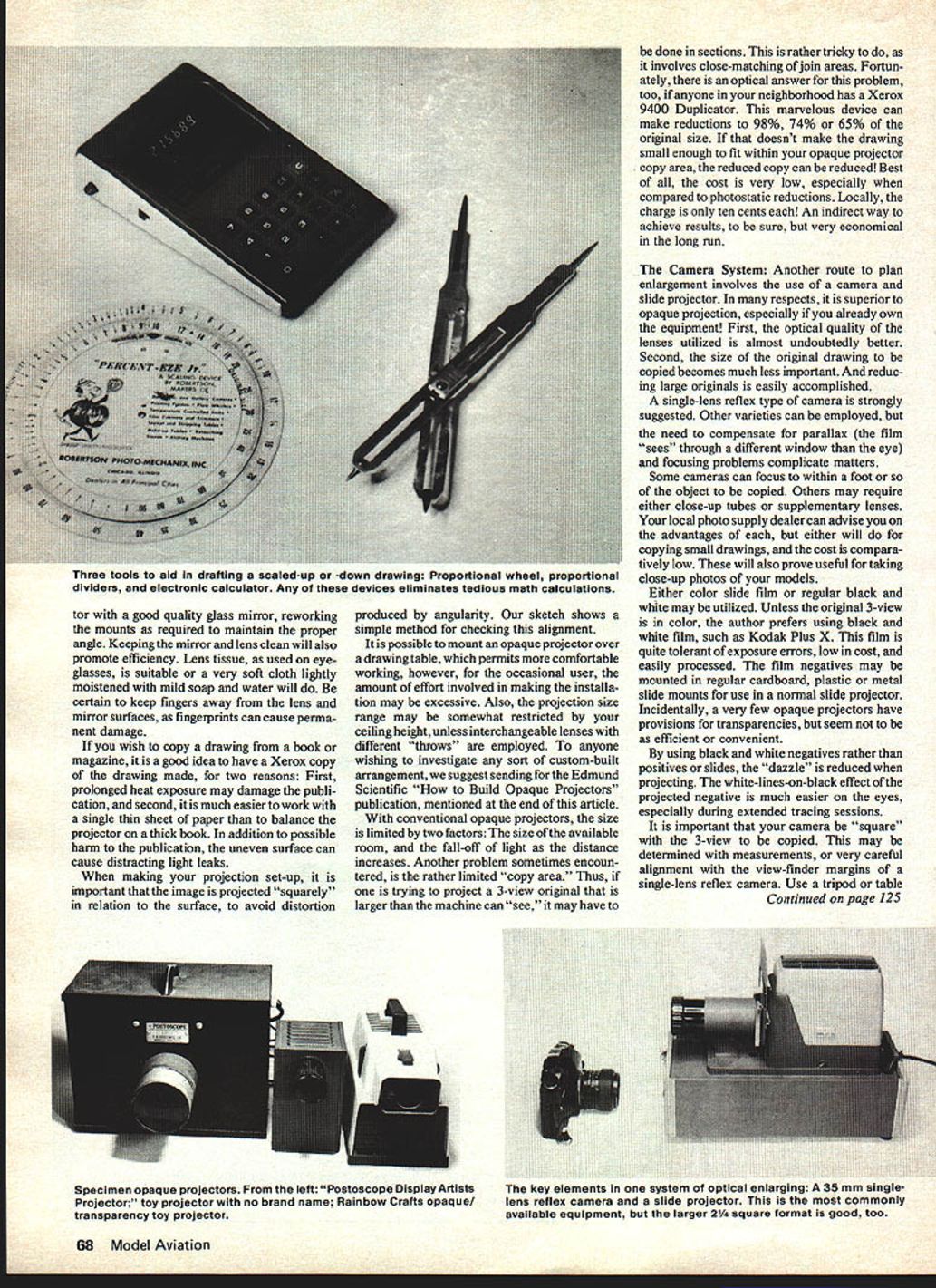
Proportional dividers are draftsman's tools that transfer point measurements directly from the small original to final size. Adjusted for ratio, they eliminate ordinary ruler measurements. However, the number of operations makes the system laborious and slow, and it is subject to errors—especially for very large blow-ups.
Pantographs
Pantographs operate similarly to proportional dividers but involve a continuous tracing action with a stylus, duplicated through linkage to the desired size by a pencil. Limitations include insufficient travel for very large plans and difficulty maintaining even pressure because of the flexible linkage. Despite their age, some people still appreciate and use them.
Photostats
Photostats are the fastest way to enlarge a plan or 3-view but also the most costly for giant sizes. The process uses a camera lens to enlarge the image and project it onto sensitized material (film). Better machines use precision optics, rigid construction, and vacuum frames to hold the drawing and minimize distortion. Operator skill and choice of materials are key.
- Be aware of slippage caused by shrinkage or stretching during wet processing. Experienced operators can often anticipate and compensate for such changes.
- Mylar film is dimensionally stable and reduces distortion, but it’s more expensive.
- Specify tolerance requirements when ordering a photostat; some firms charge more for tight tolerances.
- Some shops offer PMT direct positive prints, which can be cheaper.
- Negatives can be traced about as easily as positives, so don't rule them out.
- Photostat services are often offered by blueprint companies and print shops; shop around for price and quality.
Rotary calculating device
A handy rotary calculating device (two cardboard calibrated discs) is available from art supply and graphic materials firms. It shows the result of size changes without math. For example, to find a wing chord when enlarging to a 72-inch span, set one dial to 72 in. and the other to the span on the 3-view. Measure the 3-view chord, find it on the rotary disc, and read the model-size chord directly.
- An electronic calculator will do the same job, but the rotary wheel never needs batteries.
- Either system lets you preview prop clearance, wheel diameter, etc., before committing to an enlargement.
Opaque projectors
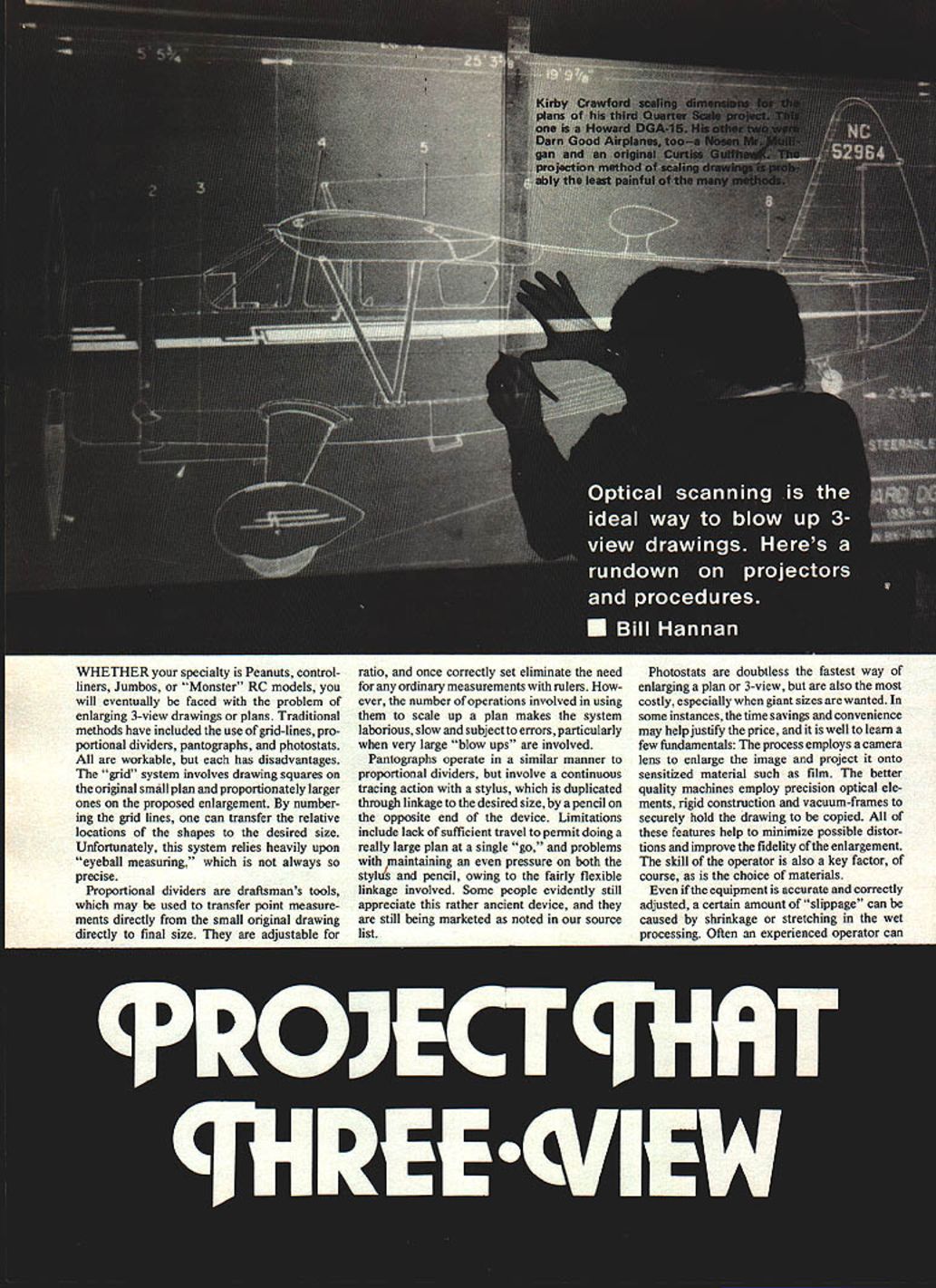
Opaque projectors are an optical approach that reflects a small image via a mirror and lens onto a surface such as a wall. By tracing the projected image on paper, you can quickly produce an enlarged drawing. Size is adjusted by changing the distance from projector to surface; fine focus is achieved by moving the lens holder.
Guidelines and limitations
- Quality varies widely: some devices are nearly toys; others are expensive professional units. Check schools or libraries for access to high-end equipment.
- Low-priced projectors often have poorer optical properties; the center of the image may be sharper than the edges.
- You can improve overall sharpness by mounting a cardboard disc with a small hole directly in front of the projection lens. This increases sharpness but reduces light intensity; working in a dark room can make this acceptable. Experiment to find the best hole size.
- Replacing frosted bulbs with clear types can improve brightness—observe maximum wattage ratings to avoid damage.
- Some top projectors can be improved by replacing polished metal reflectors with good-quality glass mirrors and reworking mounts as required.
- Keep mirrors and lenses clean using lens tissue or a very soft cloth lightly moistened with mild soap and water. Avoid touching optical surfaces with fingers.
Practical tips
- If copying from a book or magazine, make a Xerox copy to protect the publication and to provide a thin, flat sheet for projection.
- Ensure the image is projected squarely relative to the surface to avoid distortion produced by angularity (our sketch shows a simple method for checking alignment).
- Mounting an opaque projector over a drawing table can make tracing more comfortable, though ceiling height may restrict enlargement size unless interchangeable lenses are used.
- Refer to Edmund Scientific’s "How to Build Opaque Projectors" for custom-built options.
Copy area and alternatives
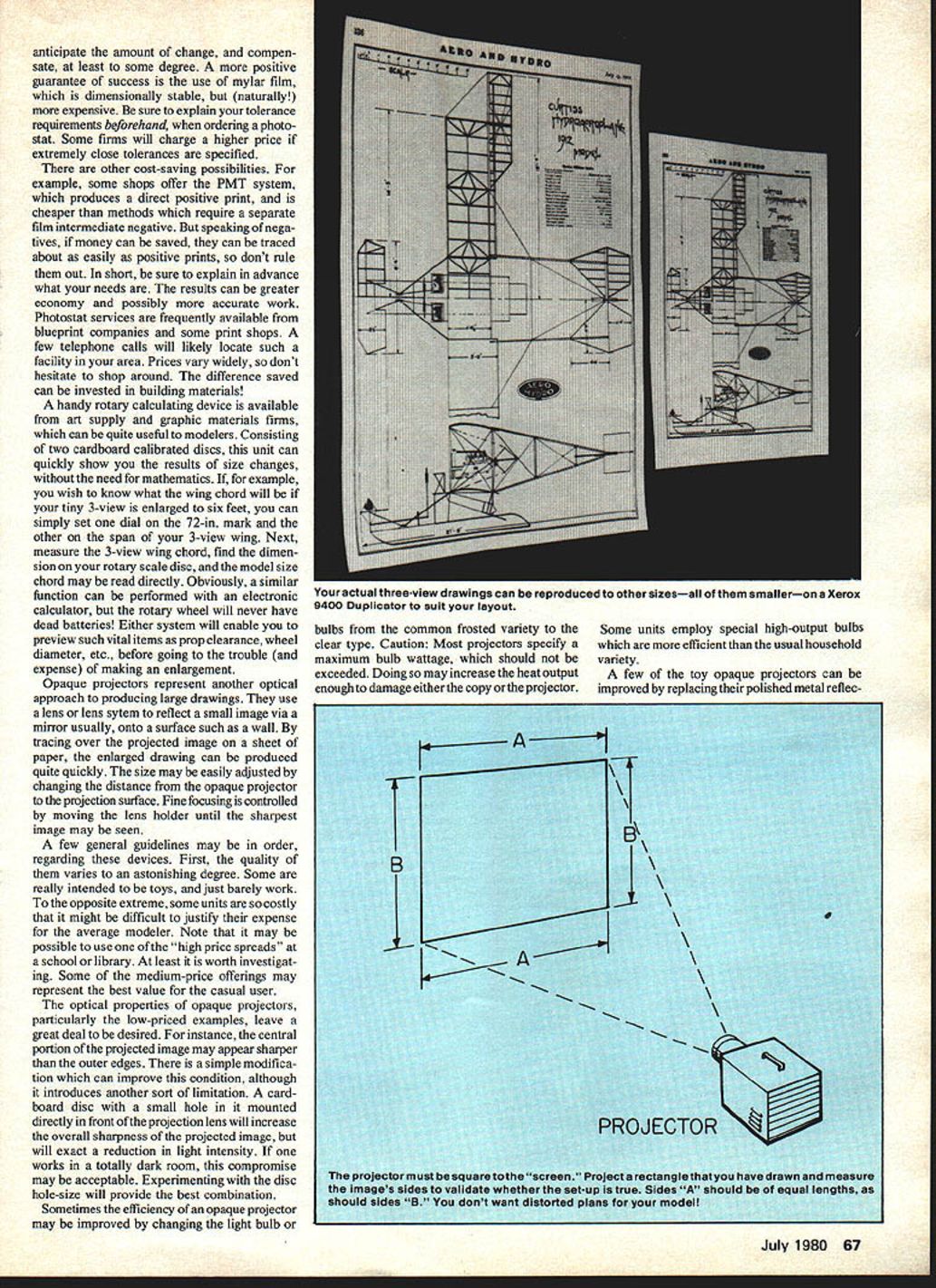
Conventional opaque projectors are limited by room size, light fall-off, and the projector’s copy area. If a 3-view original is larger than the machine can "see," you may need to project in sections and match joints carefully. An alternative is to use a Xerox 9400 duplicator to reduce large originals to 98%, 74%, or 65%—sometimes repeatedly—so they will fit within your projector’s copy area. This can be economical compared with photostats.
The Camera System
Another route to plan enlargement is using a camera and slide projector. This method is often superior to opaque projection, especially if you already own the equipment.
Camera recommendations
- A single-lens reflex (SLR) camera is strongly suggested to avoid parallax and focusing problems.
- Some cameras focus within a foot of the object; others require close-up tubes or supplementary lenses—check with a local photo-supply dealer.
- Either color slide film or black-and-white film may be used. The author prefers black-and-white film (e.g., Kodak Plus X) for non-color originals because it tolerates exposure errors, is low cost, and processes easily.
- Use black-and-white negatives rather than positives: projecting a white-lines-on-black negative is easier on the eyes during extended tracing sessions.
Shooting tips
- Make sure the camera is square with the 3-view. Determine this with measurements or careful alignment with the SLR viewfinder.
- Use a tripod or table for steadiness and a cable release for the shutter.
- Stop the lens down (higher f-number such as f/16 or f/22) for optimum sharpness.
- Light the original evenly—sunlight outdoors or two lamps indoors from left and right. The SLR viewfinder helps reveal glare or shadow problems.
- Bracket exposures (take a few different settings) to increase the chances of good results, and keep records of camera settings for repeatability.
- Photograph a number of different 3-views while set up; negatives or mounted slides take little storage space and are easy to catalog.
Uses and permissions
- Camera or opaque projector systems may also be used to enlarge photographs of models or full-scale planes to obtain one-view drawings to supplement a 3-view.
- If you use pictures from books, magazines, or similar sources, obtain permission if you plan to copy and sell the resulting plans.
- Projectors can be used with photographs as well as drawings—for example, projecting insignia or markings directly onto construction drawings to save time and improve accuracy.
A word about drawings
A high percentage of 3-view drawings contain errors caused by faulty references, perception, drafting mistakes, carelessness, or guesswork. Reproduction processes may introduce additional distortions. These discrepancies are greatly magnified when enlarged.
- Compare dimensions between views (e.g., fuselage length in top view vs. side view).
- Check printed specifications against the drawing, but be wary of typographical mistakes in written specs.
- Resolve any inconsistencies by correction or by selecting an alternative 3-view before investing time in enlargements.
- Compare drawings with photographs of the subject aircraft, allowing for perspective and lighting effects. The more photos available, the better.
- Vern Clements: "When comparing various drawings for accuracy, believe in the photographs!"
- Benno Sabel: "It is better to refer to photos than to technical drawings (3-views)."
Tracing, cleanup, and designing
Once you have your enlargement, overlay it with drafting vellum, tracing paper, or mylar drafting film. Use drafting tools (T-square, triangles, French curves) to make a clean tracing, eliminate free-hand "wiggles," and incorporate corrections. Then design the model structure, consulting published plans for similar subjects to guide structural layout.
Designing can seem formidable at first, but after several efforts the process becomes more satisfying—and for some modelers more enjoyable than the building itself.
Summary
Optical sizing can save time, minimize tedious computations, and offer a shortcut to producing new designs. Consider adding these methods and tools to your modeler's bag of tricks.
Source List
- Proportional dividers and scaling devices (proportion wheels) may be obtained from engineering equipment suppliers and large art supply outlets.
- Photostat services are offered by some blueprint firms and many printing establishments—consult the Yellow Pages.
- Camera supply stores can provide information on SLR cameras, slide mounts, and slide projectors. Used equipment and rentals are often available.
- Opaque projectors are stocked by large art supply houses and some toy stores, and may be ordered by mail. Prices and availability may have changed since this list was compiled—send a stamped, addressed envelope to suppliers for current information.
Edmund Scientific Co.
- 1888 Edscorp Building
- Barrington, NJ 08007
- "How to Build Opaque Projectors" (8 different designs) $1.50
- Deluxe Opaque Projector — #80217
- 6 x 6" copy area, two 200-watt bulbs, cooling fan, $89.95
- Imported West German Opaque Projector — #72.443
- 5 x 5" copy area, 150-watt quartz halogen lamp, cooling blower, $229.95
Foster-Tret, Inc.
- Dept. 4500-D
- Larchmont, NY 10538
- Episcopic Projector (Made in Italy)
- Hi-intensity projection bulb
- 3 1/4 x 3 1/4" copy area
- $11.95, plus $0.95 shipping and handling
Johnson Smith Company
- 30057 Automation Drive
- Mt. Clemens, MI 48043
- Panograph (25 different ratios) $68.82
- $7.95 plus $1.29 shipping and handling
- Opaque Projector
- 3 x 4" copy area
- #6007 $10.95, plus $1.69 shipping and handling
- Powerful Enlarger and Projector
- 400-watt, heavy-duty motor with fan
- 6 x 6" copy area
- $69.95, $8.95 plus $2.00 shipping and handling
F. D. Kees Mfg. Co.
- Beatrice, NE 68310
- Postscope "Display Artist Projector"
- Model E
- 3 x 6" copy area, two 100-watt bulbs
- Send for current price
Transcribed from original scans by AI. Minor OCR errors may remain.

