
Project Time Machine
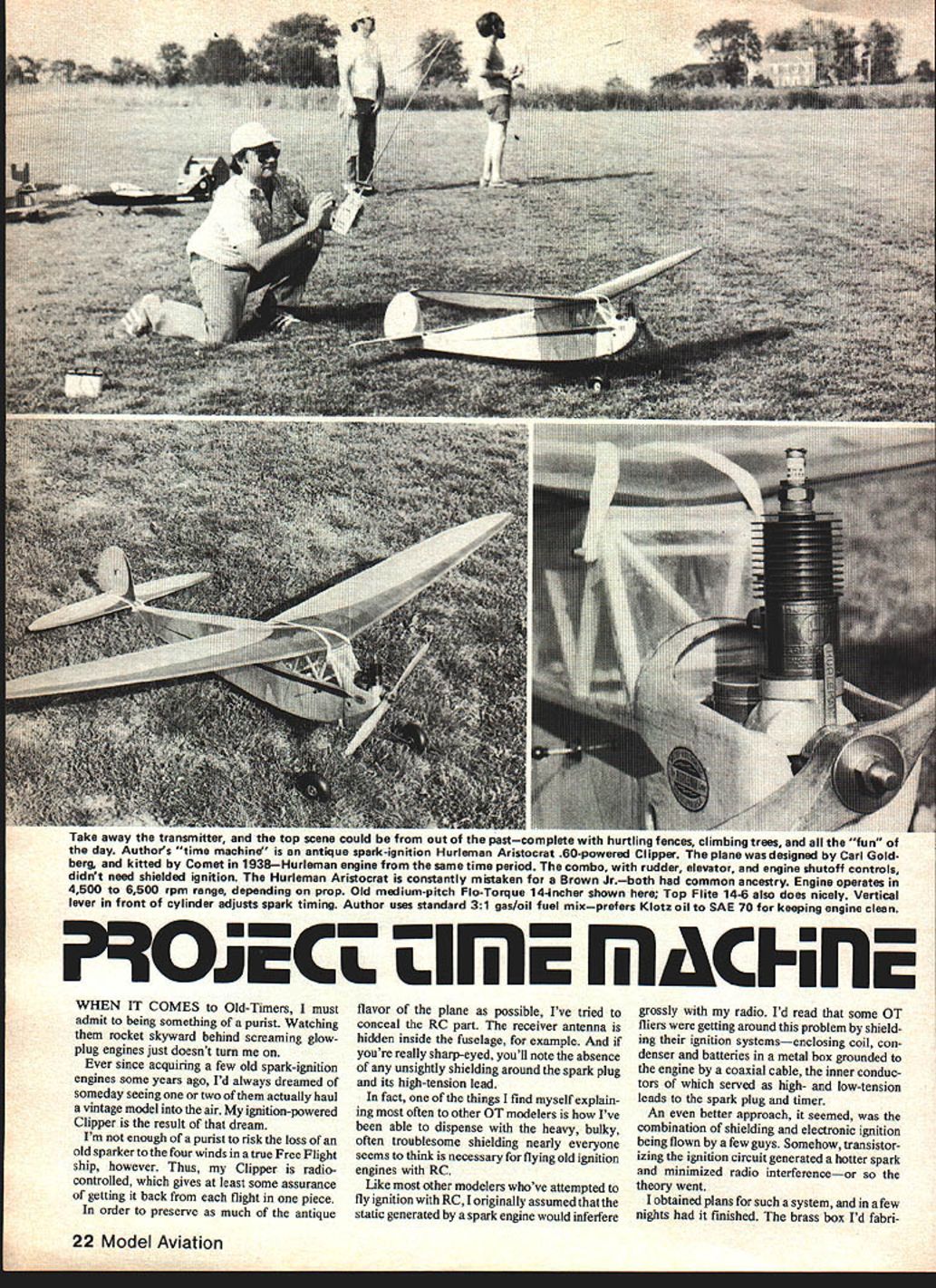
When it comes to Old-Timers, I must admit to being something of a purist. Watching them rocket skyward behind screaming glow-plug engines just doesn't turn me on. Ever since acquiring a few old spark-ignition engines some years ago, I'd always dreamed of someday seeing one or two of them actually haul a vintage model into the air. My ignition-powered Clipper is the result of that dream.
I'm not enough of a purist to risk the loss of an old sparker to the four winds in a true Free Flight ship, however. Thus, my Clipper is radio-controlled, which gives at least some assurance of getting it back from each flight in one piece.
Preserving the antique appearance
In order to preserve as much of the antique flavor of the plane as possible, I've tried to conceal the RC part. The receiver antenna is hidden inside the fuselage, for example. And if you're really sharp-eyed, you'll note the absence of any unsightly shielding around the spark plug and its high-tension lead.
One of the things I find myself explaining most often to other OT modelers is how I've been able to dispense with the heavy, bulky, often troublesome shielding nearly everyone seems to think is necessary for flying old ignition engines with RC.
Ignition and radio interference — assumptions and experience
Like most other modelers who've attempted to fly ignition with RC, I originally assumed that the static generated by a spark engine would interfere grossly with my radio. I'd read that some OT fliers were getting around this problem by shielding their ignition systems—enclosing coil, condenser and batteries in a metal box grounded to the engine by a coaxial cable, the inner conductor of which served as the high-tension lead to the spark plug and the outer conductor as the timer ground.
An even better approach, it seemed, was the combination of shielding and electronic ignition being flown by a few guys. Somehow, transistorizing the ignition circuit generated a hotter spark and minimized radio interference—or so the theory went.
I obtained plans for such a system, and in a few nights had it finished. The brass box I'd fabricated proved a heavy shoehorn to fit the relatively spacious nose of my first Old-Timer plane, a six-foot Cavalier Standard powered by an Ohlsson 60.
Unfortunately, the system proved a total failure—produced not half a dozen sparks before something, I don't know what, blew out. Being no electronics expert I couldn't fix it, so I junked it in favor of another transistorized ignition built by a friend. To make a long story short, that system worked no better. In sheer frustration I yanked the brass box out of the Cavalier and installed an old Smith coil, condenser and a pair of C-size alkaline cells—the same setup I'd used bench-testing engines and was confident in its ability.
Parts used and noise suppression
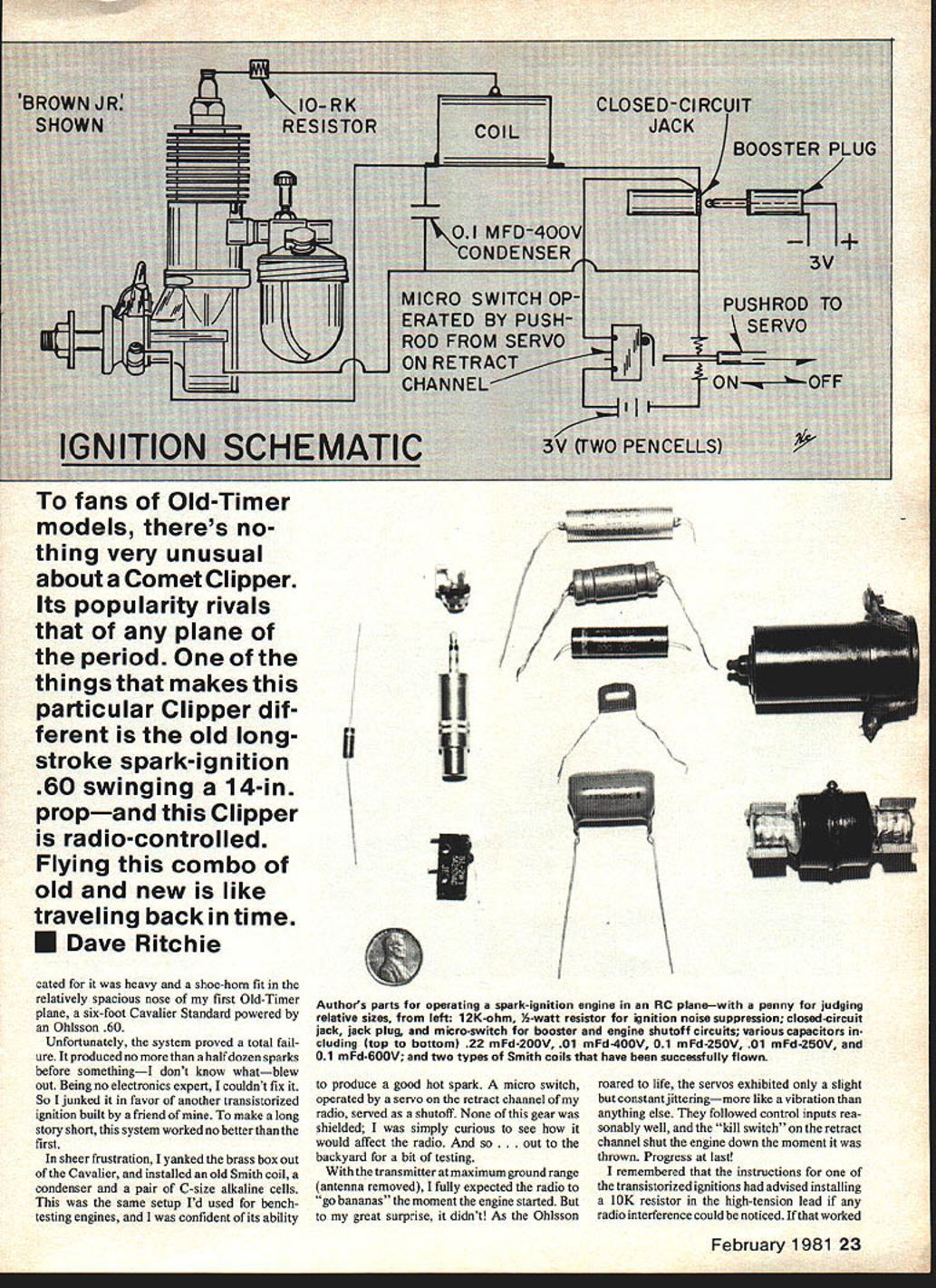
Author's parts for operating a spark-ignition engine in an RC plane included:
- 12K-ohm, 1/2-watt resistor for ignition noise suppression (10K is often recommended)
- Closed-circuit jack and jack plug
- Microswitch for the booster/engine shutoff circuit
- Various capacitors, including:
- 22 µF at 200 V
- 0.01 µF at 400 V
- 0.01 µF at 250 V
- 0.01 µF at 600 V
- Two types of Smith coils have successfully flown and produce a good hot spark
- A microswitch-operated servo on the retract channel of the radio served as the shutoff; no gear was shielded
Ground testing
Simply curious to see what effect shielding would have on the radio, I did a bit of testing in the backyard at maximum ground range with the transmitter antenna removed. I fully expected the radio to go bananas the moment the engine started. To my great surprise, it didn't. As the Ohlsson roared to life the servos exhibited only a slight constant flutter—more like vibration than anything else—and followed control inputs reasonably well. A kill switch on the retract channel shut the engine down the moment it was thrown.
I remembered that instructions for transistorized ignitions advised installing a 10K resistor in the high-tension lead if any radio interference could be noticed. If that worked on an electronic ignition, would it work with a simple coil/condenser setup? In a few minutes I had a resistor added to the spark lead and went through the same test procedure as before. This time the jitters were gone from the elevator and rudder servos, and the shutoff servo twitched only intermittently. Because the servo on that channel jumps occasionally whether or not something is bothering the radio, I figured I had the interference licked.
From the Cavalier to the Clipper
The Cavalier Standard was a crude first attempt. At six pounds it was terribly overweight and marginally airworthy—owing to a definite shortage of fin/rudder area. However, it flew well enough to prove the workability of the ignition/radio combination I had discovered quite by accident.
For a second effort I chose the Clipper—more for its pleasing lines than anything else. That choice, however, necessitated a more compact ignition installation.
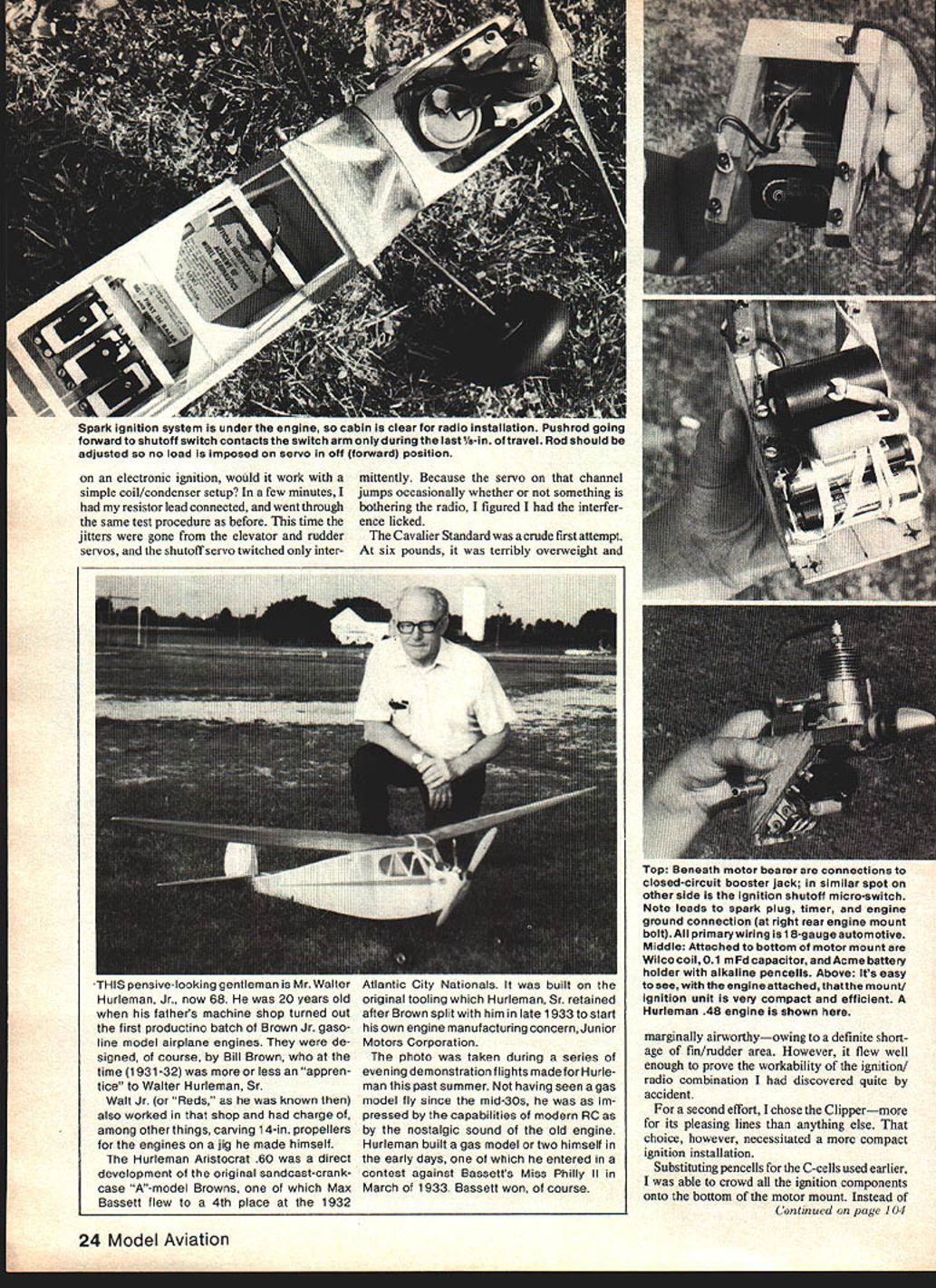
Substituting pencil cells for the C-cells used earlier, I was able to crowd all the ignition components onto the bottom of the motor mount. Instead of the Smith coil, I used a Wilco unit. Its lugs provide an easy method of attachment as well as primary electrical connections. Its fiber shell is also oil-proof, though I hot-stuffed the end covers just to make sure.
I added a miniature closed-circuit jack so the engine could be started and run on booster batteries independent of the pencil cells or the position of the shutoff switch. It's wired so that the booster plug interrupts the circuit to the pencil cells. A "dummy" jack plug can be inserted into the socket to deactivate the entire system.
The extreme forward mounting of the ignition has a number of advantages. It helps to balance the ship, allows maximum distance between the placement of the coil and receiver, and the short length of wiring necessary to reach the timer and spark plug probably contributes to reliable operation of both engine and radio. Fortunately, everything fits neatly beneath the Clipper's nose cowl.
Flight experience and components
To date the ship has accumulated over 300 flights with a number of different power plants (various model Brown Jr. and Hurleman engines from my small collection). I've experimented with different condensers (capacitors). Just about anything between 0.01 and 0.1 mFd at 250 to 600 V will work; the electrical values don't seem to be too critical. The one I like best is 0.1 mFd at 400 V—the same as originally supplied with the Brown Jr. Most caps in this range are polarized, so attention must be paid to pluses and minuses when hooking them up. Also, caps of small physical size don't last long.
I've flown two different Wilco coils and a Smith Competitor coil, in addition to the Smith Firecracker I used in the Cavalier. All work about the same. As far as the spark lead resistor is concerned, there's no noticeable difference between a 10K and a 12K. I would imagine the resistance could be increased until it begins to affect engine performance. With the booster-battery setup I have, pencil cell life is quite good; I've replaced them perhaps three or four times at most.
Radio, servos and susceptibility
The radio may or may not be the most important part of the equation in flying spark-ignition engines with RC. Mine is a five-year-old World Engines Expert Mark I, 7-channel on 75.640 MHz. I've used World's S-11 servos as well as Novak Bantam Midgets with equal success. In the Clipper, a 250 mAh flight battery is entirely adequate for a full day's flying.
Undoubtedly some makes of radios (and maybe some individual receivers of the same make) are probably more susceptible to ignition interference than others. Kraft radios, in particular, seem to have a bad reputation in this regard. And yet Jack Van Dusen has been flying a dual-conversion Kraft receiver along with a really hot unshielded electronic ignition in his Dallaire Sportster recently. Jack, by the way, has a 10K resistor in his spark lead too, so maybe that's the ticket.
Conclusion
Clearly, more work needs to be done. I suspect that spark-ignition engines are probably more flyable with RC than most modelers think—and without having to hire an electrical engineer to dream up a fancy ignition system. Word needs to be passed around as to what works and what doesn't.
If you have an old sparker you'd like to fly, but are afraid of losing it in a Free Flight, why not try RC?
Transcribed from original scans by AI. Minor OCR errors may remain.

