
Prop Pitch Gauge: A Useful Tool?
What is your prop's pitch—really?
Who needs a pitch gauge? Indeed, what is a pitch gauge? Would I use a pitch gauge if I were an umpire in a game of slow-pitch softball? Or is this gauge something that a music teacher uses to tell if your song is on pitch?
The pitch gauge of interest to aeromodelers is not a tool for softball or music, but rather a tool used to measure the pitch of a propeller.
Propeller pitch is the forward travel (in inches) of a propeller during one revolution, if the propeller acted like a section of a bolt being screwed into a nut (i.e., without any slippage). With uniform pitch, the pitch should be the same at all locations along the propeller blade.
So what's the big deal? Why the concern over propeller pitch? You just use a pitch change to adjust flight speed—right? Besides, if the pitch is wrong, what can you do?
I thought you'd never ask! The pitch of the propeller can have a strong effect on takeoff thrust, and the actual pitch may be different than the one marked on the propeller.
DON BROOKS
While doing experiments with electric power, I discovered some information about propeller pitch that was new to me. These facts may be important to any flier, glow or electric.
First, for some propellers the pitch has a strong effect on static thrust (thrust available for takeoff). This is particularly important for someone like myself who flies electric-powered models at higher elevations.
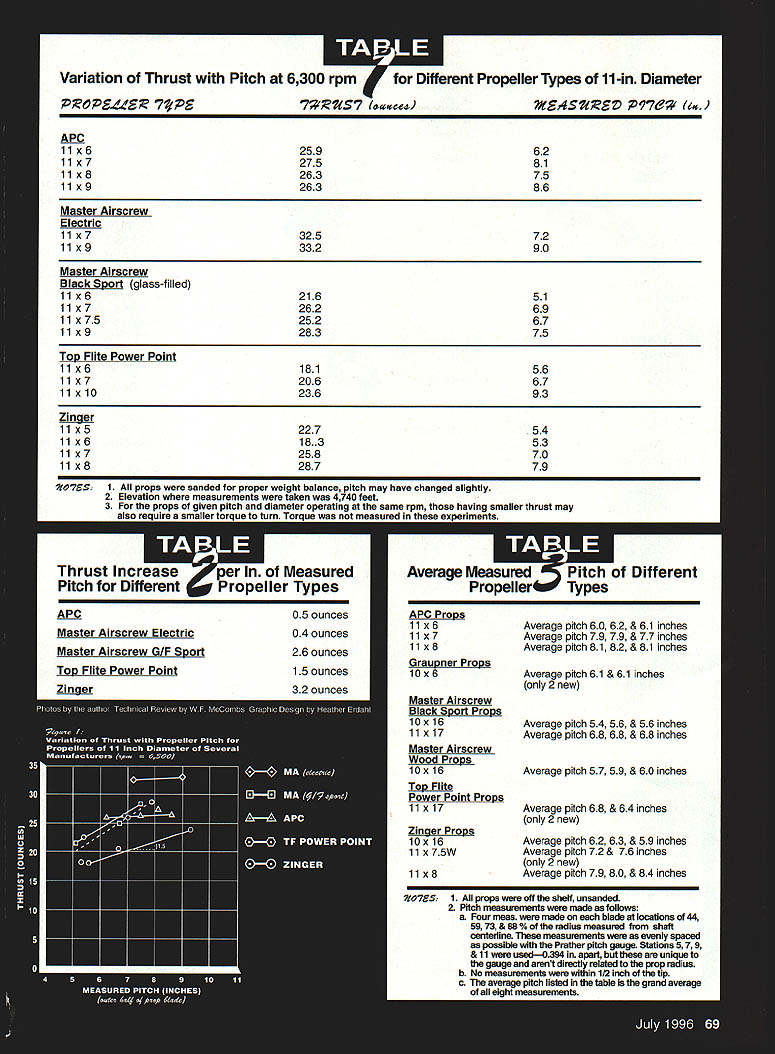
For example, Zinger and Master Airscrew propellers show a strong variation of thrust with pitch. APC propellers and the Master Airscrew Electric propellers show a very slight variation of thrust with pitch. See the comparison of 11-inch propellers shown in Table 1 and Figure 1. Note that the thrust values were measured at a 4,740-foot elevation.
There is an anomaly in the actual pitch of the APC 11 x 7 and 11 x 8 propellers that I cannot explain. The pitch values of the propellers in my personal stock are reversed. The 11 x 7 has a larger measured pitch than the 11 x 8. Perhaps these propellers are from an older production run. The newer ones measured in a hobby shop (described in Table 3) aren't reversed, but are still close to the same value of pitch. The thrust values shown in Table 1 and Figure 1 would be approximately 15% greater for the same rpm at a sea-level elevation.
Table 2 summarizes the measured thrust per inch of pitch change for each propeller type. Note that Zinger and Master Airscrew Sport propellers show the strongest thrust increase for each inch of pitch increase. These values would also be about 15% greater at sea level.
Another important point to remember is that the pitch value stamped on the propeller may not always be correct. The manufacturing process is not always perfect. For example, I measured the pitch of three 11 x 7 propellers and three 11 x 8 propellers from the same manufacturer, and found the average pitch over the outer half of the propeller blades was 7.8 and 8.1 inches respectively. These were supposed to have a one-inch difference, but the averages were 7.8 and 8.1 inches—differences of only 0.3 inches. Going from the 11 x 7 to the 11 x 8 for this style of propeller would not give the expected speed adjustment.
Table 1
Variation of Thrust with Pitch at 6,300 rpm for Different Propeller Types of 11-in. Diameter
PROPELLER TYPE | THRUST (ounces) | MEASURED PITCH (in.) --- | ---: | ---: APC 11 x 6 | 25.9 | 6.2 11 x 7 | 27.5 | 8.1 11 x 8 | 26.3 | 7.5 11 x 9 | 26.3 | 8.6
Master Airscrew Electric 11 x 7 | 32.5 | 7.2 11 x 9 | 33.2 | 9.0
Master Airscrew Black Sport (glass-filled) 11 x 6 | 21.6 | 5.1 11 x 7 | 26.2 | 6.9 11 x 7.5 | 25.2 | 6.7 11 x 9 | 28.3 | 7.5
Top Flite Power Point 11 x 6 | 18.1 | 5.6 11 x 7 | 20.6 | 6.7 11 x 10 | 23.6 | 9.3
Zinger 11 x 5 | 22.7 | 5.4 11 x 6 | 18.3 | 5.3 11 x 7 | 25.8 | 7.0 11 x 8 | 28.7 | 7.9
Notes:
- All props were sanded for proper weight balance; pitch may have changed slightly.
- Elevation where measurements were taken was 4,740 feet.
- For props of given pitch and diameter operating at the same rpm, those having smaller thrust may also require a smaller torque to turn. Torque was not measured in these experiments.
Table 2
Thrust Increase per In. of Measured Pitch for Different Propeller Types
- APC: 0.5 ounces
- Master Airscrew Electric: 0.4 ounces
- Master Airscrew G/F Sport: 2.6 ounces
- Top Flite Power Point: 1.5 ounces
- Zinger: 3.2 ounces
Figure 1 Variation of Thrust with Propeller Pitch for Propellers of 11 Inch Diameter of Several Manufacturers (rpm = 6,300)
Photos by the author. Technical review by W. F. McCombs. Graphic design by Heather Erdrath.
Table 3
Average Measured Pitch of Different Propeller Types
APC Props
- 11 x 6: Average pitch 6.0, 6.2, & 6.1 inches
- 11 x 7: Average pitch 7.9, 7.9, & 7.7 inches
- 11 x 8: Average pitch 8.1, 8.2, & 8.1 inches
Graupner Props
- 10 x 6: Average pitch 6.1 & 6.1 inches (only 2 new)
Master Airscrew Black Sport Props
- 10 x 6: Average pitch 5.4, 5.6, & 5.6 inches
- 11 x 7: Average pitch 6.8, 6.8, & 6.8 inches
Master Airscrew Wood Props
- 10 x 6: Average pitch 5.7, 5.9, & 6.0 inches
Top Flite Power Point Props
- 11 x 7: Average pitch 6.8 & 6.4 inches (only 2 new)
Zinger Props
- 10 x 6: Average pitch 6.2, 6.3, & 5.9 inches
- 11 x 7.5W: Average pitch 7.2 & 7.6 inches (only 2 new)
- 11 x 8: Average pitch 7.9, 8.0, & 8.4 inches
Notes:
- All props were off the shelf, unsanded.
- Pitch measurements were made as follows:
- Four measurements were made on each blade at locations of 44, 59, 73 & 88% of radius from the shaft centerline. Measurements were averaged.
- These measurements were as evenly spaced as possible.
- The average pitch listed in the table is the grand average of all eight measurements.
Also note that for comparing the performance of one style of propeller with another, the actual pitch may have a significant effect on the thrust produced. For a valid comparison, the actual pitch of the propellers being compared must be the same. The measurements for a sampling of six different types of propellers are shown in Table 3.
The pitch values shown in Tables 1 and 3 are the averages of pitch measurements made over both blades at 44, 59, 73, and 88% of the radius of the propeller blade, as measured from the shaft centerline. These locations were convenient for the gauge I was using.
These measurements could be made without a pitch gauge using the formula below, and the method described by W. F. McCombs in his book Making Scale Model Airplanes Fly. Mr. McCombs' method uses thin wedges cut to specific angles which are placed under the prop to measure the angle between the back side of the prop and the plane of rotation at 70 or 75% of the radius.
Pitch (in inches) = 2πR tan A
where:
- R is the distance out from the hub center to the station
- A is the angle between the blade and the plane of rotation
Determining the pitch is much easier with a propeller-pitch gauge. You can measure the propeller pitch to determine if you want to use or discard the propeller. If the propeller is not the pitch you want, select another prop. If there is more than 0.3 inches of pitch difference between the blades of the prop, discard the prop to avoid unwanted vibration.
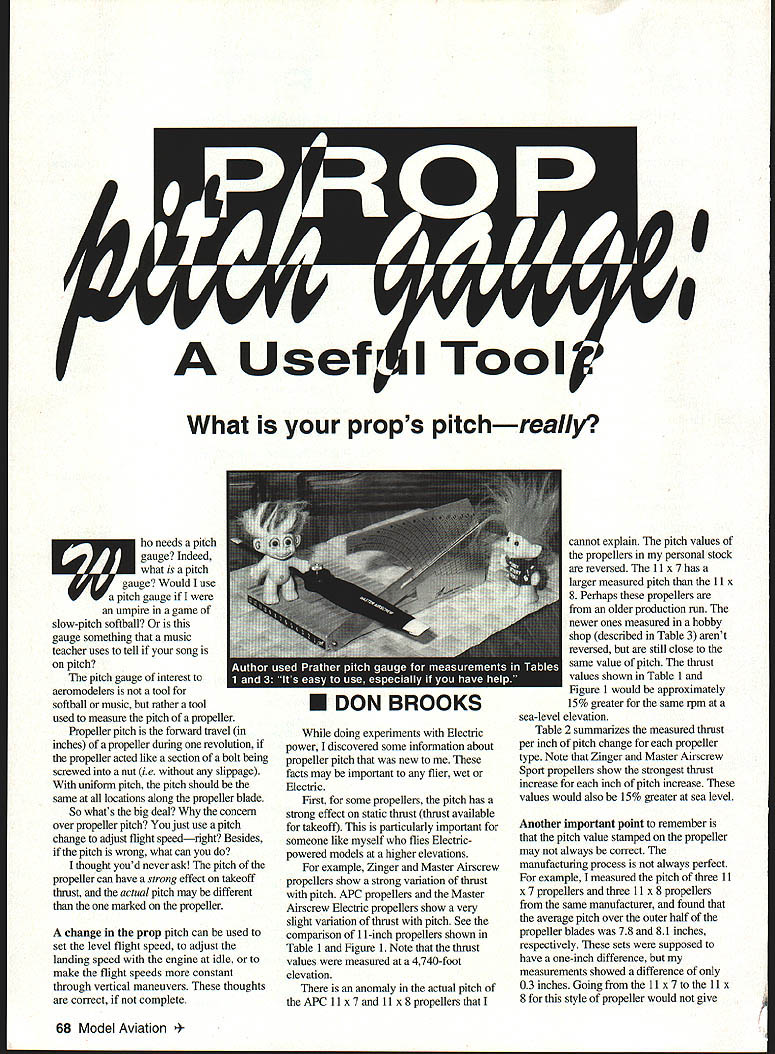
I used a Prather pitch gauge to make the propeller pitch measurements shown in Tables 1 and 3. This gauge is simple to use, especially if you have help; see photograph. The pitch-gauge platform has slots milled across its width at different distances (or stations) from the measuring arm.
A clamp slides in the slots so the back side of the propeller can be lined up against the measuring arm. The pitch can then be read from the scale for each position (station).
I found that for accurate measurements, a light positioned behind the gauge was helpful. As you close the gap between the propeller and the measuring arm, more light is visible at one edge of the propeller—if there is a slight gap between one edge of the propeller and the measuring arm, the edge with the gap will show more light.
When you have purchased propellers, have you ever wondered what their actual pitch was so you could make propeller performance comparisons? Would you like to be able to determine the pitch of the propellers to help obtain consistent flying results? If so, you might consider using the McCombs method, or getting access to a propeller pitch gauge to measure the actual prop pitch. Knowing the actual prop pitch can put you back in "pitch" control.
Sources for products mentioned in this article
- APC propellers: Landing Products, Box 938, Knights Landing, CA 95645
- Graupner propellers: Hobby Lobby International, Inc., 5614 Franklin Pike Circle, Brentwood, TN 37027
- Making Scale Model Airplanes Fly: W.F. McCombs, Aircraft Data, Box 763576, Dallas, TX 75224
- Prather pitch gauge: Prather Products, Inc., 1660 Ravenna Ave., Wilmington, CA 90744
- Top Flite props: Great Planes Model Distributors Co., Box 9021, Champaign, IL 61826-9021
- Master Airscrew props: Windsor Propeller Co., 384 Tescon Court, Santa Rosa, CA 95401
- Zinger props: J&Z Products, 25029 South Vermont Ave., Harbor City, CA 90710
Transcribed from original scans by AI. Minor OCR errors may remain.

