
Pushy Cat
Early career and Little Gem
Jim Miller began racing in 1949 in Goodyear midget racers with cut‑down Luscombe wings. In those early years many competitors used crude cowlings, exposed wheels, and awkward configurations; the winning machines were typically designed by men with extensive racing experience and engineering know‑how. Miller, however, stayed with the 190‑cubic‑inch class midget racers through 1960, improving his airplane bit by bit from his home in Fort Wayne, Indiana.
In 1957 he replaced the plywood‑covered second wing of his No. 14 Little Gem with a beautifully crafted all‑aluminum wing of his own design, gaining enough speed to enter the championship bracket. He won at Fort Wayne in 1959 and again in 1960, clocking 199 mph and 200 mph respectively.
A midair collision that killed Charley Bishop and Jim Rice virtually ended an era of small‑purse pylon racing in the U.S.; America saw no pylon racing for three years. The sport was revived at Reno in 1964. Miller had sold Little Gem and retired from competition; Bob Porter flew Little Gem to victory in 1964 (193 mph) and 1965 (202 mph). The craft later raced as Ole Tiger under Bob Downey and continued finishing among the winners for the next decade.
Move to Texas and the Texas Gem
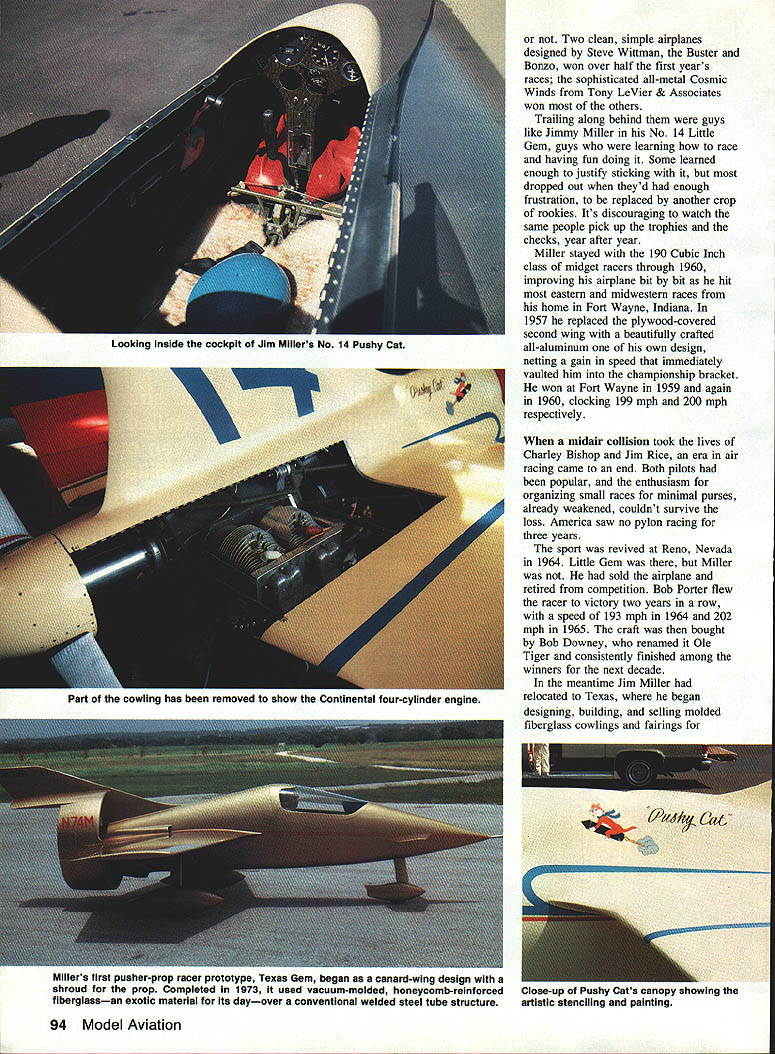
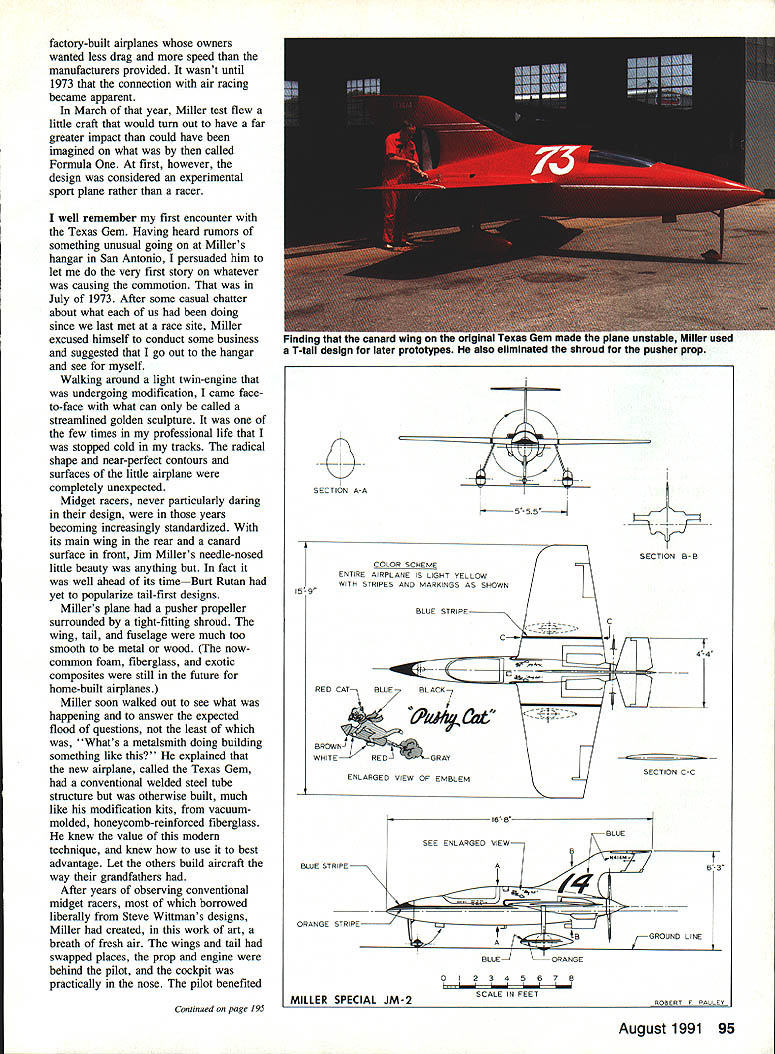
After relocating to Texas, Miller designed and built molded fiberglass cowlings and fairings. Using vacuum‑molded, honeycomb‑reinforced fiberglass over a welded steel‑tube structure—an exotic construction method at the time—he built a radical pusher‑prop prototype called the Texas Gem. Begun in 1971 and first flown in March 1973, the design featured the main wing at the rear, a forward canard, a pusher propeller, and a cockpit nearly in the nose. The airplane’s smooth, near‑perfect contours and composite construction made it look unlike any contemporary midget racer.
Development and modifications
Early flight testing revealed problems. A tight‑fitting propeller shroud could not be made to work because of engine vibration, and the canard configuration “didn’t control right.” Miller removed the shroud, replaced the canard with a more conventional T‑tail and gradually refined the airplane’s aerodynamics and structure. With each change the craft became faster and more controllable; the experimental sport plane was becoming a serious racer.
Racing progress: Texas Gem
Miller returned to racing after a 15‑year hiatus. Key results with the Texas Gem included:
- Mojave, 1975: 7th place, 194 mph (best at that time for a pusher‑prop).
- Cleveland, 1977: 4th place, 207 mph.
- Mexicali, early 1978: 4th place, 226 mph.
- Cleveland, 1978: qualified 223 mph and won the championship race at 233 mph.
From 1979–1981 Miller raced frequently, generally running well (never slower than about 215 mph in 1979). In 1981 he placed 5th in the Reno championship race at 216 mph. In 1982 he won at Petersburg, Virginia, at 223 mph and finished fourth at Reno.
Gem 260, record and tragedy
By 1983 Miller had converted the Texas Gem’s outer skins to graphite, made it a two‑seater with kit production in mind, and repainted it. He then built a second pusher, the Gem 260, specifically aimed at racing. Miller flew the Gem 260 in 1984 in the Lowers‑Baker‑Falck 500‑mile speed/efficiency competition and set an FAI 100‑km speed record for its class at 229.41 mph—a record that stood for years.
On September 1, 1984, veteran pilot Chuck Andrews was practicing in the Gem 260 for Reno when a wooden propeller blade broke, producing catastrophic vibration. The airplane broke up in flight and Andrews was killed.
Later Texas Gem success and sale
In 1985 Miller won three Midwestern races in succession—Detroit (216 mph), Cleveland (221 mph), and Columbus, Ohio (209 mph)—and finished third at Reno at 221 mph. He experimented with handmade pusher propellers and, after negotiation with race officials, obtained permission to retract the nose wheel (the rule allowed retracting any third wheel).
In 1986, Miller’s final season flying his pioneering No. 73 Texas Gem, he turned 234 mph at Minot, North Dakota (2nd place). After qualifying at 234 mph, he finished 3rd at Reno at 221 mph. He then sold the Texas Gem to Errol Roberson; Roberson renamed it Puffin and continued racing it. Later, in a separate incident at Reno, Puffin came apart in violent air during a heat race and Roberson was seriously injured.
Pushy Cat is born
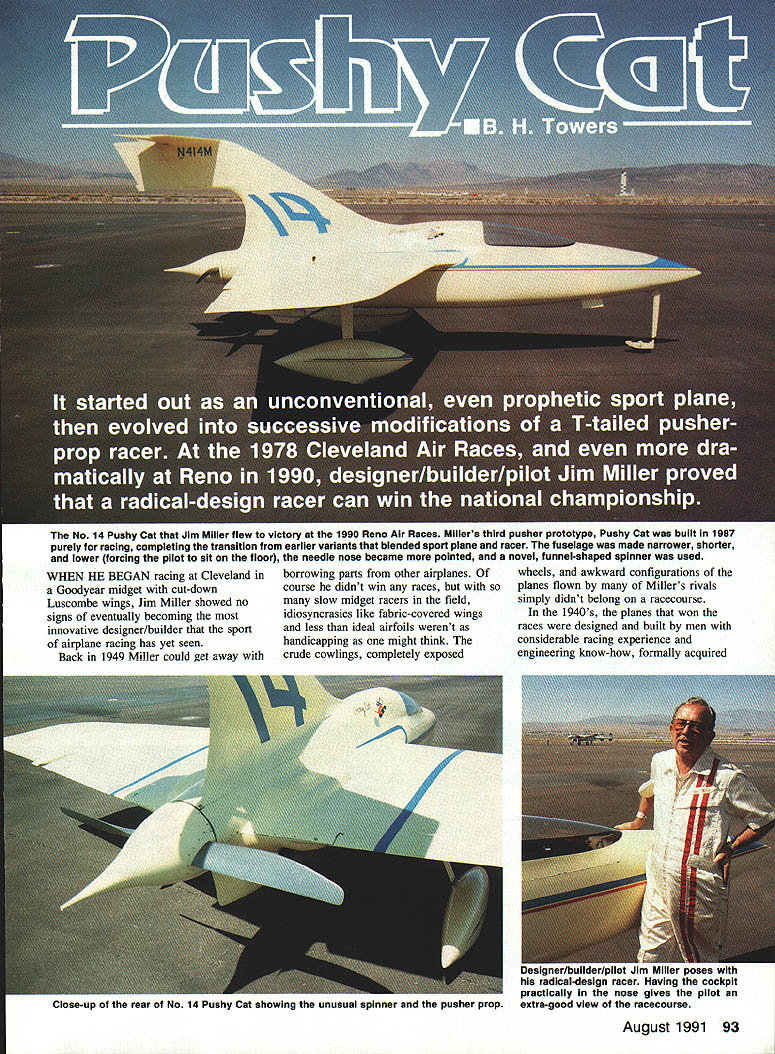
In March 1987 Miller and an assistant began work on a new pusher racer. Finished in early September using professional molds, the No. 14 Pushy Cat was narrower, shorter, and lower than its predecessor, with a more pointed nose and a novel funnel‑shaped spinner. Wingspan and wing area remained within Formula One limits; landing gear construction stayed similar (aluminum core wrapped with graphite main legs, steel tube nose gear).
Pushy Cat’s debut was immediate and impressive:
- Reno Air Races, September 1987: qualified 4th at 226 mph; championship race 223 mph but a pylon cut dropped him to 3rd.
- San Diego, 1987: 2nd in finals at 230.5 mph.
- 1988: two San Diego wins (227.6 mph and 229.7 mph) and a win at Albuquerque.
Reno drama and championships
Reno 1988 was a fast, competitive event. Alan Preston set a one‑lap Formula One record of 246.2 mph; Miller qualified second at 236.7 mph. In the final race, Miller led early but was overtaken during the fifth lap when something went wrong with Pushy Cat; he retired from that race.
1989 was mixed. Miller dominated a Cleveland weekend (Preston absent) but had variable results overall. At Reno 1989, Jon Sharp surprised with a preliminary 242.548 mph; Miller qualified third at 238.975 mph. In heat racing Miller set a speed record of 243.544 mph and won both heats, but the final saw him post 229.945 mph to Marv Cote’s winning 231.251 mph.
At Reno in 1990 Miller returned in top form. Twenty‑three Formula Ones qualified; Jim Bumford was fastest in time trials at 244.081 mph, Miller was second at 241.553 mph. Miller won the fast heats at 230.187 and 232.548 mph and in the championship final narrowly beat Hep Porter (Shoestring) by half a second over the 25‑mile course, 237.405 mph to 237.084 mph.
After decades of experimentation and refinement, Miller had proved that a radical‑design pusher could not only compete with conventional racers but also win national championships. His fans celebrated, signs reading “It’s Miller Time!” proliferated in the pits, and Pushy Cat came to symbolize the potential of innovative design in Formula One air racing.
Notable achievements and legacy
- Pioneered vacuum‑molded, honeycomb‑reinforced fiberglass construction in Formula One racing.
- Converted an experimental sport plane (Texas Gem) into a championship contender.
- Set an FAI 100‑km speed record (Gem 260) at 229.41 mph.
- Developed Pushy Cat (No. 14), a purpose‑built pusher racer that won major races including the 1990 Reno Formula One national championship.
Miller’s work demonstrated that unconventional configurations—when carefully developed and tested—could outperform traditional designs. Pushy Cat’s success left a lasting mark on pylon racing and inspired others to explore composite construction and pusher configurations.
Transcribed from original scans by AI. Minor OCR errors may remain.

