
Put on an Auction/Swap Shop
Patrick A. Cosmato
Want to raise money, attract new members, share with modelers far and near, and have an all‑round good time? Read what the author has to say about organizing and running a successful auction/swap shop.
Club needs money? Yes. Raise dues? No. Have a raffle? Ugh. Through the years modeling clubs have tried all types of fund‑raising projects including raffles, fun flies, contests, and so forth. The idea of an auction/swap shop is by no means new, but it is certainly one of the most fun and most participated‑in events a club can sponsor.
We at Roanoke Valley Radio Control are about to present our 5th Annual Wintertime Auction and Swap Shop and would like to share with clubs around the country some of our experiences. What follows are suggestions and some dos and don'ts as we perceive them, plus a brief history of our little success story.
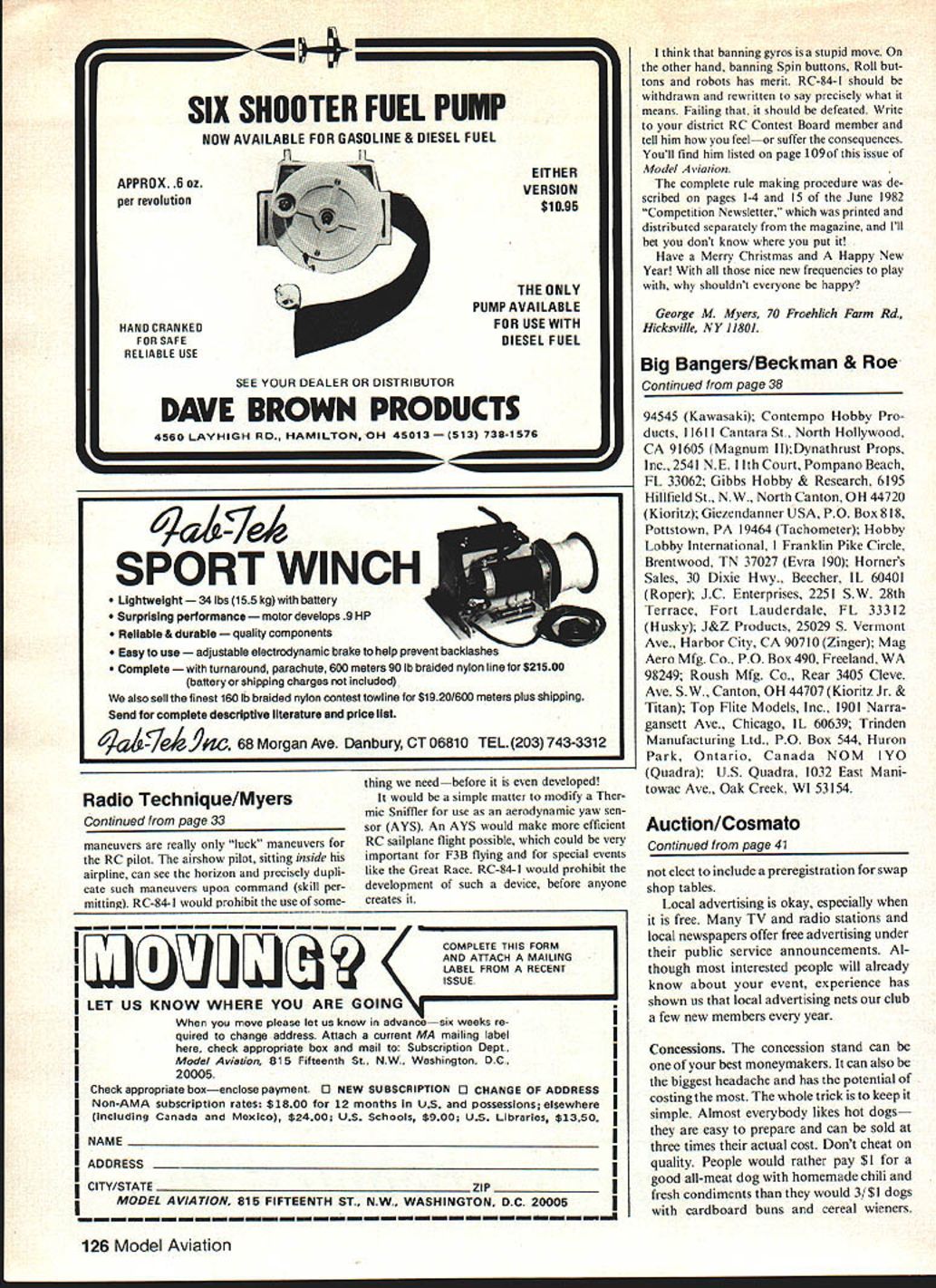
It all started innocently enough. We needed a program to get members out to our monthly club meeting. It was the end of winter, and boredom had set in—we were tired of building, and the weather was getting worse instead of better. When someone suggested that we hold a little inter‑club auction, everyone got excited. We all had something we wanted to sell, and if we made a little money we could buy that new engine, kit, or radio that we had been dreaming about. We found out that someone's junk is inevitably someone else's treasure. Our inter‑club auction continued for a few years until about five years ago when we decided to invite some neighboring clubs, and since then the RVRC Wintertime Auction has become a tradition.
We progressed from a meeting room at a local restaurant to a community center. We are currently using an entire high school. Our largest attendance so far is estimated at about five hundred, and we are looking for even more at our 5th Annual Auction which will be held March 5, 1983.
Membership participation
This, for some reason, seems to be a common problem in almost any project. The best way to get the most participation out of the most members is communication. If you don't ask for help, you will never get it.
A list of all jobs or positions needs to be prepared, and individual members or groups of members should be assigned specific tasks in advance. Notice that I said assign—if you prepare a list, take it to a club meeting, and ask for volunteers, be prepared for disappointment. However, if you personally call or meet with a particular member or group and ask them to take a specific job, the results will more likely be positive.
- Avoid vague requests such as, "Hey guys, I need a volunteer to set up the tables at our swap shop."
- Instead, be specific: "Jerry, would you be in charge of coordinating the swap shop floor plan and getting a layout of the table arrangements to the people at the registration desk?"
Site selection
Almost everything about site selection is pretty obvious: you need as much room as possible with adequate parking. The biggest problem is growth. When you spend money for a bigger site to accommodate people, and you make money, the best policy is to start out small and grow to meet needs.
Date/time selection
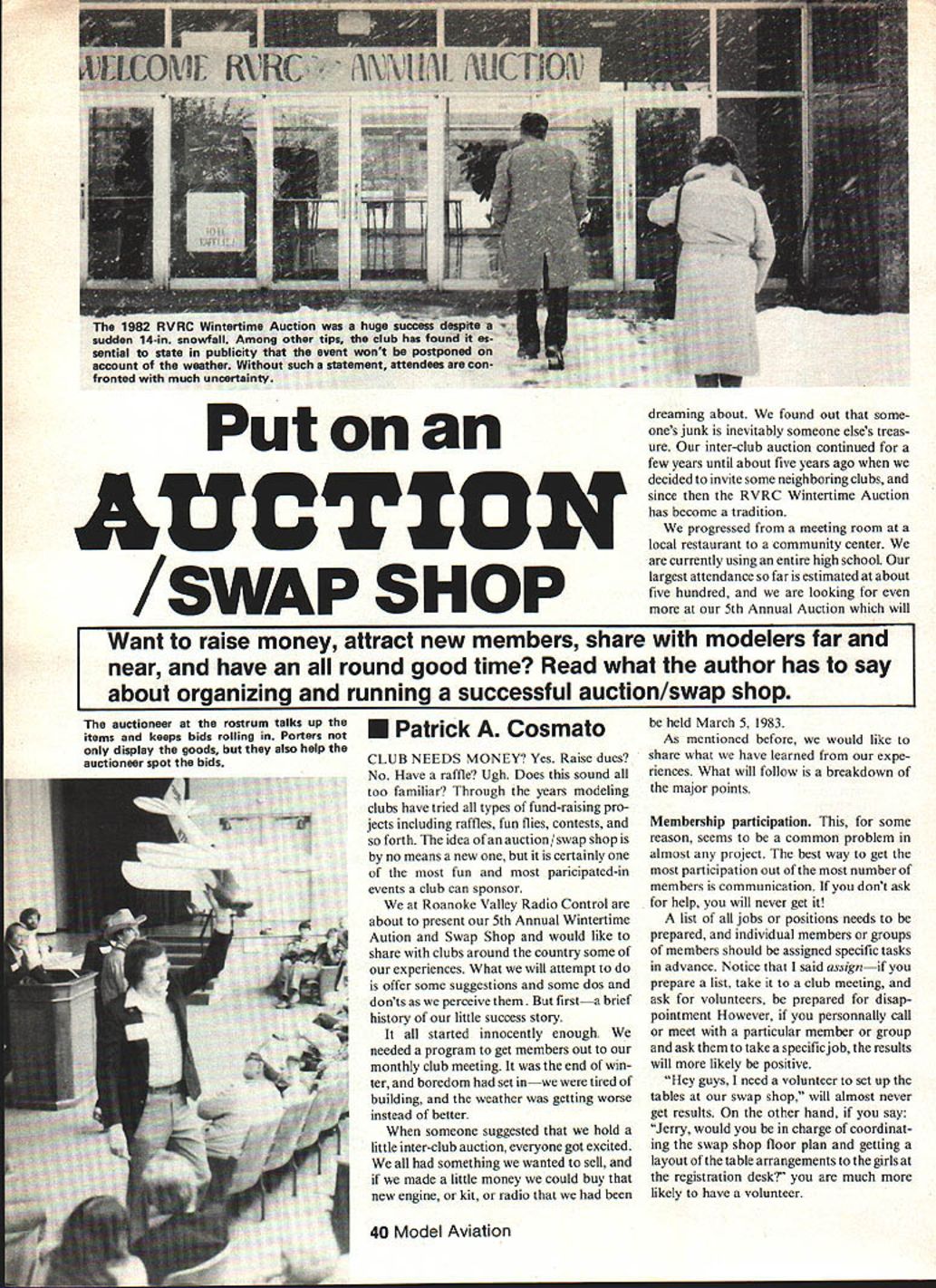
A weekend is essential — make it a one‑day event. Saturday is best. Try to stay several weeks away from any other major modeling event in the area or part of the country. Wintertime is best because nothing else is happening. Be sure the date is emphatically stated in the advertising. We learned the hard way during the 1982 Auction when 14 inches of snow kept the phones ringing off the hook. People called on the day of the event to see if it was still on, and continued calling the week afterwards to see if it was rescheduled. Despite the weather the turnout was good, but it would have been better if everyone had known beyond doubt that the auction would take place regardless of weather.
Fees
We have found it is best to charge everyone over 12 years of age who comes through the gate. The amount should be reasonable—say $1 to $3 per person. Don't be ashamed about asking a fee; it shows the town the event is worth the money. Under certain circumstances consider charging a percentage of what was sold, but the logistics of keeping track of purchases and amounts can lead to disputes and ill feelings.
Other good ways to make money at such an event:
- Rent tables for pre‑event wheeling and dealing — suggested fee $5 to $15 per table.
- Sell concessions (see concession section below).
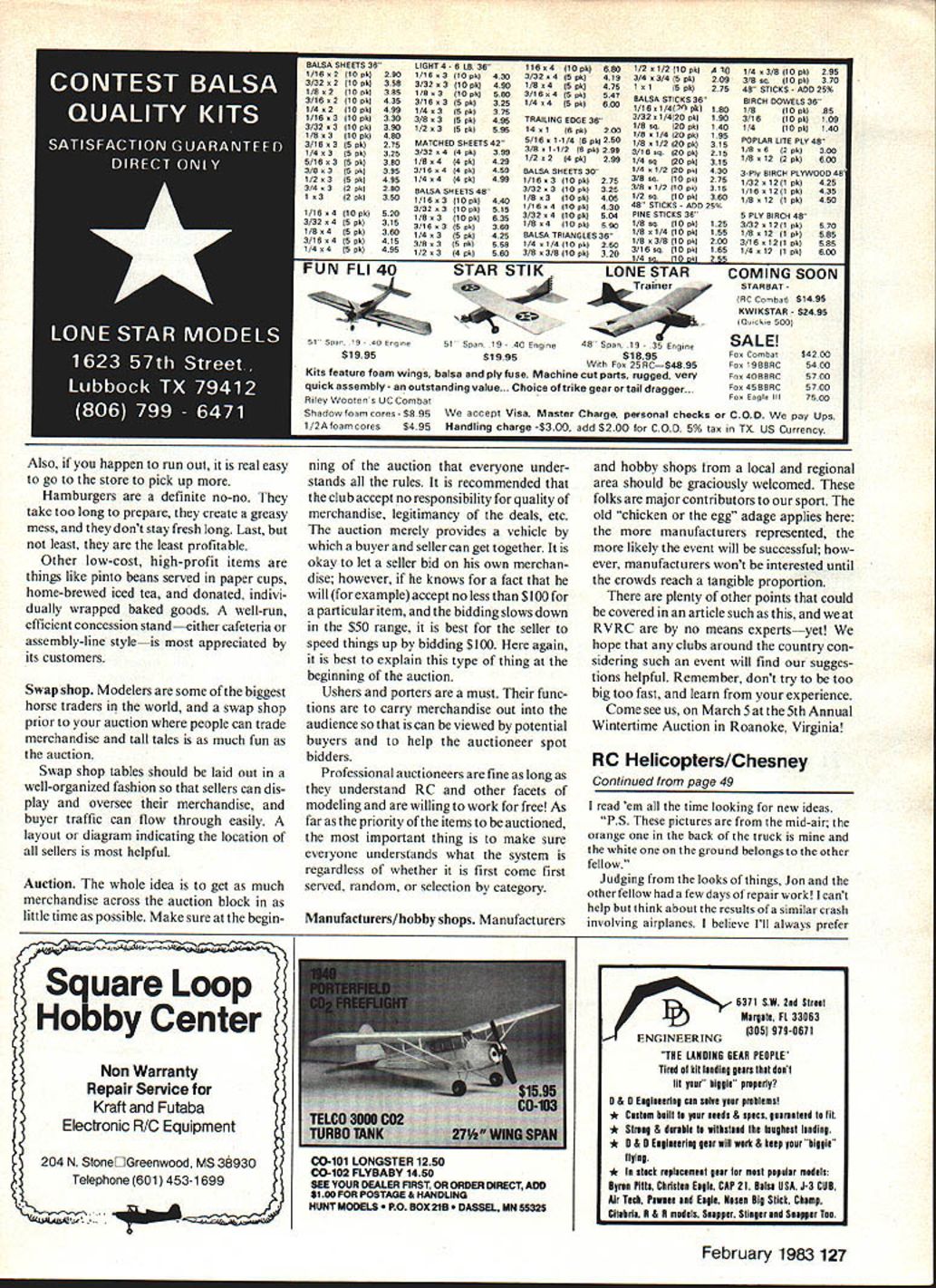
- Hold a raffle with donated prizes from local hobby dealers or merchants.
Advertising
Advertising is a biggie. People have to know about it before they can come. You have to spend money to make money.
One of the least expensive sources of advertising is this magazine. An AMA sanction is a must, and full use of every allowable inch of club advertising under "Calendar of Events" in the magazine is advised. You will be surprised at how many people scan that section to see what is going on around the country.
The next, and probably most important, method of advertising is by direct mail. AMA HQ can help. A copy of the AMA club list for a state or an AMA district may be obtained upon request for no charge; for the complete AMA club list or a list printed on pressure‑sensitive labels, write or phone AMA HQ (Attn: Carl Maroney) for a current quote. Prepare a mailing list of as many clubs as can be found within a reasonable driving distance. Send as many copies of a brochure or flyer to the club officers as your postage budget will allow, along with a letter asking them to distribute these to their club members. These brochures should also be sent to any other people for whom you have mailing addresses from contests, newsletter correspondence, and so forth. In addition, every year you will want to register all who pass through the gate and make them part of your permanent mailing list.
The brochure should be concise and easy to read. It should contain all pertinent data such as date, time, place, and fees. Make sure that all rules and regulations about the auction or swap shop are clearly outlined — people don't like surprises. Also include a map showing the location of the event and a list of nearby motels with phone numbers. Any special features such as concession stands, raffles, static displays, and awards should also be advertised. You may elect to include preregistration for swap shop tables.
Local advertising is okay, especially when it is free. Many TV and radio stations and local newspapers offer free advertising under their public service announcements. Local advertising often nets a few new members every year.
Concessions
The concession stand can be one of your best moneymakers. It can also be the biggest headache and has the potential of costing the most. The trick is to keep it simple.
- Hot dogs are easy to prepare and can be sold at a good markup. Don't cheat on quality — people prefer a good all‑meat hot dog with homemade chili and fresh condiments to cheap alternatives.
- Hamburgers are a definite no‑no. They take too long to prepare, create a greasy mess, don't stay fresh long, and are the least profitable.
- Other low‑cost, high‑profit items: pinto beans served in paper cups, home‑brewed iced tea, and donated individually wrapped baked goods.
- Run the stand cafeteria or assembly‑line style for efficiency.
- Have sufficient change on hand for registration and concession sales. A small cash box with $50 in $1 bills and several rolls of quarters and dimes will do. Have at least two people handling cash.
Raffle: Sell tickets at the gate and at the concession stand. Solicit prizes from local hobby dealers or merchants. Be sure to check local laws for raffle/lottery restrictions.
Security: You cannot guarantee the safety of items, but you can minimize thefts by posting a sign that the club is not responsible for loss and by having a few volunteers circulate through the tables. Have the auctioneer announce that the club is not responsible for items left at the end of the day.
Swap shop
Modelers are some of the biggest horse traders in the world, and a swap shop prior to your auction — where people can trade merchandise and tall tales — is as much fun as the auction.
Swap shop tables should be laid out in a well‑organized fashion so that sellers can display and oversee their merchandise and buyer traffic can flow through easily. A layout or diagram indicating the location of all sellers is most helpful. Consider a preregistration or a map for buyer convenience.
Auction
The whole idea is to get as much merchandise across the auction block in as little time as possible. Make sure at the beginning of the auction that everyone understands the rules. It is recommended that the club accept no responsibility for the quality of merchandise or legitimacy of deals — the auction merely provides a vehicle by which a buyer and seller can get together.
- It is okay to let a seller bid on his own merchandise; if a seller knows he will accept no less than a certain amount, he may bid that to speed the sale. Explain this at the beginning so there are no surprises.
- Arrange the auction area so that the auctioneer has clear sight lines to the buyers and the clerks.
- Use a loud public address system and have good lighting for the auction table.
- Keep bids moving; if an item does not sell quickly, withdraw it and place it on a discount table to be sold later.
- Have a clerk record the buyer's name, amount, and seller on each lot sheet.
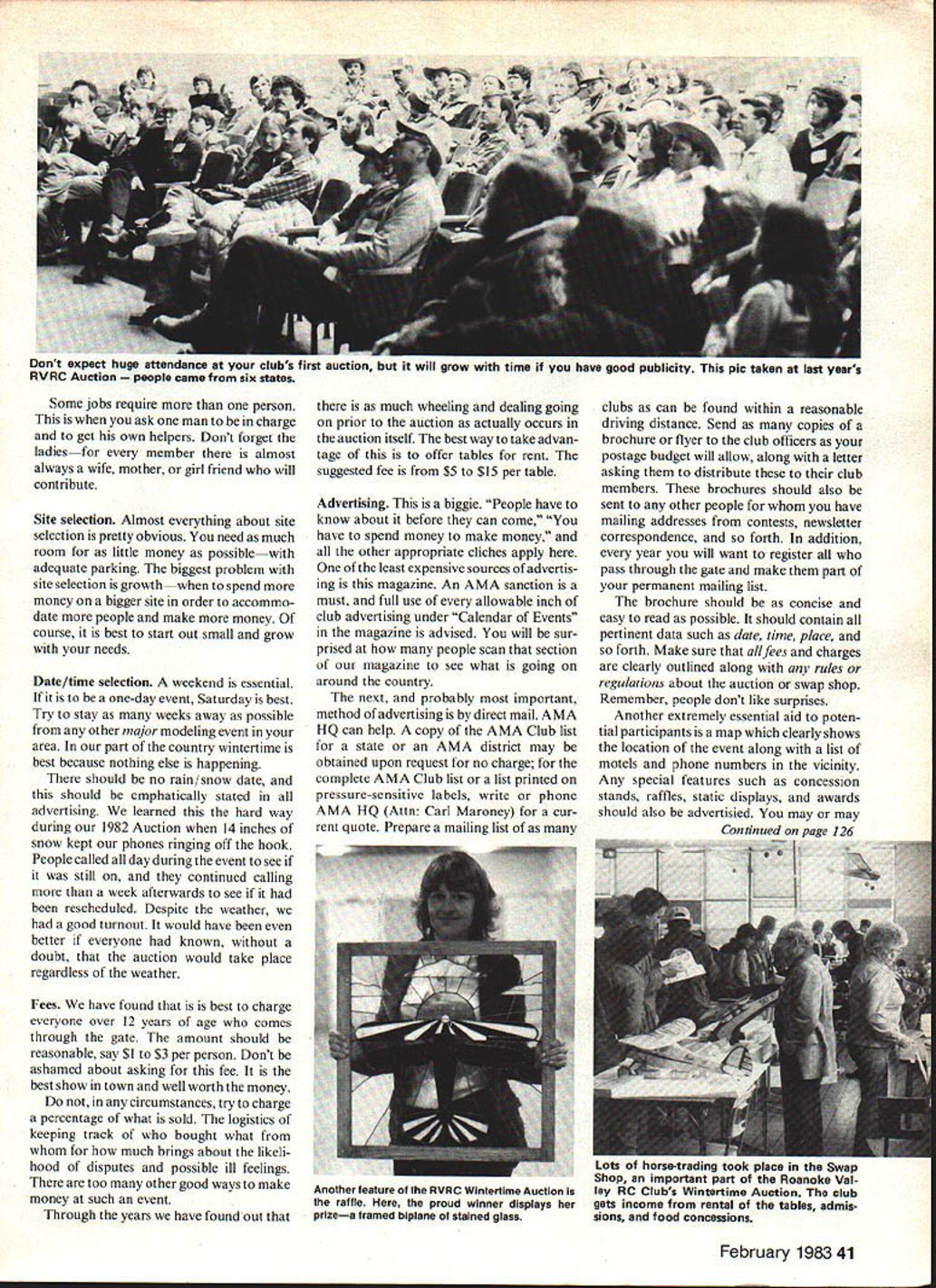
- Ushers and porters are a must. Their functions are to carry merchandise out into the audience so it can be viewed and to help the auctioneer spot bidders.
Professional auctioneers are fine as long as they understand RC and other facets of modeling and are willing to work for free! Decide and announce the order of items — first come first served, random, or by category — so everyone understands how the system works.
Auction procedures, terms and conditions
State clearly that all sales are final and there are no guarantees on used items. Sellers should be required to sign an agreement stating the club is not liable for any losses and that the seller is responsible for collecting payment from the buyer if the club is not handling transactions.
After the auction, count and reconcile all receipts before dispersing funds to sellers. Publicize the results in your club newsletter and send thank‑you letters to volunteers and donors.
Manufacturers and hobby shops
Manufacturers and hobby shops from local and regional areas should be graciously welcomed. These folks are major contributors to our sport. The more manufacturers represented, the more likely the event will be successful; however, manufacturers won't be interested until the crowds reach a tangible proportion.
There are plenty of other points that could be covered, and we at RVRC are by no means experts — yet! We hope that clubs around the country considering such an event will find our suggestions helpful. Remember, don't try to be too big too fast, and learn from your experience.
Come see us on March 5 at the 5th Annual Wintertime Auction in Roanoke, Virginia!
Transcribed from original scans by AI. Minor OCR errors may remain.

