
QSAA '88 Fly-In
Col. John A. de Vries
Overview
Last year it rained; this year it didn't. Instead of rain we had the opposite: the winds kicked up genuine desert dust storms—two, in fact. Visibility dropped to less than a hundred yards. One huge gust tore the transmitter impound shelter off its moorings and sent it airborne. Undaunted, Contest Director Rex Perkins kept things moving when the weather did cooperate, and all in all it turned out to be a magnificent Giant Scale Fly-In. The QSAA 1988 get-together was a prime example of how to run such a show.
On Friday, 28 October, the winds held off until about 3 p.m., and a lot of great flying preceded them. On Saturday the winds showed up a bit earlier, at 12:30. Flying conditions were ideal on both days before things got murky, and the QSAA fliers and spectators took advantage of higher-than-normal temperatures (85°F) for leisurely and fascinating aerial demonstrations. It was one last chance to fly the big birds before winter, and many fantastic airplanes were present. There was also an impressive demonstration of a turbofan-powered jet model.
Static Show
As usual, the dry-lake flying was preceded by a mouthwatering static show on Thursday, 27 October, in the auditorium of the Showboat Hotel in Las Vegas. Each model had its own covered table, and the QSAA provided standardized data sheets listing model type, weight, engine, scale, span, and builder(s). The variety of aircraft was almost stupefying—everything from a Beachey Looper (a Curtiss pusher-like antique) to an Enterprise space shuttle. The best part of the static show was that there weren't any restraining barriers: spectators could go right up to the models and admire incredible detail, and builders were usually standing nearby to point out prominent features.
Good friends like Harry Apoian and Forrest Edwards even opened up their models to show hidden goodies. Harry had a Volksjager with a ducted fan and readily removed the cowling to display the super-clean installation. Forrest Edwards, a genius with engines, has modified his already legendary four-stroke radials to include a supercharger. Even more power is extracted from his self-machined engines once they're coupled to one of these 25-cent-piece-sized mini blowers. It's mind-boggling when you consider the tolerances involved.
Notable Models and Highlights
Choosing a single most interesting model from the assembled throng was impossible, but three stood an edge above the rest.
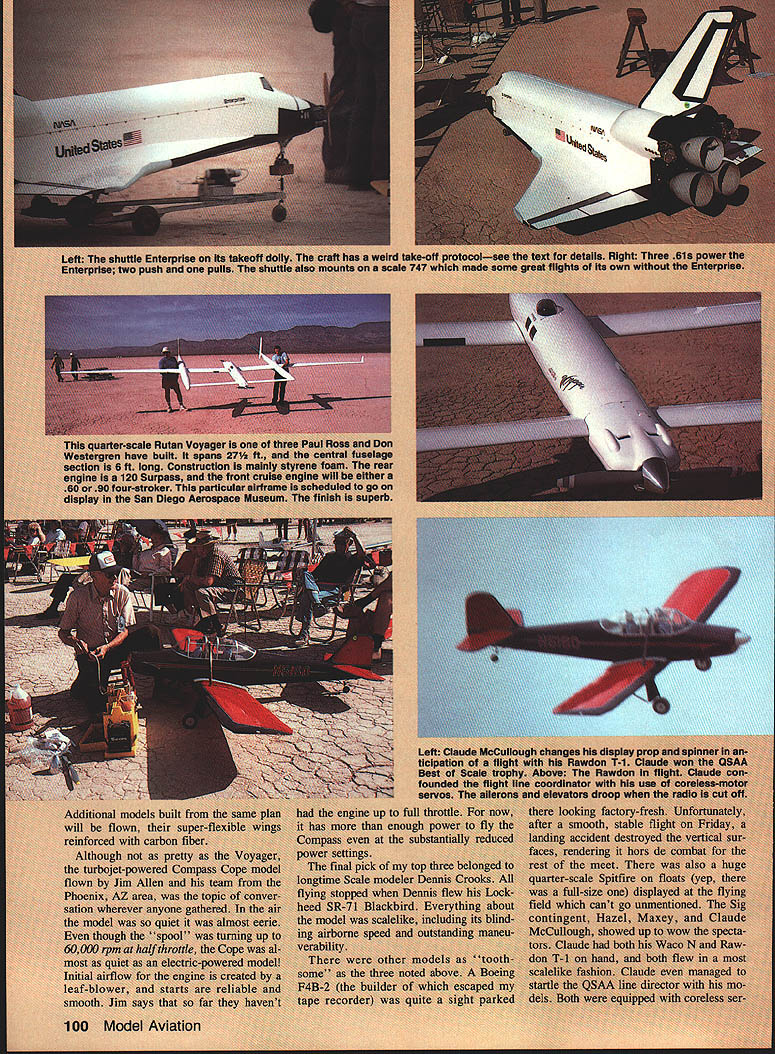
- Rutan Voyager: A 27½-ft-span version built by Paul Ross and Don Westergren (San Diego area). It had a Surpass 120 in the rear pusher position, and a .61 (or .90 four-stroke) was intended for the forward cruise engine. The Voyager on display was intended for static display in the San Diego Aviation Museum; however, two additional models built from the same plan will be flown, their super-flexible wings reinforced with carbon fiber.
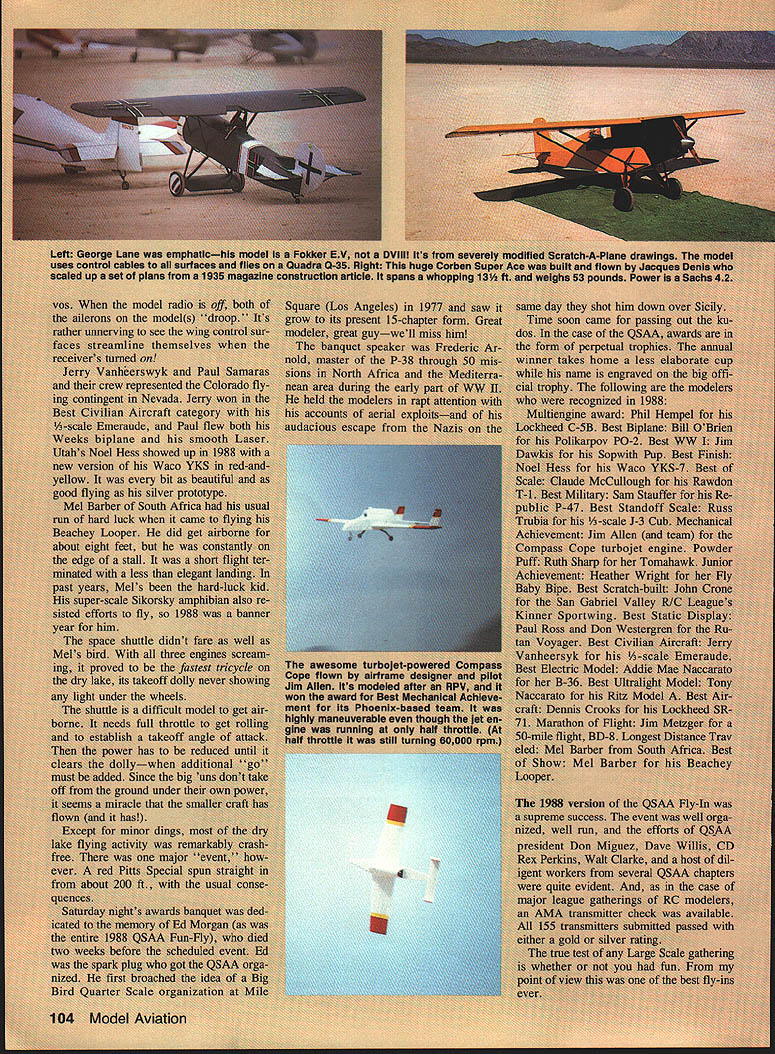
- Compass Cope turbojet: Jim Allen and his Phoenix team flew a turbojet-powered Compass Cope that was the topic of conversation. In the air the model was so quiet it was almost eerie—even with the spool turning up to 60,000 rpm at half throttle. Initial airflow for the engine is created by a leaf blower; starts are reliable and smooth. The engine has not yet been run at full throttle, but it has more than enough power to fly the Compass even at substantially reduced settings.
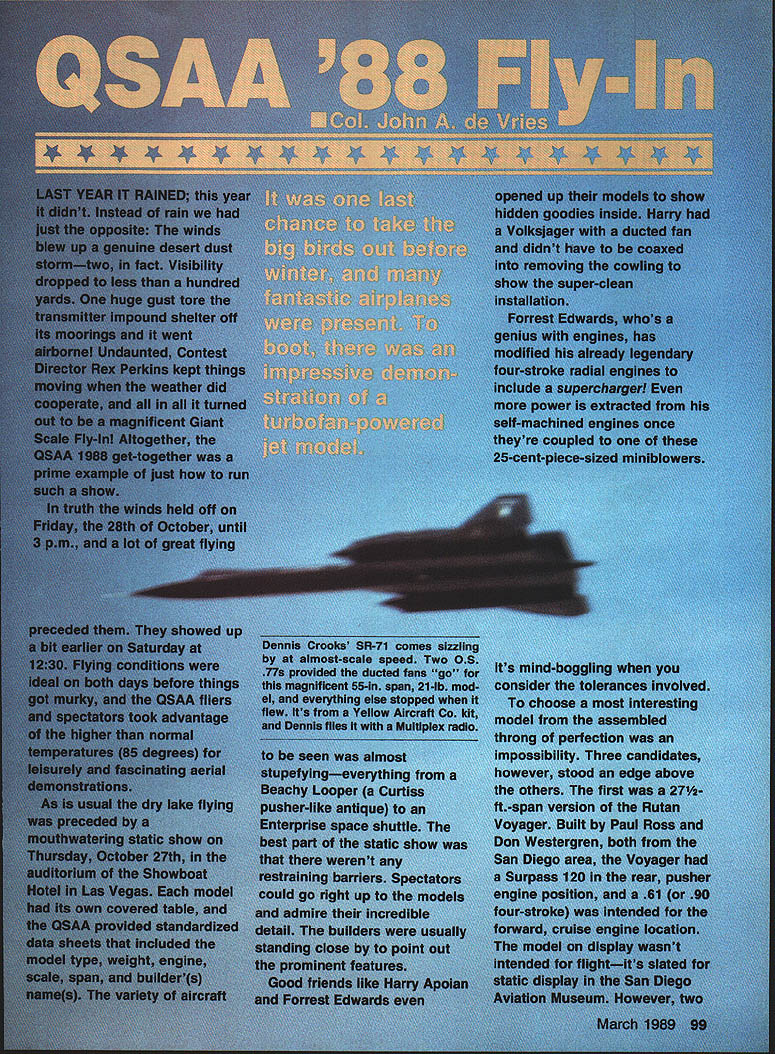
- Lockheed SR-71 Blackbird: Longtime scale modeler Dennis Crooks drew everyone’s attention when he flew his SR-71 replica. All flying stopped; the model was scalelike in appearance, blindingly fast, and highly maneuverable.
There were many other standout aircraft. A Boeing F4B-2 was a sight parked and looking factory-fresh, though a landing accident destroyed its vertical surfaces after a smooth Friday flight. A huge quarter-scale Spitfire on floats was displayed at the flying field and deserves mention. The Sig contingent—Hazel, Maxey, and Claude McCullough—wowed spectators; Claude flew both his Waco N and Rawdon T-1 in very scalelike fashion, both equipped with coreless servos. When the model radio is off, the ailerons and elevators droop, which is unnerving to see as the surfaces streamline themselves when the receiver is turned off.
Jerry Vanheeswyck and Paul Samaras represented the Colorado contingent. Jerry won Best Civilian Aircraft with his 1/3-scale Emeraude; Paul flew both his Weeks biplane and his smooth Laser. Utah's Noel Hess showed up with a new red-and-yellow Waco YKS, as beautiful and good-flying as his silver prototype. Mel Barber of South Africa had a run of bad luck: his Beachey Looper managed only about eight feet of flight before an approach to stall and a less-than-elegant landing. His super-scale Sikorsky amphibian also resisted efforts to fly. The space shuttle model proved difficult to fly as well: with all three engines screaming it was the fastest tricycle on the dry lake, yet its takeoff dolly failed to leave the ground; the shuttle needs a precise power-reduction and reapplication sequence to clear the dolly.
Except for minor dings, most of the dry-lake flying was remarkably crash-free, though one major event occurred when a red Pitts Special spun straight in from about 250 ft with the usual consequences.
Photo Captions and Other Notables
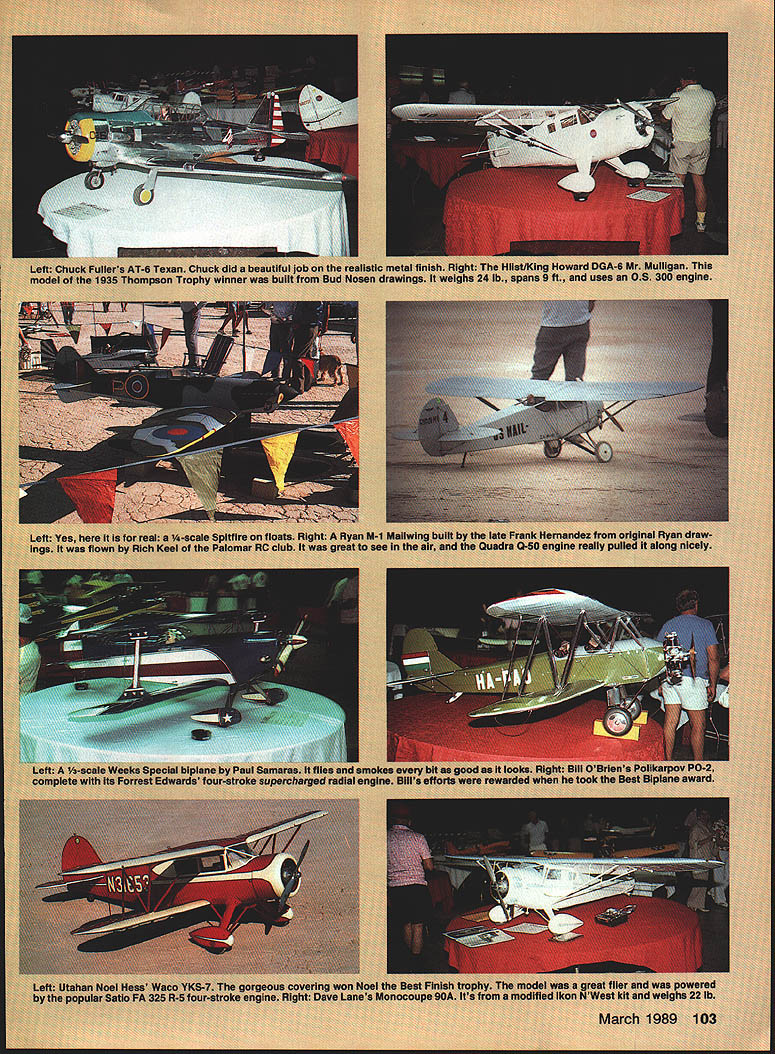
- Left: Chuck Fuller's AT-6 Texan — a beautiful, realistic metal finish. Right: The Hilst/King Howard DGA-6 "Mr. Mulligan" — the 1935 Thompson Trophy winner, built from Bud Nosen drawings; it weighs 24 lb, spans 9 ft, and uses an O.S. 300 engine.
- Left: A 1/4-scale Spitfire on floats. Right: A Ryan M-1 Mailwing built by the late Frank Hernandez from original Ryan drawings, flown by Rich Keel of the Palomar RC Club. The Quadra Q-50 engine pulled it along nicely.
- Left: A 1/3-scale Weeks Special biplane by Paul Samaras — it flies and smokes every bit as good as it looks. Right: Bill O'Brien's Polikarpov PO-2 with Forrest Edwards' supercharged four-stroke radial — Bill won Best Biplane.
- Left: Utahn Noel Hess' Waco YKS-7 — gorgeous covering that won Best Finish. Powered by a Saito FA 325 R-5 four-stroke. Right: Dave Lane's Monocoupe 90A, from a modified Ikon N'West kit, weighing 22 lb.
Banquet and Awards
Saturday night's awards banquet was dedicated to the memory of Ed Morgan, who died two weeks before the event. Ed was the spark plug who got the QSAA organized — he first broached the idea of a Big Bird/Quarter Scale organization at Mile Square (Los Angeles) in 1977 and saw it grow to its present 15-chapter form. He will be missed.
The banquet speaker was Frederic Arnold, a P-38 pilot who flew 50 missions in North Africa and the Mediterranean during the early part of WWII. He held the modelers in rapt attention with accounts of aerial exploits and his audacious escape from the Nazis on the day he was shot down over Sicily.
The QSAA awards are perpetual trophies; the annual winner takes home a less elaborate cup while his name is engraved on the big official trophy. The 1988 recognitions were:
- Multiengine award: Phil Hempel for his Lockheed C-5B
- Best Biplane: Bill O'Brien for his Polikarpov PO-2
- Best WWII: Jim Dawkis for his Sopwith Pup
- Best Finish: Noel Hess for his Waco YKS-7
- Best Scale: Claude McCullough for his Rawdon T-1
- Best Military: Sam Stauffer for his Republic P-47
- Best Standard Scale: Russ Trubia for his 1/3-scale J-3 Cub
- Mechanical Achievement: Jim Allen (and team) for the Compass Cope turbojet engine
- Powder Puff: Ruth Sharp for her Tomahawk
- Junior Achievement: Heather Wright for her Fly Baby Bipe
- Best Scratch-built: John Crone for the San Gabriel Valley R/C League's Kremer Sportwing
- Best Static Display: Paul Ross and Don Westergren for the Rutan Voyager
- Best Civilian Aircraft: Jerry Vanheeswyck for his 1/3-scale Emeraude
- Best Electric Model: Addie Mae Naccarato for her B-36
- Best Ultralight Model: Tony Naccarato for his Ritz Model A
- Best Aircraft Model: Dennis Crooks for his Lockheed SR-71
- Marathon of Flight: Jim Metzger for a 50-mile flight
- Longest Distance Traveled: Mel Barber (from South Africa)
- Best of Show: Mel Barber for his Beachey Looper
Results and Conclusion
The 1988 QSAA Fly-In was a supreme success: well organized and well run. The efforts of QSAA president Don Morgan, Dave Willis, CD Rex Perkins, Walt Clarke, and many diligent workers from several QSAA chapters were evident. As with major gatherings, the event included an AMA transmitter check and a large contingent of spectators. All 155 transmitters submitted passed with either a gold or silver rating.
The true test of any large-scale gathering is whether or not you had fun. From my point of view, this was one of the best fly-ins ever.
Transcribed from original scans by AI. Minor OCR errors may remain.

