
Quarter Scale Racing Now Four-Stroke Racing
Bernie Oldenburgh
The .12 cu. in. four-stroke engine is putting new life into Quarter Scale RC pylon racing. Flying qualities of the 1/4-size Formula I models are as nice as before, and the sound is much more pleasing to both the fliers and the spectators.
Why Four-Stroke Racing?
Tired of burning holes in the sky or practicing day after day for a Pattern meet? Would you like some excitement in your flying without getting involved in high-tech racing? Four-stroke racing may be the answer.
Quarter Scale Pylon Racing uses standoff-scale models with rules structured to make all the models fly at nearly the same speed. The original reasons for starting Quarter Scale Pylon Racing were:
- To promote racing with fun in mind.
- To use an appealing aircraft prototype.
- To be quiet, so testing and practicing at the club field won't cause problems with neighbors.
We believe we have found the key ingredient to meet these goals: four-stroke engines.
The Switch to .12 Four-Strokes
Our aircraft choice was already right from previous racing experience; the major problem had been noise. No matter what we tried, two-cycle engines remained too loud and irritating.
Hansen Manufacturing Co. played a key role in getting us started. Lynn Engdahl — a person who likes to try new things and who is interested in FAI Turnaround Pattern flying — knew that .12 four-cycle engines were being allowed in RC Pattern (both AMA and FAI) in the same class as .61 two-cycle engines. When Lynn suggested allowing .12 four-cycles to compete against .61 two-cycles in our 1984 season, there was an initial uproar. Most were against the idea, and I was one of them, but Lynn persisted and the group eventually approved the use of .12 four-strokes for 1984.
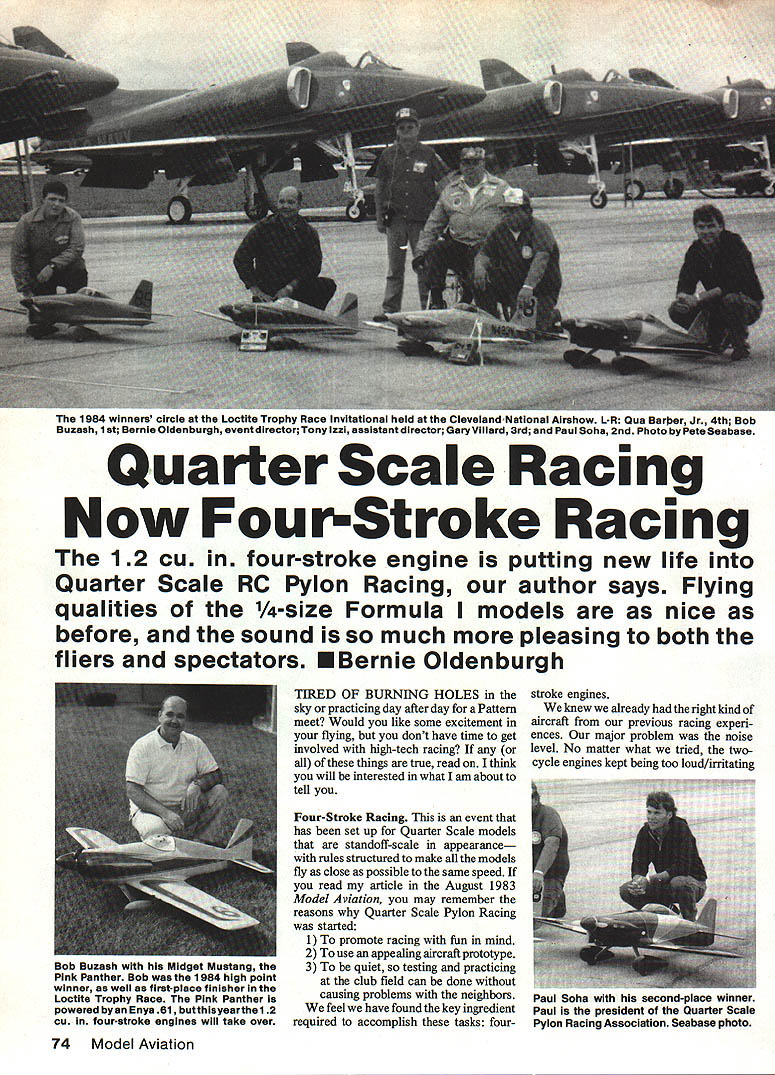
Lynn prepared a plane to run a four-stroker but, because of business and personal commitments, he couldn't enter it until the second-to-last race of the season. Unfortunately, just before that race he had radio problems and couldn't compete. By the end of the day he had solved the problems and demonstrated that the four-stroker did indeed work. The demonstration was impressive enough that president Paul Soha and secretary Pete Seabase vowed to install four-strokers in their models before the last race of the season.
1984 Season Highlights
Paul showed up with an Enya .12 in a scratch-built Swee Pea; Pete brought a Saito .12 in a 9 lb. 10 oz. Cosmic Wind. After the first round, the ready line sounded like a hive of busy bees — everyone noticed and talked about how well the planes flew and how quiet they were. The two four-strokers won heats. Pete’s Cosmic Wind/Saito narrowly missed first place for the day; Chris Abate’s two-stroker posted a heat time only .01 second faster than Pete’s. Paul Soha’s Swee Pea/Enya combination won three heats, but an unfortunate midair collision with Gary Villard dampened Paul’s otherwise excellent first four-stroker racing day.
Rules, Sponsorship, and Growth
Over the winter, many hours went into producing new rules for the 1985 season. Our 1984 major sponsor, Loctite Corporation, saw the event’s potential and is sponsoring the 1985 event, encouraging us to offer it nationally. We will propose to the RC Racing Contest Board that they adopt the new rules under the AMA system as soon as possible.
If you are interested in starting a Quarter Scale Pylon Racing Association (QSPRA) district, we will supply rules, regulations, and district requirements. Send a self-addressed stamped envelope to:
- Secretary Paul Seabase
- 1800 26th St., Cuyahoga Falls, OH 44223
Models, Awards, and Invitation
There are several kit models that now qualify for QSPRA racing. Two new ones are the Midget Mustang and the Swee Pea, manufactured by Northeast Ohio Model Supply Co. Our new rule book provides outline parameters and specifications for many other aircraft for those who want to scratch-build.
Each year’s culmination is the Loctite Series High Point Champion Trophy. Competitors who earn enough season points receive an invitation to the Cleveland National Airshow to compete for the Loctite Series trophies.
By the time this article reaches readers, half of our racing season will be finished. If you are in the area in July or August, on behalf of QSPRA President Paul Soha and all the officers and committee members, I invite you to look us up or come to the Cleveland National Airshow to see our finals.
1985 QSPRA Race Season
- June 2 — Goodyear Air Expo, Talmadge, OH
- June 23 — CRCC, Cleveland, OH
- July 14 — MARCS, Mentor, OH
- Aug. 11 — LRCC, Lorain, OH
- Aug. 31, Sept. 1 & 2 — Cleveland National Airshow, Cleveland, OH
Transcribed from original scans by AI. Minor OCR errors may remain.

