
Quickie
Don Berliner
Burt Rutan seems determined to make all the other designers of light airplanes feel like they've spent their careers restyling the Roman chariot. By bursting upon the aviation world with a string of wild ideas that really work, Rutan is embarrassing a lot of people who thought all they had to do was change the tail stripes on last year's airplane to give the impression that it was something new.
No doubt about it, the designers and builders of America's lightplanes — the "Big Four" of Piper, Cessna, Beech and Grumman‑American — haven't come up with anything especially exciting for a long, long time. Year after year they re‑design and refine and make a big fuss over little changes. Their best known models have been in production for eons: the Beech Bonanza since 1946, the Cessna 172 since 1955, the Piper Cherokee since 1961.
But why should they take the terrible financial risks of doing something glorious and clever when their routine airplanes are accepted around the world? In 1977, American manufacturers of light aircraft built 97% of the world's total! Foreign competition just hasn't been worth worrying about, so there is little chance that the U.S. industry will get a kick in the slats as did the auto makers a few years ago.
Without real competition, nothing much happens, which is the American lightplane situation in a nutshell. Airframes are built the same way they were 30 years ago; the engine designs are even older, and the aerodynamics can be traced back to World War II or earlier. Sure, there is a widely advertised trend toward T‑tails, but they've been around for such a long time.
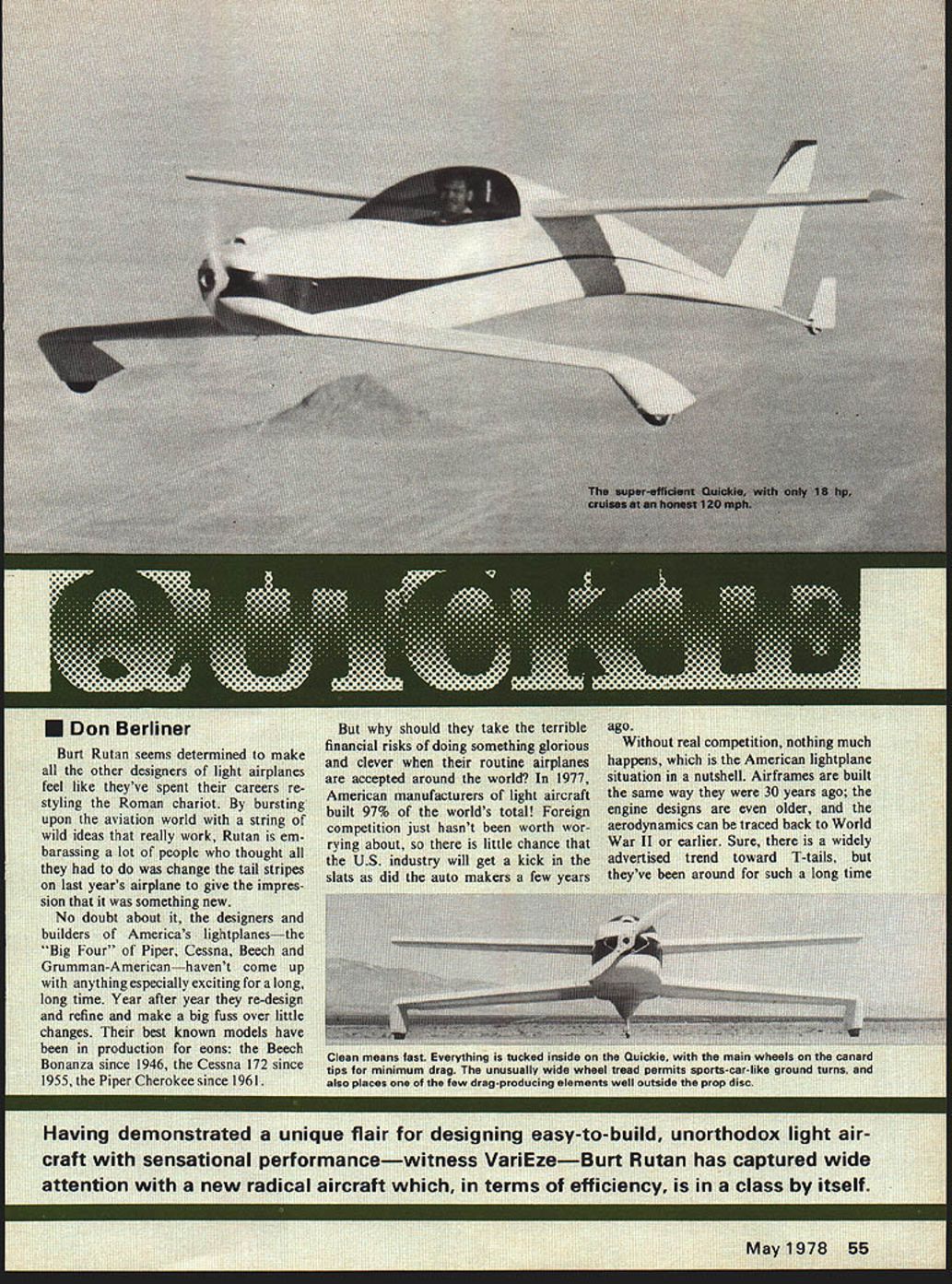
Having demonstrated a unique flair for designing easy-to-build, unorthodox light aircraft with sensational performance—witness VariEze—Burt Rutan has captured wide attention with a new radical aircraft which, in terms of efficiency, is in a class by itself. Few airplanes get much more than two miles per horsepower; they're designed mainly for speed. Factory‑built lightplanes are still struggling to get three or four miles per horsepower. The Quickie gets almost seven miles per horsepower. It developed its highly modified, durable 2‑cylinder, 4‑cycle industrial engine at a time when there was ever greater concern for fuel economy — whose objective was a 120‑mph airplane that would get close to 90 miles per gallon.
The response of EAA builders to the VariViggen was limited by its complexity and un‑pretty appearance. So far, Burt Rutan was considered a very bright young man who obviously had potential, but that was about all.
In 1975, his star began to rise very suddenly and very steeply, when his radical little "VariEze" appeared at the huge EAA Oshkosh Fly‑In after a near‑record flight from his home base at Mohave, CA. He made the jump from curiosity to guru in a single day, drawing over‑flow crowds to his forums in the design and construction of this truly original light airplane.
In one package, it offered a huge reduction in building time and complication, and an equally big improvement in performance. The sleek canard, with its NASA‑designed winglets, would carry as many people and as much fuel as the popular Cessna 150. But it cruises at better than 200 mph, while the Cessna has to strain to manage 120 mph — on the same 100‑hp Continental engine.
Other designs had excited the amateur builder before — the tiny BD‑5 pusher being a classic example — but never before had one been so thoroughly tested in advance and ready for building. Burt's careful advance work so impressed not only the novice builder, but the veterans as well, that he sold more than 1,000 sets of plans in a few days at Oshkosh '76. A year later, five homebuilt VariEzes were on the Oshkosh flight line to prove that the airplane could, indeed, be built much easier than anything before it.
Fortunately for those who are not wedded to the past, it was not in the personality of Rutan to sit back and enjoy his success. The VariEze was not an end in itself, but a demonstration that there was a new way of doing things. Suddenly, he was the center of attention not only of amateur builders, but of others, like NASA and the Air Force. Soon, he was designing Remote Piloted Vehicles (drones) and fly- ing test-beds and other things that no one wants to talk about yet in public. It looked, at least briefly, as if his previously announced plan to develop a 4-6-seater along the lines of the VariEze (to cruise at 200+ mph on 150 hp) must have been placed on hold.
But Rutan works quietly and secretly in his little "skunk works" at Mojave Airport. And the first proof of this, and of his continued dedication to the needs of the little guy, came early in 1978, when the "Quickie" was revealed to an unsuspecting world, along with rumors of more revolutionary projects yet to come. Secrecy had been maintained during the amazingly brief time between the start of construction on August 13, 1977, and the first flight on November 15.
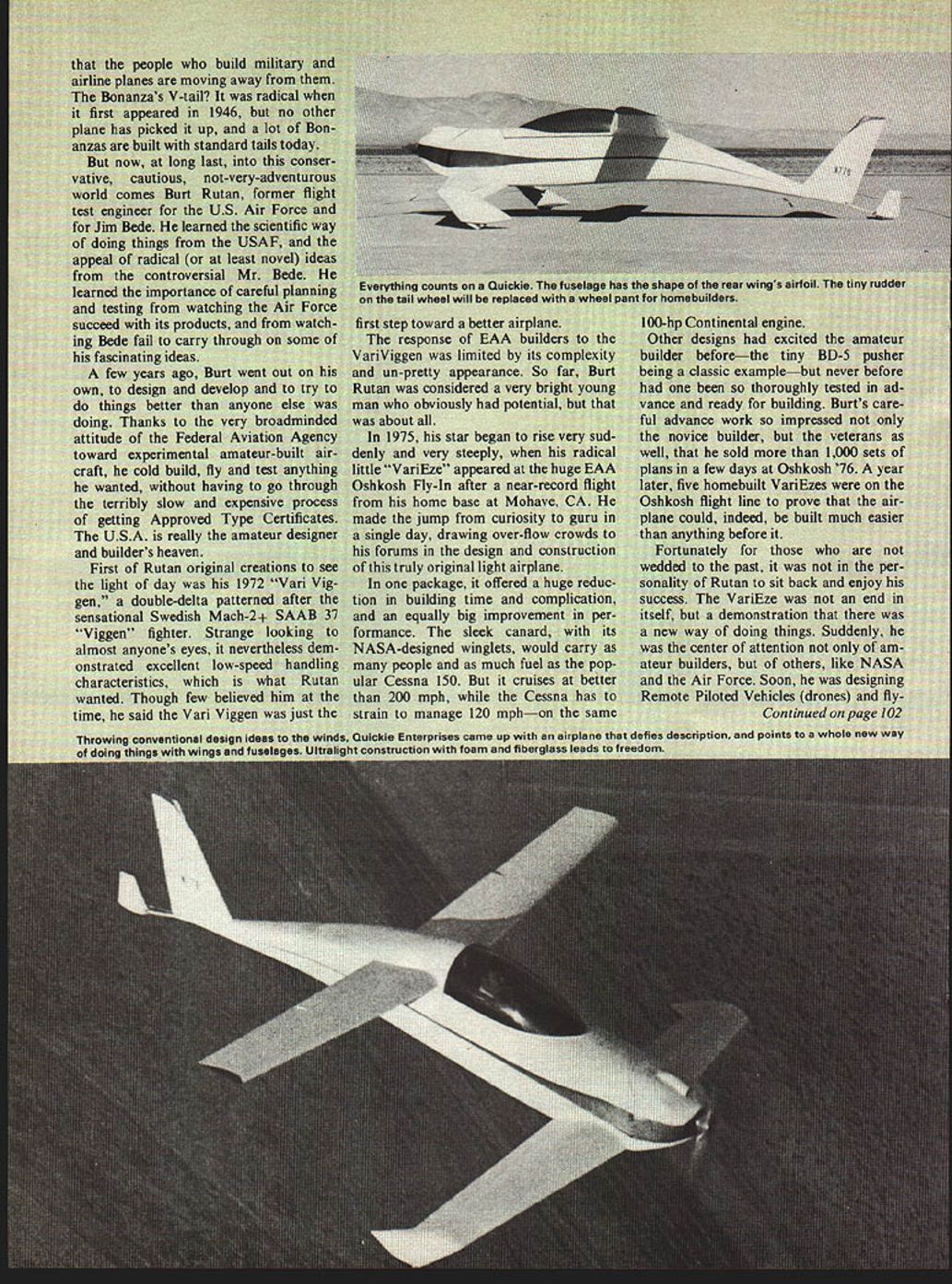
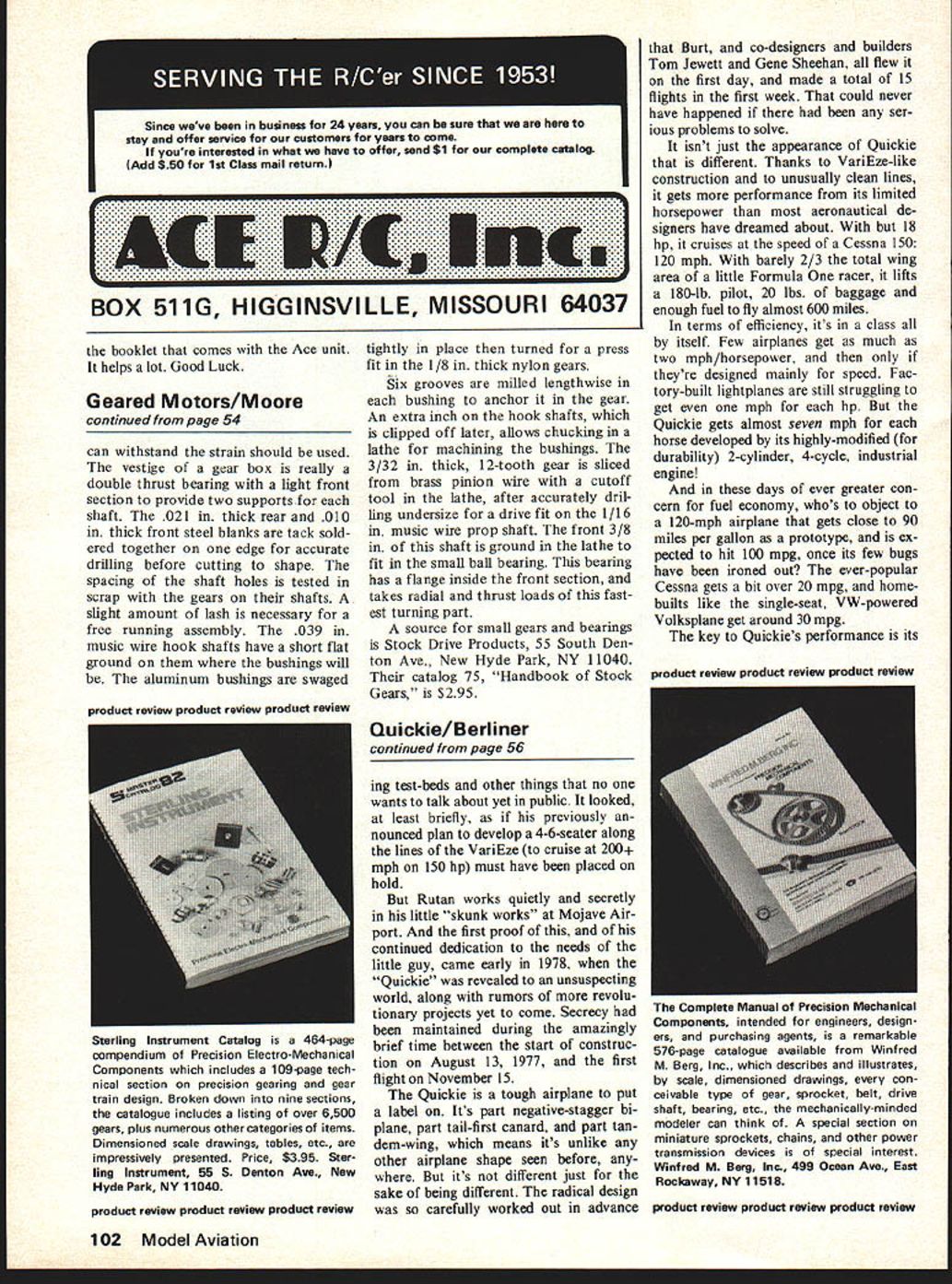
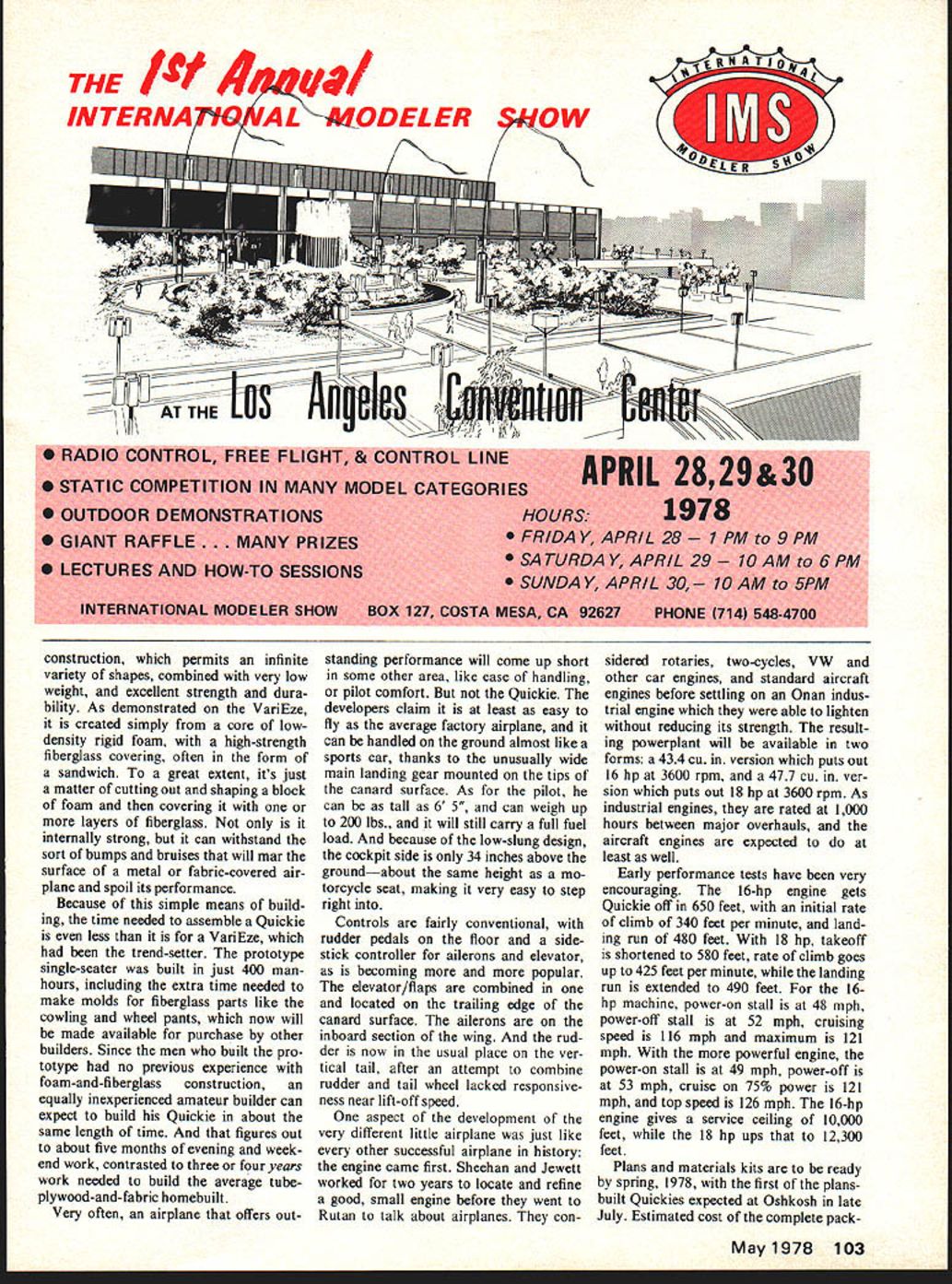
The Quickie is a tough airplane to put a label on. It's part negative-stagger biplane, part tail-first canard, and part tandem-wing, which means it's unlike any other airplane shape seen before, anywhere. But it's not different just for the sake of being different. The radical design was so carefully worked out in advance that Burt, and co-designers and builders Tom Jewett and Gene Sheehan, all flew it on the first day, and made a total of 15 flights in the first week. That could never have happened if there had been any serious problems to solve.
It isn't just the appearance of Quickie that is different. Thanks to VariEze-like construction and to unusually clean lines, it gets more performance from its limited horsepower than most aeronautical designers have dreamed about. With but 18 hp, it cruises at the speed of a Cessna 150: 120 mph. With barely 2/3 the total wing area of a little Formula One racer, it lifts a 180-lb. pilot, 20 lbs. of baggage and enough fuel to fly almost 600 miles.
In terms of efficiency, it's in a class all by itself. Few airplanes get as much as two mph/horsepower, and then only if they're designed mainly for speed. Factory-built lightplanes are still struggling to get even one mph for each hp. But the Quickie gets almost seven mph for each horse developed by its highly-modified (for durability) 2-cylinder, 4-cycle, industrial engine!
And in these days of ever greater concern for fuel economy, who's to object to a 120-mph airplane that gets close to 90 miles per gallon as a prototype, and is expected to hit 100 mpg, once its few bugs have been ironed out? The ever-popular Cessna gets a bit over 20 mpg, and homebuilts like the single-seat, VW-powered Volksplane get around 30 mpg.
The key to Quickie's performance is its construction, which permits an infinite variety of shapes, combined with very low weight, and excellent strength and durability. As demonstrated on the VariEze, it is created simply from a core of low-density rigid foam, with a high-strength fiberglass covering, often in the form of a sandwich. To a great extent, it's just a matter of cutting out and shaping a block of foam and then covering it with one or more layers of fiberglass. Not only is it internally strong, but it can withstand the sort of bumps and bruises that will mar the surface of a metal or fabric-covered airplane and spoil its performance.
Because of this simple means of building, the time needed to assemble a Quickie is even less than it is for a VariEze, which had been the trend-setter. The prototype single-seater was built in just 400 man-hours, including the extra time needed to make molds for fiberglass parts like the cowling and wheel pants, which now will be made available for purchase by other builders. Since the men who built the prototype had no previous experience with foam-and-fiberglass construction, an equally inexperienced amateur builder can expect to build his Quickie in about the same length of time. And that figures out to about five months of evening and weekend work, contrasted to three or four years' work needed to build the average tube-and-fabric homebuilt.
Very often, an airplane that offers outstanding performance will come up short in some other area, like the case of handling, or pilot comfort. But not the Quickie. The developers claim it is at least as easy to fly as the average factory airplane, and it can be handled on the ground almost like a sports car, thanks to the unusually wide main landing gear mounted on the tips of the canard surface. As for the pilot, he can be as tall as 6'5", and can weigh up to 200 lbs., and it will still carry a full fuel load. And because of the low-slung design, the cockpit side is only 34 inches above the ground—about the same height as a motorcycle seat, making it very easy to step right into.
Controls are fairly conventional, with rudder pedals on the floor and a side-stick controller for ailerons and elevator, as is becoming more and more popular. The elevator/flaps are combined in one and located on the trailing edge of the canard surface. The ailerons are on the inboard section of the wing. And the rudder is now in the usual place on the vertical tail, after an attempt to combine rudder and tail wheel lacked responsiveness near lift-off speed.
One aspect of the development of the very different little airplane was just like every other successful airplane in history: the engine came first. Sheehan and Jewett worked for two years to locate and refine a good, small engine before they went to Rutan to talk about airplanes. They considered rotaries, two-cycles, VW and other car engines, and standard aircraft engines before settling on an Onan industrial engine which they were able to lighten without reducing its strength. The resulting powerplant will be available in two forms: a 43.4 cu. in. version which puts out 16 hp at 3600 rpm, and a 47.7 cu. in. version which puts out 18 hp at 3600 rpm. As industrial engines, they are rated at 1,000 hours between major overhauls, and the aircraft engines are expected to do at least as well.
Early performance tests have been very encouraging. The 16-hp engine gets Quickie off in 650 feet, with an initial rate of climb of 340 feet per minute, and landing run of 480 feet. With 18 hp, takeoff is shortened to 580 feet, rate of climb goes up to 425 feet per minute, while the landing run is extended to 490 feet. For the 16-hp machine, power-on stall is at 48 mph, power-off stall is at 52 mph, cruising speed is 116 mph and maximum is 121 mph. With the more powerful engine, the power-on stall is at 49 mph, power-off is at 53 mph, cruise on 75% power is 121 mph, and top speed is 126 mph. The 16-hp engine gives a service ceiling of 10,000 feet, while the 18 hp ups that to 12,300 feet.
Plans and materials kits are to be ready by spring, 1978, with the first of the plans-built Quickies expected at Oshkosh in late July. Estimated cost of the complete package is about $1,200 for the moldless foam-and-fiberglass work, and about $1,400 for the engine installation and prop. Complete materials packages, including cowling and wheel pants, are expected to cost about $2,600. Plans alone are expected to be $40. Package, including a lot of pre-formed parts and the engine, is around $3,000. A packet of information is available for $6.00 from Quickie Enterprises, P.O. Box 786, Mojave, CA 93501.
Quickie is not yet a success, as only the prototype has flown. But even when it is fully proven and giving enjoyment to hundreds of amateur pilots, it will still be just another step on the road to a better airplane.
The latest rumor coming out of the Rutan Aircraft Factory is of a four- or six-place, twin-engined airplane aimed at certification and factory production. It is assumed to be like the VariEze in general layout, with a 150-hp Lycoming engine in either end. Performance should be near 250 mph cruising speed, while the price of a factory-built airplane should be just a fraction of any current twin offering such performance. The prototype could fly by summer, though it will have to go through the time-consuming FAA tests and studies before anyone is allowed to walk into a showroom and buy one.
And what of the future? Already, Burt Rutan has left the rest of the lightplane industry a decade or two behind him. It would be the height of foolishness to assume that he will now stop and wait for the others to catch up.
Transcribed from original scans by AI. Minor OCR errors may remain.

