
Quicksilver
MANY WORDS have been written about the "fun" of 1/2A Pylon Racing. Well, it doesn't take long after mixing capability with competitiveness before Fun is spelled Win and Win means Fast! In the Northwest, where 1/2A Pylon Racing has really grown and developed (don't believe everything you read from California), it is a serious racing event. In terms of the number of participants and number of races held, it is a clear favorite.
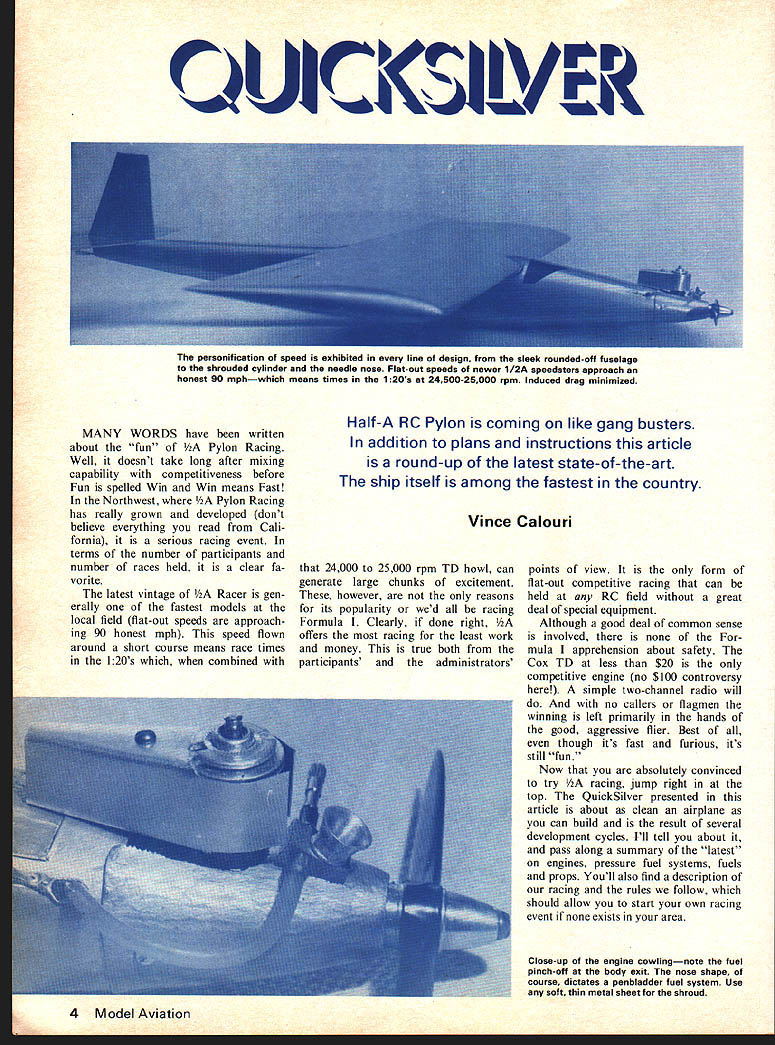
The latest vintage of 1/2A Racer is generally one of the fastest models at the local field (flat-out speeds are approaching 90 honest mph). This speed flown around a short course means race times in the 1:20's which, when combined with that 24,000 to 25,000 rpm TD howl, can generate large chunks of excitement.
Half-A RC Pylon is coming on like gang busters. In addition to plans and instructions this article is a round-up of the latest state-of-the-art. The ship itself is among the fastest in the country.
Vince Calouri
These, however, are not the only reasons for its popularity; we'd all be racing Formula I. Clearly, if done right, 1/2A offers the most racing for the least work and money. This is true both from the participants' and the administrators' points of view. It is the only form of flat-out competitive racing that can be held at any RC field without a great deal of special equipment.
Although a good deal of common sense is involved, there is none of the Formula I apprehension about safety. The Cox TD at less than $20 is the only competitive engine (no $100 controversy here!). A simple two-channel radio will do. And with no callers or flagmen the winning is left primarily in the hands of the good, aggressive flier. Best of all, even though it's fast and furious, it's still fun.
Now that you are absolutely convinced to try 1/2A racing, jump right in at the top. The QuickSilver presented in this article is about as clean an airplane as you can build and is the result of several development cycles. I'll tell you about it, and pass along a summary of the "latest" on engines, pressure fuel systems, fuels and props. You'll also find a description of our racing and the rules we follow, which should allow you to start your own racing event if none exists in your area.
The Airplane:
Like most people we started with the 1971 RCM rules which were laid out around an "Upstart" type of Ace foam-wing airplane which "kinda" resembles a real racing airplane. In our second year of racing, 1973, the mold was broken. Nelson Eddy brought out the first low-aspect-ratio wing airplane which buried everybody, and I "legalized" belly wheels with my LIT Special (Flying Models magazine, Aug., 1974). With the conformance rule dropped for 1974, we had a whole rash of new airplanes representing a second generation. All sported low-aspect-ratio wings and few had any but buried wheels. They had started to look like racers instead of miniatures of racers. Pressure systems were common and we had started to go "fast." Lap times in the 140's were normal and times in the middle 130's were being turned by the really fast. Leading the really fast pack was Bob Mikko's "Snake" which introduced the needle nose fiberglass engine cowl and a round body for lowest wetted area.
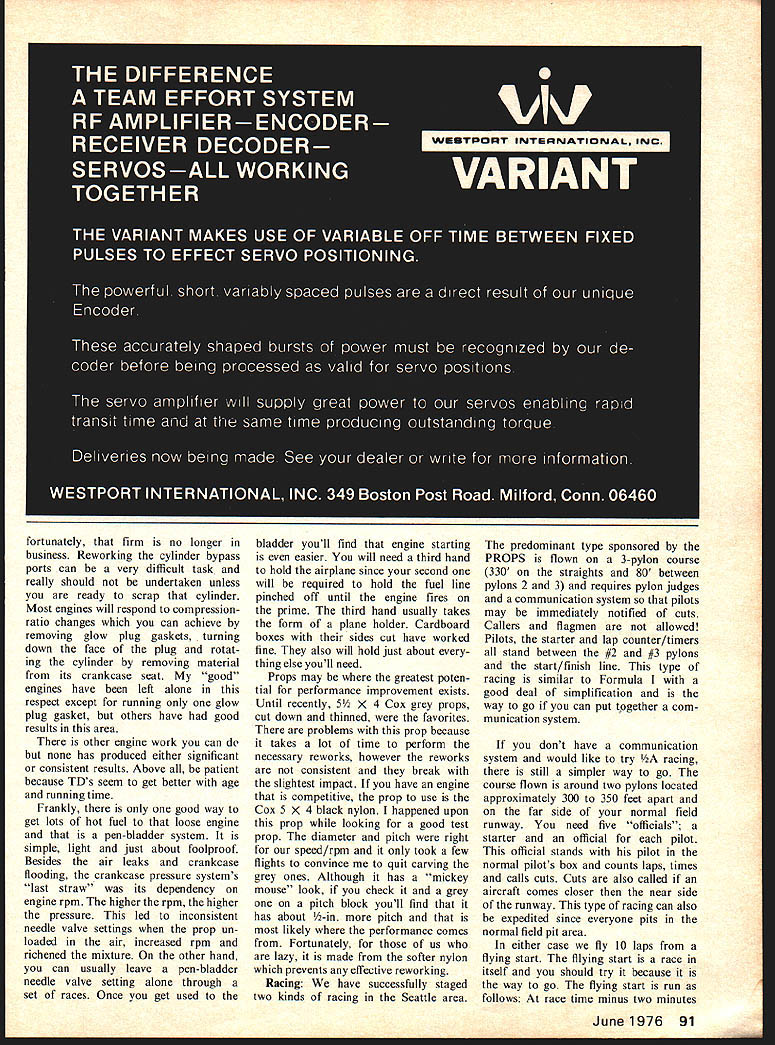
The QuickSilver belongs to 1975's third generation of racer. It incorporates the low-aspect-ratio wing (Gene Weaver's to be exact) cleanly mounted on a rounded body, a needle-nose engine cowling, buried wheels and an engine cylinder fairing/cooling shroud. (Although you might otherwise, the nose shape dictates a pen bladder fuel system.) It is as fast as proven in its first outing where it took five straight wins with a best time of 1:28. It is a very easy airplane to fly, extremely smooth and highly damped in pitch which makes it "groovy." Highly damped in pitch means a large horizontal stabilizer and an easy way to draw the vertical was to make it a respectable percentage of the horizontal — after all you can't have too much stability, right?
My previous airplanes, therefore, have always had large verticals and they have also always exhibited that most annoying tail wiggle in the turns commonly called the Quick Fly dance. It has got to slow an airplane down! Without entering into a long explanation, it's apparent that too much directional stability coupled with little dihedral can lead to this problem. There's no dihedral in the QuickSilver wing but the vertical is small and the fuselage is round behind the wing as well as in front. (Making it less effective in terms of stability.) It has not the slightest trace of dance! Additional verification can be found in the newer pattern airplanes which sport a good deal of forward fuselage area therefore reducing directional stability and also eliminating the pre knife-edge designs' tendency to dance.
The wing is a key element in the high performance of this design. Its low aspect ratio makes it simple to build and light. The low aspect ratio or large chord also result in a "thinner" wing in terms of thickness as a percent of chord and a th higher operating Reynolds number. These factors add up as follows: a lightly loaded airplane will not pull a high-lift coefficient even in a turn, therefore keeping the induced drag to a minimum while the section drag is very much dependent on percent thickness and in this size/speed regime on Reynolds number. Obviously, it's important to keep the weight to a minimum and to fly this type of airplane around the turns instead of giving it a quick "yank."
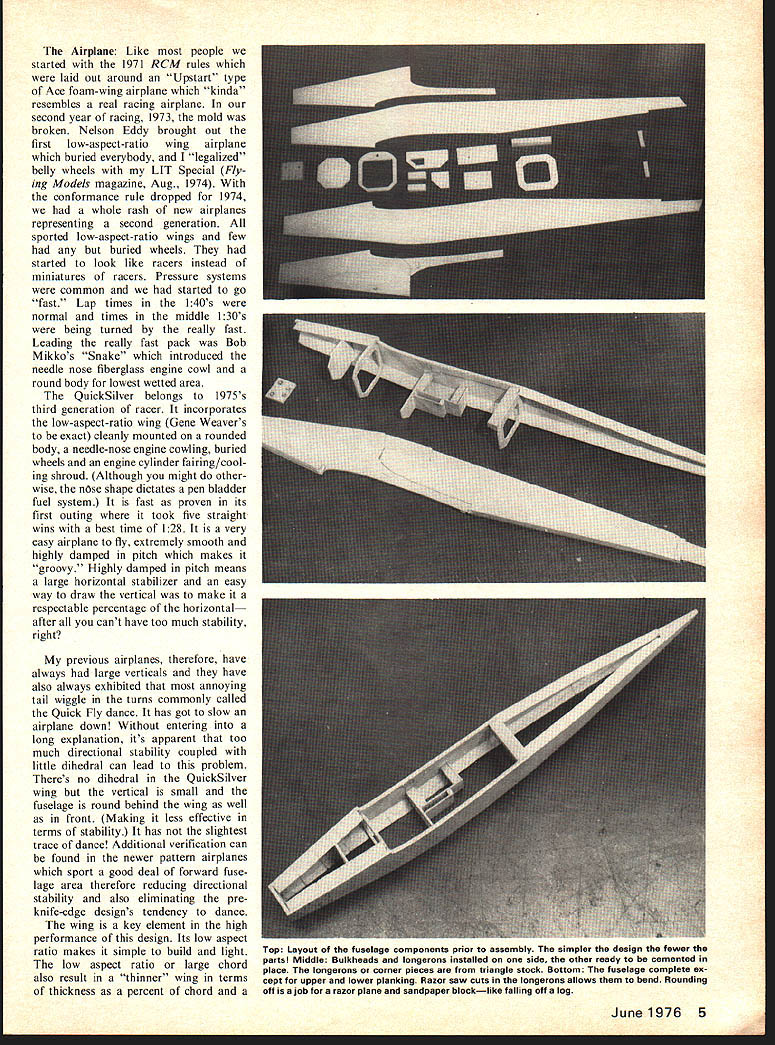
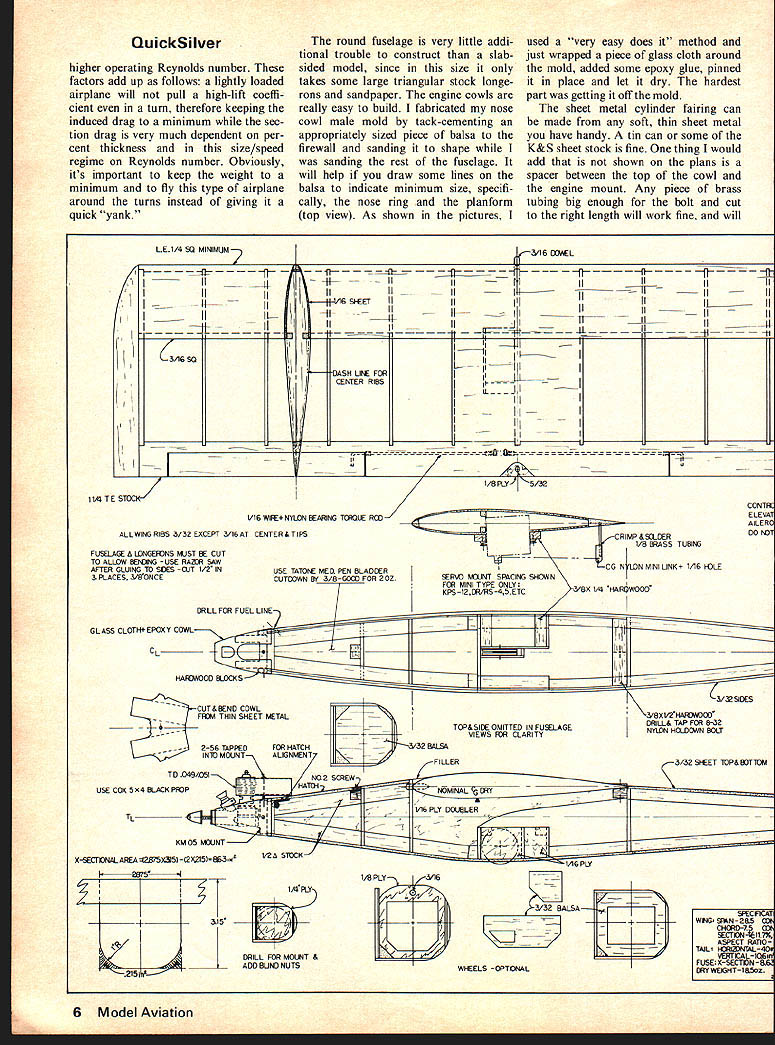
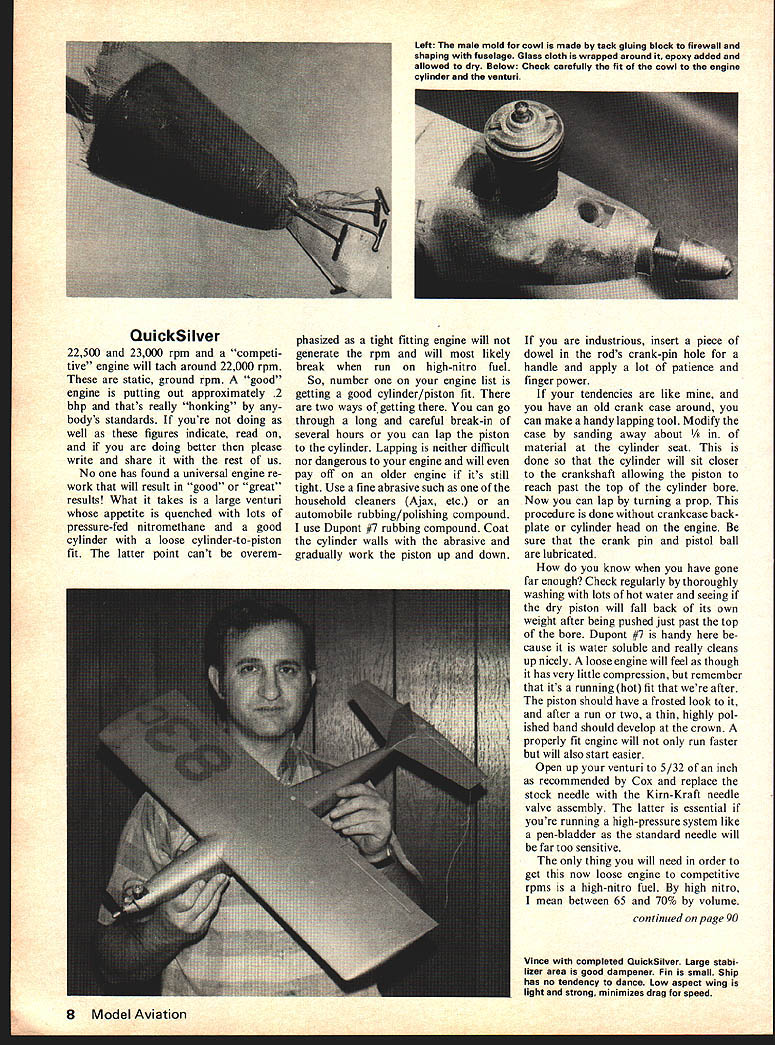
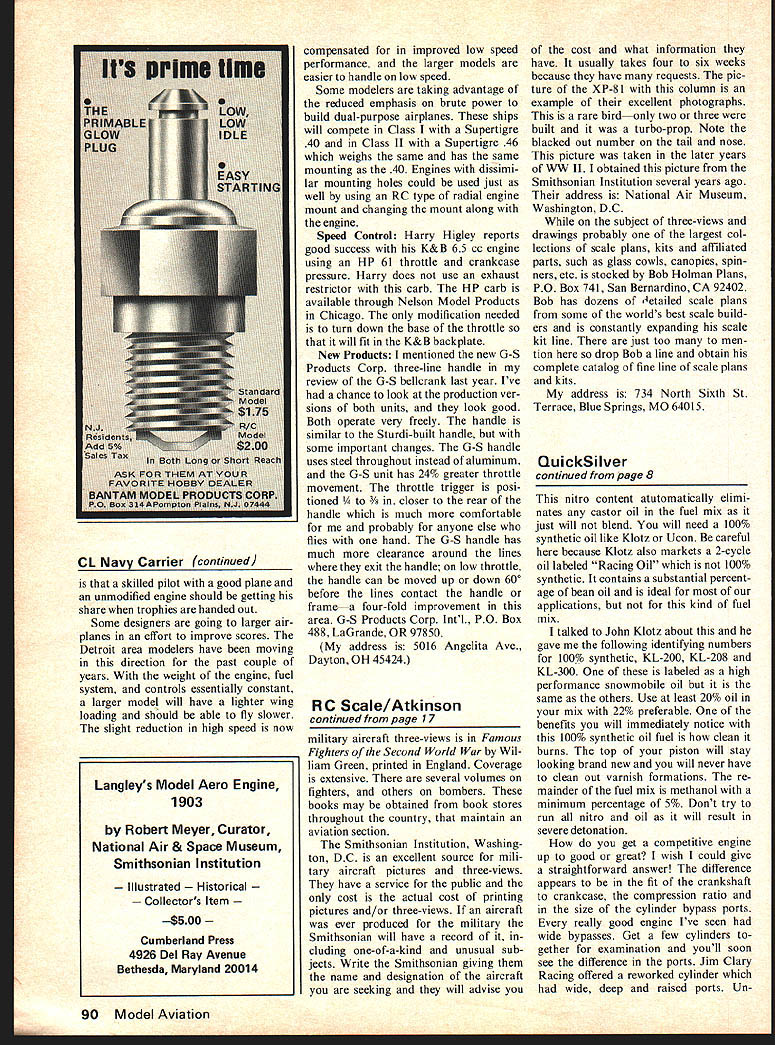
The round fuselage is very little additional trouble to construct than a slab-sided model, since in this size it only takes some large triangular stock longerons and sandpaper. The engine cowls are really easy to build. I fabricated my nose cowl male mold by tack-cementing an appropriately sized piece of balsa to the firewall and sanding it to shape while I was sanding the rest of the fuselage. It will help if you draw some lines on the balsa to indicate minimum size, specifically, the nose ring and the planform (top view). As shown in the pictures, I used a "very easy does it" method and just wrapped a piece of glass cloth around the mold, added some epoxy glue, pinned it in place and let it dry. The hardest part was getting it off the mold.
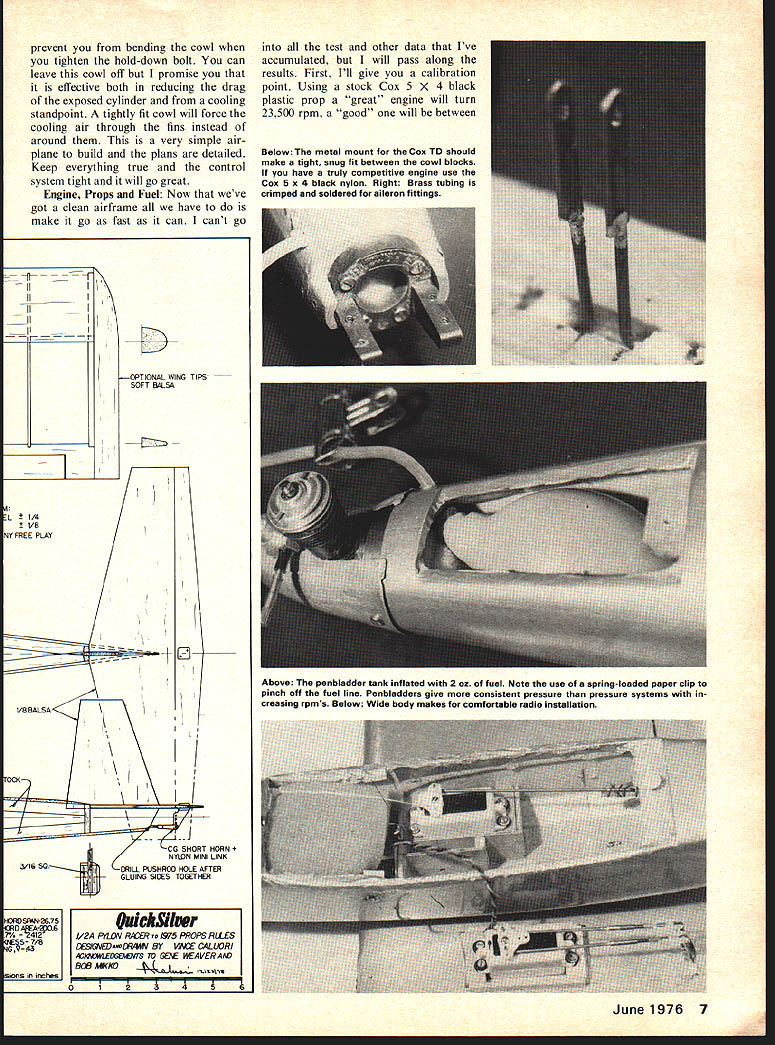
The sheet metal cylinder fairing can be made from any soft, thin sheet metal you have handy. A tin can or some of the K & S sheet stock is fine. One thing I would add that is not shown on the plans is a spacer between the top of the cowl and the engine mount. Any piece of brass tubing big enough for the bolt and cut to the right length will work fine, and will prevent crushing of the glass cowl at the bolt head. I used a 1/8" length of 3/32" brass tubing. prevent you from bending the cowl when you tighten the hold-down bolt. You can leave this cowl off but I promise you that it is effective both in reducing the drag of the exposed cylinder and from a cooling standpoint. A tightly fit cowl will force the cooling air through the fins instead of around them. This is a very simple airplane to build and the plans are detailed. Keep everything true and the control system tight and it will go great.
Engine, Props and Fuel: Now that we've got a clean airframe all we have to do is make it go as fast as it can. I can't go into all the test and other data that I've accumulated, but I will pass along the results. First, I'll give you a calibration point. Using a stock Cox 5 x 4 black plastic prop a "great" engine will turn 23,500 rpm, a "good" one will be between 23,000 and 24,000 rpm. A truly competitive engine will turn 24,500–25,000 rpm. The TD howl can generate large chunks of excitement; however, that's not the only reason for its popularity with racing Formula. Clearly done right, racing offers the least work and money from both participants' and administrators' points of view. From the standpoint of flat-out competitive racing, it can be held on an R/C field with a great deal less special equipment. Although a good deal of common sense is involved, there is some apprehension about safety. A Cox TD for less than $20 is a competitive engine — no $100 controversy. A simple two-channel radio will do; no callers, flagmen — winning is left primarily to the hands of a good, aggressive flier. Best of all, though it's fast and furious, it's still fun. Now, if you're absolutely convinced you want to try racing, jump right in.
QuickSilver, presented in this article, is a clean airplane you can build as the result of several development cycles. I'll tell you about past designs and pass along a summary of the latest engines, pressure fuel systems, fuels and props. You'll also find a description of the racing rules that follow and should allow you to start your own racing event if one doesn't exist in your area.
Like people started in 1971, R/CM rules were laid out around the upstart-type Ace foam-wing airplane that kind of resembled a real racing airplane. The second year of racing, 1973, the mold was broken when Nelson Eddy brought out the first low-aspect-ratio wing airplane and buried everybody. Legalized belly wheels and—Special Flying Models magazine (Aug. 1974) conformance rule dropped in 1974. A whole rash of new airplanes representing the second generation sported low-aspect-ratio wings; a few buried wheels and started to look like racers instead of miniature racers. Pressure systems became common as people started to go fast. Lap times of 140 seconds were normal; times in the middle 130s were being turned by those flying really fast.
Leading the really fast pack, Bob Mikko's Snake introduced the needle-nose fiberglass engine cowl and round body for the lowest wetted area. QuickSilver belongs to 1975's third-generation racers and incorporates a low-aspect-ratio wing, Gene Weaver's exact, cleanly mounted rounded body, needle-nose engine cowl, buried wheels and engine cylinder fairing/cooling shroud. Although the nose shape dictates a pen-bladder fuel system, it proved fast. In its first outing it took five straight wins with a best time of 1:28. It is a very easy airplane to fly, extremely smooth, and a highly damped pitch makes it groovy.
Highly damped pitch means a large horizontal stabilizer. An easy way to draw the vertical is to make it a respectable percentage of the horizontal. You can't have too much stability, right? Previous airplanes, therefore, have always had large verticals, and have also exhibited an annoying tail wiggle in turns commonly called the "Quick-Fly dance" which has slowed airplanes down. Without entering into a long explanation, it's apparent that too much directional stability coupled with little dihedral can lead to this problem. There's no dihedral in the QuickSilver wing. The vertical is small, the fuselage round behind the wing as well as in the front, making the vertical less effective in terms of stability and giving the slightest trace of the dance. Additional verification can be found in newer pattern airplanes which sport a good deal of forward fuselage area, thus reducing directional stability and also eliminating the pre–knife-edge-designs' tendency to dance.
The wing is a key element of high-performance design. Its low aspect ratio makes it simple to build and light. Low aspect ratio and large chord also result in a thinner wing in terms of thickness. 22,500 and 23,000 rpm and a "competitive" engine will catch around 22,000 rpm. These are static, ground rpm. A "good" engine is putting out approximately .2 bhp and that's really "honking" by anybody's standards. If you're not doing as well as these figures indicate, read on, and if you are doing better then please write and share it with the rest of us.
No one has found a universal engine rework that will result in "good" or "great" results! What it takes is a large venturi whose appetite is quenched with lots of pressure-fed nitromethane and a good cylinder with a loose cylinder-to-piston fit. The latter point can't be overemphasized as a tight fitting engine will not generate the rpm and will most likely break when run on high-nitro fuel. So, number one on your engine list is getting a good cylinder/piston fit. There are two ways of getting there. You can go through a long and careful break-in of several hours or you can lap the piston to the cylinder. Lapping is neither difficult nor dangerous to your engine and will even pay off on an older engine if it's still tight. Use a fine abrasive such as one of the household abrasives (Ajax, etc.) or an automobile rubbing/polishing compound. I use Dupont #7 rubbing compound. Coat the cylinder walls with the abrasive and gradually work the piston up and down.
If you are industrious, insert a piece of dowel in the rod's crank-pin hole for a handle and apply a lot of patience and finger power.
If your tendencies are like mine, and you have an old crankcase around, you can make a handy lapping tool. Modify the case by sanding away about 1/8 in. of material at the cylinder seat. This is done so that the cylinder will sit closer to the crankshaft allowing the piston to reach past the top of the cylinder bore. Now you can lap by turning a prop. This procedure is done without crankcase back plate or cylinder head on the engine. Be sure that the crank pin and piston ball are lubricated.
How do you know when you have gone far enough? Check regularly by thoroughly washing with lots of hot water and seeing if the dry piston will fall back of its own weight after being pushed just past the top of the bore. Dupont #7 is handy here because it is water soluble and really cleans up nicely. A loose engine will feel as though it has very little compression, but remember that it's a running (hot) fit that we're after. The piston should have a frosted look to it and after a run or two, a thin, highly polished band should develop at the crown. A properly fit engine will not only run faster but will also start easier.
Open up your venturi to 5/32 of an inch as recommended by Cox and replace the stock needle with the Kim-Kraft needle valve assembly. The latter is essential if you're running a high-pressure system like a pen-bladder as the standard needle will be far too sensitive.
The only thing you will need in order to get this now loose engine to competitive rpms is a high-nitro fuel. By high nitro, I mean between 65 and 70% by volume.
QuickSilver
This nitro content automatically eliminates any castor oil in the fuel mix as it just will not blend. You will need a 100% synthetic oil like Klotz or Ucon. Be careful here because Klotz also markets a 2-cycle oil labeled "Racing Oil" which is not 100% synthetic. It contains a substantial percentage of bean oil and is ideal for most of our applications, but not for this kind of fuel mix.
I talked to John Klotz about this and he gave me the following identifying numbers for 100% synthetic, KL-200, KL-208 and KL-300. One of these is labeled as a high performance snowmobile oil but it is the same as the others. Use at least 20% oil in your mix with 22% preferable. One of the benefits you will immediately notice with this 100% synthetic oil is how clean it burns. The top of your piston will stay looking brand new and you will never have to clean out varnish formations. The remainder of the fuel mix is methanol with a minimum percentage of 5% nitro, but most like to run a nitro mix of 6%.
How do you get a competitive engine up to good or great? I wish I could give a straightforward answer! The difference seems to be in the fit of the crankshaft to crankcase, the compression ratio, the size of the cylinder bypass ports. Every really good engine I've seen had wide bypasses. Get a few cylinders together for examination and you'll soon see the difference in the ports. Jim Clary Racing offered a reworked cylinder which had wide, deep and raised ports.
My address is: 734 North Sixth St. Terrace, Blue Springs, MO 64015. fortunately, that firm is no longer in business. Reworking the cylinder bypass ports can be a very difficult task and really should not be undertaken unless you are ready to scrap that cylinder. Most engines will respond to compression-ratio changes which you can achieve by removing glow plug gaskets, turning down the face of the plug and rotating the cylinder by removing material from its crankcase seat. My "good" engines have been left alone in this respect except for running only one glow plug gasket, but others have had good results in this area.
There is other engine work you can do but none has produced either significant or consistent results. Above all, be patient because TDs seem to get better with age and running time.
Frankly, there is only one good way to get lots of hot fuel to that loose engine and that is a pen-bladder system. It is simple, light and just about foolproof. Besides the air leaks and crankcase flooding, the crankcase pressure system's "last straw" was its dependency on engine rpm. The higher the rpm, the higher the pressure. This led to inconsistent needle valve settings when the prop unloaded in the air, increased rpm and richened the mixture. On the other hand, you can usually leave a pen-bladder needle valve setting alone through a set of races. Once you get used to the bladder you'll find that engine starting is even easier. You will need a third hand to hold the airplane since your second one will be required to hold the fuel line pinched off until the engine fires on the prime. The third hand usually takes the form of a plane holder. Cardboard boxes with their sides cut have worked fine. They also will hold just about everything else you'll need.
Props may be where the greatest potential for performance improvement exists. Until recently, 5/16 x 4 Cox grey props, cut down and thinned, were the favorites. There are problems with this prop because it takes a lot of time to perform the necessary reworks, however the reworks are not consistent and they break with the slightest impact. If you have an engine that is competitive, the prop to use is the Cox 5 x 4 black nylon. I happened upon this prop while looking for a good test prop. The diameter and pitch were right for our speed/rpm and it only took a few flights to convince me to quit carving grey ones. Although it has a "mickey mouse" look, if you check it and a grey one on a pitch block you'll find that it has about 1/2-in. more pitch and that is most likely where the performance comes from. Fortunately, for those of us who are lazy, it is made from the softer nylon which prevents any effective reworking.
Racing: We have successfully staged two kinds of racing in the Seattle area. The predominant type sponsored by the PROPS is run on a 3-pylon course (330' on the straights and 80' between pylons 2 and 3) and requires pylon judges and a communication system so that pilots may be immediately notified of cuts. Callers and flagmen are not allowed! Pilots, the starter and lap counter/timers all stand between the #2 and #3 pylons and the start/finish line. This type of racing is similar to Formula I with a good deal of simplification and is the way to go if you can put together a communication system.
If you don't have a communication system and would like to try 1/2A racing, there is still a simpler way to go. The course flown is around two pylons located approximately 300 to 350 feet apart and on the far side of your normal field runway. You need five "officials": a starter and an official for each pilot. This official stands with his pilot in the normal pilot's box and counts laps, times and calls cuts. Cuts are also called if an aircraft comes closer than the near side of the runway. This type of racing can also be expedited when everyone pits in the normal field pit area.
In either case we fly 10 laps from a flying start. The flying start is a race in itself and you should try it because it is the way to go. The flying start is run as follows: At race time minus two minutes the pilots walk to the line and at one minute the engines are started. At fifteen seconds the starter hands the pilots a 3/4" dowel to hold between the index finger and thumb. The dowel is about 6 inches long. The starter's job is to release the dowels at zero and wave the flag. The pilots run with the airplanes to the line, place the dowel under the spinner and release. The airplane takes off as the pilot throws the dowel. The pilot must be behind the starting line when the airplane takes off otherwise he is penalized. The pilot may hold the airplane but must have the controls in normal position and may not touch any part of the airplane except during the throw. The pilots then fly the 10 laps and attempt to make it through the course without incurring cuts. The lap counter reports the finishing time and any cuts are added as penalties.
Another form of racing we have tried is pylon racing with three pylons forming a triangle. This is the kind of racing used in many of the larger events and is fast and furious. We have found that for 1/2A this kind of course is too small unless you can achieve high speeds. We have run three-pylon races around a 250- to 300-foot triangle and the results were close and exciting. The "start your engines" signal is given. Launching of the models occurs at random as they are started and fliers who get up early can take a few practice laps if they desire. Time to go is announced at regular intervals and at "T" minus 15 seconds all models must be launched and those airborne are required to proceed to the left of the first pylon or downwind of the #2 and #3 pylons. If you're not in the air at the -T-15 second mark, it is a "no start" and no further engine running is allowed. This ruling is required so that all pilots can hear the 10-second countdown.
Normally, everyone has gained a considerable amount of altitude circling above the course and the simultaneous dive to the starting line is an exciting race in itself. Occasionally, fliers will chicken out, fearing that they will cut by passing the start line before T-zero is called out. Loops or other maneuvers may be taken to delay your arrival at the line. All clocks start together at T-zero.
All other rules and scoring are conventional. In a nutshell, the airplane rules are as follows: maximum engine displacement .051 cu. inches; weight not less than 20 or more than 32 oz.; fuselage minimum cross section of 8.5 sq. inches; minimum wing area of 200 sq. inches with constant chord and a minimum thickness of 7% at the root. We are still requiring two functional 1.25-in. wheels but they are on their way out. A new rule we have added this year is a requirement for a positive servo actuated engine cut-off. This was done to expedite the running of the races since we were getting some pretty long engine runs after the races were over. It's a simple item to mechanize by using a down elevator command to squeeze the fuel line.
Where do we go from here? Well, one thing for sure, we will go faster. We look for race times to drop below 1:20 before the season is over and there will always be new and clever design innovations. Where we really need to go is to some national standards for the event so we can use a common yardstick to measure our progress and to perhaps compete on a national level. In any case you can always visit us during the winter; on the first Sunday of the month at the Robin Kent field on the second Sunday of the month at the Delta Park field in Portland.
Just before mailing this article (late Dec.), I had a chance to talk to Dale Kirn about the availability of his needle valve assemblies, TD parts, piston-setting tools, etc., which Clary Corp. had been marketing. Dale is still recovering from an operation and is not certain about any personal involvement. He did say, however, that a good number of needle valve assemblies were in the distribution pipeline and these should be available (A & L has several hundred according to Dale). There are still many other parts in inventory at Clary and Dale; he felt these would also find their way to the market. If further information becomes available, Dale will be glad to let you know. You can reach him at: 2830 North Spruce Drive, Anaheim, CA 92805.
Transcribed from original scans by AI. Minor OCR errors may remain.

