
THE "QUIET MAN" MAKES IT TO THE TOP
Rick Allison
Overview
The 13th International Tournament of Champions (TOC), October 24–27, 1996, at William G. Bennett RC Field (formerly Circus Circus RC Field) in Las Vegas, Nevada, was won by a quiet man from Baltimore: Steve Stricker. Stricker won by consistently outflying the field in both Known and Unknown programs, taking three of six rounds in the wind-shortened preliminaries and three of six in the finals to beat many of the world's best RC aerobatic pilots.
Event background
- Host: Sahara Hotel and Casino (William G. "Bill" Bennett)
- Founded: 1974 by Walt Schroder and Bill Bennett
- Prize money pot: $151,000 (richest money contest in aeromodeling)
- Models: Large-scale aerobatic models (up to ~48% scale this year)
- Engines, hardware, airframes, and radio systems: cutting-edge; TOC has pushed giant-scale technology forward over its history
Contest format and scoring
- Qualifying: three days, nine rounds total
- 3 Known Compulsory Programs
- 3 Unknown Compulsory Programs (handed to contestants the night before; no practice allowed)
- 3 four-minute Free Programs
- Finals: top five pilots after qualifying fly six rounds (two Known, two Unknown—#4 and #5—and two Frees)
- In both prelims and finals the lowest scoring flight of each program type is dropped
- Scoring: modified IAC/FAI/Aresti rules, weighted
- 50% Unknowns
- 30% Knowns
- 20% Free program
- Note: For the first time in recent memory there were no special flight score bonuses based on aircraft size or type
Preliminaries — highlights and round summaries
- Defending champion Quique Somenzini won the opening-round Unknown decisively. Jason Shulman was second, Bill Cunningham and Steve Stricker were third and fourth, and Christophe Paysant Le Roux fifth.
- Round Two (Known): Steve Stricker uncorked a nearly flawless performance to win the round. Quique dropped to second; Christophe third; Shulman fourth; Cunningham fifth.
- Round Three (second Known): Wind picked up. Bill Cunningham set an early standard, but Stricker delivered a wind-corrected flight to win the round. Round result: Stricker first, Cunningham second, Somenzini third, Peter Erang fourth, Dave von Linsowe fifth.
- After three rounds (end of Day 1): Somenzini led by a small margin; Stricker second; Cunningham third; Shulman fourth; Paysant Le Roux fifth. On the bubble: von Linsowe (6th), F3A World Champion Giichi Naruke (7th), Mike Klein (8th), Ivan Kristensen (9th), Mike McConville (10th).
Weather interruption and restructured schedule
- Forecast: advancing cold front with winds predicted 30–40 mph
- Friday: after eight flights into Unknown #2, Event Director Steve Rojecki called a pilots' meeting and halted flying; conditions worsened and contest day was canceled
- Restructure: the third Unknown and two Frees would be flown on Saturday to complete two Knowns, two Unknowns, and two Frees for finalists selection
Saturday — cleanup, demos, and final qualifying flights
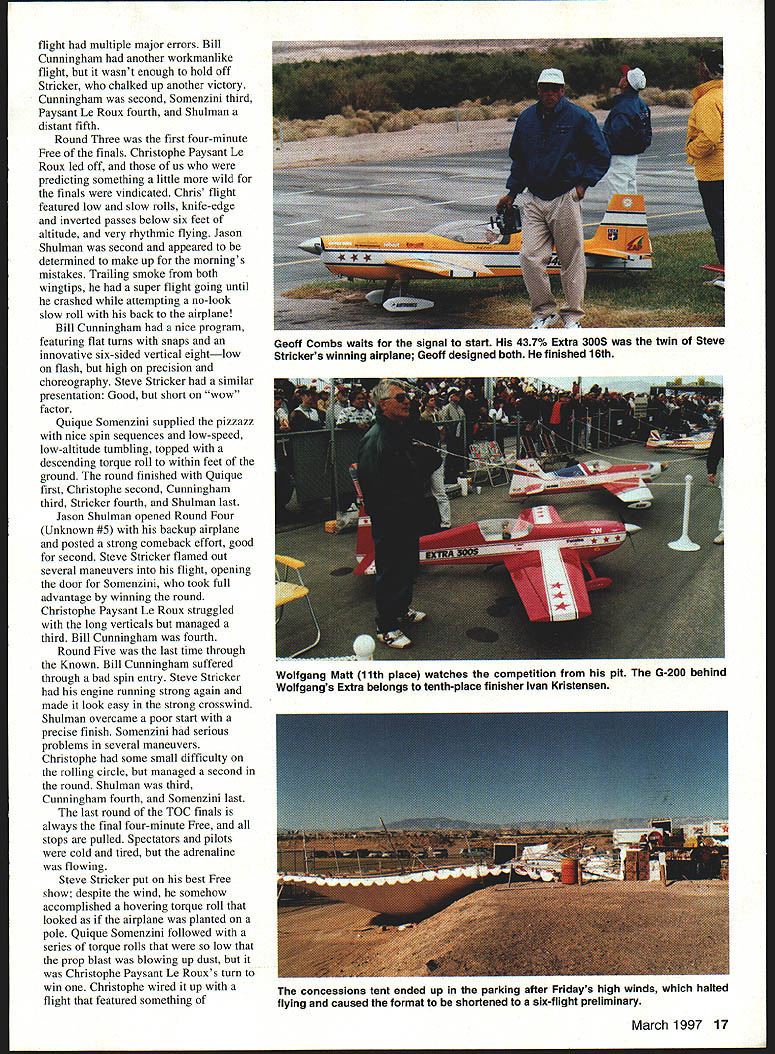
- Overnight winds (~50 mph) caused damage around the field (concessions tent ripped loose). Sahara crews cleaned up.
- In gusty conditions, Stricker posted a monster flight in Unknown #3; Somenzini was second; Mike McConville third; Paysant Le Roux fourth; Cunningham fifth.
- The Free program: subjective scoring based on originality, versatility, harmony, rhythm, and execution. Saturday featured many stylish and daring Frees; spins and tumbling maneuvers were in fashion.
- Saturday lunchtime: disqualification news — Mike Klein (8th after Thursday) was disqualified for an unauthorized test flight Friday evening and finished 20th.
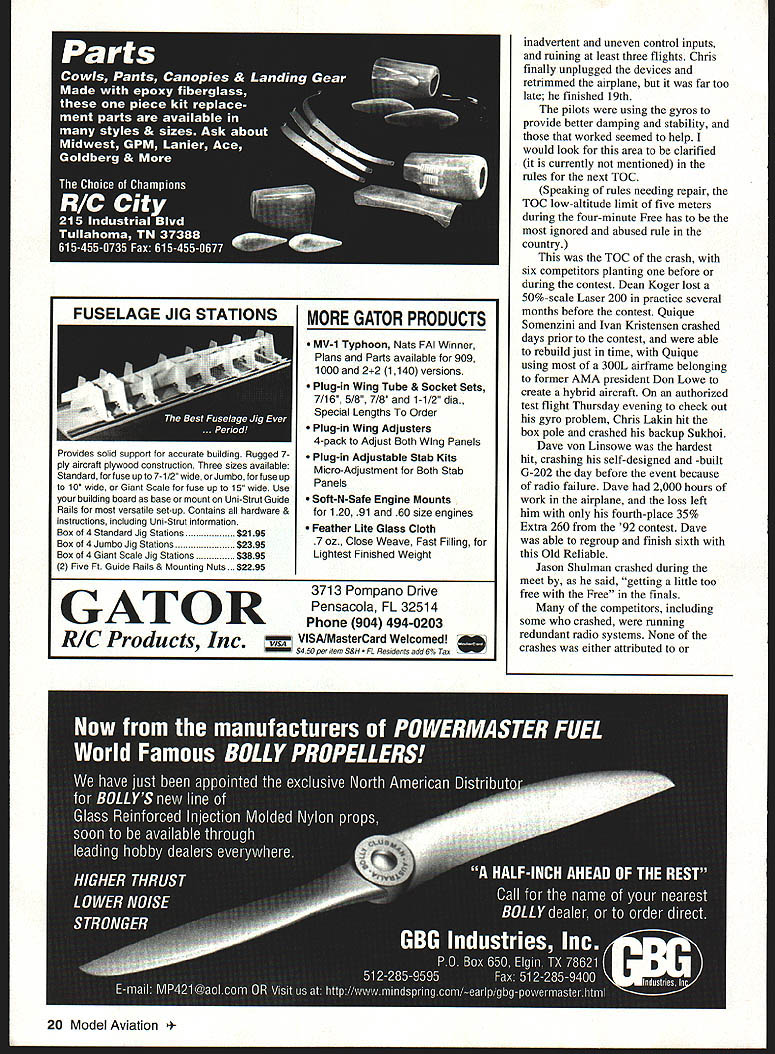
- Demonstrations: helicopter demos (Curtis Youngblood, Dave Storey), formation aerobatics (Frank Noll, Trent Williams), jet demos (Kent Noy, Garland Hamilton, Bob Violett), Flying Lawnmower (Lloyd Marohl), and daily noon performances by full-scale Extra 300S pilot Patty Wagstaff.
- Final qualifying Free: Dave von Linsowe posted an excellent second-place Free; however his effort left him just short of the finals, finishing 6th overall.
- Finalists announced at Saturday banquet: Steve Stricker, Quique Somenzini, Bill Cunningham, Christophe Paysant Le Roux, Jason Shulman (same top five as after Thursday's opening round).
Finals — round-by-round
- Finals morning (Unknown #4): Stricker flew first and had a great performance. Round order: Stricker 1st, Somenzini 2nd, Cunningham 3rd, Paysant Le Roux 4th, Shulman scratched from the round for missing his start (zero).
- Finals Known: a steady 20-mph crosswind returned. Stricker again won the round. Cunningham 2nd, Somenzini 3rd, Paysant Le Roux 4th, Shulman 5th.
- First finals Free: Paysant Le Roux opened with a wild, rhythmical flight and took the round. Shulman crashed late in his Free while attempting a no-look slow roll. Round finish: Somenzini 1st, Paysant Le Roux 2nd, Cunningham 3rd, Stricker 4th, Shulman last.
- Unknown #5: Shulman returned with his backup plane and posted a strong second. Stricker had a mishap; Somenzini won the round. Paysant Le Roux 3rd, Cunningham 4th.
- Last Known: Stricker recovered with a strong crosswind Known win. Paysant Le Roux 2nd, Shulman 3rd, Cunningham 4th, Somenzini last.
- Final Free (deciding round): Stricker delivered his best Free, including a hovering torque roll that looked planted on a pole. Somenzini followed with very low torque rolls; Paysant Le Roux capped the round with a superlative, well-rounded Free. Shulman and Cunningham also put in top efforts.
Final standings and prizes
- Steve Stricker — $30,000 (Champion)
- Quique Somenzini (Argentina) — $20,000
- Jason Shulman — $10,000
- Christophe Paysant Le Roux — $8,500
- Bill Cunningham — $7,500
Note: The final Free did not change the podium order; four of the five pilots had their strongest flights in the final round and overall scores were close.
Notable teams, equipment, and trends
- Team Stricker crew: Kelly Jacobsen (mechanic), Ron Stahl (mechanic), Paul Kirsch (coach/caller)
- Fuel/engines:
- For the first time in recent years most aircraft ran on gasoline rather than glow fuel.
- Maximum engine displacement raised from 8.8 cu. in. to up to 12.0 cu. in., depending on wing area.
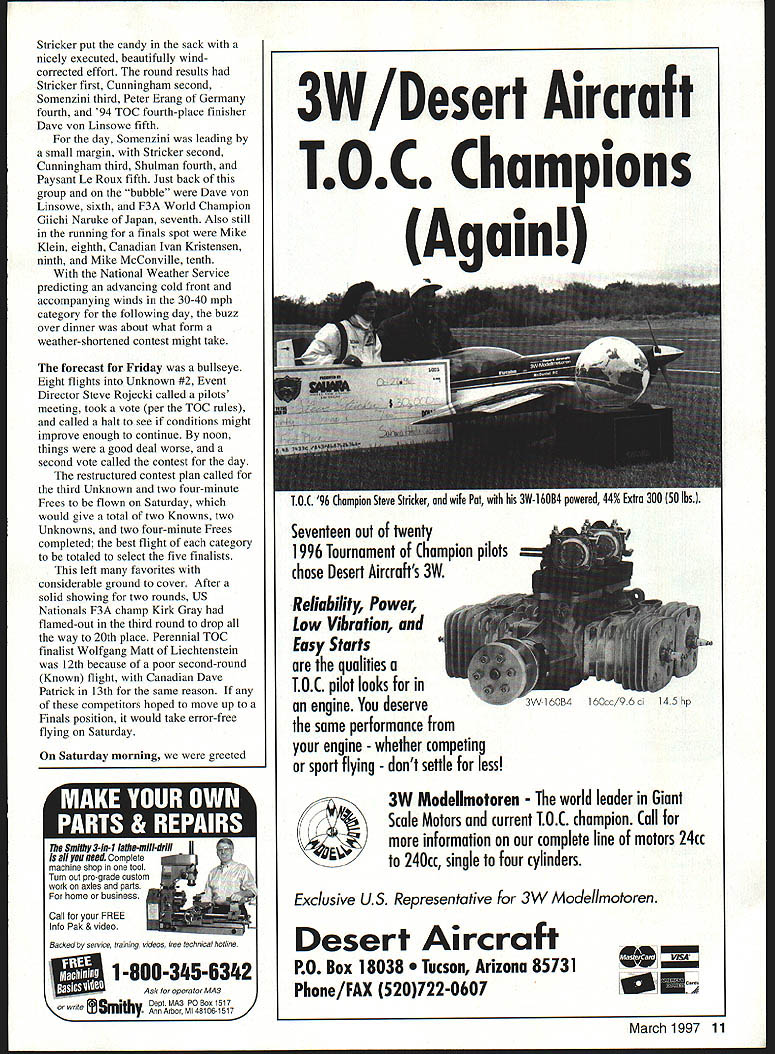
- Several pilots used the German-made 3W 160 four-cylinder (9.6 cu. in.) for over-40% scale aircraft (e.g., Stricker, Mike Klein).
- Most-used engine: 3W 120 twin (7.0 cu. in.) — powered about half the models entered.
- Overall, 3W engines (120, 160, 80, 70) powered roughly 75% of models.
- Paysant Le Roux brothers used Team 7.0 single-cylinder engines and experienced horsepower deficits for long vertical lines.
- Props:
- Menz: 10 competitors
- Bolly: 7
- APC: 3
- Aircraft types:
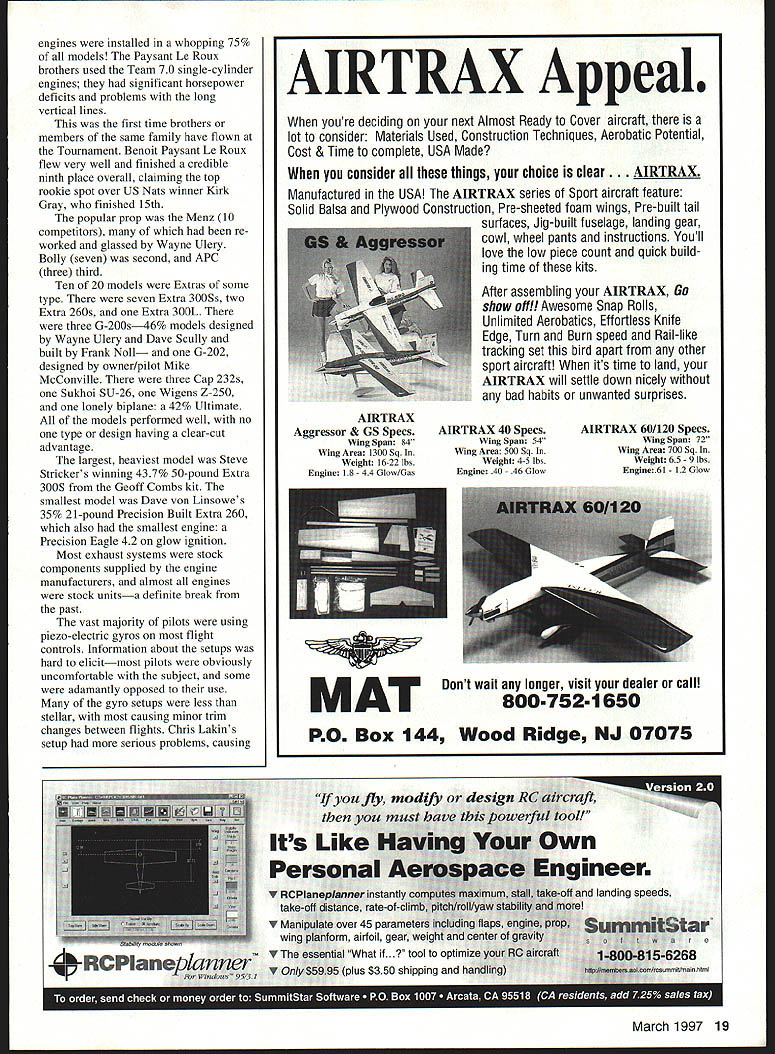
- 10 of 20 models were Extras (7 Extra 300S, 2 Extra 260, 1 Extra 300L)
- 3 G-200s (46%, designed by Wayne Ulery and Dave Scully, built by Frank Noll)
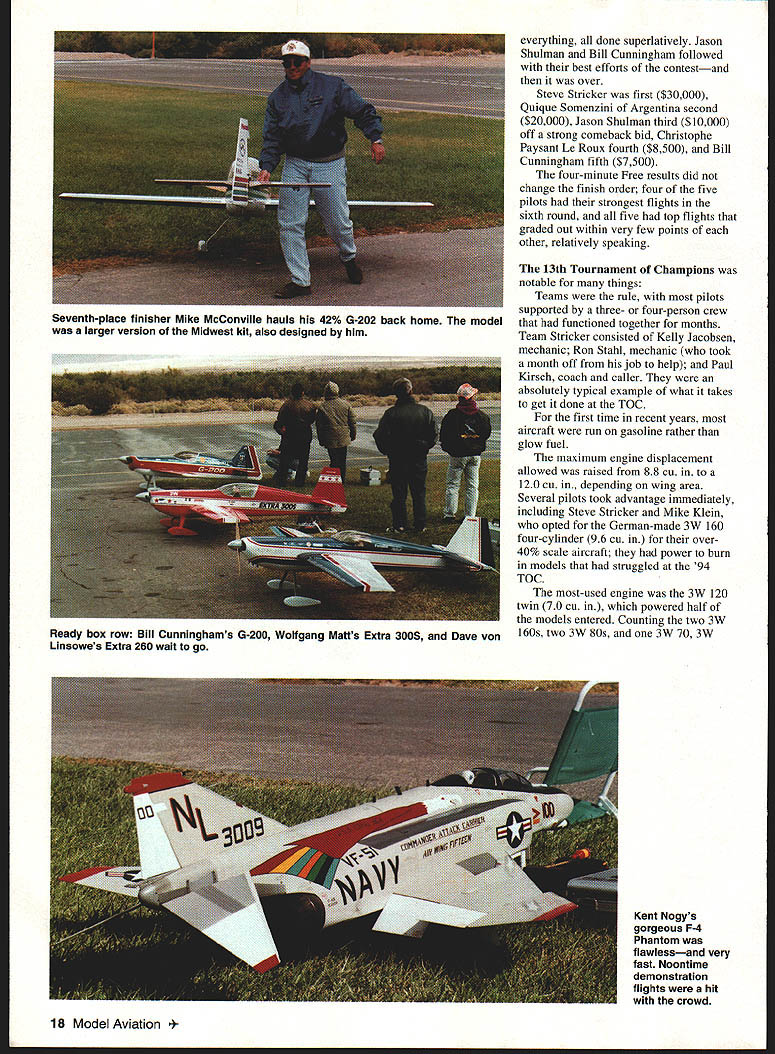
- 1 G-202 (designed by owner/pilot Mike McConville)
- 3 Cap 232s, 1 Sukhoi SU-26, 1 Wigens Z-250 (48% fiberglass-fuselage by Peter Erang), 1 42% Ultimate biplane
- Largest model: Stricker’s 43.7% 50-lb Extra 300S (Geoff Coombs kit)
- Smallest model: Dave von Linsowe’s 35% 21-lb Precision Built Extra 260 (Precision Eagle 4.2 glow engine)
- Radio, servos, and gyros:
- Radios: 16 used Futaba, 3 JR, 1 Airtronics (Geoff Coombs); radios performed well overall
- Two servos per control surface common; several used four servos on rudder via bellcrank for torque
- Many pilots used chokes, signal generators, and heavier-gauge wiring for long servo leads
- Gyros: piezo-electric gyros were widely used for damping and stability; many pilots were guarded about setups and several gyro installations caused trim or control issues. Chris Lakin suffered major gyro-induced problems and finished 19th after unplugging them.
- Gadgets of note:
- Peter Erang’s electrically fired colored smoke canisters in his Wigens Z-250 wheelpants (excellent craftsmanship)
- Quique Somenzini’s ducted smoke system extending to wingtips
Crashes, disqualifications, and safety notes
- Crashes before/during the event:
- Dean Koger lost a 50% Laser 200 in practice months prior
- Quique Somenzini and Ivan Kristensen crashed days before the contest and rebuilt in time (Somenzini used much of a 300L airframe owned by Don Lowe)
- Chris Lakin crashed backup Sukhoi on an authorized test flight Thursday evening while troubleshooting a gyro problem
- Dave von Linsowe crashed his self-designed G-202 the day before the event due to radio failure; he regrouped with an older Extra 260 and finished 6th
- Jason Shulman crashed in the finals after getting "a little too free"
- Disqualification:
- Mike Klein disqualified for an unauthorized test flight Friday evening; finished 20th
- Redundancy: several competitors ran redundant radio systems; no crash was clearly attributed to or prevented by redundancy
- Rule comments: the TOC’s low-altitude limit of five meters during the four-minute Free is widely ignored and abused
Criticisms and observations
- Judging and Unknown programs: This year's Unknowns were progressively more difficult for pilots as intended, but they also became progressively difficult for judges and spectators. The fifth Unknown lacked balance, flow, symmetry, spectator appeal, and common sense. A fly-through or more forethought by contest management could improve the situation.
- Gyro rules: many pilots used gyros for stability; clearer rules and guidance on gyro use may be needed for future TOCs.
- Attendance and logistics: attendance was excellent (thousands, including many foreigners). First-time Sahara sponsorship caused a few logistical glitches but nothing major.
Conclusion
The 13th Tournament of Champions was a fabulous event and, in many ways, typical of past TOCs: a high level of competition, cutting-edge equipment, memorable flying, storms and drama, and heroic recoveries. Steve Stricker's win was popular with fans, press, and pilots—a feel-good victory earned by grit, talent, persistence, and hard work. The author plans to return in 1998.
Transcribed from original scans by AI. Minor OCR errors may remain.

