
John F. Kilsdonk If you'd like to have a go at CL racing but
THE RACE...
MOST HUMANS have a basic need to compete. This may happen on the job, in the neighborhood, in sports, or in hobbies. When your hobby is model airplanes and you have this urge to compete, you enter contests. Normally, your model is entered against several other people's models. At the end of the meet, the scores for the day are compared and the winner is decided. The ultimate in competition of course is in head to head flying. Racing events obviously fit this situation.
To my knowledge "B" Team Racing was the first official racing event. It enjoyed great popularity in the mid to late 1950's. I can remember going out to Rouge Park in Detroit to one of the Strathmoor Contests in 1956 or so and seeing as many as 50 team racers. Gradually though, interest in B-TR died and Rat Race started to gain popularity. The original Rat Racers were nothing but Ringmasters with green-head K&B's or Foxes on them. These evolved into the present sleek-looking cowled racers fitted with high-powered .40's.
Goodyear also gained popularity through the promotions of Cal Smith, followed by the Tulsa group, and it was given the final push to full-fledged recognition by a consolidated effort of several Midwest clubs. (Editor's Note: The Californians, Keith Storey and Les McBrayer, brought prototypes of two team racers to a Nationals in Olathe, Kan. in the late 40's. Storey was the initial promoter of the racing idea in control-line, and also of RC Pylon Racing. Storey's TR model was the Key, which was kitted by Berkeley and published in the old Air Trails. McBrayer's model was published in Mechanix Illustrated. Smith, whose Skyraider won the first Carrier event ever held, then wrote many fine articles which popularized both TR and Carrier.)
1975 saw 1/2 Mouse Race gain official status and 1976 was the year that Slow Rat Race finally made the grade. Meanwhile, FAI TR is still popular in most European countries although it's only supported by a small group in the USA. The future may bring other new Racing events such as Big (.40) Goodyear, .15 Rat Race, etc. Some of the present events may lose popularity, but there always will be some forms of CL Racing.
Racing events require more than just a model and a powerful engine. Additionally they require team work, physical dexterity, practice, strategy, and luck. I feel that these requirements not only make the racing events unique, they also put these events at the pinnacle of all CL events. I even secretly believe that they are the most challenging of all of the AMA events.
This article is intended to complement most previous construction articles on the various CL racing models. Hopefully it will answer some of the questions of the new competitors who have just finished their new model and wonder: What do I do now?
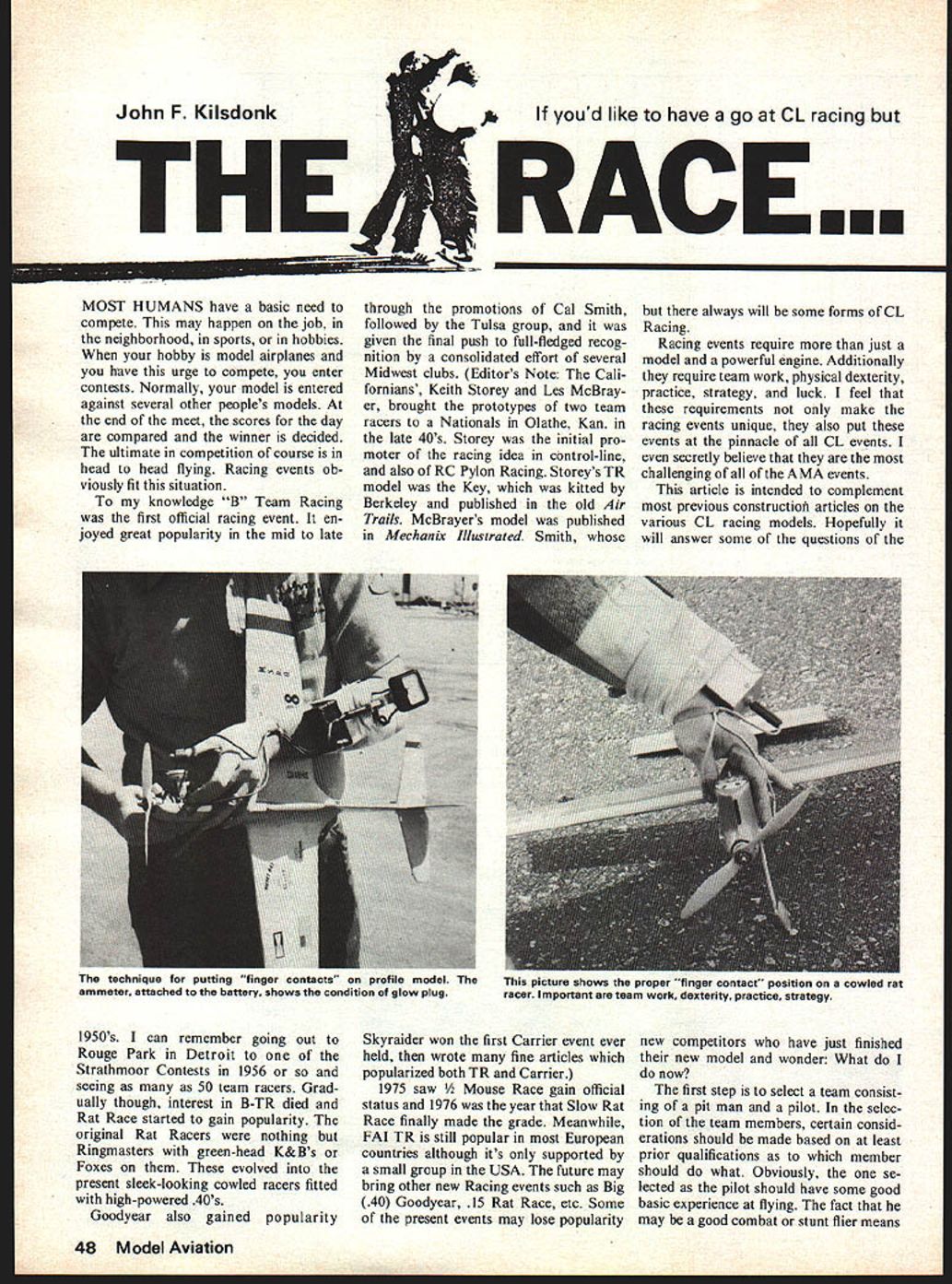
The first step is to select a team consisting of a pit man and a pilot. In the selection of the team members, certain considerations should be made based on at least prior qualifications as to which member should do what. Obviously, the one selected as the pilot should have some good basic experience at flying. The fact that he may be a good combat or stunt flier means he may be a good combat or stunt flier; it does not necessarily mean he should be a pilot. Model aviation technique, putting "finger contacts" on profile models, the ammeter attached to the battery, and the condition of the glow plug are examples of basic areas the pilot should be familiar with.
Important team work, dexterity, practice, strategy, and feel cannot be put down in a few lines. Briefing by experienced competitors will prove invaluable. There is very little actual flying maneuvering — racing planes require little skill in aerobatics. Usually planes are quite insensitive and won't maneuver very well. However, the pilot must develop a good deal of physical dexterity and reflexes. In the case of Rat Race he must have some brute physical strength. Additionally, a taller pilot has an advantage, although it is not absolutely necessary. Left-handed pilots are at a big disadvantage.
Physical dexterity, knowing where to rest your feet and how to hold your body, are things that must be developed. Being able to run fast is important because you don't want to run out around the circle; you want to walk a tight circle later. General physical condition is quite important for fast events such as Rat Race and Goodyear. John Ballard claims he runs five miles per day to stay in shape. Personally, some jogging a mile a couple days a week in addition to some tennis aids general well-being for flying.
It is important to put team members in the proper positions and to understand the basic field layout for racing events. Depending on facilities available, the configuration may vary. However, a basic layout should be used whenever possible. Pilots should stay in the flying area; landings and takeoffs should stay in designated areas; pitting, including initial starts, should be confined to the pitting zone. During landings and takeoffs, pilots should maintain a crouched position to avoid snagging the head or other flier. Being able to run fast is not important because you don't want to run around the circle. You want to walk in a tight circle. More on this later. General physical condition is quite important in the "fast" events such as Rat Race and Goodyear. John Ballard claims he runs five miles per day to stay in shape. Personally, I do some jogging but at most only a mile or so a couple days a week in addition to some tennis, although this is more for the general well-being than for the flying.
In order to put each of the team members in the proper position, it is necessary to understand the basic field layout for racing events (Fig. 1). Depending on the facilities available, this configuration may vary. However, this basic layout should be used whenever possible for all events except the 1/2A events which use slightly different dimensions, and you can consult the rule book for these.
Area A is the flying zone. Pilots should stay in this area while flying. On landings and takeoffs, they should stay in Area B. Area C is the no-no zone. Nobody should be in that area during the race. Area D is the pitting zone. All pitting, including initial starts are confined to this area.
During landings and takeoffs, the pilot should maintain a crouched position in Area B so as to avoid snagging his head on the other fliers' lines. While the plane is being serviced, he should squat down and keep the flying handle near the ground and the lines on the ground. OK, now you've gotten the team together, what's next? Practice! Practice is the single most important thing to do in preparation for the race.
Both pilot and pit man must not only learn and practice their individual responsibilities, but also must work together as a team. First off, you must get familiar with the model by practice flying it alone. Practice flying it alone until all of the basic systems and routines are working well. Then get someone else to fly with you. Flying with two other people in the circle is a lot different than flying alone. Although both pilot and pit man comprise the team, they both have different and distinct responsibilities.
The pit man is the team leader. He should call all of the shots. He must be very familiar with all of the operating characteristics of the engine and fuel shutoff in addition to his "personal equipment": the battery system and fuel refilling device. Additionally, it is the pit man's responsibility to monitor the lap count and determine the best race strategy for pit stops.
One thing that isn't so obvious though is that the pilot is best able to determine needle valve settings. The pilot hears the steady drone of the engine in addition to being better able to determine settings through maneuvering the airplane. The pit man has difficulty "hearing" needle settings once the model is launched, especially with one or two other planes flying in the same circle.
The pit man's "personal equipment" includes some sort of battery pack strapped to his body (preferably his left arm) with lead wires connected to a "hot glove" or finger contacts. I have found that finger contacts or rings made from copper pipe work the best. These are available at most hardware stores. Select one size that fits your thumb and another that fits your finger. A 1/2 inch length is plenty. If the standard pipe doesn't seem right, try some of the copper pipe fittings. Bearing in mind that the pipe and fittings are round and your fingers are somewhat oval in shape, you can gently squeeze the pipe in a vise to flatten it out to better conform to your fingers.
An ammeter in series with one of the lead wires is very handy as it readily indicates the glow plug condition. I have found that the Model Rectifier 0-6 AMP meter (available at HO train dealers) works the best. Refer to Fig. 2 for a schematic of the hook-up. Once you become familiar
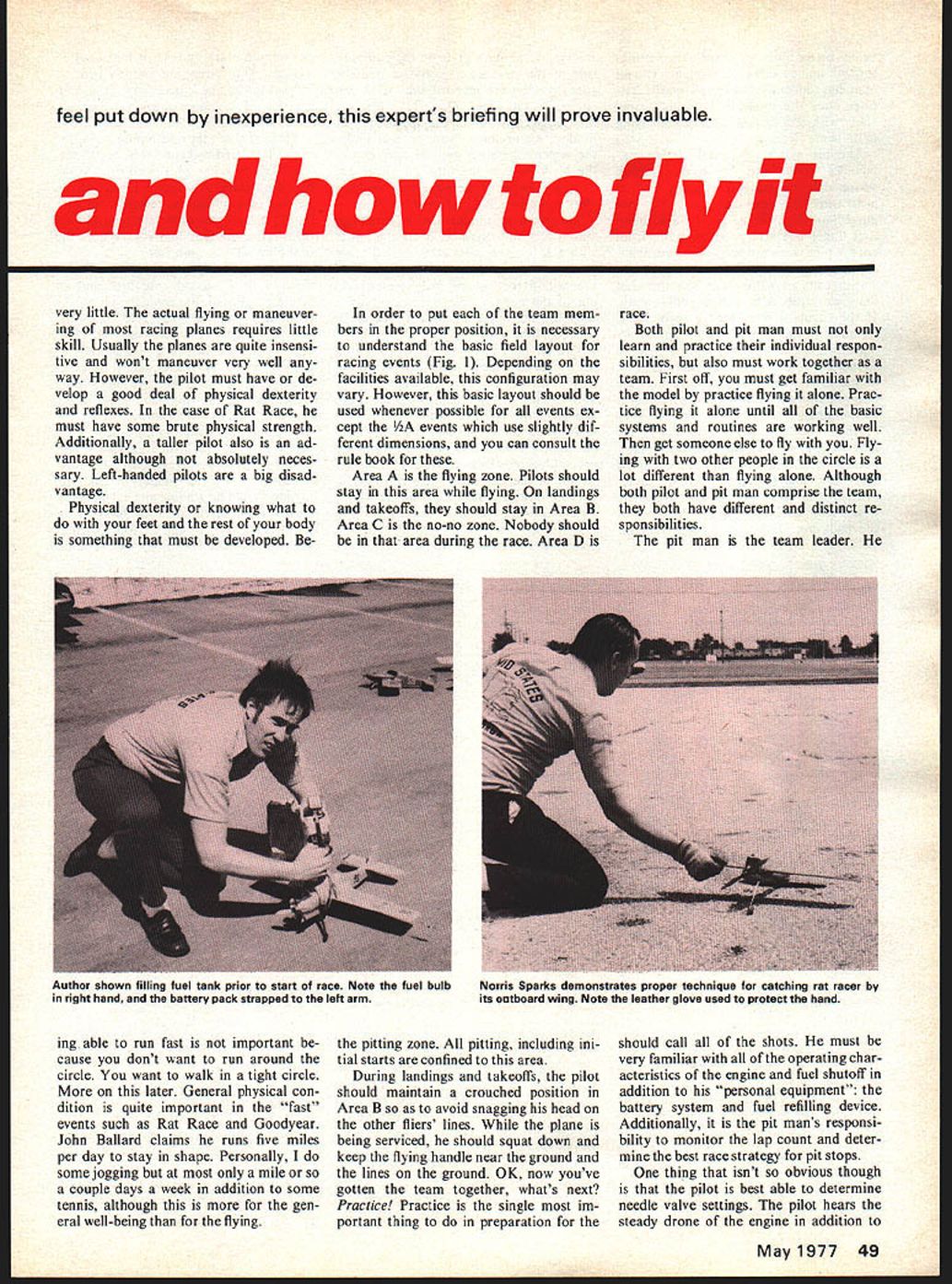
On Rat Racers, we prefer a plate on the outboard side of the cowl as one contact and the speed pan on the inboard side below the engine as the other. On profile fuselage models, such as Goodyear and Slow Rat models, we prefer a brass contact under the upper engine lug and the bare end of the glow plug as the other. I have seen many variations of these and most seem to work equally well.
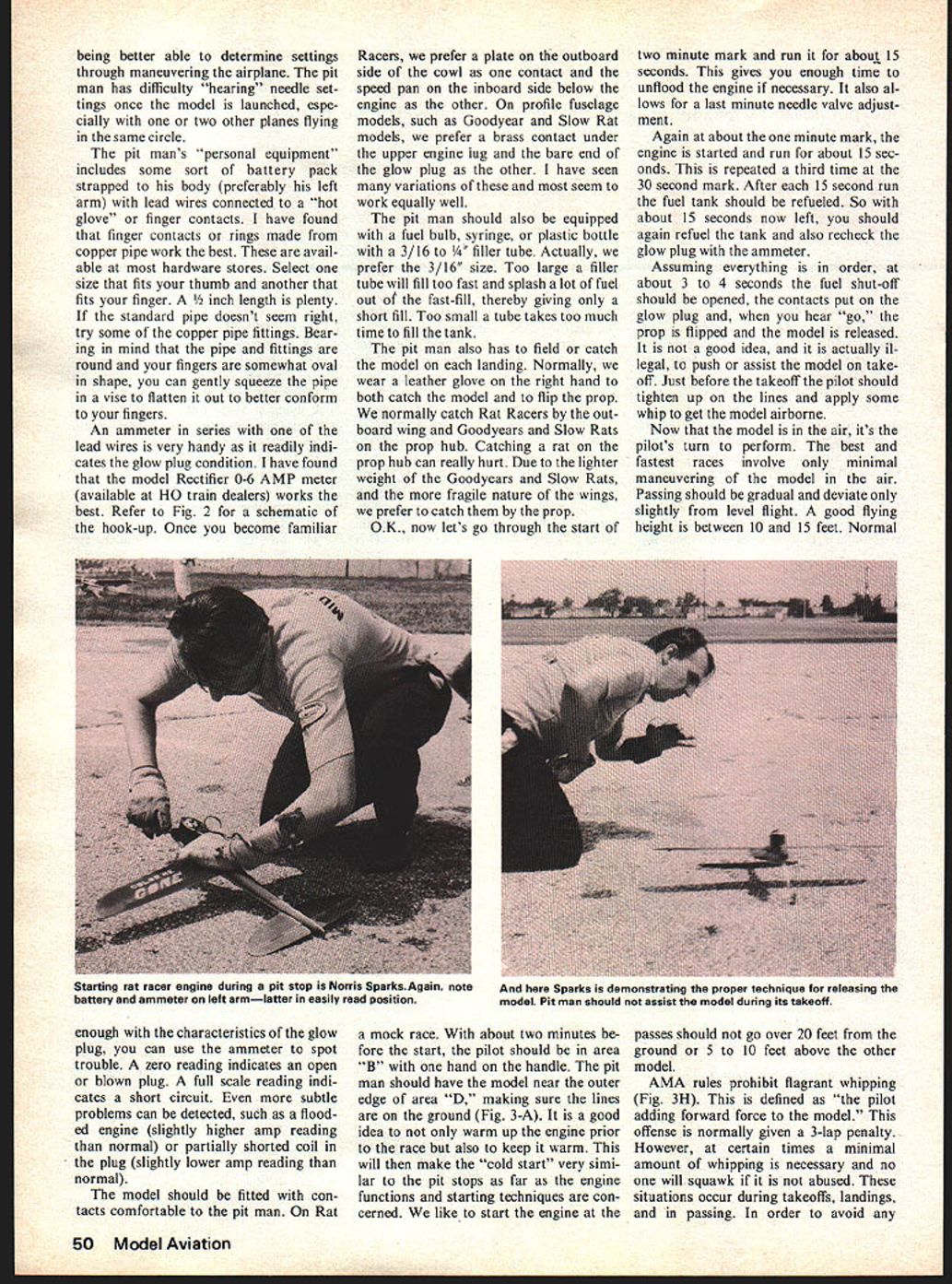
The pit man should also be equipped with a fuel bulb, syringe, or plastic bottle with a 3/16 to 1/4" filler tube. Actually, we prefer the 3/16" size. Too large a filler tube will fill too fast and splash a lot of fuel out of the fast-fill, thereby giving only a short fill. Too small a tube takes too much time to fill the tank.
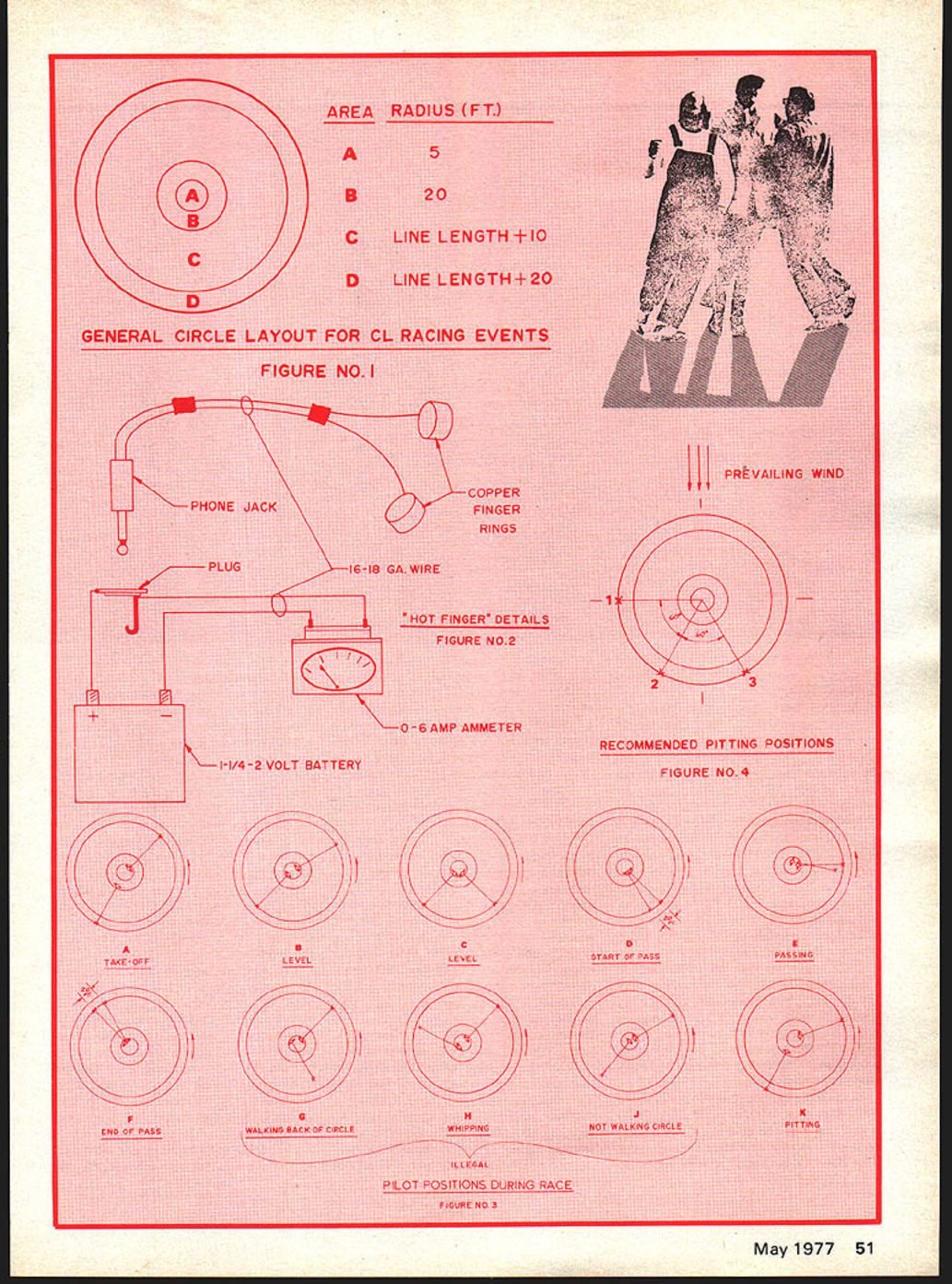
The pit man also has to field or catch the model on each landing. Normally, we wear a leather glove on the right hand to both catch the model and to flip the prop. We normally catch Rat Racers by the outboard wing and Goodyears and Slow Rats on the prop hub. Catching a rat on the prop hub can really hurt. Due to the lighter weight of the Goodyears and Slow Rats, and the more fragile nature of the wings, we prefer to catch them by the prop.
O.K., now let's go through the start of a mock race. With about two minutes before the start, the pilot should be in area "B" with one hand on the handle. The pit man should have the model near the outer edge of area "D," making sure the lines are on the ground (Fig. 3-A). It is a good idea to not only warm up the engine prior to the race but also to keep it warm. This will then make the "cold start" very similar to the pit stops as far as the engine functions and starting techniques are concerned. We like to start the engine at the two minute mark and run it for about 15 seconds. This gives you enough time to unflood the engine if necessary. It also allows for a last minute needle valve adjustment.
Again at about the one minute mark, the engine is started and run for about 15 seconds. This is repeated a third time at the 30 second mark. After each 15 second run the fuel tank should be refueled. So with about 15 seconds now left, you should again refuel the tank and also recheck the glow plug with the ammeter.
Assuming everything is in order, at about 3 to 4 seconds the fuel shut-off should be opened, the contacts put on the glow plug and, when you hear "go," the prop is flipped and the model is released. It is not a good idea, and it is actually illegal, to push or assist the model on takeoff. Just before the takeoff the pilot should tighten up on the lines and apply some whip to get the model airborne.
Now that the model is in the air, it's the pilot's turn to perform. The best and fastest races involve only minimal maneuvering of the model in the air. Passing should be gradual and deviate only slightly from level flight. A good flying height is between 10 and 15 feet. Normal passes should not go over 20 feet from the ground or 5 to 10 feet above the other model.
AMA rules prohibit flagrant whipping (Fig. 3H). This is defined as "the pilot adding forward force to the model." This offense is normally given a 3-lap penalty. However, at certain times a minimal amount of whipping is necessary and no one will squawk if it is not abused. These situations occur during takeoffs, landings, and in passing. In order to avoid any
enough with the characteristics of the glow plug, you can use the ammeter to spot trouble. A zero reading indicates an open or blown plug. A full scale reading indicates a short circuit. Even more subtle problems can be detected, such as a flooded engine (slightly higher amp reading than normal) or partially shorted coil in the plug (slightly lower amp reading than normal).
GENERAL CIRCLE LAYOUT FOR CL RACING EVENTS
AREA RADIUS (FT.)
A 5 B 20 C LINE LENGTH + 10 D LINE LENGTH + 20
FIGURE NO. 1
PHONE JACK
PLUG
16-18 GA. WIRE
COPPER FINGER RINGS
"HOT FINGER" DETAILS
FIGURE NO. 2
0-6 AMP AMMETER
1-1/4 - 2 VOLT BATTERY
PREVAILING WIND
RECOMMENDED PITTING POSITIONS
FIGURE NO. 4
PLOT POSITIONS DURING RACE
FIGURE NO. 3
A TAKE-OFF B LEVEL C LEVEL D START OF PASS E PASSING F END OF PASS G WALKING BACK OF CIRCLE H WHIPPING ILLEGAL I NOT WALKING CIRCLE K PITTING penalty, any whipping in these cases should not exceed one half lap.
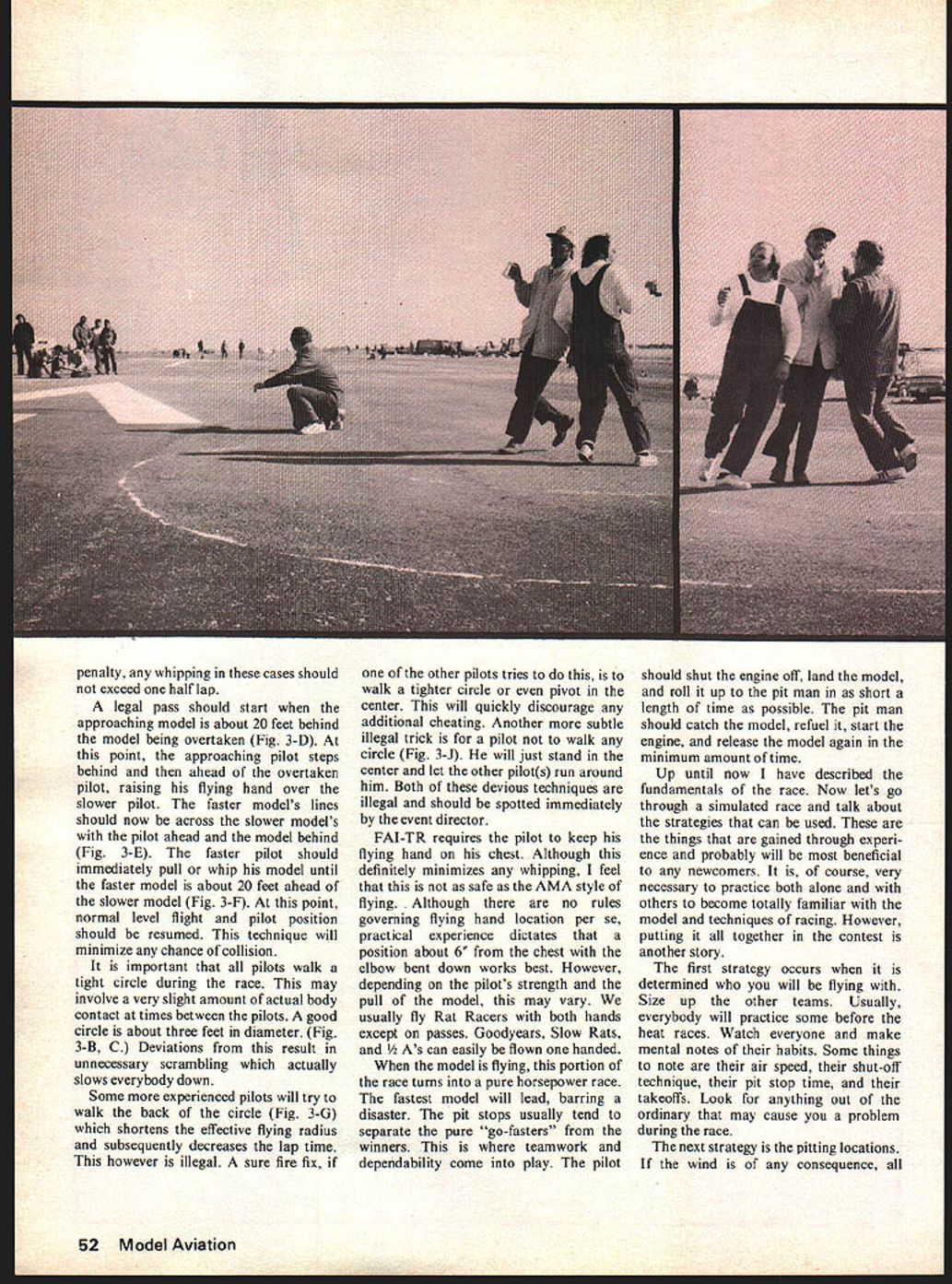
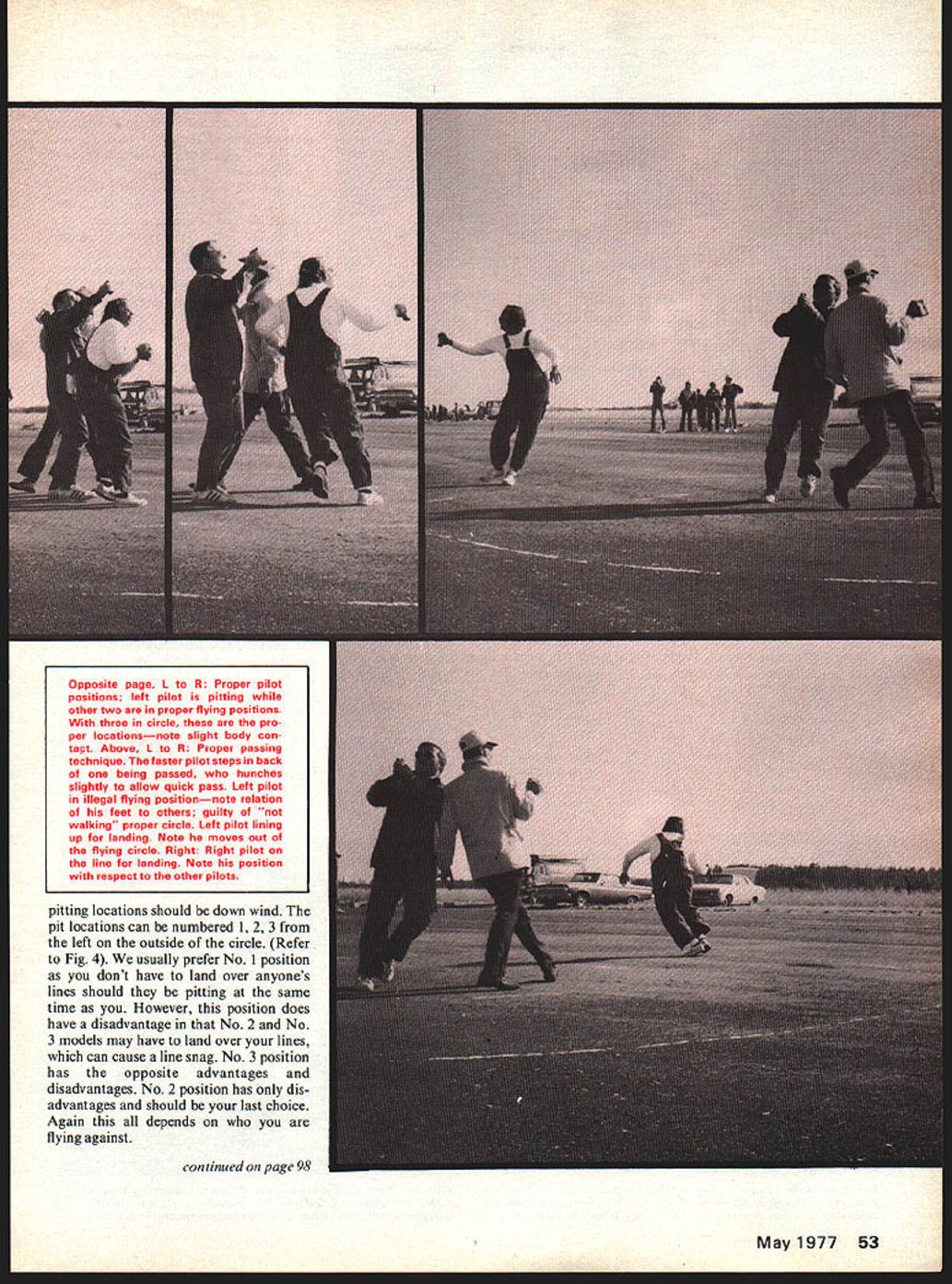
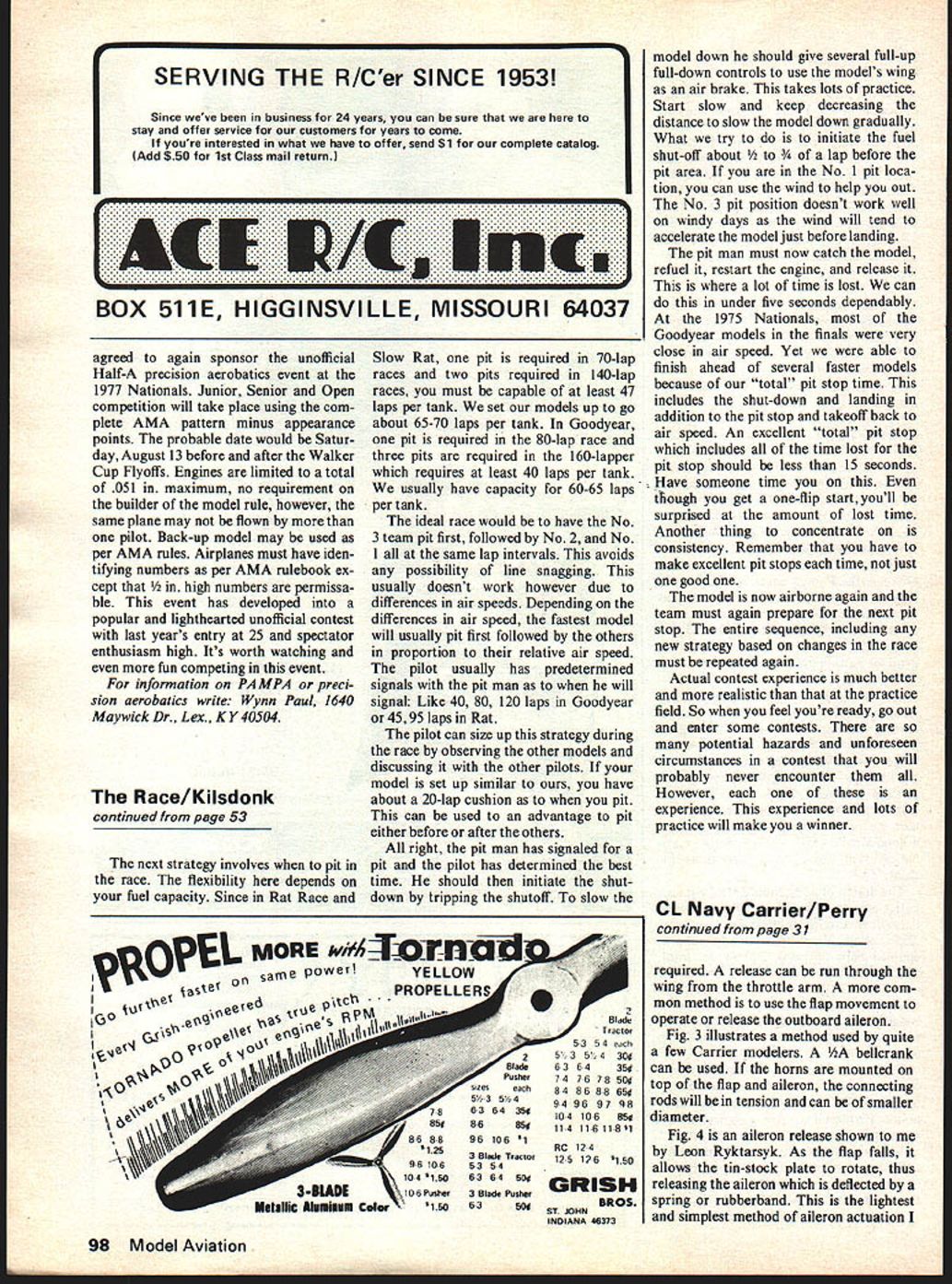
A legal pass should start when the approaching model is about 20 feet behind the model being overtaken (Fig. 3-D). At this point, the approaching pilot steps behind and then ahead of the overtaken pilot, raising his flying hand over the slower pilot. The faster model's lines should now be across the slower model's with the pilot ahead and the model behind (Fig. 3-E). The faster pilot should immediately pull or whip his model until the faster model is about 20 feet ahead of the slower model (Fig. 3-F). At this point, normal level flight and pilot position should be resumed. This technique will minimize any chance of collision.
It is important that all pilots walk a tight circle during the race. This may involve a very slight amount of actual body contact at times between the pilots. A good circle is about three feet in diameter. (Fig. 3-B, C.) Deviations from this result in unnecessary scrambling which actually slows everybody down.
Some more experienced pilots will try to walk the back of the circle (Fig. 3-G) which shortens the effective flying radius and subsequently decreases the lap time. This however is illegal. A sure fire fix, if one of the other pilots tries to do this, is to walk a tighter circle or even pivot in the center. This will quickly discourage any additional cheating. Another more subtle illegal trick is for a pilot not to walk any circle (Fig. 3-J). He will just stand in the center and let the other pilot(s) run around him. Both of these devious techniques are illegal and should be spotted immediately by the event director.
FAI-TR requires the pilot to keep his flying hand on his chest. Although this definitely minimizes any whipping, I feel that this is not as safe as the AMA style of flying. Although there are no rules governing flying hand location per se, practical experience dictates that a position about 6" from the chest with the elbow bent down works best. However, depending on the pilot's strength and the pull of the model, this may vary. We usually fly Rat Racers with both hands except on passes. Goodyears, Slow Rats, and 1/2 A's can easily be flown one handed.
When the model is flying, this portion of the race turns into a pure horsepower race. The fastest model will lead, barring a disaster. The pit stops usually tend to separate the pure "go-fasters" from the winners. This is where teamwork and dependability come into play. The pilot should shut the engine off, land the model, and roll it up to the pit man in as short a length of time as possible. The pit man should catch the model, refuel it, start the engine, and release the model again in the minimum amount of time.
Up until now I have described the fundamentals of the race. Now let's go through a simulated race and talk about the strategies that can be used. These are the things that are gained through experience and probably will be most beneficial to any newcomers. It is, of course, very necessary to practice both alone and with others to become totally familiar with the model and techniques of racing. However, putting it all together in the contest is another story.
The first strategy occurs when it is determined who you will be flying with. Size up the other teams. Usually, everybody will practice some before the heat races. Watch everyone and make mental notes of their habits. Some things to note are their air speed, their shut-off technique, their pit stop time, and their takeoffs. Look for anything out of the ordinary that may cause you a problem during the race.
The next strategy is the pitting locations. If the wind is of any consequence, all pitting locations should be down wind. The pit locations can be numbered 1, 2, 3 from the left on the outside of the circle. (Refer to Fig. 4). We usually prefer No. 1 position as you don't have to land over anyone's lines should they be pitting at the same time as you. However, this position does have a disadvantage in that No. 2 and No. 3 models may have to land over your lines, which can cause a line snag. No. 3 position has the opposite advantages and disadvantages. No. 2 position has only disadvantages and should be your last choice. Again this all depends on who you are flying against. The next strategy involves when to pit in the race. The flexibility here depends on your fuel capacity. Since in Rat Race and Slow Rat, one pit is required in 70-lap races and two pits required in 140-lap races, you must be capable of at least 47 laps per tank. We set our models up to go about 65-70 laps per tank. In Goodyear, one pit is required in the 80-lap race and three pits are required in the 160-lapper which requires at least 40 laps per tank. We usually have capacity for 60-65 laps per tank.
The ideal race would be to have the No. 3 team pit first, followed by No. 2, and No. 1 all at the same lap intervals. This avoids any possibility of line snagging. This usually doesn't work however due to differences in air speeds. Depending on the differences in air speed, the fastest model will usually pit first followed by the others in proportion to their relative air speed. The pilot usually has predetermined signals with the pit man as to when he will signal: Like 40, 80, 120 laps in Goodyear or 45, 95 laps in Rat.
The pilot can size up this strategy during the race by observing the other models and discussing it with the other pilots. If your model is set up similar to ours, you have about a 20-lap cushion as to when you pit. This can be used to an advantage to pit either before or after the others.
All right, the pit man has signaled for a pit and the pilot has determined the best time. He should then initiate the shut-down by tripping the shutoff. To slow the model down he should give several full-up full-down controls to use the model's wing as an air brake. This takes lots of practice. Start slow and keep decreasing the distance to slow the model down gradually. What we try to do is to initiate the fuel shut-off about 1/2 to 3/4 of a lap before the pit area. If you are in the No. 1 pit location, you can use the wind to help you out. The No. 3 pit position doesn't work well on windy days as the wind will tend to accelerate the model just before landing.
The pit man must now catch the model, refuel it, restart the engine, and release it. This is where a lot of time is lost. We can do this in under five seconds dependably. At the 1975 Nationals, most of the Goodyear models in the finals were very close in air speed. Yet we were able to finish ahead of several faster models because of our "total" pit stop time. This includes the shut-down and landing in addition to the pit stop and takeoff back to air speed. An excellent "total" pit stop which includes all of the time lost for the pit stop should be less than 15 seconds. Have someone time you on this. Even though you get a one-flip start you'll be surprised at the amount of lost time. Another thing to concentrate on is consistency. Remember that you have to make excellent pit stops each time, not just one good one.
The model is now airborne again and the team must again prepare for the next pit stop. The entire sequence, including any new strategy based on changes in the race must be repeated again.
Actual contest experience is much better and more realistic than at the practice field. So when you feel you're ready, go out and enter some contests. There are so many potential hazards and unforeseen circumstances in a contest that you will probably never encounter them all. However, each one of these is an experience. This experience and lots of practice will make you a winner.
Transcribed from original scans by AI. Minor OCR errors may remain.

