
RACING AGAINST SUNSET
Team Effort to Break Closed Course Distance Record
Maynard Hill
Background
The Mason‑Dixon Dragway sits at latitude 39.66°, longitude 77.66°—about five miles east of Hagerstown, Maryland. On August 3, 1998, official sunrise was 6:08 a.m. Eastern Daylight Time and sunset was 8:10 p.m., giving a day length of 14 hours and 2 minutes. To set a world record for FAI Closed Course Distance for piston‑powered RC models, we needed an airplane that could fly roughly 60 mph nonstop for the full daylight period; otherwise the sun would set before we beat the record.
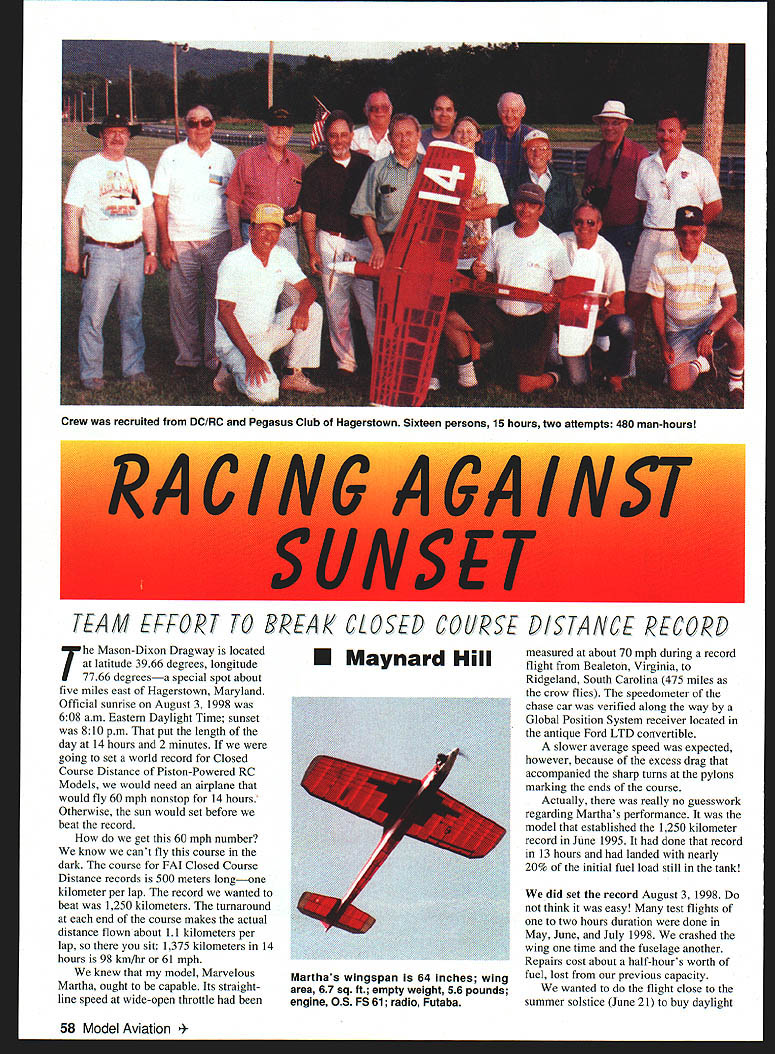
My model, Marvelous Martha, had already established the 1,250 kilometer record in June 1995, completing the distance in 13 hours and landing with nearly 20% of the initial fuel load still in the tank. Its straight‑line speed at wide open throttle had been measured at about 70 mph during a record flight from Bealeton, Virginia, to Ridgeland, South Carolina (475 miles as the crow flies).
Calculations
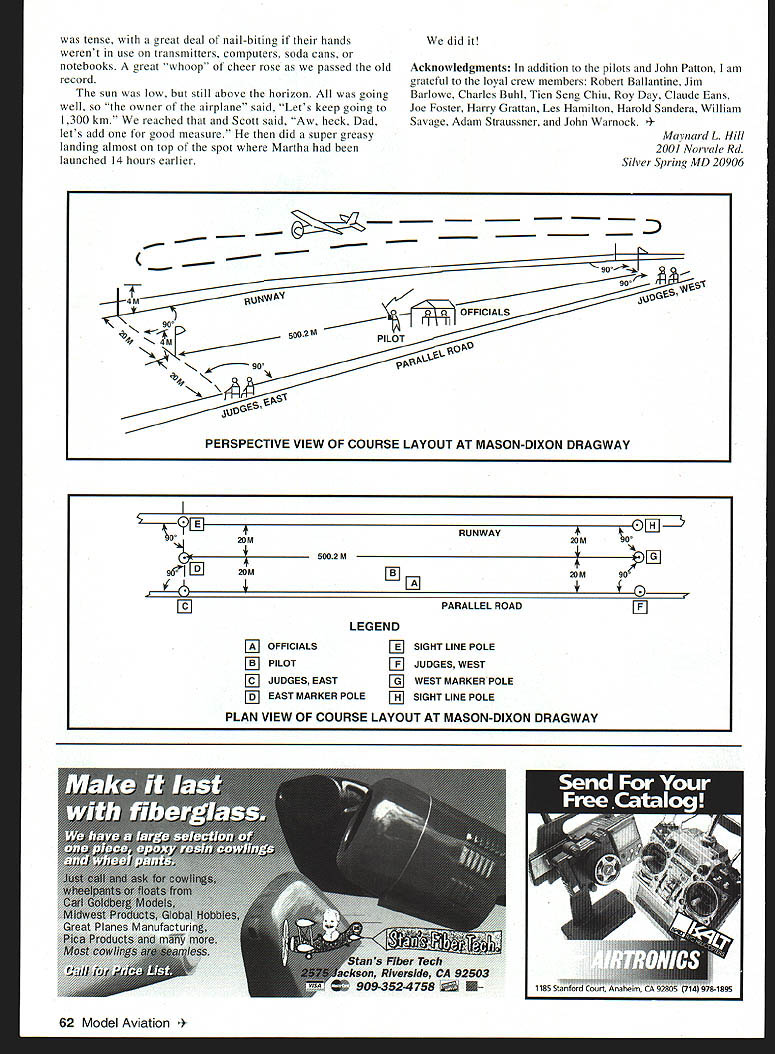
- The FAI closed course is arranged with pylons 500 meters apart. An out‑and‑back lap therefore is roughly one kilometer.
- Turnarounds at each end add distance; the actual lap distance is about 1.1 kilometers.
- To beat the existing 1,250 km record within available daylight, we needed to fly about 1,375 kilometers in 14 hours, which equates to roughly 98 km/hr or 61 mph average ground speed.
Because the sharp turns at the pylons increase drag, average speed would be slower than straight‑line top speed; nonetheless, Martha’s prior performance made her a good candidate.
Practice and Setbacks
We conducted many test flights of one to two hours during May, June, and July 1998. We had two crashes—one that damaged a wing and another that damaged the fuselage. Repairs were made; the lost time and work equated to roughly a half‑hour’s worth of fuel capacity.
Between July 27 and August 3, Scott and I performed two long flight sessions to check fuel consumption in the air. The procedure was tedious: weigh the wing with fuel, fly at least an hour, then weigh again to determine fuel used. Great care is necessary not to lose a drop from fuel lines.
We also installed new lithium batteries: Electrochem 91SC, 13 ampere‑hour, 36V D cells for receiver, servos, and ignition spark. These "supercells" are lightweight (about 3.5 ounces each) but costly—approximately $80 per attempt.
Because so many people are required to attempt this record, we had to commit two days ahead of the flight date. The August 1 weather prediction for August 3 was favorable and proved accurate.
July 27 Attempt
July 27 provided 14 hours, 23 minutes from sunup to sundown. I was awakened at 3:15 a.m., completed morning routines, had coffee, and hit the road at 3:45 a.m., arriving at Mason‑Dixon in time to fuel and weigh the model for daybreak launch.
Launch problems—primarily a dolly that didn't work—kept us grounded until 6:45 a.m., wasting nearly an hour of daylight. A 10–15 mph wind parallel to the course slowed laps to about 40 seconds, making a finish before sundown uncertain.
Two laptop computers kept count of laps flown, lap times, average speed, and continuously predicted completion time. They forecast completion of 1,250 laps around 8:20–8:30 p.m., which was very dicey given the limited twilight expected because of cloud cover.
Rob Rosenthal was second pilot on July 27. The bumpy wind forced him to concentrate intensely; judges and computers kept reading lap times over a loudspeaker, and Rob and I involuntarily winced when readouts showed 40 seconds per lap.
The stress ended about 7:00 p.m. when the engine went dead—out of gas. We had had a false‑start on launch and apparently I had bumped the needle‑valve "clock arm." To compensate for vision impairment I have soldered a clock arm to the needle so I can feel and see the needle position; arm positions correspond roughly to clock positions—about 2 o'clock to 4 o'clock equals about three clicks rich. On that cold morning, with numb fingers and high stress, I failed to check the needle and made the mistake.
Preparation for August 3
After the July 27 disappointment, Scott and I reviewed fuel burn, repaired what was necessary, and prepared for another attempt. We slept through our planned 3:15 a.m. alarm on August 3 and woke at 4:20 a.m., spilling coffee as we hurried to the dragstrip. Thanks to the July 27 practice, we were able to fuel, weigh, and sign papers for launch by 6:58 a.m.—about ten minutes before astronomers’ sunrise, and roughly 20 minutes before sunrise in our valley because of an 1,800‑foot ridge two miles to the east.
Joe Foster, an athletic young man trained in hand‑launching Martha, was absent that day, so I had to run and heave the model. Martha uses a high‑pitch prop (12 x 13) that spins at about 6,500 rpm static on the ground; at launch the steep pitch can cause momentary sink until the prop bites and the model climbs out. The first throw on August 3 was successful; the needle valve was set correctly.
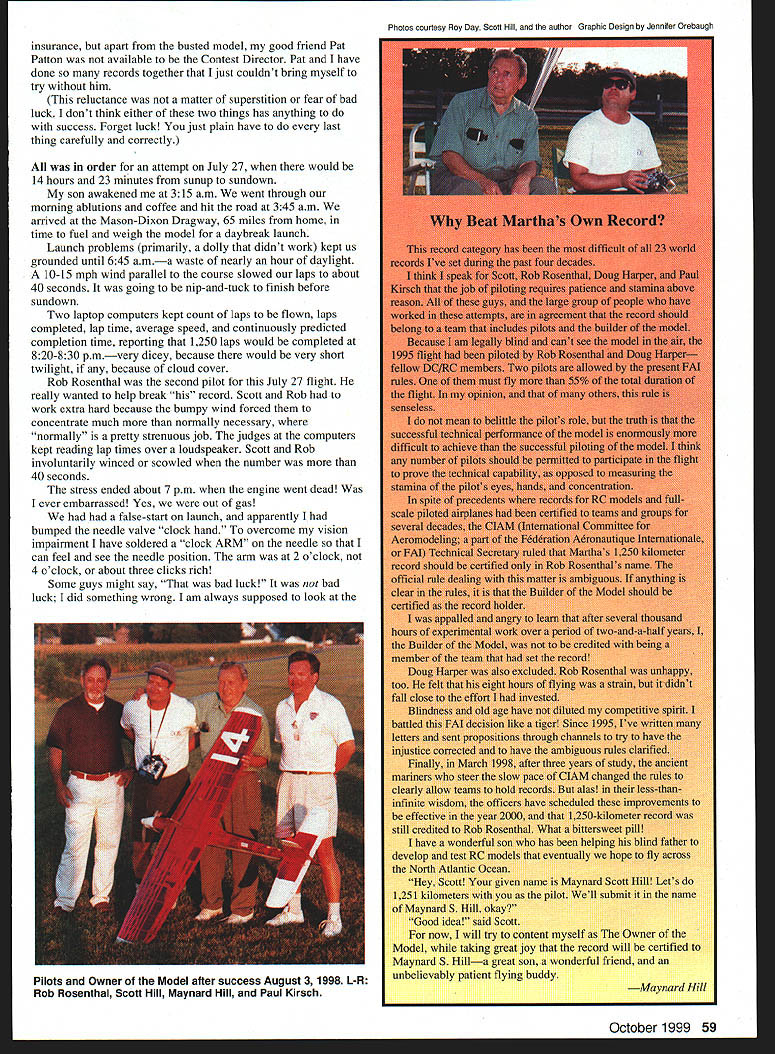
Rob had to work that morning, so longtime friend Paul Kirsch came to be the assistant pilot. Scott was far more relaxed than he had been a week earlier, and flying Martha was straightforward for Paul, who has several RC aerobatics wins.
Record Flight — August 3, 1998
- Weather: warm and calm, with only a few bumps from thermals.
- Engine: O.S. F.S. 61 running at 6,700 rpm at 90% power without a cough or miss all day.
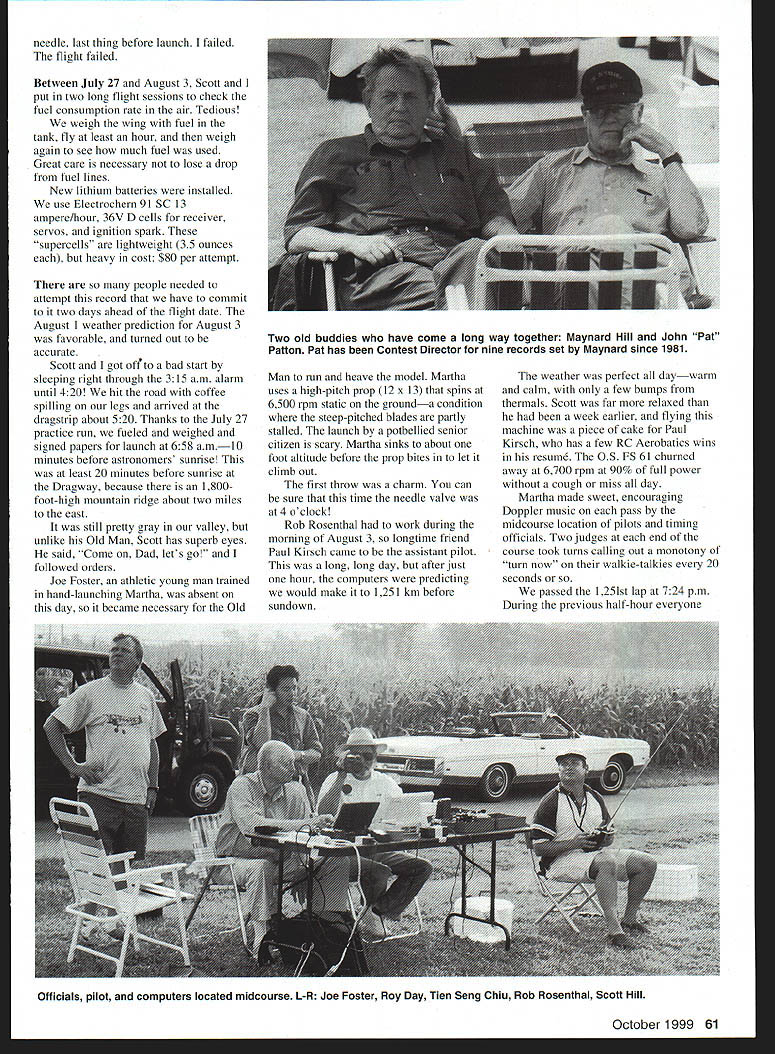
- Operations: Two judges at each end of the course took turns calling "turn now" on their walkie‑talkies every 20 seconds or so. Two laptops continuously tracked laps, lap time, and predicted completion.
- Laps: We passed the 1,251st lap at 7:24 p.m. during a tense half‑hour when everyone was biting nails. A great cheer rose as we passed the old record.
The sun was low but still above the horizon. Everything was going well, so I said, "Let's keep going to 1,300 km." We reached that, then Scott said, "Aw, heck, Dad, let's add one for good measure," and he executed a super‑greasy landing almost on top of the spot where Martha had been launched 14 hours earlier.
We did it.
Acknowledgments
In addition to the pilots and John Patton, I am grateful to the loyal crew members:
- Robert Ballantine
- Jim Barlowe
- Charles Bush
- Tien Seng Chin
- Roy Day
- Claude Eanes
- Joe Foster
- Harry Grattan
- Les Hamilton
- Harold Sandera
- William Savage
- Adam Strausser
- John Warnock
—Maynard L. Hill 2001 Norvale Rd. Silver Spring, MD 20906
Transcribed from original scans by AI. Minor OCR errors may remain.

