
Racing YAKS
Introduction
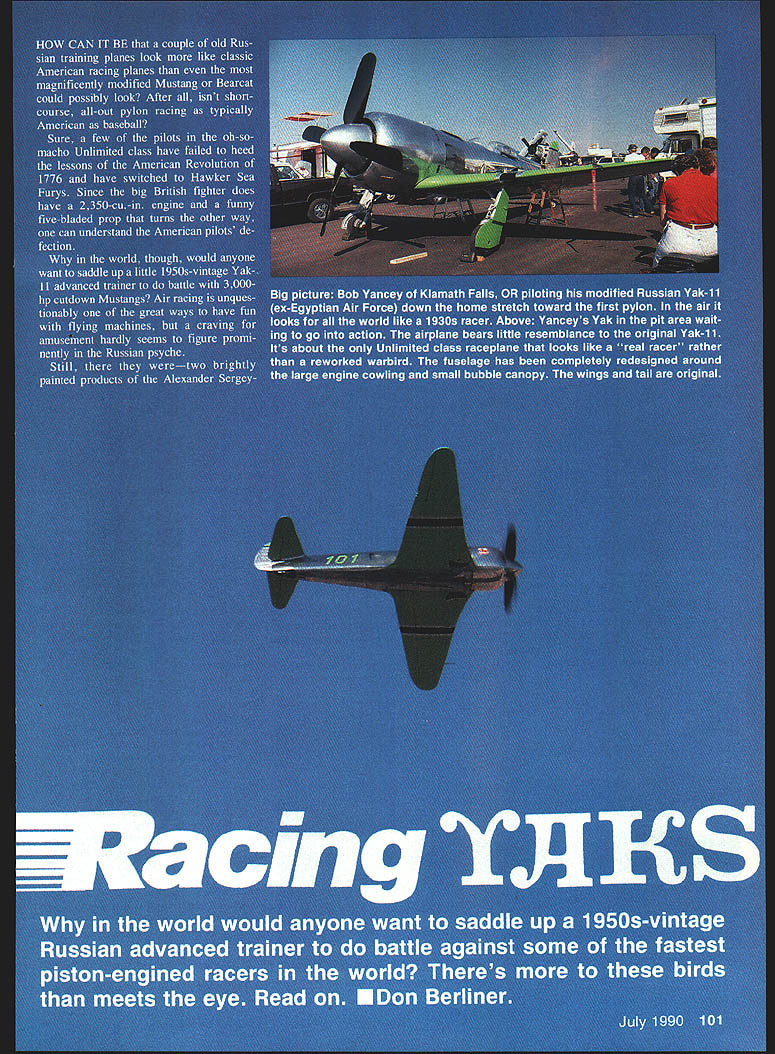
How can a couple of old Russian training planes look more like classic American racing ships than even the most magnificently modified Mustangs or Bearcats? At the 1988 Reno National Championship Air Races two Yakovlev Yak‑11s — small, inexpensive Soviet advanced trainers from the 1950s — showed up in the Unlimited pits and attracted a lot of attention. Look more closely and the answer becomes obvious: these were highly modified machines, stuffed with vastly more power and trimmed for pure speed.
Why use Yak‑11s in Unlimited racing?
- Small: The Yak‑11 is significantly smaller than a P‑51 Mustang — about six feet less wingspan, more than four feet less length, roughly 40% less wing area and about 70% less empty weight.
- Cheap: With liquidated Mustangs selling for hundreds of thousands of dollars, surplus trainers represented an inexpensive way to get a small, clean airframe to adapt for racing.
- The racing logic: Unlimited racing often comes down to one simple idea — put the largest possible engine into the smallest possible airframe.
Yak‑11 background
The Yak‑11 was an advanced trainer used by Soviet Bloc air forces in the mid‑1950s through the 1960s. More recently China, several Arab countries and Albania operated the type. Some 4,500 Yak‑11s were built in all, including about 700 produced under license in Czechoslovakia. Its two‑seat lineage came directly from performance‑oriented wartime designs (its immediate predecessor was a two‑seat version of the Yak‑3), and several Yak‑11s were used to set official FAI speed records — impressive for a trainer.
Bob Yancey’s Yak racer
Bob Yancey of Klamath Falls, Oregon, converted a Yak‑11 into a full‑blown Unlimited racer.
Modifications and features:
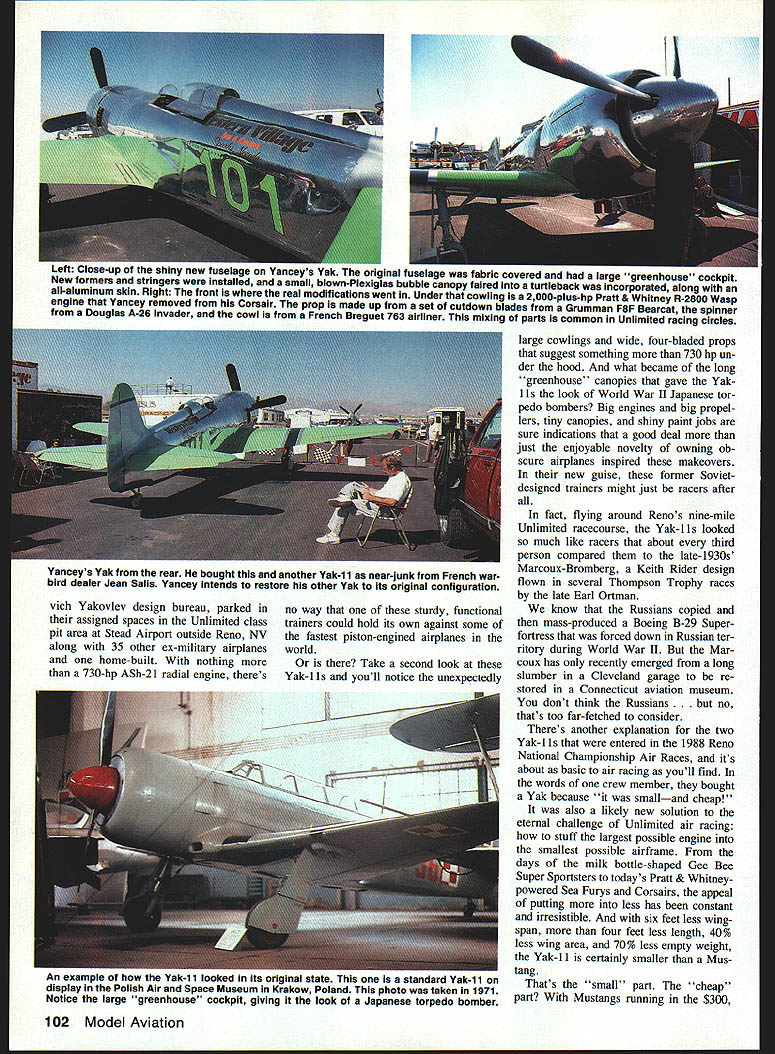
- Fuselage: The original fabric covered fuselage (with the long greenhouse canopy) was stripped to the formers and stringers. Yancey installed new metal formers and stringers and reskinned the fuselage in aluminum to fit a larger cowl. The greenhouse canopy was replaced by a small blown‑Plexiglas bubble faired into a turtleback.
- Engine: A 2,000+‑hp Pratt & Whitney R‑2800 Wasp (taken from Yancey’s Corsair).
- Prop/drive train: Cut‑down propeller blades from a North American T‑28 trainer mounted on a prop hub taken from a Grumman F8F Bearcat. The spinner had previously been used on a Douglas A‑26 Invader. The cowlwork incorporated parts from a French Breguet 763 airliner. (Mixing and matching parts from many sources is common in Unlimited racing.)
- Weights: About 5,200 lb empty and roughly 7,300 lb ready to race (at the stage reported).
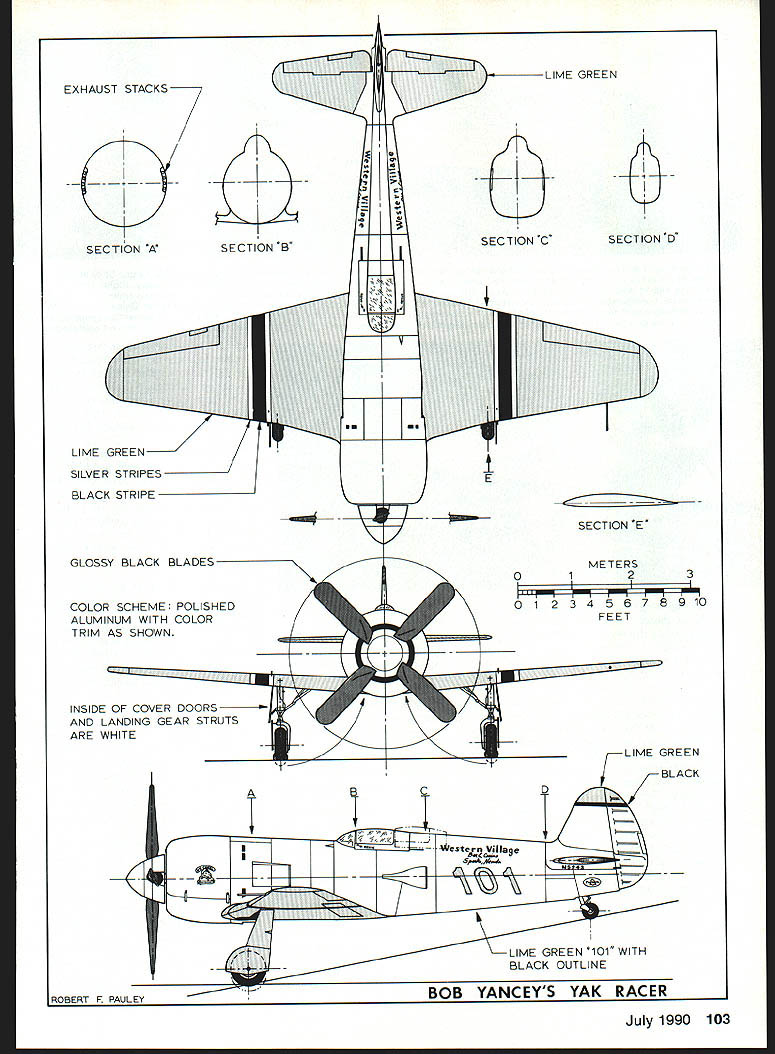
- Livery / markings (Yancey’s racer):
- Color scheme: polished aluminum with color trim as shown
- Lime green tail stripe and “101” with black outline
- Silver stripes and a black stripe
- Glossy black propeller blades
- Inside of cowl doors and landing‑gear struts painted white
- Sponsor/association noted: Western Village
"Mr. Awesome" (Joe Kasparoff’s Yak)
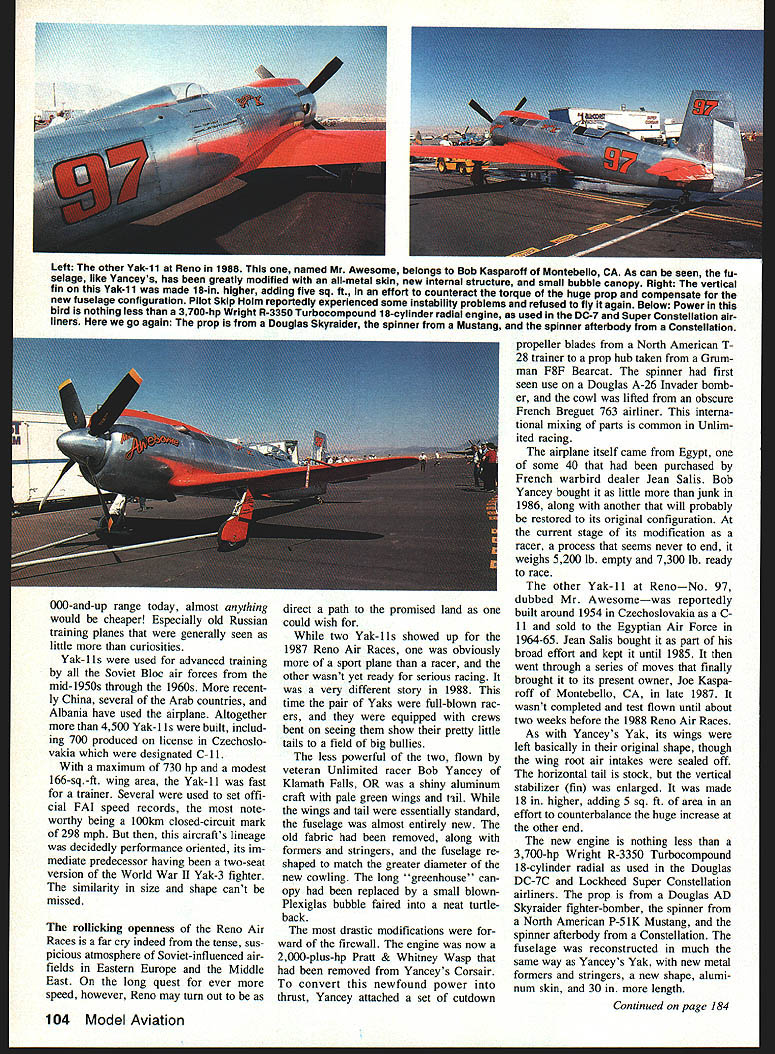
The other Yak at Reno — No. 97, nicknamed Mr. Awesome — was similarly transformed.
Modifications and features:
- Origin: Built around 1954 (Czechoslovakia as a C‑11) and sold to the Egyptian Air Force in the 1960s; later acquired and completed in the U.S.
- Fuselage: Reconstructed with new formers, stringers and aluminum skin; the fuselage was lengthened by about 30 inches. The long canopy was replaced by a small bubble.
- Empennage: The vertical fin was enlarged — about 18 inches higher, adding roughly 5 sq ft of area to help counteract the torque and yaw tendencies of the huge prop/engine installation.
- Engine: A Wright R‑3350 turbocompound 18‑cylinder radial (the 3,700‑hp type used in DC‑7s and Super Constellations).
- Prop/drive train: Prop from a Douglas AD Skyraider, spinner from a P‑51K Mustang, spinner afterbody from a Constellation.
- Handling: Pilot Skip Holm reportedly experienced instability problems in flight and refused to fly the airplane again.
Reno 1988 — performance and problems
- Visibility and reaction: The two Yaks drew heavy interest at Reno — many spectators had never seen Soviet‑built types at an American air race, and the exotic conversions were crowd pleasers.
- Power vs. propeller limits: Both Yaks demonstrated a central technical challenge — how to absorb very large horsepower with the short propellers forced by the Yak’s modest landing‑gear height. Full‑size props (as on Bearcats or Skyraiders) would be too large and would likely damage their tips on takeoff/landings.
- Qualifying and heats:
- Bob Yancey recorded a qualifying lap that translated to about 373.8 mph.
- In Heat racing, Skip Holm (flying one of the Yaks) averaged about 405.9 mph in his heat but reported handling problems after catching propwash and wobbling; he pulled out and later declined to fly that Yak again.
- Yancey flew smoothly in his Yak (which retained original vertical‑tail area) and placed second in Heat 1‑C at about 378.7 mph.
- Yancey qualified for the Silver Race (a first‑round consolation) and finished fourth at about 386.5 mph, beating some P‑51s and a stock Bearcat.
- Outcome: The Yaks didn’t revolutionize Unlimited racing overnight. Extensive modifications often require years and large investments to turn novel concepts into consistent winners. But the two Yak‑11s did perform respectably and added an exotic, creative note to the competition.
Impact on Unlimited racing and closing thoughts
- Exotic alternatives: Unlimited class racing has long been dominated by highly modified Mustangs, Bearcats, Sea Furys and Corsairs. The Yak conversions showed that other small, clean, strong surplus airframes could be viable alternatives for imaginative teams with limited budgets.
- Trend: There is also a parallel trend toward purpose‑built racers (for example, the Tsunami and experimental designs such as Burt Rutan’s Pond Racer), which aim to push speed and design creativity even further.
- Opportunity: While purpose‑built racers develop and mature, there remains a big opportunity for competitors who convert lesser‑known surplus airplanes into competitive racers. The Yak‑11 efforts demonstrated both the promise and the engineering hurdles — particularly propeller and stability issues — that come with shoehorning large powerplants into compact airframes.
Notes on common Unlimited‑racing modification practices
- Engines and parts are often sourced from many different aircraft (Corsair R‑2800s, Constellation R‑3350s, Skyraider props, Bearcat hubs, A‑26 spinners, etc.).
- Fuselage and cockpit modifications frequently include replacing fabric skins with aluminum, installing new formers/stringers, shortening or replacing canopies with small bubble cockpits, and lengthening fuselages to improve balance.
- Propeller diameter is constrained by landing‑gear height; short landing gear forces the use of cutdown props, which can limit the ability to convert extremely high horsepower into usable thrust.
Transcribed from original scans by AI. Minor OCR errors may remain.

