
Radical Racers
Since the time air racing began, designers have dreamed of going faster than the other guy—and also of doing it in a way no one had thought of before. Many have come up with different and unusual configurations, but so far doing it conventionally is producing the winners.
Success in full-scale pylon racing often depends on fractions of a second. Rudy Kling won the 1937 Thompson Trophy Race over Earl Ortman by just 0.57 seconds after three-quarters of an hour of tearing around the Cleveland Air Races course. Something as minor as a slightly improved fairing could have given Kling his 0.05-mph edge.
Pilots, builders, and mechanics pour over each racing plane almost endlessly: at home, in the pit area, and even on the way to the starting line. They are always smoothing, filling, taping over, and polishing in hopes of getting that tiny bit of additional speed that will mean all the difference. They did it back in the glorious 1930s, and they still do it today at Reno. The airplanes may have changed tremendously, but the philosophy remains the same.
Yet while they strain to perfect the little things, they may be missing some big things: techniques that could provide an edge of dozens of miles per hour rather than fractions. Of the 1,000+ airplanes that have been raced ’round pylons since the sport began in France in 1909, hardly any have varied from the basic form of small commercial airplanes. Most have the wing (or wings) in front, tail in back, single engine, and propeller in front.
Oh, sure, a lot of people have considered building radical racers that would make all the rest instantly obsolete. They have in mind airplanes containing such clever new ideas that the whole sport would be changed in the few minutes between the starting flag and the finish line. The payoff is obvious. Yet a group of otherwise very courageous men have shown little willingness to step out of the mainstream.
Ask almost any racing plane designer or builder why he doesn't try something truly novel, and he'll point to the amazing lack of success of radical-design racing planes in the 80 years of the game. Men have tried over the years, and with almost no exceptions they have failed to show that a radical racer can compete on even terms with a conventional one. In most cases the radical racers were flops.
Schneider Trophy and early experiments
The first really serious attempt to charge off in new directions was made by the Italian High-Speed Flight in 1929 as the Schneider Trophy Race series for seaplanes was nearing its climax. Three separate attacks were planned on the tried-and-true formula of combining a huge engine with an airplane having enormous twin floats. There had to be a better way.
- Piaggio-Pegna P.7
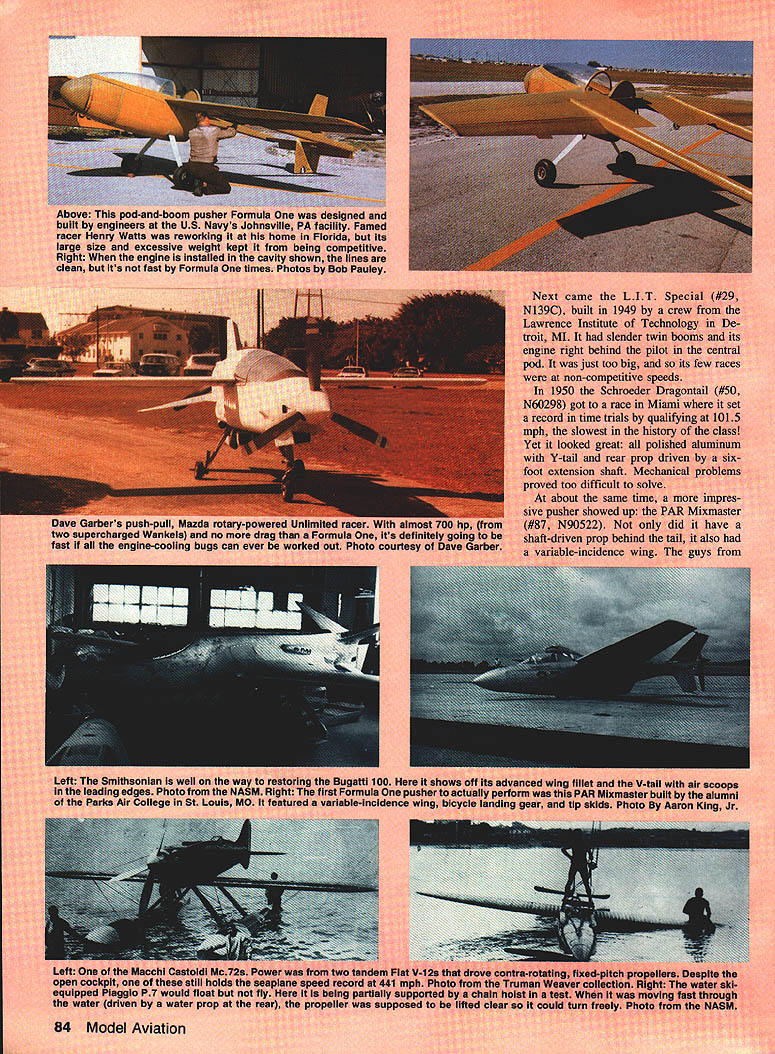
The most unusual of the three ideas was the Piaggio-Pegna P.7. It had a 1,000-hp V-12 engine in the nose of a very clean fuselage and a trim elliptical wing, but no big drag-producing floats. Instead, it used a pair of tiny hydrofoils mounted on simple, clean struts. At rest it sat in the water almost up to its mid-wing. The idea was to power it forward with a boat-style water propeller beneath the tail, then, as it gathered speed, shift the power via a gearbox and clutch to the high-pitch air propeller in the nose. Once in the air it would have had about half the drag of its rivals. The P.7 never got off the water; mechanical troubles with the gearbox, clutch, and drive shaft were never solved.
- Savoia-Marchetti S.65
The twin-boom S.65 had 1,000-hp engines in both ends of the pilot's central pod. This one flew, but it crashed in 1930 on a practice flight.
- Macchi-Castoldi MC.72
The MC.72 was the least unusual of the three, with a conventional fuselage, floats, and wings. Its novelty was tandem Fiat V-12 engines in a long, pointy nose producing a total of 3,000 hp to drive a pair of two-bladed, contra-rotating, fixed-pitch propellers via concentric drive shafts. This arrangement eliminated torque problems and enabled unprecedented horsepower to be harnessed with relatively short propeller blades. Five MC.72s were built; two crashed in tests and the remaining three were not ready in time for the final Schneider Race in 1931. Continued development aimed at world speed records: on April 10, 1933 Francesco Agello set a 3 km record of 424 mph, and on October 23, 1934 he increased it to 440.68 mph. This remained the absolute speed record until 1939 and is still the record for prop-driven seaplanes, but the MC.72 never raced under a starter's flag.
Coupe Deutsch and interwar radical designs
The Coupe Deutsch Race series in France in the 1930s, dominated by Caudron racers, forced designers to look away from conventional layouts. Ideas were abundant; time and money were not.
- Bugatti 100
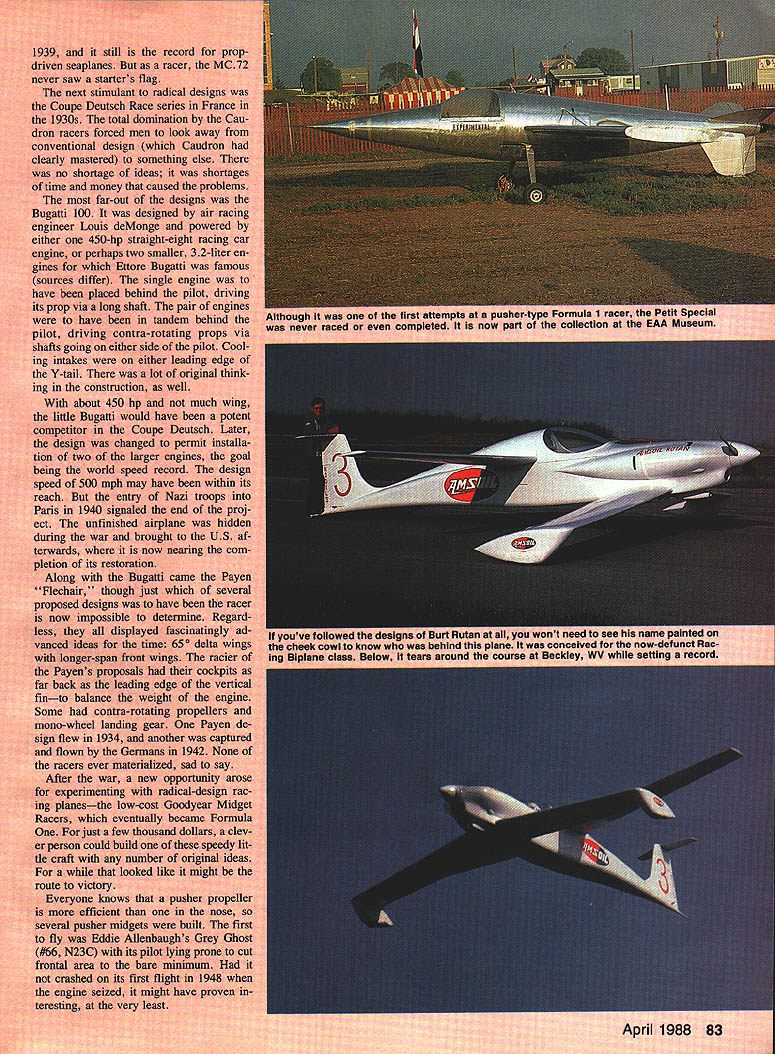
Designed by Louis DeMonge and associated with Ettore Bugatti, the Bugatti 100 was one of the most far-out designs. It was intended to be powered either by a single 450-hp straight-eight racing car engine or by two smaller 3.2-liter engines in tandem. The single-engine version would have the engine behind the pilot driving its prop via a long shaft; the twin setup would drive contra-rotating props via shafts running on either side of the pilot. Cooling intakes were on either leading edge of a Y-tail. With about 450 hp and minimal wing, it could have been a potent Coupe Deutsch competitor; with two larger engines the design aimed for a 500 mph world speed record. The project ended with the fall of Paris in 1940. The unfinished airplane was hidden during the war and later brought to the U.S., where it has since been restored or restored-in-progress.
- Payen "Flechair" designs
Payen proposed several advanced ideas: steep (65°) delta wings combined with longer-span front wings, cockpits set far back near the leading edge of the vertical fin to balance engine weight, contra-rotating propellers, and mono-wheel landing gear. One Payen design flew in 1934, and another was captured and flown by the Germans in 1942, but the proposed racers never materialized.
Postwar experiments: Midget Racers and pushers
After World War II the low-cost Goodyear Midget Racers (eventually Formula One) offered an opportunity to experiment with radical ideas cheaply. Several pusher-layout midget racers appeared:
- Grey Ghost (#66, N23C) — Eddie Allenbaugh
The pilot lay prone to minimize frontal area. It was the first pusher midget to fly but crashed on its first flight in 1948 when the engine seized.
- L.I.T. Special (#29, N139C) — Lawrence Institute of Technology
Slender twin booms with the engine behind the pilot in a central pod. It proved too large and raced non-competitively.
- Schroeder Dragontail (#50, N60298)
Appeared at Miami in 1950 and set a time-trial qualifying record at 101.5 mph (slow for the class). Polished aluminum finish, Y-tail, and a rear prop driven by a six-foot extension shaft; mechanical problems proved difficult to solve.
- PAR Mixmaster (#87, N90522) — Parks Air College
Featured a shaft-driven prop behind the tail and a variable-incidence wing. Qualified in the 180-mph range but suffered poor starts and binding in bearings when its long shaft bent under high G loads.
- Sierra Sue (N12K)
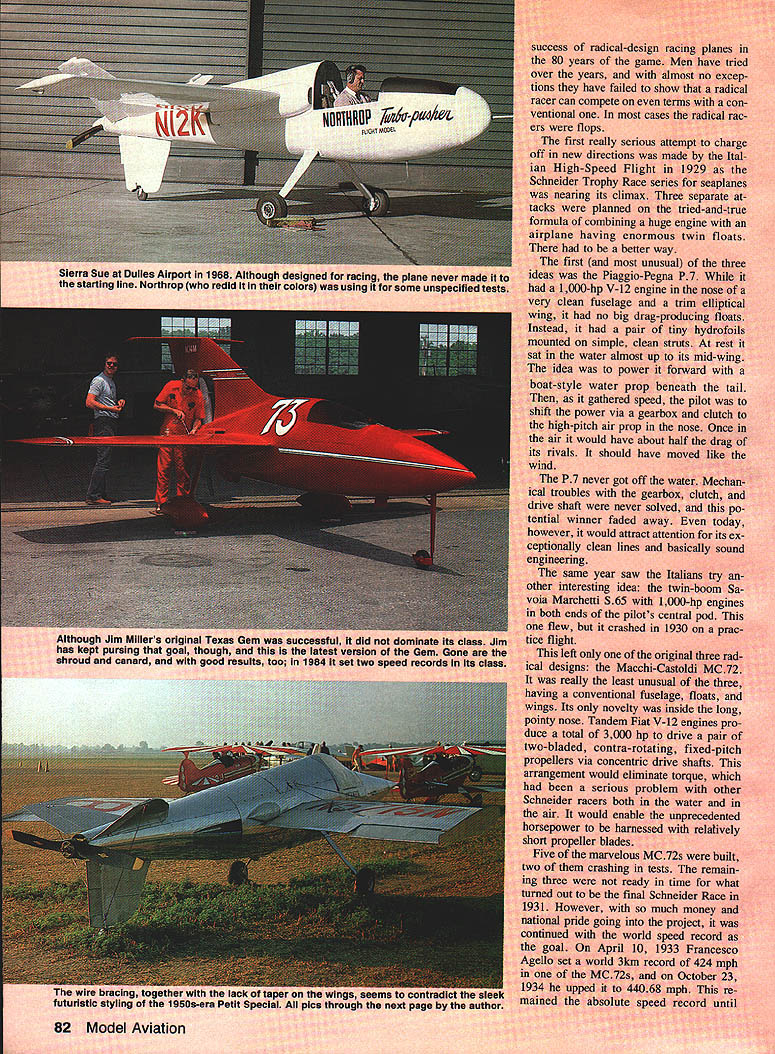
An all-metal racer built in Los Angeles in the mid-1950s. It never received a racing number and was later leased to Northrop for test work.
- Petit Special (#18, N5715N)
Nearly completed and later placed in the EAA Museum. Its all-metal wing had wire bracing that clashed with the advanced shape.
- Johnsville pusher (#46, N233H) — Naval Test Center
A pod-and-boom layout weighed down by too much engineering and did not succeed even after attempts to improve it.
For a time the pusher concept looked promising, but recurring mechanical and handling problems kept these designs from displacing conventional racers. By 1972 conventional designs had been perfected and speeds were over 230 mph on a nominal 130 hp, but the rate of improvement had slowed—suggesting limits for conventional layouts.
Texas Gem and the first successful radical racer
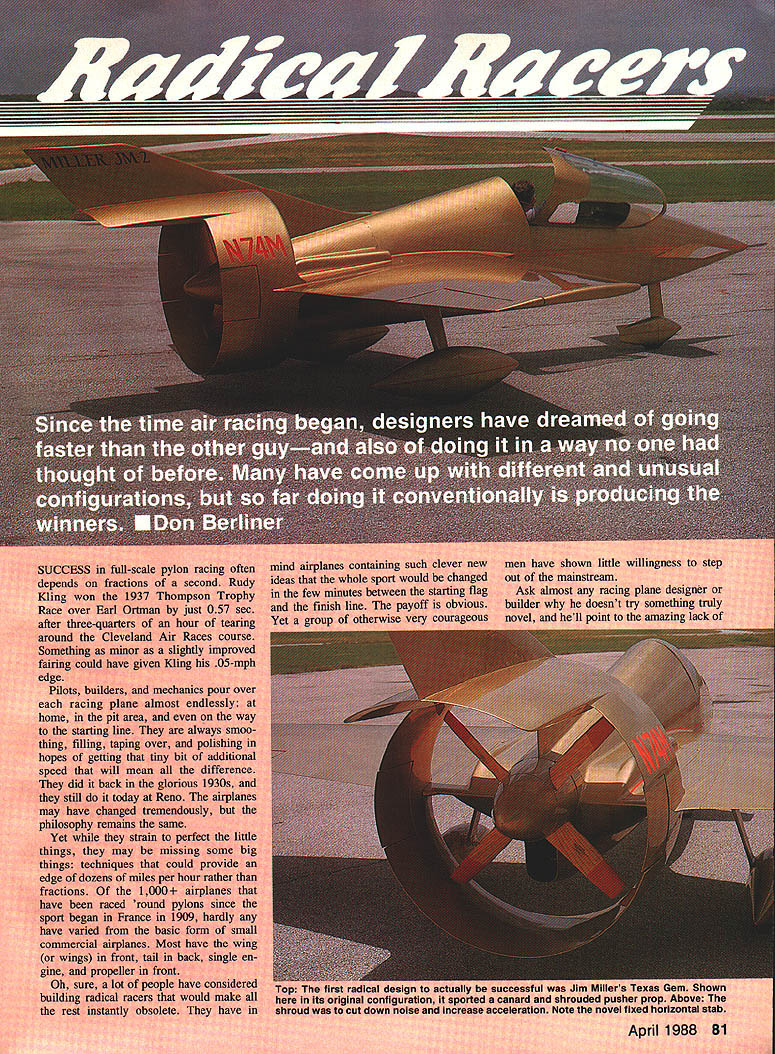
Veteran Formula One builder/pilot Jim Miller decided to go futuristic rather than tweak a winning design. After racing his trim Little Gem (#14, N74V) with success, he started over and produced the Texas Gem (#73, N74M), a machine packed with original ideas.
Key features:
- Rear-mounted main wing with a small canard surface in the nose (later moved).
- Engine mounted well behind the pilot driving a four-bladed pusher propeller via a short extension shaft to avoid distortion under high G loads.
- A snug-fitting shroud around the prop to reduce noise and improve initial acceleration (later removed when it lost effectiveness above about 200 mph).
- Main landing gear located aft with a fixed nose wheel (initial configuration).
- An almost flush canopy that still provided excellent visibility.
The Texas Gem, finished in metallic gold, was a shock to the racing community. Teething problems were expected with so many innovations: the prop shroud was removed, the canard was relocated, and handling gradually improved as speeds rose. By the late 1970s Miller and the Texas Gem were winning at near-record speeds. Miller later set FAI speed records in his weight class for the 100 km course (229 mph) and the 500 km course (228 mph) in 1984. The airplane was lost in a crash the next year, but Miller continued with pusher designs and in 1986 placed third at Reno in a field of 23 racers, qualifying at 234 mph and flying one heat at 231 mph. This marked the first truly successful radical racing airplane in history.
Racing Biplane class and the Amsoil-Rutan Racer
The short-lived Racing Biplane class (1977–1983) brought more experimentation. Early entries like the Sorceress and Sundancer were unusual but essentially conventional. In 1981 Dan Mortensen introduced the Amsoil-Rutan Racer, designed by Burt Rutan—the man behind the VariEze and many radical lightplanes.
Dan's racer resembled a larger tandem-wing Quickie and was powered by a 160-hp Lycoming. It was fast and efficient, but on a three-mile pylon course it lacked aileron effectiveness. At Reno in 1983 Mortensen was caught between another airplane and the ground while rounding a pylon; a wing tip struck the ground, the airplane cartwheeled and was destroyed, though he escaped with minor injuries. Before the Racing Biplane class disappeared, Mortensen's racer had proved fast enough to earn FAI records in its weight class: 235 mph for the 3 km course and 233 mph for 100 km.
Thanks to Miller and Mortensen, the prospects for radical racers brightened. Their successes showed that unconventional ideas could compete.
Future prospects
It would be exciting to foresee race courses filled with wild-looking airplanes—delta wings, joined wings, swept wings, buried engines driving multiple propellers, and other ideas yet unnamed. As of this writing, the only radical design known to be nearing racing status was Dave Garber's Unlimited with supercharged rotary engines in either end of its fuselage, though that project has been long in the works.
The doors are finally wide open to all kinds of ideas, be they nutty or almost sensible. One of these days someone will come along with a strange-looking racer that will do what many have always suspected was possible: whip the pants off everything that looks like a conventional racer. It will be a day for celebration—and a night for filling cases full of bar napkins with sketches of the future.
Transcribed from original scans by AI. Minor OCR errors may remain.

