
RADIO CONTROL
ELECTRICS
Bob Kopski, 25 West End Dr., Lansdale, PA 19446
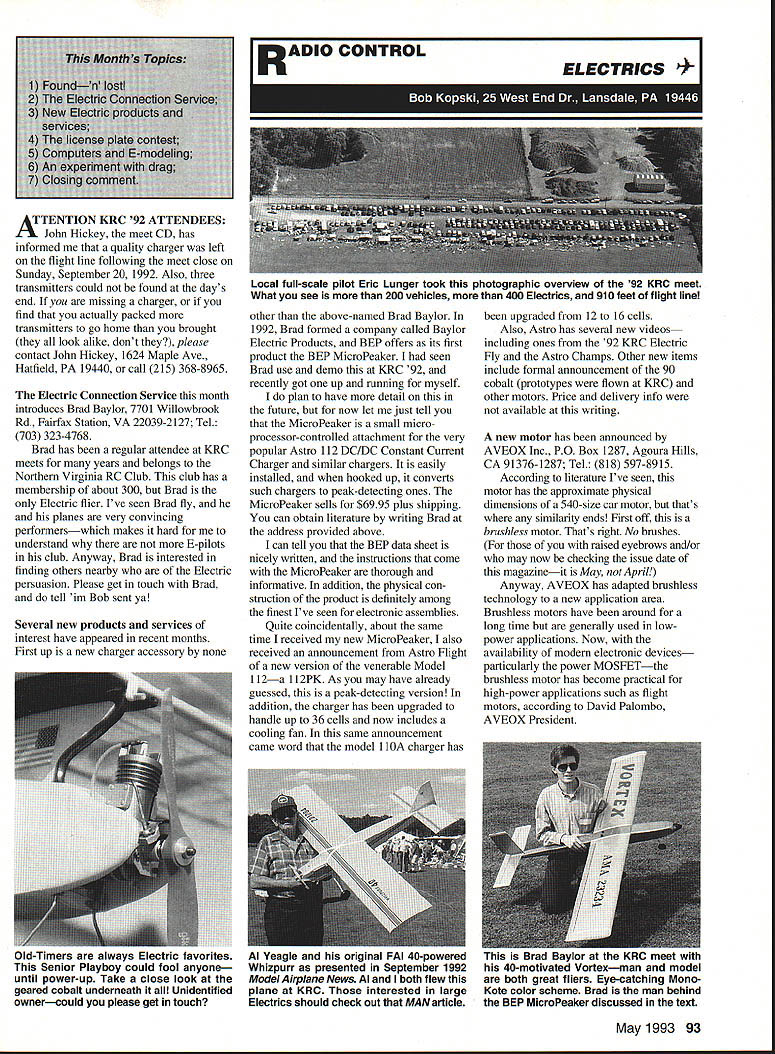
ATTENTION KRC '92 ATTENDEES: John Hickey, the meet CD, has informed me that a quality charger was left on the flight line following the meet close on Sunday, September 20, 1992. Also, three transmitters could not be found at the day's end. If you are missing a charger, or if you find that you actually packed more transmitters to go home than you brought (they all look alike, don't they?), please contact John Hickey, 1624 Maple Ave., Hatfield, PA 19440, or call (215) 368-8965.
The Electric Connection Service this month introduces Brad Baylor, 7701 Willowbrook Rd., Fairfax Station, VA 22039-2127; Tel: (703) 323-4768.
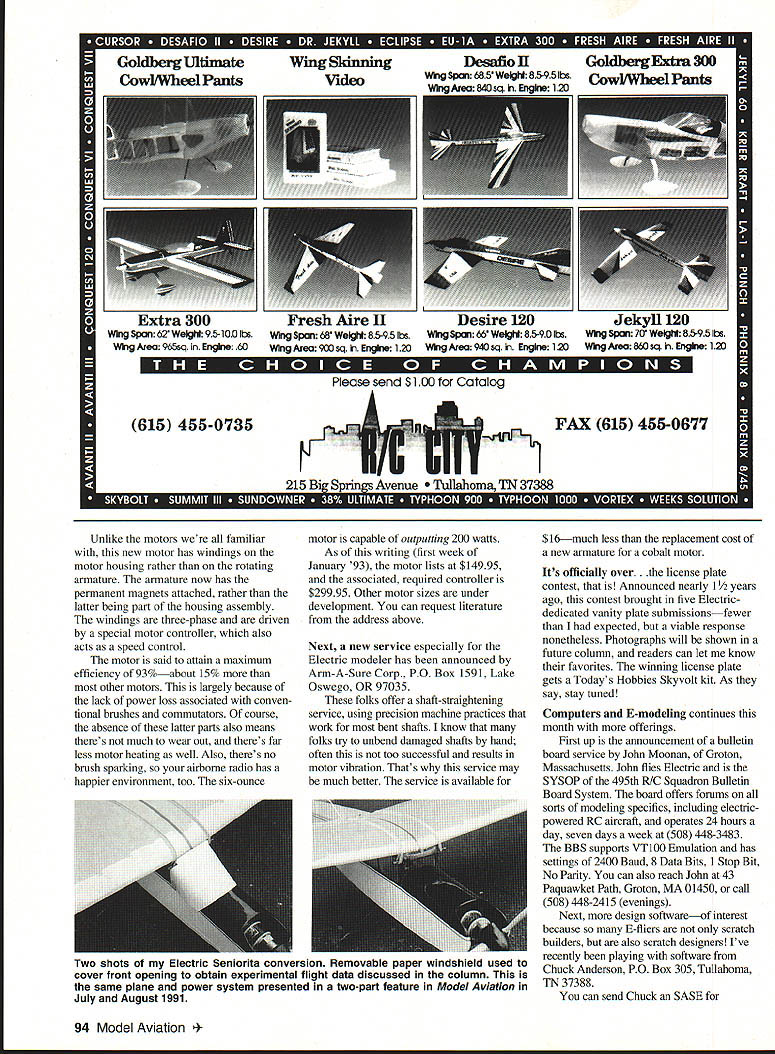
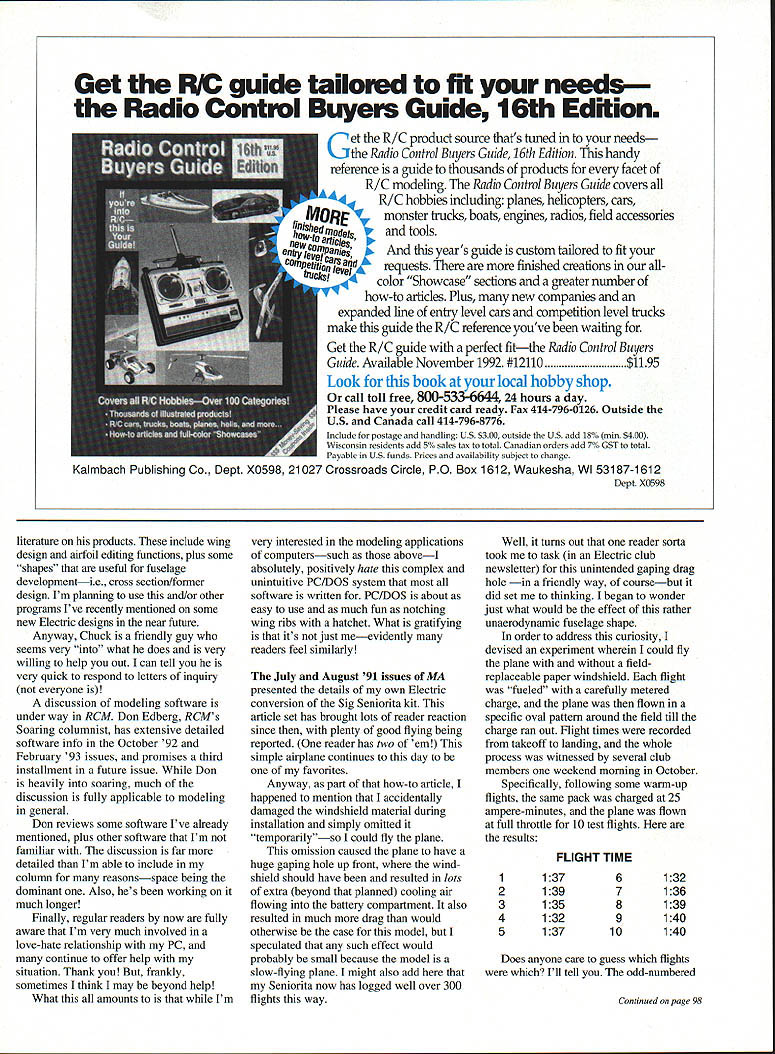
Brad has been a regular attendee at KRC meets for many years and belongs to the Northern Virginia RC Club. This club has a membership of about 300, but Brad is the only electric flier. I've seen Brad fly, and he and his planes are very convincing performers — which makes it hard for me to understand why there are not more E-pilots in his club. Anyway, Brad is interested in finding others nearby who are of the electric persuasion. Please get in touch with Brad, and do tell him Bob sent you!
Several new products and services of interest have appeared in recent months. First up is a new charger accessory by none other than the above-named Brad Baylor. In 1992, Brad formed a company called Baylor Electric Products, and BEP offers as its first product the BEP MicroPeaker. I had seen Brad use and demo this at KRC '92, and recently got one up and running myself.
I plan to have more detail on this in the future, but for now let me just tell you that the MicroPeaker is a small microprocessor-controlled attachment for the popular Astro 112 DC/DC constant-current charger and similar chargers. It is easily installed, and when hooked up it converts such chargers to peak-detecting ones. The MicroPeaker sells for $69.95 plus shipping. You can obtain literature by writing Brad at the address provided above.
The BEP data sheet is nicely written, and the instructions that come with the MicroPeaker are thorough and informative. In addition, the physical construction of the product is definitely among the finest I've seen for electronic assemblies.
Coincidentally, about the same time I received my new MicroPeaker, I also received an announcement from Astro Flight of a new version of the venerable Model 112 — the 112PK. As you may have guessed, this is a peak-detecting version. In addition, the charger has been upgraded in the handle up to 36 cells and now includes a cooling fan. In the same announcement came word that the Model 110A charger has been upgraded from 12 to 16 cells.
Also, Astro has several new videos — including ones from the '92 KRC Electric Fly and the Astro Champs. Other new items include a formal announcement of the 90 cobalt prototypes flown at KRC and other motors. Price and delivery info were not available at this writing.
A new motor has been announced by AVEOX Inc., P.O. Box 1287, Agoura Hills, CA 91376-1287; Tel: (818) 597-8915.
According to literature I've seen, this motor has the approximate physical dimensions of a 540-size car motor, but that's where any similarity ends. First off, this is a brushless motor — that's right, no brushes.
For those of you with raised eyebrows and/or who may now be checking the issue date of this magazine — it is May, not April!
AVEOX has adapted brushless technology to a new application area. Brushless motors have been around for a long time but are generally used in low-power applications. Now, with the availability of modern electronic devices — particularly the power MOSFET — the brushless motor has become practical for high-power applications such as flight motors, according to David Palombo, AVEOX president.
Unlike familiar motors, the new motor has the windings on the motor housing rather than on a rotating armature. The armature now has permanent magnets attached; the windings are three-phase and are driven by a special motor controller which also acts as the speed control. The motor is said to attain maximum efficiency (93% — about 15% higher than other motors), largely because of the lack of power loss associated with conventional brushes and commutators.
Of course, the absence of these latter parts also means there's not much to wear out, and there's far less motor heating as well. Also, there's no brush sparking, so your airborne radio has a happier environment, too. The six-ounce motor is capable of outputting 200 watts.
As of this writing (first week of January '93), the motor lists at $149.95, and the associated required controller is $299.95. Other motor sizes are under development. You can request literature from the address above.
Next, a new service especially for the electric modeler has been announced by Arm-A-Sure Corp., P.O. Box 1591, Lake Oswego, OR 97035.
These folks offer a shaft-straightening service, using precision machine practices to work on bent shafts. I know that many folks try to unbend damaged shafts by hand; often this is not too successful and results in more vibration. That's why this service may be much better. The service is available for $16 — much less than the replacement cost of a new armature for a cobalt motor.
It's officially over... the license plate contest, that is! Announced nearly 1-1/2 years ago, this contest brought in five electric-dedicated vanity plate submissions — fewer than I had expected, but a viable response nonetheless. Photographs will be shown in a future column, and readers can let me know their favorites. The winning license plate gets a Today's Hobbies Skyvolt kit. Stay tuned!
Computers and e-modeling continue this month with more offerings.
First up is the announcement of a bulletin board service by John Moreau, of Groton, Massachusetts. John is the SYSOP of the 495th R/C Squadron Bulletin Board System. The board offers forums on all sorts of modeling specifics, including electric-powered RC aircraft, and operates 24 hours a day, seven days a week at (508) 448-3483. The BBS supports VT100 emulation and has settings of 2400 baud, 8 data bits, 1 stop bit, no parity. You can also reach John at 43 Papawaket Path, Groton, MA 01450, or call (508) 448-2415 (evenings).
Next, more design software — of interest because so many E-fliers are not only scratch builders, but are also scratch designers. I've recently been playing with software from Chuck Anderson, P.O. Box 305, Tullahoma, TN 37388. You can send Chuck an SASE for literature on his products. These include wing design and airfoil editing functions, plus some "shapes" that are useful for fuselage development — i.e., cross-section/former design. I'm planning to use this and/or other programs I've recently mentioned on some new electric designs in the near future.
Chuck is a friendly guy who seems very into what he does and is very willing to help you out. He is very quick to respond to letters of inquiry (not everyone is)!
A discussion of modeling software is under way in RCM. Don Edelberg, RCM's Soaring columnist, has extensive detailed software info in the October '92 and February '93 issues, and promises a third installment in a future issue. While Don is heavily into soaring, much of the discussion is fully applicable to modeling in general.
Don reviews some software I've already mentioned, plus other software that I'm not familiar with. The discussion is far more detailed than I'm able to include in my column for many reasons — space being the dominant one. Also, he's been working on it much longer!
Finally, regular readers by now are fully aware that I'm very much involved in a love-hate relationship with my PC, and many continue to offer help with my situation. Thank you! But, frankly, sometimes I think I may be beyond help.
What this all amounts to is that while I'm very interested in the modeling applications of computers — such as those above — I absolutely, positively hate this complex and unintuitive PC/DOS system that most software is written for. PC/DOS is about as easy to use and as much fun as notching a wing rib with a hatchet. What is gratifying is that it's not just me — evidently many readers feel similarly!
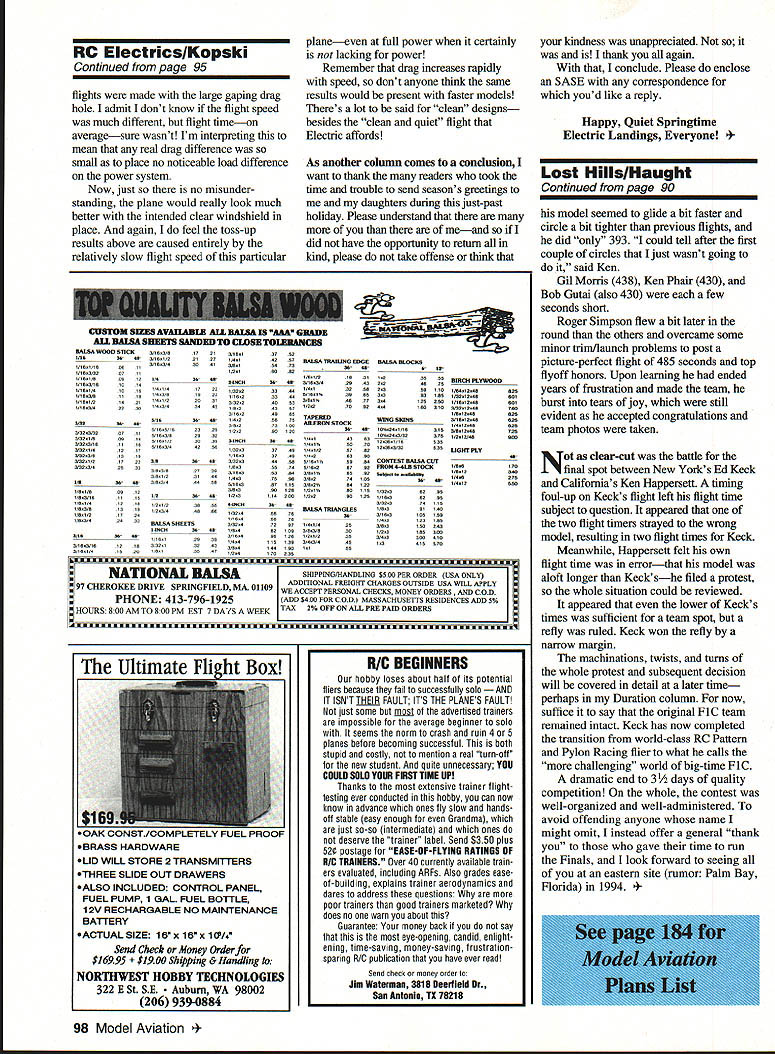
The July and August '91 issues of MA presented the details of my own electric conversion of the Sig Seniorita kit. This article set has brought lots of reader reaction since then, with plenty of good flying being reported. (One reader has two of them!) This simple airplane continues to this day to be one of my favorites.
As part of that how-to article, I happened to mention that I accidentally damaged the windshield material during installation and simply omitted it "temporarily" so I could fly the plane.
This omission caused the plane to have a huge gaping hole up front, where the windshield should have been, and resulted in lots of extra (beyond that planned) cooling air flowing into the battery compartment. It also resulted in much more drag than would otherwise be the case for this model, but I speculated that any such effect would probably be small because the model is a slow-flying plane. I might also add here that my Seniorita now has logged well over 300 flights this way.
One reader took me to task (in an electric club newsletter) for this unintended gaping drag hole — in a friendly way, of course — but it did set me to thinking. I began to wonder just what would be the effect of this rather un-aerodynamically useful shape.
In order to address this curiosity, I devised an experiment wherein I could fly the plane with and without a field-replaceable paper windshield. Each flight was "fueled" with a carefully metered charge, and the plane was then flown in a specific oval pattern around the field until the charge ran out. Flight times were recorded from takeoff to landing, and the whole process was witnessed by several club members one weekend morning in October. Specifically, following some warm-up flights, the same pack was charged at 25 amperes, and the plane was flown at full throttle for 10 test flights. Here are the results:
- 1:37
- 1:39
- 1:35
- 1:32
- 1:37
- 1:32
- 1:36
- 1:39
- 1:40
- 1:40
Does anyone care to guess which flights were which? I'll tell you. The odd-numbered flights were flown without the windshield (the gaping hole); the even-numbered flights were flown with the temporary paper windshield in place. The results show no significant difference in endurance — the plane performed well even at full power when it certainly is not lacking for power.
Remember that drag increases rapidly with speed, so don't anyone think the same results would be present with faster models. There's a lot to be said for "clean" designs — besides the "clean and quiet" flight that electric power affords!
As another column comes to a conclusion, I want to thank the many readers who took the time and trouble to send season's greetings to me and my daughters during this just-past holiday. Please understand that there are many more of you than there are of me — and so if I did not have the opportunity to return all in kind, please do not take offense or think that your kindness was unappreciated. It was, and I thank you all again.
Please do enclose an SASE with any correspondence for which you'd like a reply.
Happy, quiet springtime electric landings, everyone!
Transcribed from original scans by AI. Minor OCR errors may remain.

