
Radio Control: Aerobatics
Ron Van Putte
111 Sleepy Oaks Rd. Ft. Walton Beach, FL 32548
F3A Team Selection Finals — contest planning
As Contest Director (CD) for the F3A Team Selection Finals, I am deep into making plans for the contest, which will be held at Duke Field, Eglin AFB, Florida on June 25–30. Also participating in the planning, in an informal capacity because he will be a competitor, is John Fuqua. John is an active CD who has directed my club's annual contest for the past four years, with me as his assistant. Between us we have either directed or assisted in directing more than thirty Pattern contests, so we know what to do and when to do it for Pattern contests.
There are a lot of clubs that might consider putting on a Pattern contest but don't have anyone who knows how to do it. Enter the Dixie R/C Club (Baton Rouge, Louisiana). They have put together a book on how to sponsor a Pattern contest. It contains virtually everything one needs to know about sponsoring a Pattern contest, from applying for a CD license to reporting to the AMA at the end of the contest. It even has a recipe for hamburgers to serve at the concession stand.
Authored primarily by Jim Fife and Kearney Lejeune (originator of the "Kearney Burger"), the booklet is 70 pages long. The price is right, too — a free copy is available by writing to Jim Fife at 16929 Chickasaw St., Greenwell Springs, Louisiana 70739.
Radio exchange program and testing
Like thousands of others, I just got my radio equipment back in the 1991 radio exchange program. While I have some confidence in the R/C manufacturers, I also have a lot of time and money invested in my Pattern airplanes. Consequently, I didn't just drop the receivers in my Pattern airplanes and go fly. The first thing I did was make sure that everything appeared to work properly on the bench. Then I tested the receivers in my radio test airplane, a veteran of many radio tests.
Over the years there have been a number of airplanes I called my radio test airplane, but many have gone to that big hangar in the sky because the radio flunked the test. It's a good idea to risk crashing an airplane other than your best Pattern airplane if you're not positive the radio is working properly. A radio can get on the "suspect" list by many paths. The most common way is for the radio to survive a crash. Did the radio cause the crash? Are you sure? If a servo dies and dumps the airplane, a receiver which still works could be a disaster waiting to happen.
I watched a mid-air collision between Don Lowe (AMA president) and Don Coleman (former top-line Pattern flier from near Mobile, Alabama) at the 1975 Nationals. Lowe's airplane crashed immediately, but Coleman's survived the collision and he landed it. After an inspection revealed only minor structural damage, he chose to complete the flight with the same airplane. Shortly after takeoff, the airplane crashed due to radio failure. In hindsight, Coleman should have switched to a backup radio and/or airplane and waited until he'd checked the suspect radio in his favorite radio test airplane before flying it in a good Pattern airplane again.
The radio test airplane
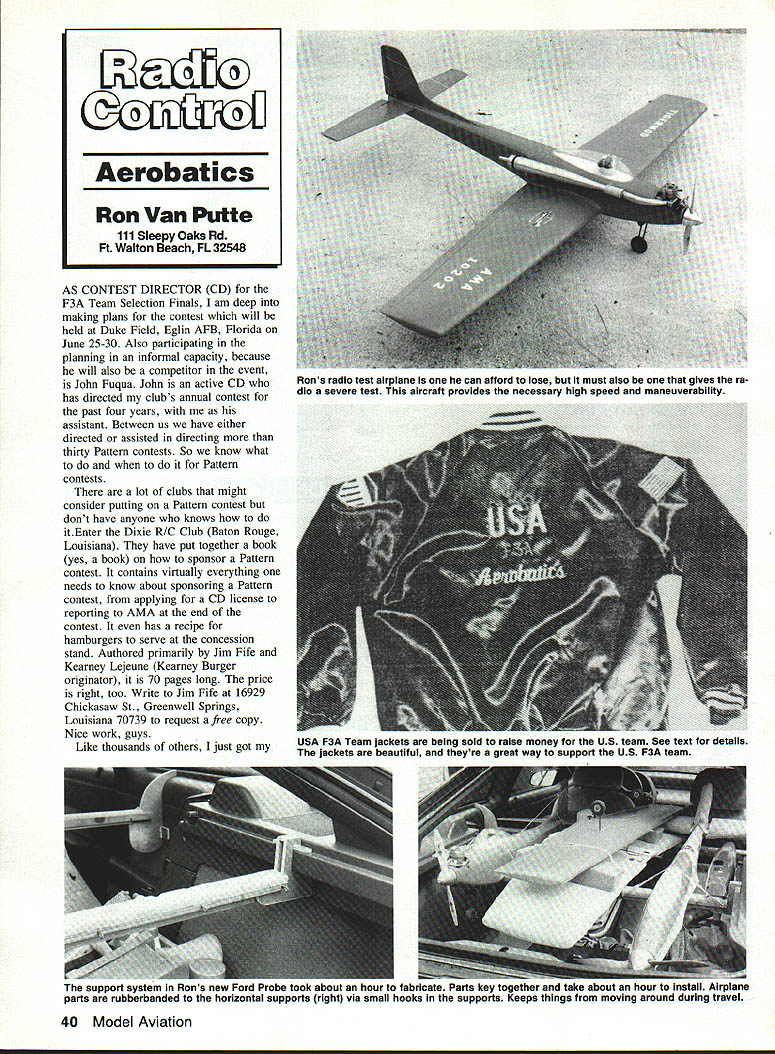
Does a radio test airplane have to be a junky one? No — just one you can afford to lose. My current test plane happens to be an old sporty-looking original powered by a Super Tigre 40S with a Mac's pipe. It goes like a scalded cat. If a radio works in it, it will work in my good Pattern airplanes.
Since I sent in two transmitters and four receivers for exchange, it has been getting a lot of flying lately. Save yourself a lot of grief and give your radio a good test in an airplane you can afford to lose. If you don't have one, it's a good investment to consider.
NSRCA Team Fund jackets
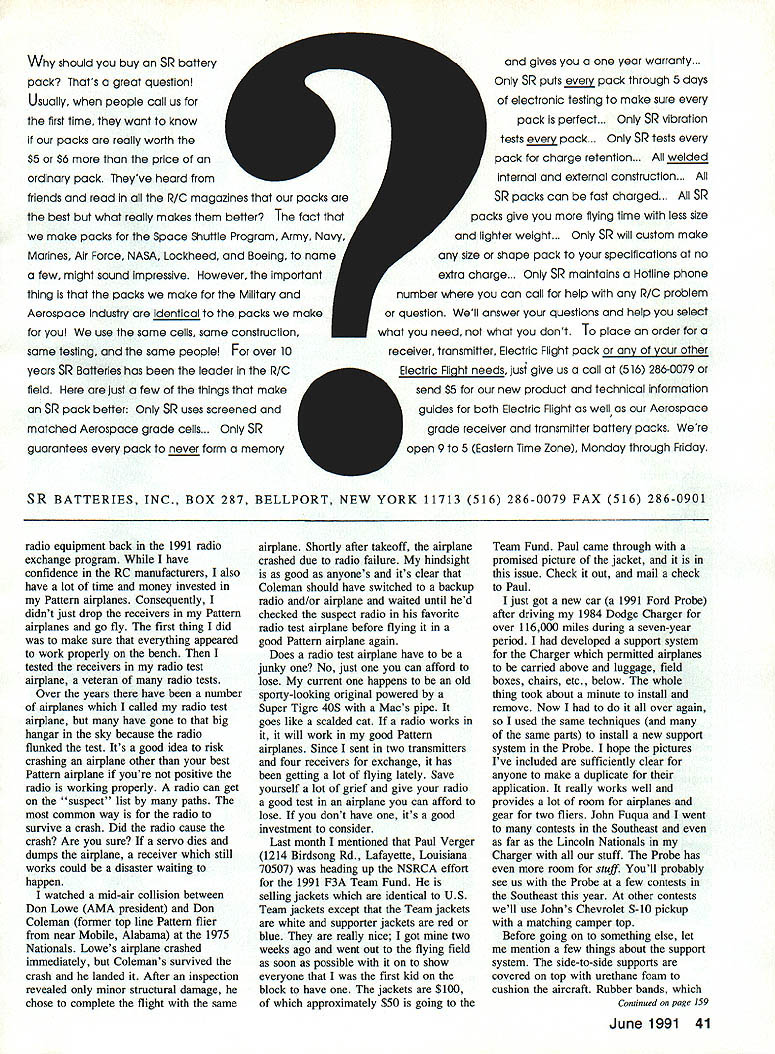
Last month I mentioned that Paul Verger (1214 Birdsong Rd., Lafayette, Louisiana 70507) is heading up the NSRCA effort for the 1991 F3A Team Fund. He is selling jackets which are identical to U.S. Team jackets except that the Team jackets are white and supporter jackets are red or blue. They are really nice; I got mine two weeks ago and went out to the flying field as soon as possible to show everyone that I was the first on the block to have one.
The jackets are $100, with approximately $50 going to the Team Fund. Paul came through with a promised picture of the jacket; it is in this issue. Check it out, and mail a check to Paul.
Car support system for carrying airplanes
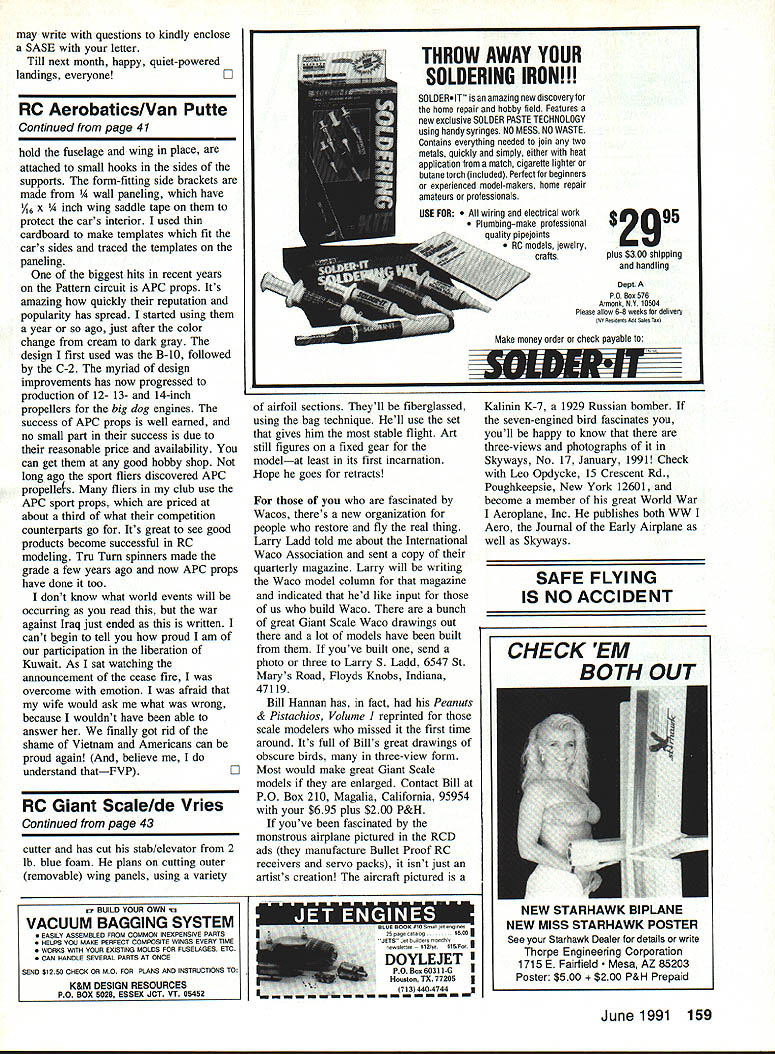
I just got a new car (a 1991 Ford Probe) after driving my 1984 Dodge Charger for over 116,000 miles during a seven-year period. I had developed a support system for the Charger which permitted airplanes to be carried above and luggage, file boxes, chairs, etc., below. The whole thing took about a minute to install and remove. Now I had to do it all over again, so I used the same techniques (and many of the same parts) to install a new support system in the Probe.
I hope the pictures I've included are sufficiently clear for anyone to duplicate for their application. It really works well and provides a lot of room for airplanes and gear for two fliers. John Fuqua and I went to many contests in the Southeast and as far as the Lincoln Nationals in my Charger with all our stuff. The Probe has even more room for gear. You'll probably see us with the Probe at contests in the Southeast this year. At other contests we'll use John's Chevrolet S-10 pickup with a matching camper top.
A few details about the support system:
- The side-to-side supports are covered on top with urethane foam to cushion the aircraft.
- Rubber bands that hold the fuselage and wing in place are attached to small hooks in the sides of the supports.
- The form-fitting side brackets are made from 1/4" wall paneling and have 1/2" x 1/4" wing saddle tape on them to protect the car's interior.
- I used thin cardboard to make templates that fit the car's sides and traced the templates on the paneling.
APC propellers
One of the biggest hits in recent years on the Pattern circuit is APC props. It's amazing how quickly their reputation and popularity have spread. I started using them a year or so ago, just after the color change from cream to dark gray. The design I first used was the B-10, followed by the C-2. The myriad of design improvements has now progressed to production of 12-, 13- and 14-inch propellers for the big engines.
The success of APC props is well earned, and no small part of that success is due to their reasonable price and availability. You can get them at any good hobby shop. Not long ago the sport fliers discovered APC propellers. Many fliers in my club use the APC sport props, which are priced at about a third of what competing sport props go for. It's great to see good products become successful in RC modeling. Tru Turn spinners made the grade a few years ago and now APC props have done it too.
A personal note
I don't know what world events will be occurring as you read this, but the war against Iraq had just ended as this was written. I can't begin to tell you how proud I am of our participation in the liberation of Kuwait. As I sat watching the announcement of the cease-fire, I was overcome with emotion. I was afraid my wife would ask me what was wrong, because I wouldn't have been able to answer her. We finally got rid of the shame of Vietnam and Americans can be proud again. (And, believe me, I do understand that — FVP.)
Transcribed from original scans by AI. Minor OCR errors may remain.

