
Radio Control: Aerobatics
Author
Ron Van Putte 111 Sleepy Oaks Rd. Ft. Walton Beach, FL 32548
THE SPORTSMAN rules change
THE SPORTSMAN rules change snafu is over. The RC Aerobatics Contest Board voted to accept my proposal to add three turnaround maneuvers to the existing schedule. I hope you saw the news in the "Focus on Competition" section in the June issue.
Two-stroke vs. four-stroke discussion
Clair Sieverling (Phoenix, AZ) sent me a letter in response to Eric Hawkinson's letter, published with my comments in the April column. He had already responded to a similar discussion by Don Lowe in his column in the November 1991 Radio Control Modeler. Don published Clair's response in his April column.
The long and the short of it is that Clair offers an alternative way to "level the field" in managing two-stroke versus four-stroke engines in Pattern competition: give a 5% bonus to fliers using two-stroke engines, or a 5% penalty to those using four-stroke .120 engines. He pointed out that since early four-stroke engines were inferior to two-stroke ones, they were given a displacement waiver to make up for their lack of power and to encourage development of four-stroke Pattern engines. The objective was overachieved. Today's four-stroke .120-cu.-in. engines make much more potent Pattern engines than do piped .060 two-strokers. Clair thinks it's time to level the field again.
According to Clair, a 5% bonus or penalty would amount to "50 points on a 1,000-point round" — enough to make the .120 user ponder somewhat, since there are usually less than 50 points between first and second and third places in a normal competitive round of flying. I would hazard a guess that the extra power from the .120 may be worth nearly 50 points per flight over a .61 engine.
"The concept lets the .120 pilot continue to use his preference, but the game would be a little more equal. The pilot who prefers the piped .61 can continue to use the equipment he prefers, and he has a more equal chance that pilot skill alone will determine the outcome. No manufacturers end up with obsolete engines or fuselage molds, and we won't have a million dollars worth of Pattern planes suddenly plummeting to sport plane prices all over the country."
I like that idea and have written Clair to inquire whether he plans to submit a rules change proposal to implement it. If he does, I'll support it; if he doesn't, I'll submit one myself. I have the summer to see how a 5% bonus or penalty would affect the outcome of contests around the country.
Of course, such a rules change proposal would affect AMA classes only. Being governed by their own rules, FAI members would be immune. Since most RC Aerobatics Contest Board members are FAI fliers, I'm concerned that they may perceive such a rules change proposal as a potential threat down the road. In other words, they may fear that the rules change would eventually work its way into their class. It would be interesting to compare the votes and see how board members who use four-stroke engines vote on the proposal.
Deleted maneuver descriptions
A curious thing happened during production of the rule book. I had submitted a rules change proposal to delete from the rule book the maneuver descriptions for the Eight Point Roll, Reverse Point Roll, and Three Reverse Inside Loops, because none of these maneuvers is included in any of the AMA Pattern maneuver schedules. The proposal was defeated, yet all three of the maneuver descriptions were deleted from the rule book. I wonder how that happened.
Contest notice: San Francisco Vultures
Also in my mailbag recently was a letter from Jef Raskin (Pacifica, California) requesting that I publicize an Aerobatics contest. Now that's not an unusual request, but as a rule I don't publicize contests. The basic reason is that if I do it for one contest, everybody will expect me to do it for theirs.
So why should I tell you that the San Francisco Vultures will host its fourth annual Aerobatics contest on July 26th? Simple. This is probably the only sanctioned Sailplane Aerobatics competition in the country. The meet will be held at Milagra Ridge in Pacifica, California. For more information, send a SASE to:
- Jef Raskin, 8 Gypsy Hill Rd., Pacifica, CA 94044
- Phone: (415) 359-8588
SPA contest follow-up
Thanks for the great feedback on my Senior Pattern Association contest report in the February issue ("SPA Contest"). Judging by the number of letters and phone calls, there must be a lot of us who enjoy the nostalgia surrounding the SPA. The only negative response I received on this contest coverage was from the host club, which I forgot to identify. To make amends: The North Georgia Flying Circus hosted the 1991 SPA contest and will host the 1992 SPA Championships on September 26 and 27. Write to:
- CD Mickey Walker, 3121 Northview Place, Smyrna, GA 30080
- Phone: (404) 435-8158
Switch failure and replacement harnesses
Have you ever had an airplane crash because of switch failure? I have. I suspect that switch failure downed my A-6 Intruder at the Senior Pattern Association contest last fall. Why? I had noticed that the receiver didn't always come on when I turned on the switch. Sometimes the servos would twitch, but the system wouldn't respond to the transmitter. Yet if I turned the receiver switch off and back on, the system would always "wake up."
My first thought was that I hadn't moved the switch all the way from off to on. Then I reasoned that moving the switch back and forth may have removed some oxidation from the contacts and permitted the switch to function properly. I thought the switch was functioning properly—until the Intruder crashed.
Recently the same symptoms occurred in my Pattern airplane, which has a different switch harness from the one on the A-6. That scared me. I don't want my LA-1 to crash because of something as dumb as switch failure. As Futaba owners are probably aware, the company has replaced its double-pole, single-throw receiver switches with single-pole, single-throw switches. This means that the switches are no longer redundant. I don't think that's a good idea, and I was reluctant to replace my switch harnesses with ones I believe to be less reliable. But where do you find switch harnesses that are compatible with Futaba radios except from Futaba?
To the rescue came Ultra R/C Products, makers of the Ultra Wing Man. This company offers switch harnesses for many radios, complete and ready to plug in, for $29.95. Inexpensive? No. But this switch harness boasts some impressive credentials. The specifications sheet shows performance capabilities that are far beyond our requirements. For example, one test requirement is to survive a 96-hour salt spray test. My airplanes don't normally get exposed to salt spray; do yours?
I now have an Ultra R/C Products switch harness in my LA-1, and all those worrying symptoms have disappeared. After I'd removed the Du-Bro Kwik Switch Mount from the fuselage, it took about a minute to install the switch in the vacant hole and plug it in. Because it's a toggle switch, it will take some getting used to. I haven't had a toggle switch in an airplane since my early days in single-channel RC.
My switch is installed so that it will remain in the on position when the plane moves forward. That's a carryover from those single-channel days when we hand-launched our airplanes. We always installed the switch so that the forward motion of our hand in launching the airplane would not turn the switch off if our hand happened to bump it.
Is the Ultra R/C Products switch harness worth it? You've got to decide that for yourself. I've made up my mind; I just sent off for two more. To order the switch harness or for further information:
- Ultra R/C Products, 5455 Linger Longer Road, Cumming, GA 30130
- Phone: (404) 899-4758
Smart Light Battery Voltage Monitor
I've also been using another product in my LA-1 that I really like. It's called a Smart Light Battery Voltage Monitor. An indicator light mounts in the side of the fuselage and tells you if your battery voltage is good enough for flight. The light glows green if the receiver battery pack voltage is above 4.8 volts and red if it fails to meet the threshold. You can install the sensing circuit between the switch harness and the receiver or plug it into an unused channel output in the receiver.
Has the Smart Light Battery Voltage Monitor saved me an airplane? Not yet—but the first time it does, it will pay for itself many times over. Besides, it's comforting to switch on the receiver and see that green indicator come on. The price (when I purchased it last July) was $26 plus $3 shipping and handling. If you're interested, contact:
- Anthony Szczur, ZZ Enterprises, Inc., 631 Manchester Rd., Norristown, PA 19403
- Phone: (215) 539-7476
Models by Sam Turner
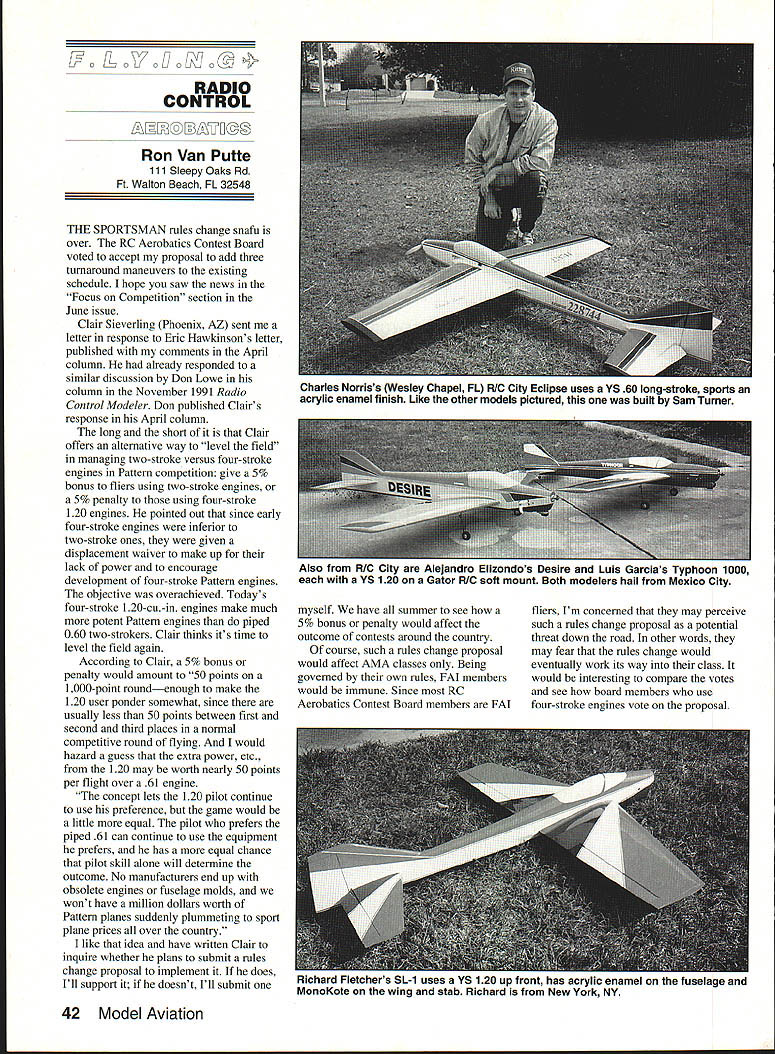
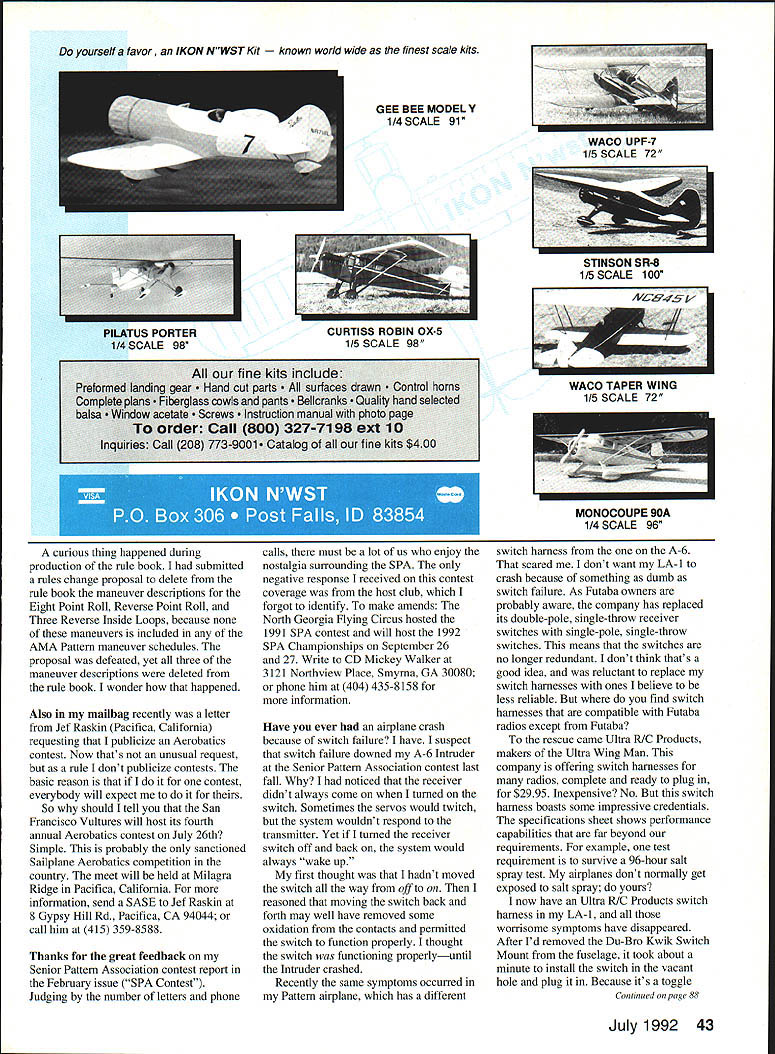
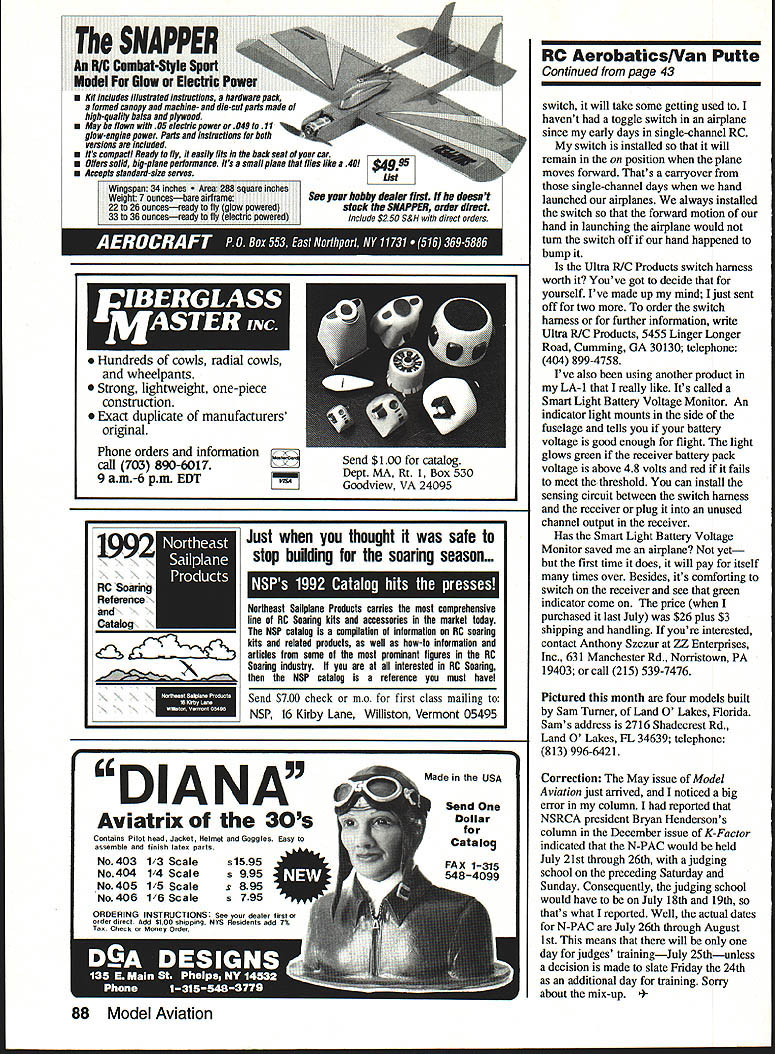
Pictured this month are four models built by Sam Turner, of Land O' Lakes, Florida. For more information:
- Sam Turner, 2716 Shadecrest Rd., Land O' Lakes, FL 34639
- Phone: (813) 996-6421
Correction: N-PAC dates
Correction: The May issue of Model Aviation just arrived, and I noticed a big error in my column. I had reported that NSRCA president Bryan Henderson's column in the December issue of K-Factor indicated that the N-PAC would be held July 21st through 26th, with a judging school on the preceding Saturday and Sunday. Consequently, the judging school would have to be on July 18th and 19th, so that's what I reported. Well, the actual dates for N-PAC are July 26th through August 1st. This means that there will be only one day for judges' training—July 25th—unless a decision is made to slate Friday the 24th as an additional day for training. Sorry about the mix-up.
Transcribed from original scans by AI. Minor OCR errors may remain.

