
Radio Control: Aerobatics
Ron Van Putte 111 Sleepy Oaks Rd. Ft. Walton Beach, FL 32548
IMAC and Scale Aerobatics
The title of this column is "Radio Control Aerobatics." That connotes some obvious subject material, so I wasn't really surprised when I received a letter from Ira Rosner (13234 104th Terrace, Miami, FL 33186), who is editor of Scale Aerobatics, the newsletter of the International Miniature Aerobatic Club (IMAC). Here are some excerpts from Ira's letter:
"To the uninitiated, IMAC, which gets its inspiration from the International Aerobatic Club (IAC), supports, sanctions, and promotes aerobatic competition for radio-controlled model aircraft. What sets IMAC apart from Pattern, however, is that IMAC seeks to replicate full-size aerobatic competition both by using scale models of aerobatic-capable aircraft and flying maneuver schedules largely identical to those prepared by the IAC for full-size competition. Those maneuver schedules change each year, and contests generally feature a round of 'unknowns' for the top two classes, in which the pilot receives the maneuver schedule on the morning of the competition.
"IMAC was the pioneer in adopting Turnaround flying per IAC style, a format long since accepted for use at the Tournament of Champions and now becoming ubiquitous in the traditional Pattern world. In addition, IMAC utilizes a defined aerobatic box, and boundary infractions are penalized. Maneuvers are K-factored."
I am a devoted reader of Model Aviation. Yet in the nearly three years that I have been active in IMAC, I cannot recall a single mention in your column of our organization and its challenging and authentic form of aerobatic competition. I am baffled by this, and I write this letter in the hope that the lack of attention stems purely from a lack of awareness.
"It's worth noting that with Pattern moving toward a virtually all-Turnaround format, traditional Pattern and IMAC share their fundamental elements. I believe this presents a prime opportunity for crossover between the two forms of the sport. I do not view either Pattern or IMAC as the 'correct' or orthodox form of aerobatic competition; rather, they represent multiple competitive avenues, much in the way Mario Andretti raced both Formula and Grand Prix as well as Indianapolis-type circuits. I'll admit that I think that IMAC's use of scale aircraft types creates a refreshing and interesting distinction from Pattern; but deep down, the object of our passion is the same: high-performance Precision Aerobatics."
My reply to IMAC
I wrote to Ira Rosner; here is an excerpt from what I wrote:
"I plead guilty. I have no interest in IMAC and do not feel qualified to write about it. While there are some IMAC airplanes that are about the same size as the ones competing in Pattern, the majority I have seen have been very large and loud. Pardon my prejudice, but I hate big airplanes, scale or otherwise. Nevertheless, I do feel guilty about not putting something about IMAC in the column.
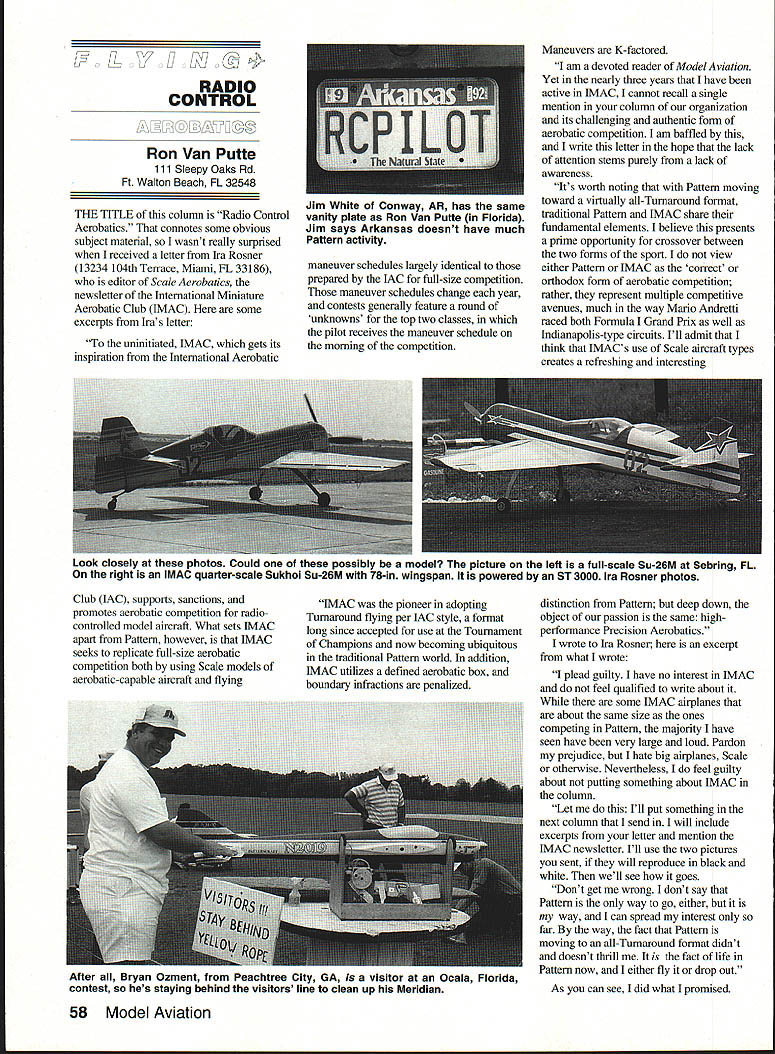
"Let me do this: I'll put something in the next column that I send in. I will include excerpts from your letter and mention the IMAC newsletter. I'll use the two pictures you sent, if they will reproduce in black and white. Then we'll see how it goes.
"Don't get me wrong. I don't say that Pattern is the only way to go, either, but it is my way, and I can spread my interest only so far. By the way, the fact that Pattern is moving to an all-Turnaround format didn't and doesn't thrill me. It is the fact of life in Pattern now, and I either fly it or drop out."
As you can see, I did what I promised.
What happens after this is up to IMAC participants. Items of interest and good photographs are solicited and will be used. If you would like to get more information or submit a membership application, write to Gil Horstman, P.O. Box 107, Ritzville, WA 99169-0107. Annual dues are $15.
Stall Turn controversy
Have you heard the latest controversy? It's the Stall Turn. What's controversial about the Stall Turn? Well, if you are a judge and a flier flops a Stall Turn, do you award a zero? What if the Stall Turn is part of a maneuver, such as the Stall Turn with 1/2 Rolls or the Figure M with 3/4 Rolls? Do you give the same score for a flop?
If you use the one-point downgrade for 15° of error, all flops can zero score. On the other hand, some people argue that the Stall Turn is only part of these maneuvers, and a flop should not get a zero. Others argue that the correction after a flop requires the pilot to perform a maneuver (180° roll) that is not in the maneuver description, and that should cause the award of a zero.
What we need is consistency in judging. In order to achieve that consistency, I believe that a flopped Stall Turn deserves a zero—no matter what the maneuver. That's what I intend to do unless the rule book (or subsequent corrections) provides some direction to the contrary.
Wait, we're not done with the Stall Turn yet! The AMA rules specify a downgrade for "return track more than one-half (1/2) wingspan from entry track." On the other hand, the FAI Sporting Code says, "If the maximum pivot radius is one-half wingspan, the radius exceeds 1/2 wingspan, the maneuver is severely downgraded."
That sounds clear enough to me. However, some people argue about the location of the pivot point and whether the CG is the point to which to measure. If you assume that the airplane must pivot about a point inside the wingtip in order to not get downgraded, the U.S. and FAI rules are in step.
There are probably even more controversies involving the Stall Turn, but I haven't heard about them.
Equipment note: retractable gear
Have you seen the retracts in the new Hobby Lobby catalog? Catalog #19 has a tricycle retractable gear set that looks like Supra clones and sells for $28.40. I've seen both sets, and it's hard to tell the difference. They both have smooth working action. I don't know whether they have the same strength and durability. They bear looking into.
Senior Pattern Association
One of the nice things about this column is that I get to promote events that are of interest to me. The Senior Pattern Association is interesting to me. It was started by Mickey Walker (3121 Northview Pl., Smyrna, GA 30080; telephone (404) 435-8158). The first contest was held in Marietta, Georgia, on October 12 and 13, 1991, and drew 20 contestants.
The rules are simple:
- The airplane design must have been flown before December 31, 1969.
- Flaps are not allowed.
- Retracts must be locked down if present.
- Non-Schneider-ported two-cycle engines up to 0.6 cu. in. or four-cycle engines up to 0.7 cu. in. are legal.
- A muffler must be used.
Interested? Write to Mickey Walker to join or for more information.
My club, the Eglin Aero Modellers (FL), became Chapter 2 of the Senior Pattern Association last fall. As promised, we will hold a contest this year on August 15 and 16. The Contest Director will be Henry Bourgeois (407 20th Street, Niceville, FL 32578; telephone (904) 729-2957). He'd be glad to get a contest flyer to you if you want one and haven't received one before you read this. Y'all come on down and see us!
NSRCA Pan American Aerobatic Championship (N-PAC)
Entries for the National Society of Radio Control Aerobatics (NSRCA) Pan American Aerobatic Championship (N-PAC) are going well, according to Charles Castaing, registrar for the event. N-PAC will be held July 26 through August 1 in Lawrenceville, Illinois.
If you plan to attend, now is your last chance to enter. Unlike the Nationals, no entries will be accepted at the event. The regular entry deadline is July 1, but late entries will be accepted until July 15. Entry forms have been included in the NSRCA newsletter, K-Factor, for the past few months, but if you are not an NSRCA member and don't have an entry form, write to Charles at 814 Pruox Street, New Iberia, LA 70560, to request one, and send it right back to him. I hope to see you there.
Transcribed from original scans by AI. Minor OCR errors may remain.

