
Radio Control: Aerobatics
Ron Van Putte
111 Sleepy Oaks Rd. Ft. Walton Beach, FL 32548
Four-stroke vs. Two-stroke in Pattern Competition
The potential rules-change proposal to penalize four-stroke .120 users has generated more mail than I've ever received (except perhaps for mail concerning the downwind turn). Four-stroke users have been uniformly indignant that such a thing could be considered. Their virtually unanimous response has been that pilot ability and practice are more important than engine power in determining a winner. I don't have much of an argument — I'm sure it's correct. However, the claim that a four-stroke .120 engine gives a competitive edge over two-stroke engines deserves some examination.
Four-stroke engines have two advantages over two-stroke engines.
1. Performance advantage
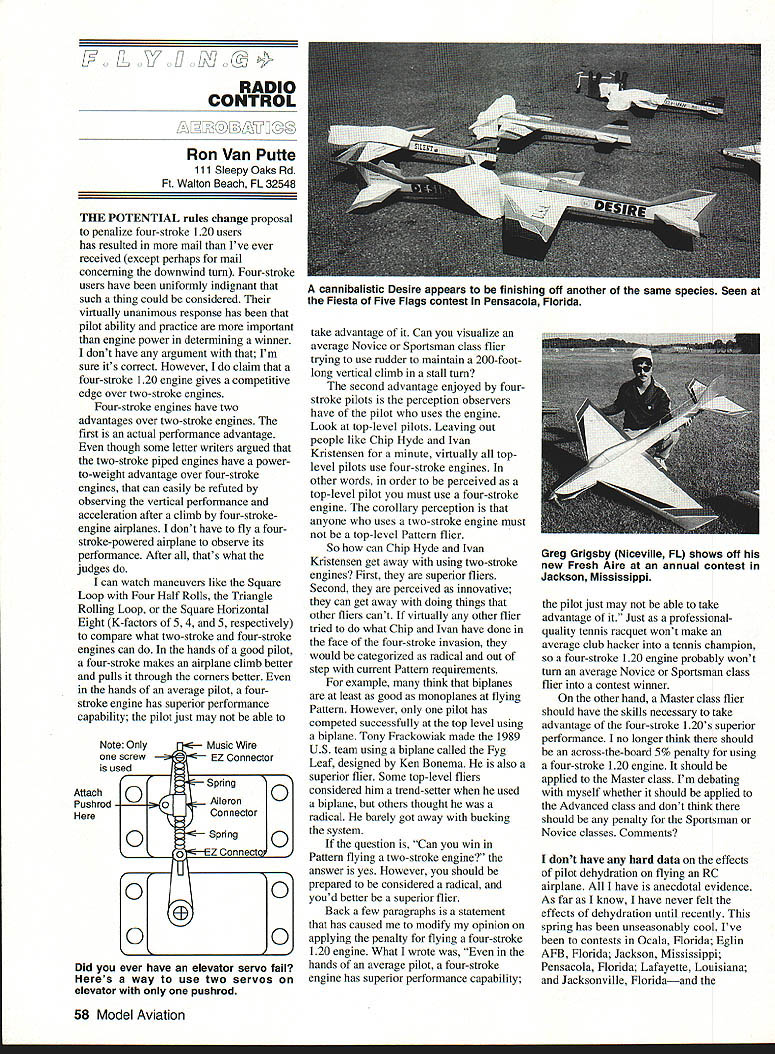
- Observers and judges can see a four-stroke's superior vertical performance and acceleration after a climb.
- In the hands of a good pilot, a four-stroke makes an airplane climb better and pull through corners more crisply. Maneuvers you can watch to compare engines include the Square Loop with Four Half Rolls, the Triangle Rolling Loop, and the Square Horizontal Eight (K-factors of 5, 4, and 5, respectively).
- Even an average pilot flying a four-stroke-powered airplane has greater performance capability; the pilot may simply not be able to take full advantage of it. For example, can you visualize an average Novice or Sportsman flier using rudder to maintain a 200-foot-long vertical climb in a stall turn?
2. Perception advantage
- Observers associate top-level fliers with four-stroke engines. Leaving out pilots such as Chip Hyde and Ivan Kristensen, virtually all top-level pilots use four-strokes.
- Consequently, using a two-stroke can mark a pilot as "not top-level" in the eyes of judges and competitors—regardless of actual skill.
- Exceptions like Chip Hyde and Ivan Kristensen get away with two-strokes because they are superior fliers and are perceived as innovative. Other fliers attempting the same would likely be labeled radical.
- A similar example: biplanes versus monoplanes. Tony Frackowiak made the 1989 U.S. team flying a biplane called the Fig Leaf (designed by Ken Bonema). He was a superior flier; some called him a trendsetter, others a radical. He barely got away with bucking the system.
My position on a penalty
- Can you win Pattern flying a two-stroke engine? Yes — but expect to be considered radical, and you'd better be a superior flier.
- I previously thought a blanket 5% penalty for four-stroke .120 users might be justified. After reconsideration, I no longer support an across-the-board penalty. My current thinking:
- Apply a penalty to the Master class (where pilots can reliably exploit the four-stroke's advantages).
- I'm still debating whether the Advanced class should be penalized.
- No penalty for Sportsman or Novice classes.
Comments welcome.
Heat, dehydration, and flight performance
I don't have hard data on pilot dehydration and RC flying, only anecdote. This spring has been unseasonably cool; I attended contests in Ocala, Eglin AFB, Jackson (MS), Pensacola, Lafayette (LA), and Jacksonville — and the weather was cool until the Jacksonville contest. At Jacksonville it was hot. After a long day trying to stay out of the sun at the Gateway R/C Club's new pavilion, I went up for my fourth-round flight.
Since I fly Advanced, my first maneuver after takeoff is a Double Immelmann. I performed the first half and was ready for the one-half outside loop but had difficulty remembering the sequence. I finally recalled it and completed the maneuver. I completed the One Half Reverse Cuban Eight turnaround without incident, but when I started the Slow Roll I couldn't figure out what the initial rudder input should be.
The rest of the flight showed poor mental condition and coordination. It got so bad I told my caller I wanted to land. He convinced me to continue, and I completed the flight successfully. Since nothing like that had happened to me before, I assume I was dehydrated and/or suffering heat exhaustion. It was scary and unexpected — I'm a long-distance runner and have completed nine marathons in the past six years without trouble. You can bet I'll be drinking plenty of water, Gatorade, and soft drinks at hot flying sessions from now on.
Dual elevator servos using a single pushrod
Do you feel uneasy having only one elevator servo? I do. I've had servo failures before (recent ones were in the ailerons), and I use two aileron servos on my Pattern airplanes which allowed safe landings. The elevator gets as much use as the ailerons, and a failed elevator servo can cause a crash. To mitigate this, I installed two elevator servos in my last three airplanes but didn't want the weight of two pushrods. I devised a neat way to hook up two elevator servos to one pushrod and installed it on my LA-1; it works well.
Parts required
- Two Du-Bro #121 EZ Connectors
- Two springs from a Du-Bro #120 Control Over-ride Servo Saver
- One Sig #SH-659 aileron connector
- Short piece of 1/16" music wire
How it works
- The Sig aileron connector has a 1/16" hole that fits snugly over the 1/16" music wire, eliminating slop.
- File the aileron connector flat on one side so it will clear the servo arm.
- Use the two EZ connectors and the two springs so the aileron connector is centered between the servo arm outputs; the springs keep it centered.
- If one servo stops working, the remaining servo can move the pushrod via the mechanism, but you get about half throw instead of full throw.
- To compensate, set the transmitter elevator dual rate to about half throw during normal flying. If a servo quits, switch to high-rate elevator to regain full elevator authority.
I haven't had any elevator servo failures since installing this system, but I'm ready if one occurs.
Contest participation — food for thought
Only 96 Pattern fliers were at Westover AFB, Massachusetts for the 1992 AMA Nationals — the smallest number in many years to enter a Nationals. Last year, 203 Pattern fliers competed in the Lawrenceville, Illinois Nationals. In 1985, the last time the Nationals were held at Westover AFB, there were 145 Pattern fliers.
What significance can be drawn from these facts? I would like to hear readers' thoughts.
Transcribed from original scans by AI. Minor OCR errors may remain.

