
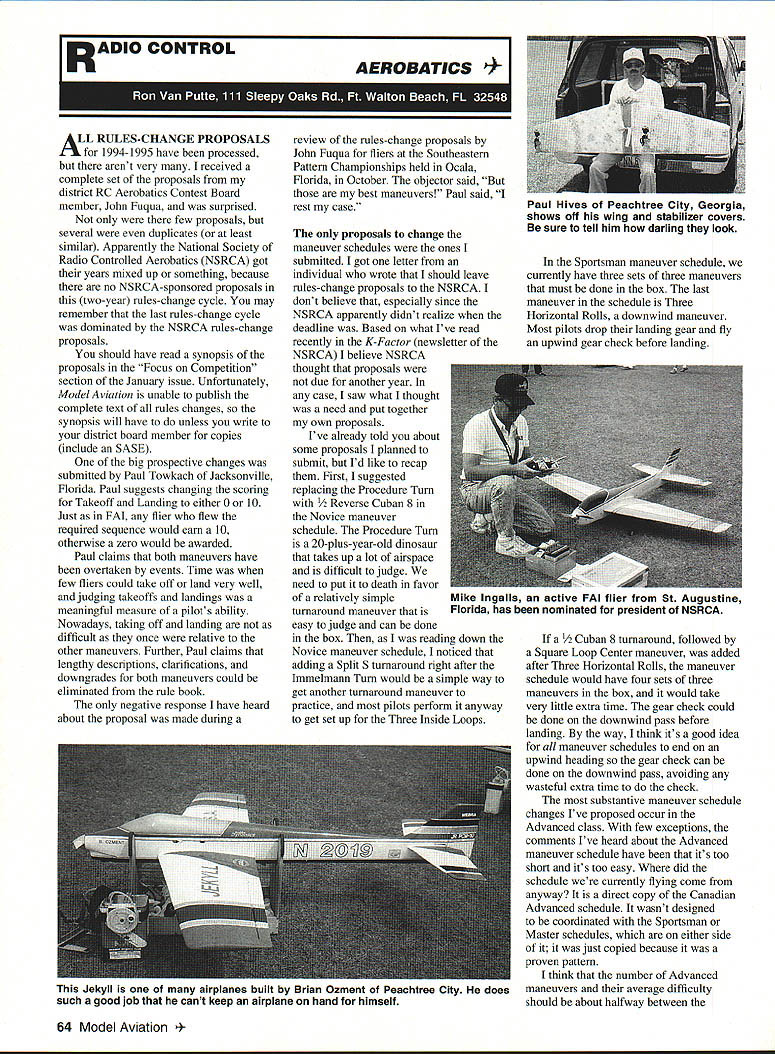
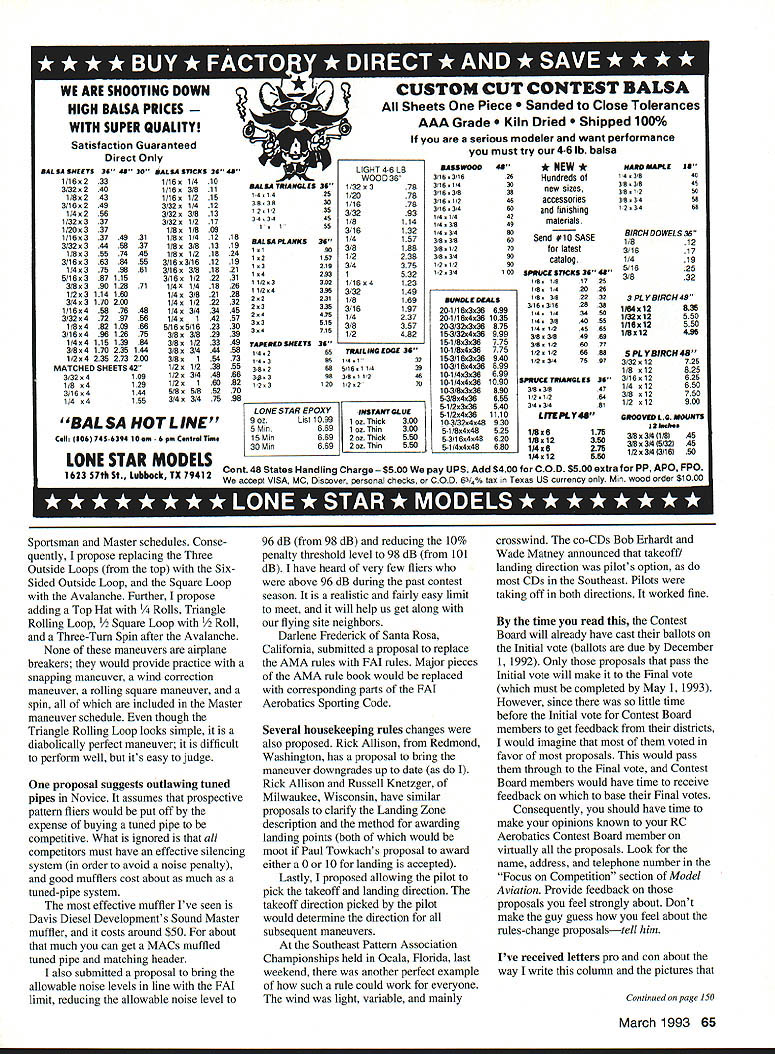
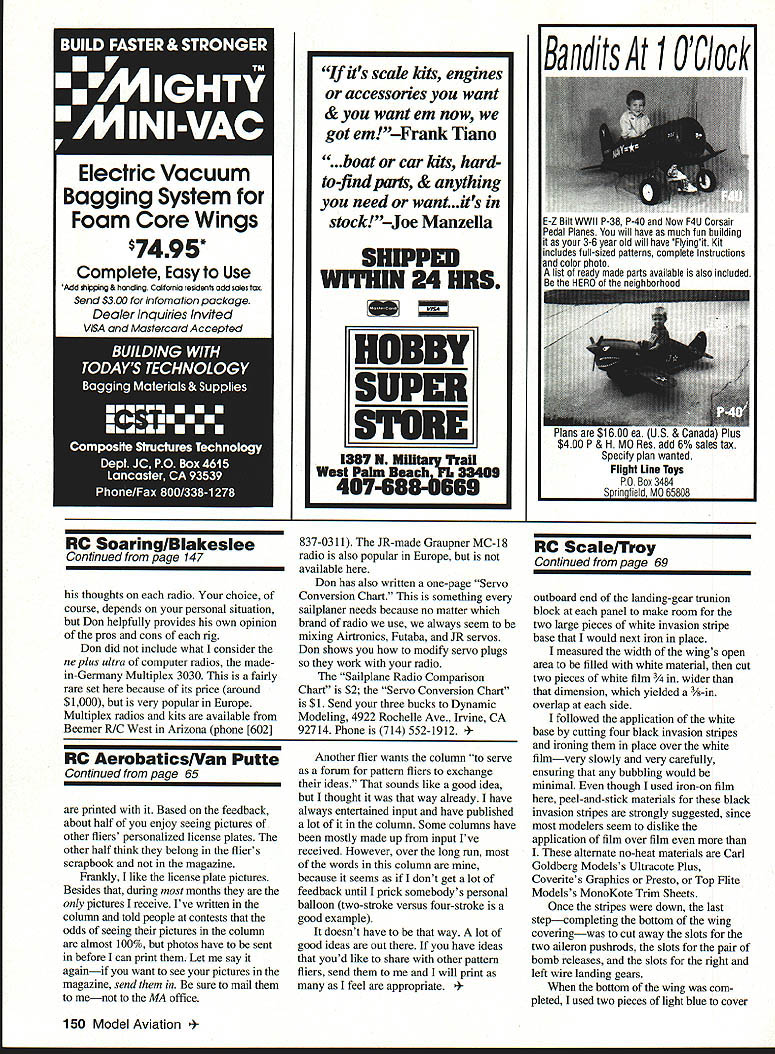
Radio Control: Aerobatics
By Ron Van Putte
111 Sleepy Oaks Rd., Ft. Walton Beach, FL 32548
ALL RULES-CHANGE PROPOSALS for 1994–1995 have been processed, but there aren't very many. I received a complete set of the proposals from my district RC Aerobatics Contest Board member, John Fuqua, and was surprised.
Not only were there few proposals, but several were even duplicates (or at least similar). Apparently the National Society of Radio Controlled Aerobatics (NSRCA) got their years mixed up or something, because there are no NSRCA-sponsored proposals in this (two-year) rules-change cycle. You may remember that the last rules-change cycle was dominated by NSRCA rules-change proposals.
You should have read a synopsis of the proposals in the "Focus on Competition" section of the January issue. Unfortunately Model Aviation is unable to publish the complete text of all rules changes, so the synopsis will have to do unless you write to your district board member for copies (include an SASE).
Major proposals and comments
One of the big prospective changes was submitted by Paul Towkach of Jacksonville, Florida. Paul suggests changing the scoring for Takeoff and Landing to either 0 or 10. Just as in FAI, any flier who flew the required sequence would earn a 10; otherwise a zero would be awarded.
Paul claims that both maneuvers have been overtaken by events. Time was when few fliers could take off or land very well, and judging takeoffs and landings was a meaningful measure of a pilot's ability. Nowadays, taking off and landing are not as difficult as they once were relative to the other maneuvers. Further, Paul claims that lengthy descriptions, clarifications, and downgrades for both maneuvers could be eliminated from the rule book.
The only negative response I have heard about the proposal was made during a review of the rules-change proposals by John Fuqua for fliers at the Southeastern Pattern Championships held in Ocala, Florida, in October. The objector said, "But those are my best maneuvers!" Paul said, "I rest my case."
The only proposals to change the maneuver schedules were the ones I submitted. I got one letter from an individual who wrote that I should leave rules-change proposals to the NSRCA. I don't believe that, especially since the NSRCA apparently didn't realize when the deadline was. Based on what I've read recently in the K-Factor (newsletter of the NSRCA) I believe NSRCA thought that proposals were due for another year. In any case, I saw what I thought was a need and put together my own proposals.
My maneuver-schedule proposals
I've already told you about some proposals I planned to submit, but I'd like to recap them.
- Novice class:
- Replace the Procedure Turn with a 1/2 Reverse Cuban 8. The Procedure Turn is a 20-plus-year-old dinosaur that takes up a lot of airspace and is difficult to judge. The 1/2 Reverse Cuban 8 is a relatively simple turnaround maneuver that is easy to judge and can be done in the box.
- Add a Split S turnaround immediately after the Immelmann Turn to provide another turnaround maneuver to practice; most pilots already perform it to set up for the Three Inside Loops.
- Sportsman class:
- Currently we have three sets of three maneuvers that must be done in the box; the last maneuver is Three Horizontal Rolls, a downwind maneuver. Most pilots drop their landing gear and fly an upwind gear check before landing.
- Proposal: After Three Horizontal Rolls, add a 1/2 Cuban 8 turnaround followed by a Square Loop Center maneuver. This would create four sets of three maneuvers in the box with very little extra time required. The gear check could be done on the downwind pass before landing.
- I also think all maneuver schedules should end on an upwind heading so the gear check can be done on the downwind pass, avoiding extra time.
- Advanced class (most substantive changes):
- The current Advanced schedule is generally considered too short and too easy. It is a direct copy of the Canadian Advanced schedule and wasn't designed to coordinate with Sportsman or Master schedules.
- I propose the number of Advanced maneuvers and their average difficulty be about halfway between Sportsman and Master schedules. Specific changes:
- Replace Three Outside Loops (from the top) with the Six-Sided Outside Loop.
- Replace the Square Loop with the Avalanche.
- Add the following maneuvers after the Avalanche:
- Top Hat with 4 Rolls
- Triangle Rolling Loop
- 1/2 Square Loop with 1/2 Roll
- Three-Turn Spin
- These additions are not airplane breakers; they provide practice with a snapping maneuver, a wind-correction maneuver, a rolling-square maneuver, and a spin — all included in the Master schedule. The Triangle Rolling Loop, while it appears simple, is diabolically perfect: difficult to perform well but easy to judge.
Other proposals
- Tuned pipes in Novice:
- One proposal suggests allowing tuned pipes in Novice, assuming prospective pattern fliers would be put off by the expense of buying a tuned pipe to be competitive.
- Counterpoint: competitors must have an effective silencing system (no muffler penalty), and good mufflers cost about as much as a tuned-pipe system. The most effective muffler I've seen is Davis Diesel Development's Sound Master, which costs around $50. For about that much you can get a MAC's muffled tuned pipe and matching header.
- Noise limits:
- I submitted a proposal to bring allowable noise levels in line with the FAI limit: reduce the allowable noise level to 96 dB (from 98 dB) and reduce the 10% penalty threshold level to 98 dB (from 101 dB).
- Few fliers exceeded 96 dB last season. It is a realistic and fairly easy limit to meet and will help with flying-site neighbors.
- Replace AMA rules with FAI rules:
- Darlene Frederick of Santa Rosa, California, submitted a proposal to replace the AMA rules with FAI rules. Major pieces of the AMA rule book would be replaced with corresponding parts of the FAI Aerobatics Sporting Code.
- Housekeeping changes:
- Rick Allison (Redmond, Washington) proposed bringing maneuver downgrades up to date.
- Russell Knetzger (Milwaukee, Wisconsin) proposed clarifying the Landing Zone description and the method for awarding landing points (these would be part of Paul Towkach's proposal to award either a 0 or a 10 for landing if accepted).
- Pilot choice of takeoff/landing direction:
- I proposed allowing the pilot to pick the takeoff and landing direction for all subsequent maneuvers. At the Southeast Pattern Association Championships in Ocala, Florida, the co-CDs, Bob Erhardt and Wade Matney, announced that takeoff/landing direction was the pilot's option, as do most CDs in the Southeast. Pilots were taking off in both directions and it worked fine.
Voting timeline and how you can respond
By the time you read this, the Contest Board will already have cast their ballots on the initial vote (ballots were due by December 1, 1992). Only those proposals that pass the initial vote will be sent to the final vote (which must be completed by May 1, 1993).
Since there was so little time before the initial vote for Contest Board members to get feedback from their districts, I would imagine that most of them voted in favor of most proposals to pass them through to the final vote. Contest Board members will have little time to receive feedback before the final vote.
Consequently, you should have time to make your opinions known to your RC Aerobatics Contest Board member on virtually all the proposals. Look for the names, addresses, and telephone numbers in the "Focus on Competition" section of Model Aviation. Provide feedback on the proposals you feel strongly about. Don't guess how you feel about the rules-change proposals—tell them.
Reader feedback, photos, and resources
I've received letters pro and con about the way I write this column and the pictures that are printed with it. Based on the feedback, about half of you enjoy seeing pictures of other fliers' personalized license plates. The other half think they belong in the flier's scrapbook and not in the magazine.
Frankly, I like the license plate pictures. Besides that, during most months they are the only pictures I receive. I've written in the column and told people at contests that the odds of seeing their pictures in the column are almost 100%, but photos have to be sent in before I can print them. Let me say it again—if you want to see your pictures in the magazine, send them in. Be sure to mail them to me—not to the MA office.
The JR-made Graupner MC-18 radio is also popular in Europe, but is not available here.
Don has written a one-page "Servo Conversion Chart." This is something every sailplaner needs because no matter which brand of radio we use, we always seem to be mixing Airtronics, Futaba, and JR servos. Don shows you how to modify servo plugs so they work with your radio.
- The "Sailplane Radio Comparison Chart" is $2.
- The "Servo Conversion Chart" is $1.
- Send $3 to: Dynamic Modeling, 4922 Rochelle Ave., Irvine, CA 92714. Phone: (714) 552-1912.
Another flier wants the column "to serve as a forum for pattern fliers to exchange their ideas." That sounds like a good idea, but I thought it was what we already have. I have always entertained input and have published a lot of it in the column. Some columns have been mostly made up from input I've received. However, over the long run, most of the words in this column are mine, because it seems as if I don't get a lot of feedback until I prick somebody's personal balloon (two-stroke versus four-stroke is a good example).
It doesn't have to be that way. A lot of good ideas are out there. If you have ideas that you'd like to share with other pattern fliers, send them to me and I will print as many as I feel are appropriate.
Transcribed from original scans by AI. Minor OCR errors may remain.

