
Radio Control: Aerobatics
Ron Van Putte, 111 Sleepy Oaks Rd., Ft. Walton Beach, FL 32548
I'm still alive. You may have noticed that my column was missing from the December 1992 and January 1993 issues. Those omissions came as surprises to me, too. It was the first and second times that either my regular column or special coverage has been missing from an issue of Model Aviation in the 17½ years I've been writing for it. I think I know what happened, and I'll tell you about it at the end of this month's column.
As I write this, I have been assured that there will be a regular column in the February issue and both a regular column and N‑PAC coverage in the March issue. The column you're now reading should appear in the April issue.
FAI Team Selection finals
FAI Team Selection finals have been announced for June 7–12, 1993, in Corvallis, Oregon, with Mike Dunphy as Contest Director. If Mike is as good a Contest Director as he is a pattern judge, it should be a well-run contest, and I'm looking forward to it.
The 1993 event should be significantly different from past Team Selection finals because the number of contestants will be reduced by more restrictive entry standards. In the past, many fliers met the qualifying standards, and the only thing that kept attendance manageable was the cost of entering the U.S. FAI program and the expenses involved in attending the contest.
Several interesting letters arrived lately, and I would like to share parts of some of them with you.
Bill Kite — "Complaint Department" idea
Bill Kite (Kingsport, Tennessee) wrote:
"Each AMA district ought to have a 'Complaint Department' (for lack of a better name at this time) to be established by the district representative on the Contest Board. A flier could call something to his attention pertaining to the action (or lack of action) of a Contest Director.
"I have seen and heard of events being canceled due to lack of contestants showing up, combining classes at the last minute, and some other things that the rule book forbids. This way a Contest Director could be informed of his error and asked to better manage his contest, or, if it was repeated, there could be steps taken to refuse sanctions for future contests.
"The way things are now it seems that when someone runs one poorly or scoffs at the rules, the contestant has no recourse except to gripe to other fliers or boycott future events there."
I think Bill has a good idea. I don't know if the Contest Board member is the correct individual to be the policeman, though. The board members are not currently involved with contest sanctions. They would either have to be given the authority to inform the District Contest Coordinator not to recommend a sanction for a particular contest, or they would have to be in the approval chain for a sanction.
For example, we could have the potential Contest Director send a sanction request to the Contest Board member, who would forward it to the District Contest Coordinator for action if there were no "black marks" against the CD or the sponsoring club. Are there any opinions on this?
(Editor's note: AMA Technical Director Bob Underwood notes that concerns such as those expressed by Mr. Kite are investigated by AMA Headquarters—when they are reported. A system does exist whereby Contest Directors can be placed on probation or have their CD status revoked for continued violations of standards or procedures.)
Ralph Thomas — airline transport of pattern ships
Ralph Thomas (P.O. Box 32733, Decatur, GA 30034) wrote:
"I occasionally travel by air to other cities in the United States and would like to be able to participate in pattern contests in those cities. The problem is—how do I take along a pattern-size aircraft (Escape, Summit, etc.) and not have to pay the outrageous charges because the package is too long? Apparently weight is not the problem. On domestic flights, the maximum size is 80 inches total (width + depth + length).
I am sure I am not the only person who has run into this problem. I would appreciate any advice you could give me. In fact, this might be a good subject for a future column."
I agree. I don't have a complete solution, but I know there are many of you who can help Ralph and others with a similar problem. Please write to me so I can spread the word in a future column.
Are the K‑factors okay?
There has been a lot of discussion lately about claims that K‑factors have been improperly awarded for many maneuvers. No one seemed to have a good idea what to do about it until I received a letter from Sam Turner (Land O' Lakes, Florida). Sam has some interesting ideas about K‑factors. Excerpts from his letter follow.
Sam's main points:
- He's concerned that the penalty for "flopping" any stall turn has been determined to be zero due to a strict interpretation of the "15‑degree rule."
- He contends the K‑factor should be the equalizer that reflects complexity, difficulty, and penalty potential of maneuvers. Complex maneuvers should have higher K‑factors; simple maneuvers should carry low K‑factors.
- Over the years we've added complex maneuvers to upper classes and more differentiation in lower classes, but we've kept a limited K‑factor range of 1 to 5. Sam believes this range is too narrow.
Sam suggests basing K‑factors on the number of separate control-axis inputs required to perform the maneuver. Examples and his proposed K assignments include:
- Simple single‑input maneuvers:
- Takeoff, One Loop, One Roll: K = 1
- Multiples are additive: Three Inside Loops: K = 3; Three Horizontal Rolls: K = 3
- Outside Loops get an added point for being outside: Outside Loop = 4
- Base K on axes inputs for more complex maneuvers:
- Simple Stall Turn: pitch + yaw + pitch = 3
- Cuban Eight: pitch + roll + pitch + roll = 4
- Immelmann Turn: pitch + roll = 2
- Straight Inverted Flight: roll + roll = 2
- Further examples Sam gave:
- Figure M = pitch + yaw + pitch + yaw + pitch = 5
- Figure M with Rolls = pitch + roll + yaw + roll + pitch + roll + roll + yaw + roll + pitch = 9
- Downward 45° Snap = pitch + snap + pitch = 3
- Avalanche = pitch + snap + pitch + snap = 4
- Top Hat = pitch + roll + pitch + pitch + roll + pitch = 6
- Reverse Top Hat = Top Hat + inverted = 7
Sam's conclusion: expanding the K‑factor range will make judging more consistent, increase score spread, and eliminate the "instant demise" and judging confusion that now exists.
My response: Sam makes very good points — the K‑factors are due for review and revision. However, I disagree with using only the "15‑degree rule" for heading errors. I believe a flopped Stall Turn should earn a zero. In fact, I think we should keep the "15‑degree rule" for rolling errors and also institute a "5‑degree rule" for heading errors. You can see a 5° pitch or yaw error in most maneuvers; it takes about 15° of roll error before you can see it. Comments?
Regarding Sam's claim that there's no element in the Square Loop with Half Rolls that "causes its instant and total demise," he must not have seen some of my early attempts. I remember several flights in a strong crosswind at the Pensacola contest when the judges and I were really sweating that maneuver.
Which one is best?
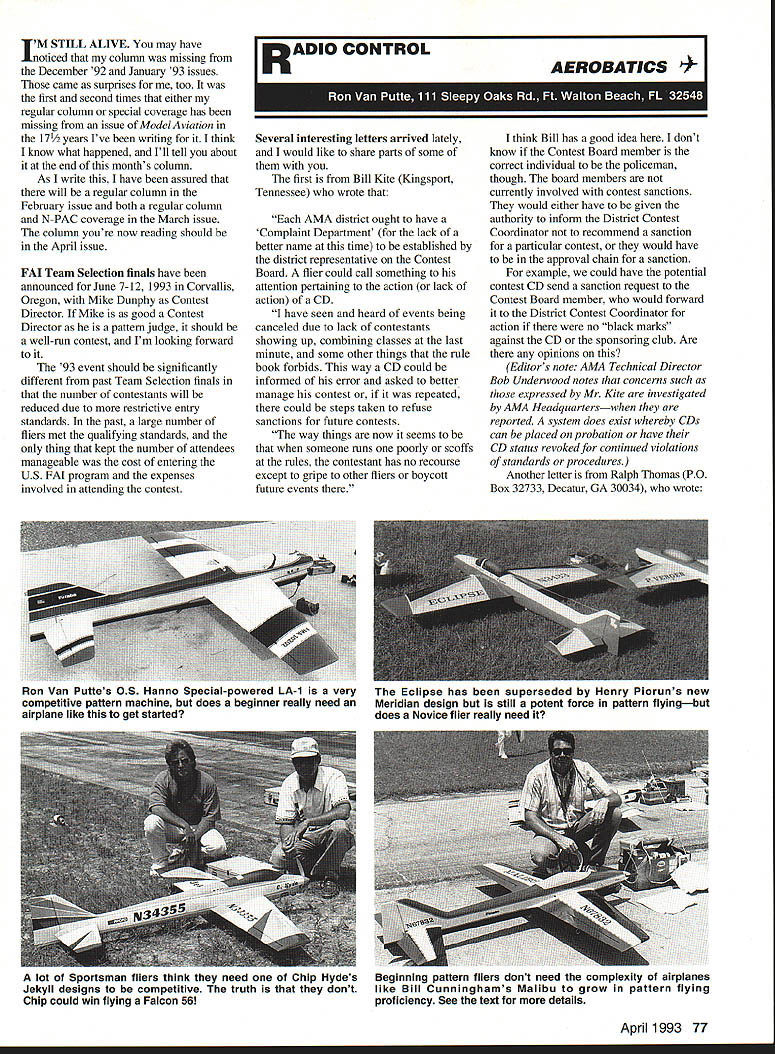
I've received quite a few letters from would‑be and new pattern fliers asking what the best designs are for their first and second airplanes. I have my opinions, but someone claimed my level of pattern experience made it difficult for me to recommend aircraft for new fliers.
I don't think I've "lost perspective regarding the lower classes," but I'm curious whether opinions out there differ from mine about good airplanes for a new pattern flier. Let me hear from you. If there's any resemblance of a consensus, I'll publish the results.
The missing columns
Here's what I think caused the missing columns. The December 1992 issue should have included the NSRCA Pan‑American Championships (N‑PAC) coverage in lieu of my regular column. However, magazine management decided to insert "more important" and/or older special articles, and the N‑PAC report was pushed later in the schedule. Since I had not sent a regular column, I therefore had nothing in the December issue.
When it came time for the January 1993 issue, the same thing happened to N‑PAC coverage — it got bumped again by other special articles. Somehow management forgot that they already had a January 1993 regular column from me and didn't put it in either. So my January‑intended column finally appeared in the February issue, and then we were back on a regular schedule again. Am I right?
Transcribed from original scans by AI. Minor OCR errors may remain.

