
Radio Control: Aerobatics
By Ron Van Putte 111 Sleepy Oaks Rd., Ft. Walton Beach, FL 32548
1993 Nationals — Lawrenceville
Listen: the 1993 Nats will return to Lawrenceville. Tony Stillman has accepted the job as Pattern Event Director. The Nats will be July 17–25.
- A pattern-judging training session will be held on Sunday the 18th.
- Pattern competition will commence on Monday the 19th and finish on Friday the 23rd.
- There will be two sessions each day:
- Morning: 8:00 a.m. until about 12:30 p.m.
- Afternoon: about 1:30 p.m. until 6:00 p.m.
- Six rounds of AMA classes will be flown; all available time will be used until six rounds have been completed. Since at least 1½ rounds must be flown each day, a round that starts one day may finish the next—fliers must be careful to be present when it is their time to fly.
- Tentative event split: Sportsman/Masters in the morning, Advanced/FAI in the afternoon.
- Everyone can expect to work one shift; this procedure has worked well in the past.
- The Holiday Inn in Vincennes, Indiana, will serve as a sort of headquarters motel; the awards party will be held there on Friday evening.
CD complaints and AMA procedure
In the April column I published a letter from Bill Kite (Kingsport, Tennessee) urging that each AMA district monitor complaints about Contest Directors (CDs) doing things the rule book forbids. I read the minutes of the July 25 AMA Executive Council meeting (published in January Model Aviation). A motion was passed to revoke the CD license from anyone who violates the rules as Bill described.
What was missing from the minutes was whether procedures were established to implement that decision. I called AMA Headquarters; JoAnne Spampinato (assistant to Technical Director Bob Underwood) told me Bob Underwood is the person to contact about CD complaints. Report problem CDs to Bob Underwood and let the new system for removing bad-apple CDs do its job.
FAI Team Selection — a fraudulent practice to watch for
Some CDs have been encouraging lower-class AMA Pattern fliers to enter the FAI event at the same contest and perform only a token FAI flight so they can be counted as FAI competitors. The effects:
- The number of FAI contestants is inflated.
- More serious FAI fliers can claim they finished in the top half of the FAI event at that contest.
- Such claims help those fliers qualify for the FAI Team Selection Finals.
This practice benefits the CD’s buddies and makes the contest look like a stronger FAI event, attracting more serious FAI fliers who want to qualify. It’s dishonest. If you suspect a CD is conniving in this way, report the CD to Bob Underwood.
A local repair story — pontoon boat ignition
This has nothing to do with RC Pattern, but I wanted to share. My wife and I live on a small bayou near the Gulf of Mexico; water sports are part of life. Recently my wife bought an old pontoon boat with an old 55-horsepower Evinrude engine. After reconditioning the boat, the engine was unreliable and then completely quit working. After a couple of weekends we determined the ignition module was bad.
- The local marine dealer would have sold a new module for $220 plus tax. I thought that excessive.
- A local marine engine repair specialist offered to sell a used module from a junked engine at half price. He recommended an economical repair using:
- an auto ignition coil (with internal resistance),
- new Champion J6C spark plugs,
- an ignition condenser.
- He talked me through removing the defunct ignition module, the coil, and the existing spark plugs, and replacing them with the parts I bought. The parts cost about $38 plus tax. I followed his instructions and it worked great.
It felt good to be part of that solution, and the repairman will get any marine engine work I can’t handle in the future.
Support your local hobby dealer
Many hobby dealers do more than just sell RC products. Think of at least one hobby dealer who has helped local RC fliers and deserves recognition. Spread the word among RC fliers in your area that the dealer’s efforts are appreciated and that he deserves patronage.
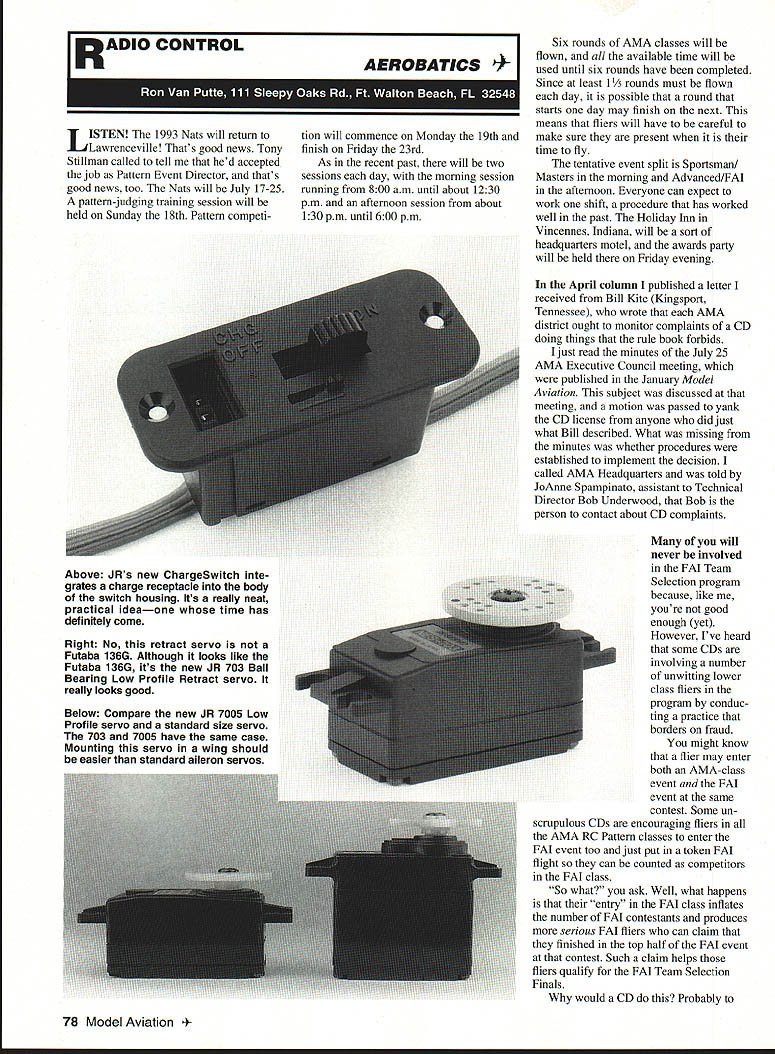
Products: JR ChargeSwitch and JR 703 low-profile retract servo
Chris Mikoskovsky (marketing publicist for Horizon Hobby Distributors) asked if I’d review the JR ChargeSwitch and the 703 Ball Bearing Low-Profile Retract servo. I’m a Futaba flier, but I was glad to look at the JR items.
ChargeSwitch
- Combines the charging jack and receiver on/off switch in the same case, so you need only one hole in the fuselage for both functions.
- Includes a dust-cover actuator for the charge receptacle that looks like a miniature switch arm.
- All electrical connections are gold plated.
- The switch is double-pole, providing a redundant on/off circuit.
- The new JR switch harness can be used with Futaba radios.
Connector notes:
- JR servo connectors will plug into a Futaba receptacle, but be careful to get the polarity right—you can’t just match wire colors blindly.
- Futaba connectors won’t plug into JR receptacles unless you remove the narrow guide running down the side of the Futaba connector (easily done with a #11 X‑Acto blade). Then they will plug in—still follow the polarity guidelines.
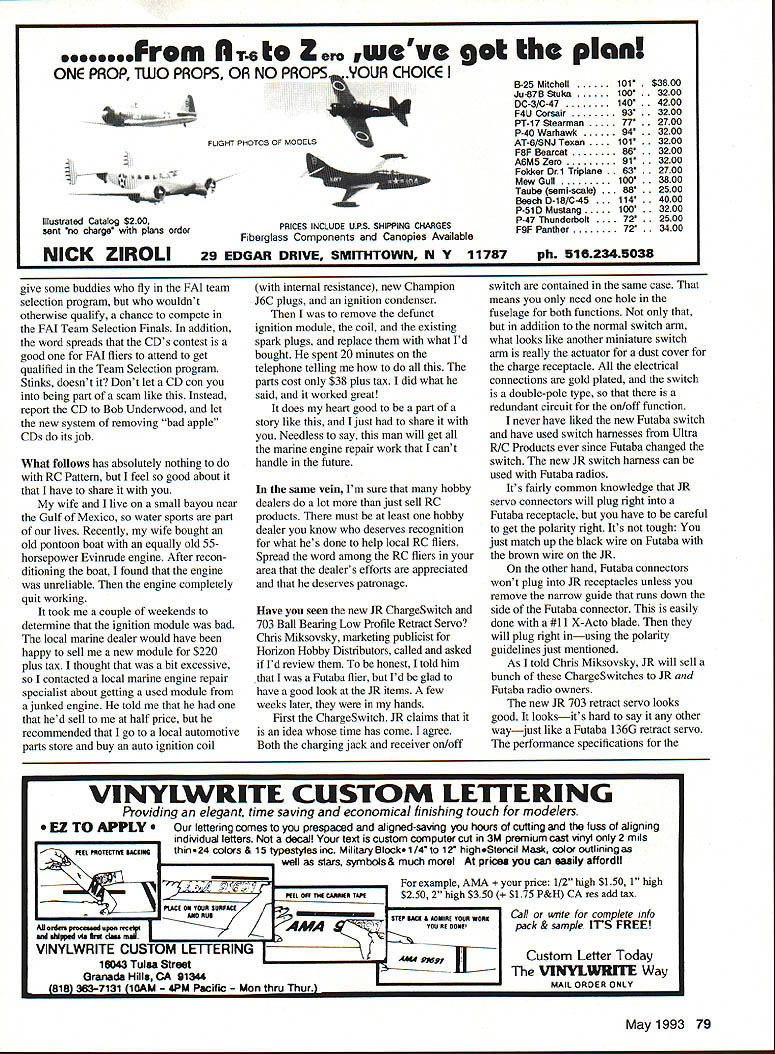
JR 703 Ball Bearing Low-Profile Retract Servo
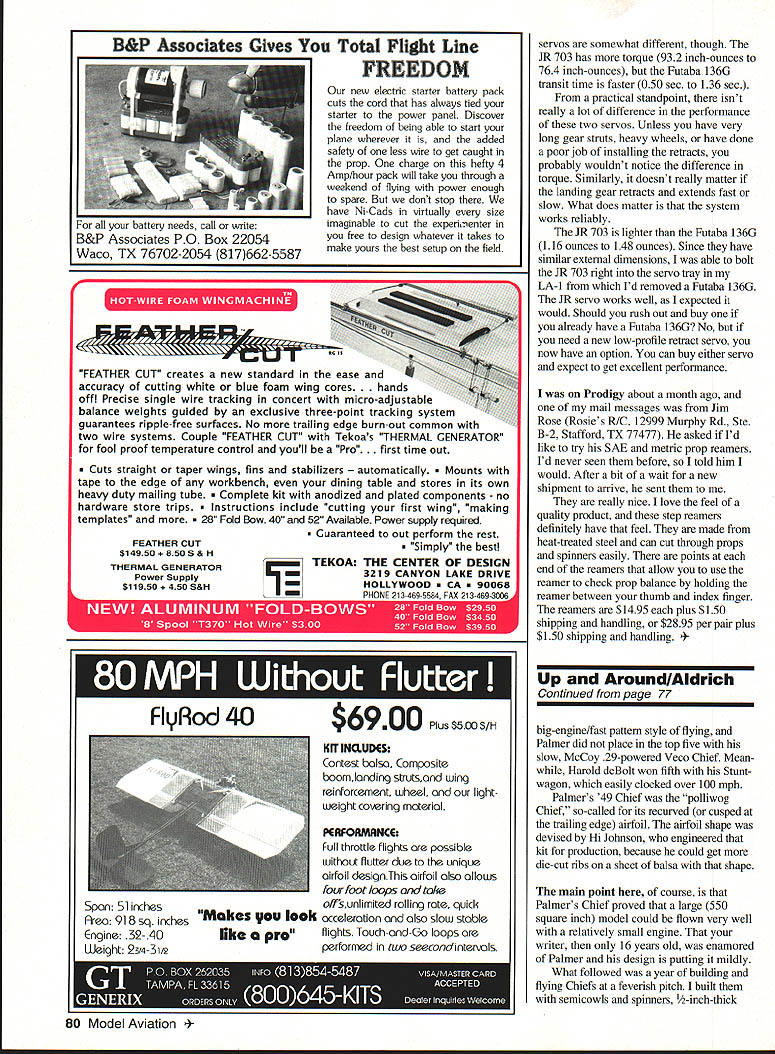
- Appearance: similar to the Futaba 136G; JR 703 and JR 7005 low-profile servos share the same case.
- Torque: JR 703 93.2 in-oz vs Futaba 136G 76.4 in-oz.
- Transit time: Futaba 136G faster (about 0.50 sec) vs JR 703 (about 1.36 sec).
- Weight: JR 703 ~1.48 oz vs Futaba 136G ~1.6 oz.
- In practice, there isn’t a large difference between the two servos. Unless you have very long gear struts, heavy wheels, or a poor installation, you probably won’t notice the torque difference. Similarly, retract speed matters less than reliable operation.
- I bolted a JR 703 into the servo tray of my LA-1 where a Futaba 136G had been. It works well. If you already have a Futaba 136G there’s no reason to rush out and replace it, but the JR 703 is a good option if you need a new low-profile retract servo.
Prop reamers — Rosie's R/C
I received an offer from Jim Rose of Rosie's R/C (12999 Murphy Rd., Ste. B-2, Stafford, TX 77477) to try his SAE and metric prop reamers.
- Quality feel: heat-treated steel that cuts through props and spinners easily.
- Each reamer has points at both ends so you can use it to check prop balance by holding the reamer between your thumb and index finger.
- Pricing: $14.95 each plus $1.50 shipping and handling, or $28.95 per pair plus $1.50 shipping and handling.
I like the feel and performance of these reamers; they’re a nice, useful tool for any flier.
Closing
If you have concerns about contest conduct or CD behavior, report them to Bob Underwood at AMA Headquarters so the new procedures can be applied. And if a local hobby dealer or technician has helped you, let others know—good people deserve recognition.
Transcribed from original scans by AI. Minor OCR errors may remain.

