
Radio Control: Aerobatics
Ron Van Putte 111 Sleepy Oaks Rd. Ft. Walton Beach, FL 32548
Turnaround: history and personal view
It wasn't too many years ago that the Turnaround concept was introduced to aerobatics. Many proponents of Turnaround were characterized — some correctly — as manipulators attempting to force their ideas on a reluctant group. Most RC Pattern fliers were happy with Pattern, and Turnaround fanatics were not well received. If you weren't involved with RC Pattern when Turnaround arrived, you can't imagine how angry and indignant many of us were about being "forced" into Turnaround whether we liked it or not.
Here we are in 1991. Although I've only competed in two Turnaround events, I am the contest director for the U.S. F3A Team Selection Finals, which will be held a few weeks after you read this. Have I had a change of heart? To be honest, I can still get angry when I remember what went on when Turnaround was first introduced. On the other hand, I recognize that the Turnaround concept is a superior way to compete. Part of me says, "Yes, Turnaround is really better," while another part says, "I don't want representatives from other countries telling us how we will compete."
Americans generally don't like being told what to do. Most of my bosses (military and civilian) will tell you I don't take orders graciously when I don't agree with them. Nevertheless, maturity gives one the ability to look at things more objectively. I agree that Turnaround is a better way to go, and I even authored rules-change proposals to get Turnaround maneuvers into the Novice and Sportsman schedules. For me, resistance against Turnaround is over — though nostalgia for hearing a Tiporare powered by a Rossi and nitro pipe does wander through my mind now and again.
Clubs and Pattern contests
John Fuqua and I were on the way to a swap fest in Warner Robins, Georgia, a couple of weeks ago. I had acquired a lot of dope and decided to sell it at the swap fest. We were able to cross two state lines without getting caught and unload all the dope. Lest anyone get the wrong idea, this dope came from Pactra. When you're on the road together for a long time, there are a lot of topics to discuss. One of the topics was why clubs promote RC Pattern contests.
There are basically two reasons clubs sponsor Pattern contests:
- To raise money for the club.
- Not to raise money — i.e., to run contests purely for the sport and to break even.
For many years I questioned the soundness of sponsoring a contest primarily to raise money. My reasoning was that you can only have one main objective if you want to be successful: if your main goal is a high-quality Pattern contest, trying to make money could force compromises that adversely affect contest quality. For many years my club sponsored the Jim Kirkland Memorial Contest with the goal of breaking even. We did very well until Pattern "died" in the early 1980s.
A couple of years later the club asked John Fuqua and me to restart the annual Pattern contest, and we did. During the first couple of years we tried to break even — and we did. About the same time we noticed many good contests around the country were sponsored by clubs that did make money on the event. So we decided to sponsor a contest that made money, but with a twist: we would contribute all contest profits to a charity.
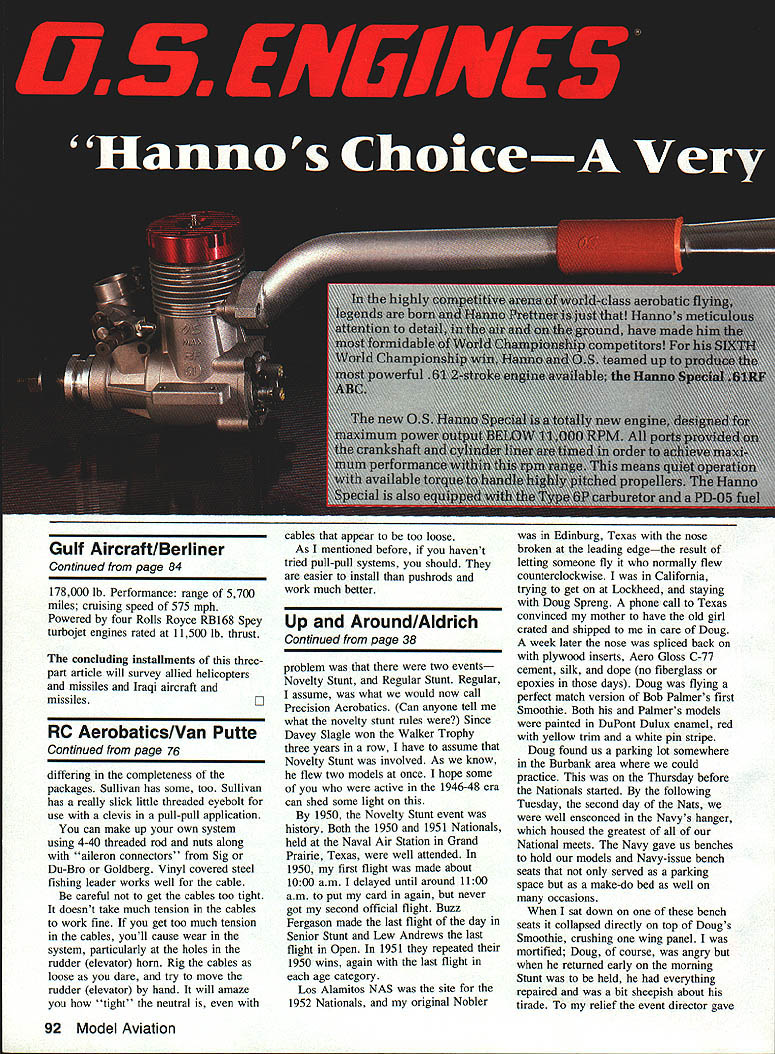
One club member suggested donating the contest profits to the Air Force Armament Museum at Eglin AFB. Since we are the Eglin Aero Modelers, it was a perfect fit. It turned out to be even better than we expected. Museum officials suggested we could use the nonprofit status to solicit charitable contributions from local businesses and individuals. That was an eye-opening experience.
- A local apparel company donated shirts and hats, which we gave to contestants and contest workers.
- A barbecue business donated food for our Saturday night dinner.
- Other businesses and individuals donated checks made out to the Museum.
In three years we were able to donate over $3,000 to the Museum. Step back and look at the situation: a club sponsoring a very successful contest (breaking even or making money), a worthwhile charitable institution receiving a substantial annual contribution, and a club reaping goodwill in the community. If your club can adopt a local charity and do the same, it only takes a little extra work. Please let me know if you try it — I'd like to brag about your club, too.
Pull-pull control systems
Have you tried a pull-pull system on one of your Pattern airplanes? If you haven't, you should. The most dramatic results are achieved when using pull-pull on the rudder. Everyone who uses a pushrod on rudder knows it works fine in one direction, but rudder control tends to be soft in the other.
When a pushrod pushes on the rudder horn, all the potential "slop" in the system shows up: the pushrod bends, the music wire bends at the servo and at the fuselage exit, the wire moves in the fuselage exit guide, etc. All of these reduce the effective rudder throw in the push direction. With a pull-pull system:
- You won't need as much rudder throw in one direction.
- The airplane will have greater directional stability due to a tighter neutral on rudder.
Pull-pull systems can also be used on elevator. The benefits are not quite as noticeable as on rudder, but elevator control will be tighter in one direction and the airplane will be more stable in pitch.
Turnaround has made people almost fanatically conscious of weight. You can save 2 to 4 ounces by using pull-pull systems instead of pushrods — now do I have your attention?
Several companies make accessories for pull-pull systems. Sonic Tronics sells them in a couple of packages.
July 1991
Transcribed from original scans by AI. Minor OCR errors may remain.

