

RADIO CONTROL AEROBATICS - 2001/01
Eric Henderson, 303 Shady Ln., Marlton NJ 08053; E-mail: eric.henderson@home.com
Square Loops
A loop with four straight lines can look very attractive if done well. This month I will take on that maneuver.
New "Square Loop" attemptees tend to pull the elevator hard, four times. It may not look too difficult, but looks can be deceiving. You may have performed the perfect Square Loop; to be sure, read the following.
The Square Loop belongs to a family of loops with lines; others are the three-sided, the six-sided, and the eight-sided—all of which can be performed inverted or right-side up. They can also have a whole range of rolls on the lines.
When judging the Square Loop, it is obviously right or wrong. Humans seem capable of spotting squareness more readily than roundness. The maneuver is comprised of four 90° corners, and four straight lines of equal length.
The short form of the above is that you are trying to achieve four equal corners, four equal lines, all in the same plane. There is a common, but very wrong myth that Square Loops must have tight corners. Please ignore any guidance based on this misconception. Equal radii and equal straight lines are the rule. It's even written in the AMA rule book! Excessively tight corners are considered downgrades.
You definitely need a friend to tell you if you are doing this one right. Time and distance awareness play tricks on the pilot as the airplane changes speed in the four lines.
Preparation and basic execution:
- Fly in a straight line across in front of you, approximately 100 yards away. This may be uncomfortable at first, but it presents the maneuver in a much more viewable, and possibly favorable, light.
- Select roughly 3/4 throttle and fly past the imaginary centerline in front of you.
- Pull the first 1/4-loop and apply full throttle as you go vertical. This allows you to pull a tighter corner without sliding too far horizontally.
- Concentrate on holding a vertical line. Do not be surprised if your airplane goes slightly to the side or toward the canopy. Hold a bit of corrective rudder or elevator, or both.
- Before you run out of vertical speed, pull the second corner. Release any corrective inputs before pulling the corner. Be careful not to pull as much elevator displacement; gravity will be helping, and will cause a pinched corner if you let it.
- Be ready with some down-elevator to prevent the airplane from diving while inverted.
- As the line is being established and held, slowly come back on the throttle. Some pilots throttle back too quickly, which causes the model to slow down and sink. Get too slow, and your model will require too much down-elevator in a hurry. It is much better to throttle back slowly, up to the third corner.
- By now, your throttle should be all the way back. Pull the third corner as you did the second. You are looking for the same radius as the first and second corners had. The model will gain speed on the down-line, so take care to reproduce the curve of the last corner.
- Avoid stalling the elevator as you pull out of the dive. The secret is to plan a Square Loop backward. Learn what the model is capable of on the last corner, and start the Square Loop with that radius.
- Try a few down-lines and pullouts, to see what you and your airplane are comfortable doing. Armed with this information, you can plan a Square Loop that uses this down-line radius as the standard for the first, second, and third corners.
Common issues and tips:
- Some hard parts to get right in this maneuver are the different radii that your airplane will pull at different airspeeds. You will need much less up-elevator when pulling the top two corners than when pulling the bottom two corners.
- There is a common misconception that Square Loops must have tight corners. Equal radii and equal straight lines are the rule; excessively tight corners are considered downgrades.
- The maneuver must remain in a single plane. Practice with a friend watching and giving feedback.
Wind correction:
- Pull slightly less elevator for the upwind corners, and give more when pulling into the wind.
- Lean the airplane into the wind on the up-line and on the down-line. If you don't, the model will drift back as you climb and will not draw a true vertical line.
- You will probably have to hold some down-elevator on the up-line and up-elevator on the down line.
- In a crosswind, the same rudder is held all the way around, but it causes problems when you pull the corners because the airplane is leaning off the vertical or horizontal. The smart move is to straighten the airplane with rudder before, or as, you pull the 90° corner. Then put the rudder back in to deal with crosswind only when on the straight lines.
Practice advice:
- Try the Square Loop both right-side up and inverted.
- Start with a modest vertical segment (three or four seconds) and adjust length if the model loses too much speed.
- Flying with purpose and a flight plan adds a new dimension to why you fly, and even to what you build next.
"Landing, starting now." MA
The AMA Nationals
The AMA NATIONALS is now in the history books. There was a separate Nationals report last month, so I will not duplicate that effort.
As the Pattern columnist, I normally could/would have covered the event, but I was so heavily involved with competing, judging, and evening meeting administration this year, it would not have been practical. As he often does, Tony Stillman stepped into the breach and, as a veteran reporter and prior Nationals Pattern event director, was a welcome person for the job.
For those of you who have not been to a Nationals, it really is worth the trip. We practically take over the whole site for a week; the "site" being the three runways running two flightlines all day. You meet competitors from across the country, and they all have one major thing in common: they made the journey and are determined to have a good time. Despite the pressures of competing, there are many smiling faces. Years of accumulated acquaintances metamorphose into camaraderie and cooperation.
You meet people you have only ever read about. This year, all the major Pattern personalities were there, and it was educational to see them fly.
To make this year more interesting, the US Team Selection program was held as an overlay to the Federation Aeronautique Internationale (FAI) Championships. Therefore, the AMA Nationals could address two issues at once:
- Why we do not use the top three pilots from the Nationals as the US world team, which is continually asked.
- The excessive demand on US team pilots, by asking them to use two separate weeks of vacation time to participate in both competitions.
The Nationals also suffered in attendance every second year—directly in step with the team-selection process. You can't blame a pilot for wanting to make the world team, and using that precious week's vacation to do it.
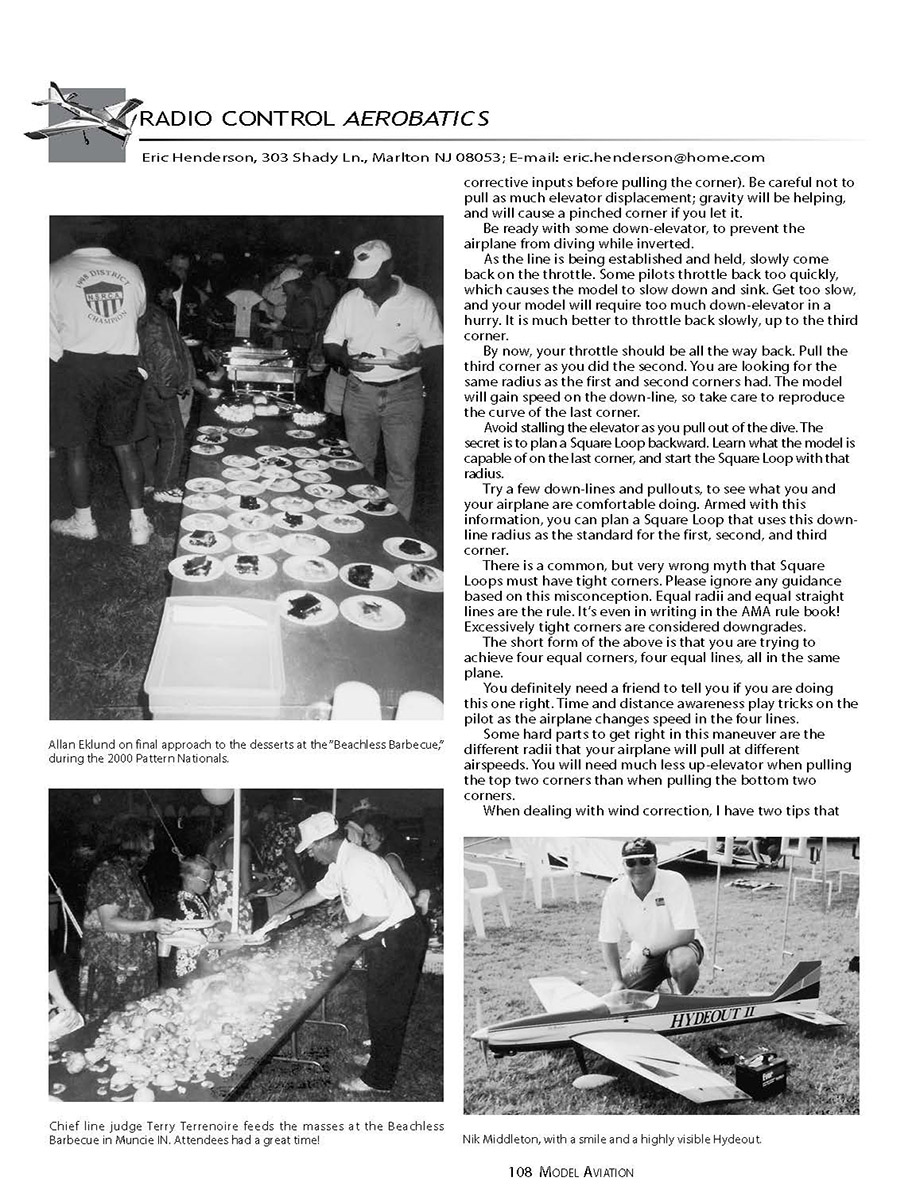
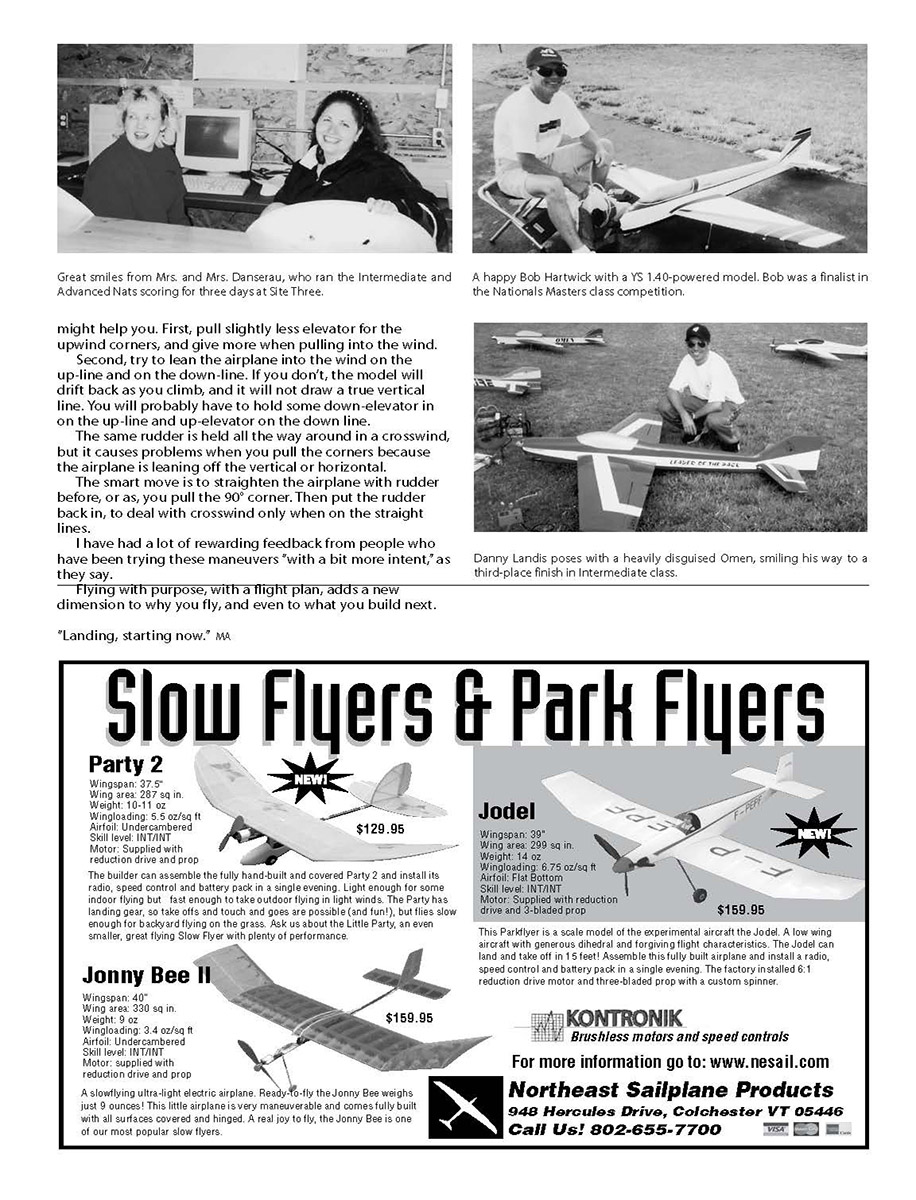
I must mention Maureen Dunphy, the National Society of Radio Controlled Aerobatics (NSRCA) Secretary/Treasurer, who served as Nationals Manager. Without Maureen, we would not have had a hospitality tent, the board and general NSRCA meetings, or the "Beachless Barbecue." Everyone had a great time, and the party finished just before flying began the next day.
I take my hat off to Bob Noll, who ran the mainstream Pattern Nationals for the third year in a row and the US FAI F3A world-team selection trials. Bob pulled it off, with only minor concerns for the FAI pilots.
This year, the FAI schedules and rules changed enough so that it was impossible to use the top three American pilots from the Nationals for the FAI team. The Nationals FAI formula has three rounds of the preliminary schedule P-01, from which approximately 15 pilots went through to the AMA FAI class finals. Then the finalists flew four rounds of the FAI finals schedule F-01. They did not fly Unknown schedules. (This formula will be used in the 2001 World Championships.)
The day after the AMA FAI class finals, the team-selection contest was run. The top eight US finalists were subjected to two rounds of F-01 and two rounds of Unknown schedules, to determine the top three fliers and an alternate.
Notice that I said approximately 15 pilots went through to the AMA FAI class finals; this is because non-US finalists also went through to the AMA finals, but would not be in the subsequent team-selection contest. Quique Somenzini finished a superb second in the US FAI Nationals, but his position did not factor into the US team selection. This meant that a 16th US pilot was included in the AMA finals.
Now you have an idea of why I take my hat off to Bob. If you meet me, please don't ask me to go through it again; but thanks to Bob for doing it!
Now we have new champions in all AMA classes:
- Robert Mathews in 402 Intermediate
- Dean Wilson in 403 Advanced
- Peter Collinson in 404 Masters
- Chip Hyde in FAI
It is great to see Chip focused and tuning up for a run at the world title. It was just as exciting to see Peter Collinson win consecutive AMA titles in Intermediate, Advanced, and Masters. Watch out, Chip!
The youth of today really gives me high hopes for our Pattern future.
The World Championships team consists of Chip Hyde, Sean McMurtry, and Jason Schulman, with Kirk Gray as the alternate. I heard that only a handful of points separated them. My thoughts go out to Kirk, who has represented the US so well in the past.
The US has a disproportionately low representation for the FAI Championships, when you consider how many world-class FAI F3A Pattern fliers we have. Is there a way to propose an FAI rules change to allow a country such as the US to field a Team A and a Team B? Perhaps something based on the percentage of registered FAI pilots?
The US team needs your support. The NSRCA (www.NSRCA.org) has nothing to do with the FAI administratively, but it is a very strong supporter of the US team. This Pattern Special Interest Group (SIG) does, and will, contribute to the US team fund, but it is very expensive to ship a group to Ireland.
The team needs donations. As members of AMA, you outnumber NSRCA members by a factor of 300. Imagine how much money could be raised for the team if each of you contributed a few dollars. Please give it some thought. Send donations to the AMA, marked US Pattern Team Fund.
Transcribed from original scans by AI. Minor OCR errors may remain.

