
RADIO CONTROL AEROBATICS
Eric Henderson 303 Shady Ln., Marlton, NJ 08053 E-mail: eric.henderson@home.com
Senior Pattern Association (SPA)
In my first column, I made a brief reference to the Senior Pattern Association (SPA). Well, now I know that not only do the members read this column, but they are very active in radio control (RC) precision aerobatics competitions of their own.
I received a letter from Mickey Walker, who is a mover and shaker in the world of SPA. We exchanged a few very enjoyable phone calls, which resulted in the primary content for this month's column.
Mickey wrote:
"I have just finished reading your article in Model Aviation. I think that maybe you are not familiar with the Senior Pattern Association. I am the founder and current president. I have asked our secretary to send you our regular new member mail-out. It tells you what we are all about. I think you will find we cover most of what you mention in your article.
"We are 10 years old now and have up to 10 contests a year. We have just held our Masters contest in Knoxville; we had 37 contestants with 12 Novice fliers. At our Atlanta contest this year, we had 38 contestants with 14 Novice fliers.
"Look over what we send, and if you need anything else let me know. I can send you some pictures if you like. We are having a ball with it. If I can help further just let me know."
Thank you, Mickey. There is nothing a columnist likes more than someone writing in. Even more fun is when the person supplies really good column material.
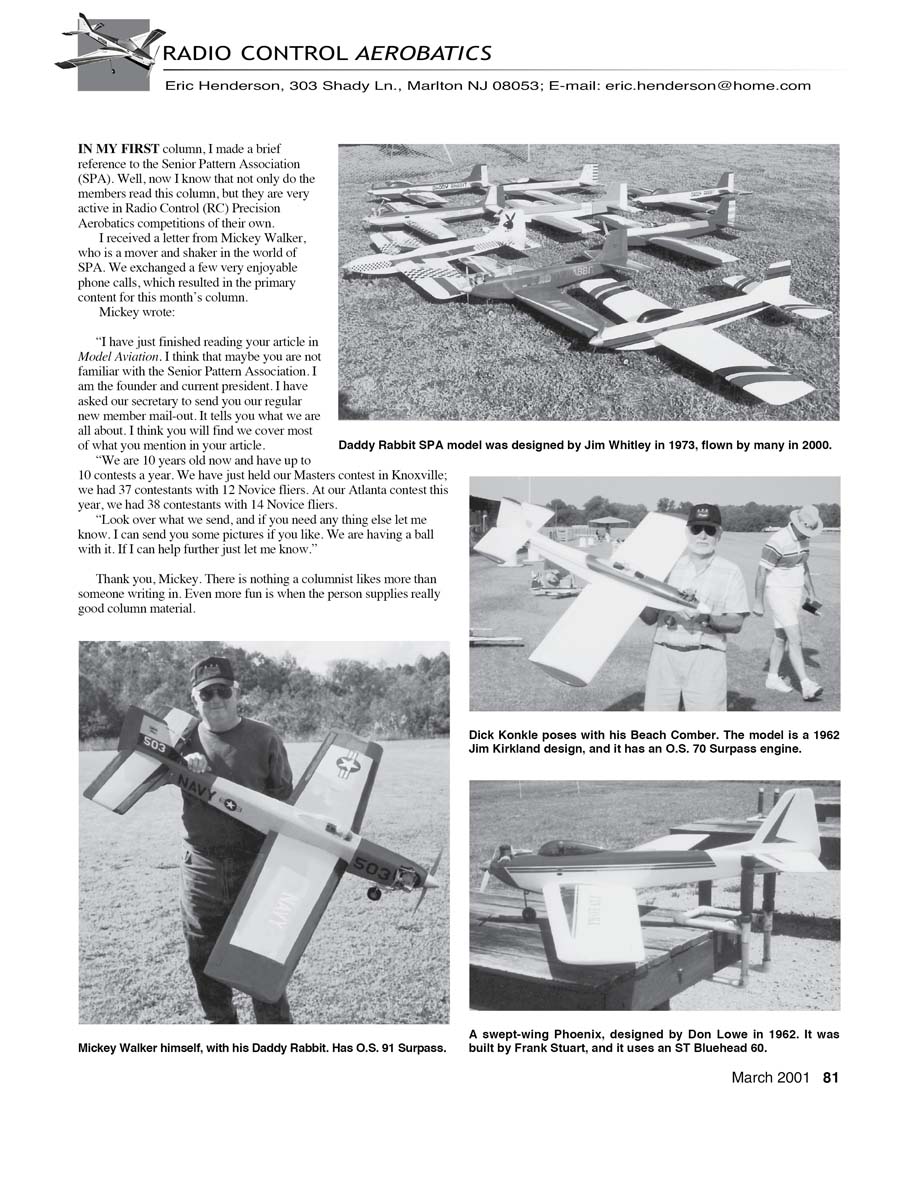
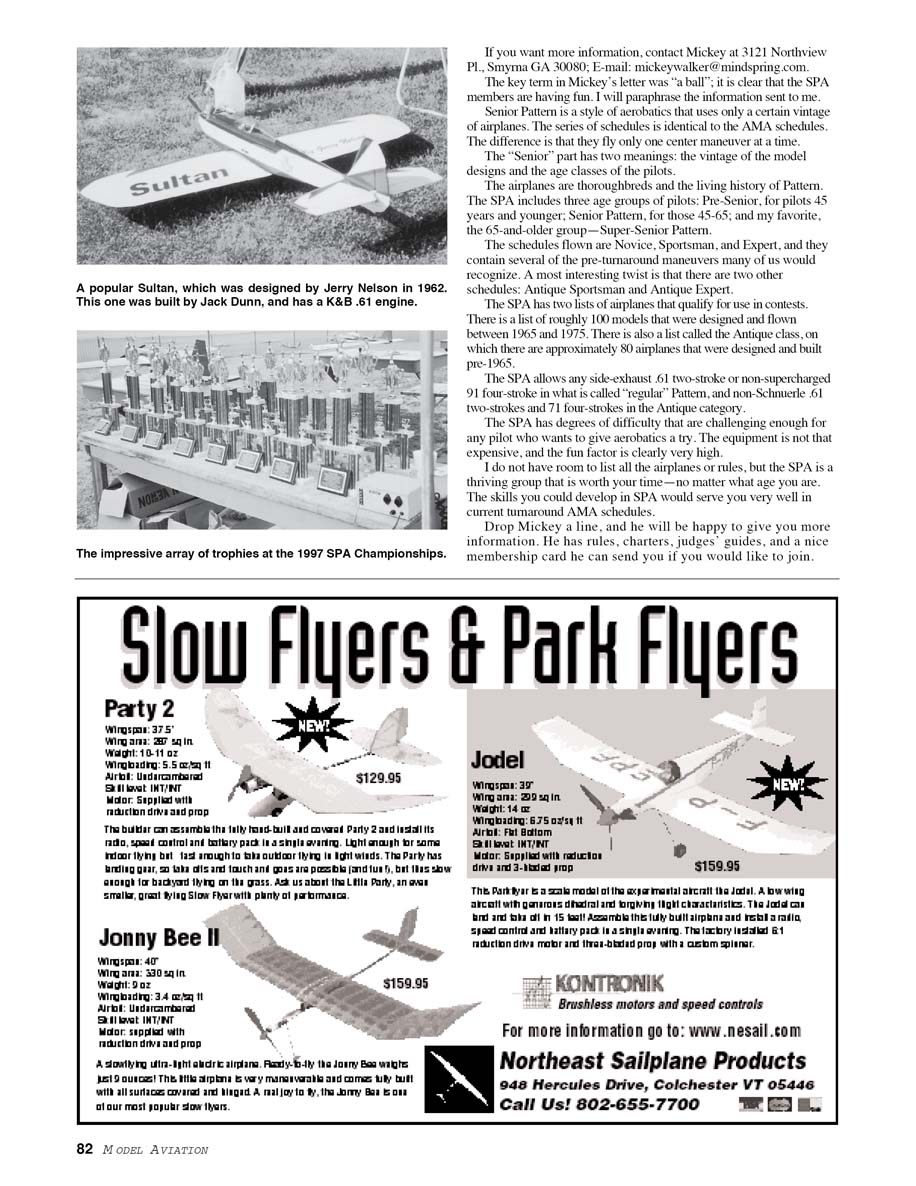
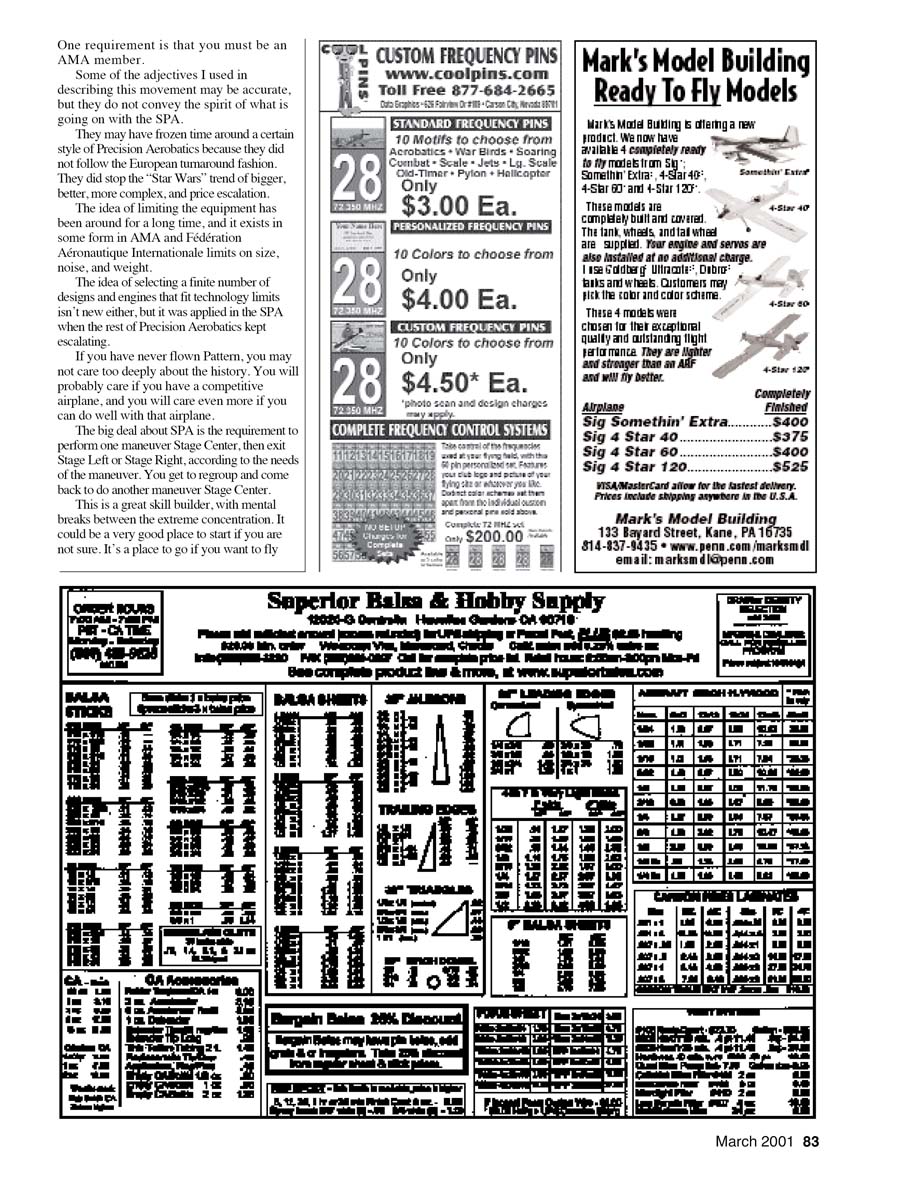
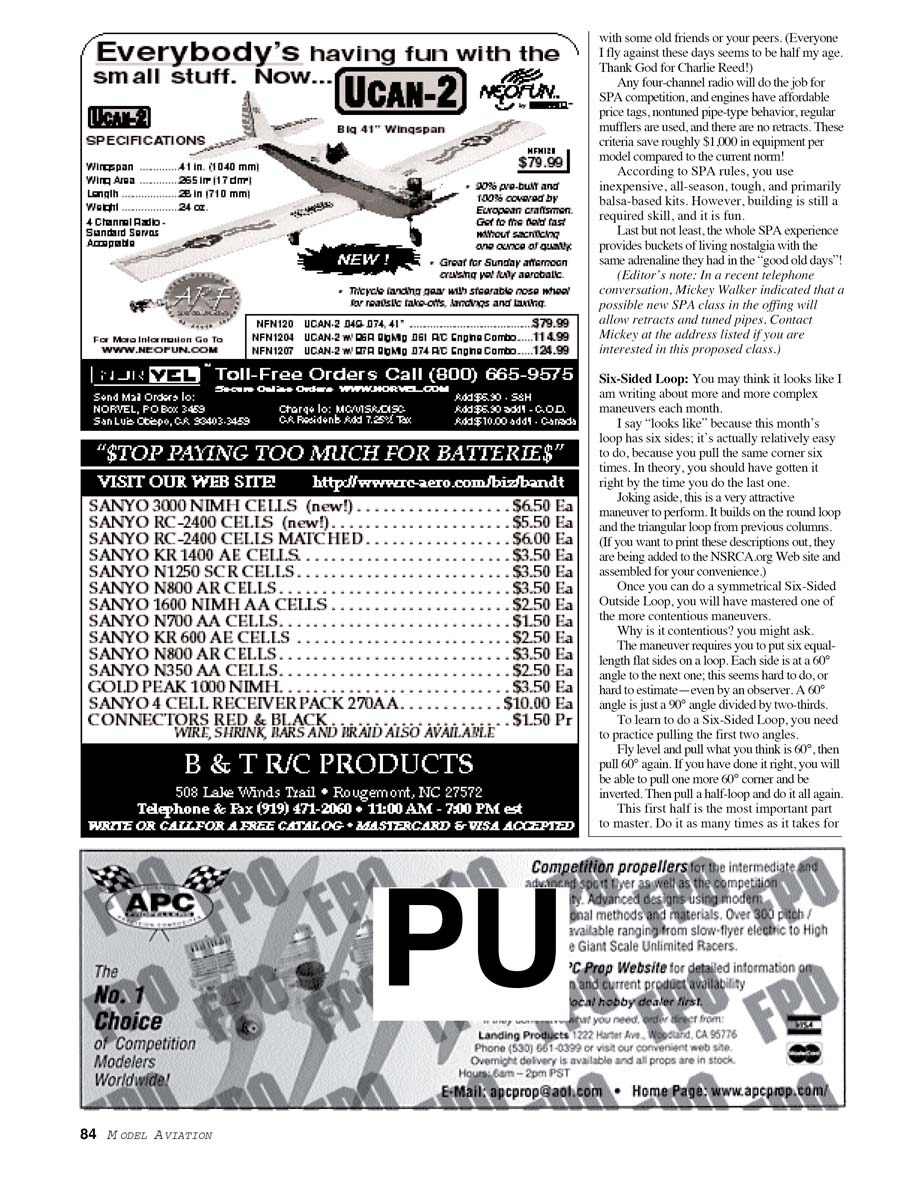
Senior Pattern is a style of aerobatics that uses only a certain vintage of airplanes. The series of schedules is identical to the AMA schedules. The difference is that they fly only one center maneuver at a time. The "Senior" part has two meanings: the vintage of the model designs and the age classes of the pilots. The airplanes are thoroughbreds and the living history of Pattern.
The SPA includes three age groups of pilots:
- Pre-Senior: pilots 45 years and younger
- Senior Pattern: pilots 45–65
- Super-Senior Pattern: pilots 65 and older
The schedules flown are Novice, Sportsman, and Expert; they contain several of the pre-turnaround maneuvers many of us would recognize. A most interesting twist is that there are two other schedules: Antique Sportsman and Antique Expert.
The SPA has two lists of airplanes that qualify for use in contests:
- Regular list: roughly 100 models designed and flown between 1965 and 1975
- Antique list: approximately 80 airplanes designed and built before 1965
Engine limits are used to preserve the vintage feel. The SPA allows side-exhaust .61 two-strokes or non-supercharged .91 four-strokes in what is called "regular" Pattern, and non-Schnuerle .61 two-strokes and .71 four-strokes in the Antique category.
The SPA has degrees of difficulty that are challenging enough for any pilot who wants to try aerobatics. The equipment is not that expensive, and the fun factor is clearly very high. I do not have room to list all the airplanes or rules, but the SPA is a thriving group that is worth your time—no matter what age you are. The skills you could develop in SPA would serve you very well in current turnaround AMA schedules. Drop Mickey a line, and he will be happy to give you more information. He has rules, charters, judges' guides, and a nice membership card he can send you if you would like to join.
Contact Mickey at: 3121 Northview Pl., Smyrna, GA 30080 E-mail: mickeywalker@mindspring.com
One requirement is that you must be an AMA member.
Some of the adjectives I used in describing this movement may be accurate, but they do not convey the spirit of what is going on with the SPA. They may have frozen time around a certain style of precision aerobatics because they did not follow the European turnaround fashion. They did stop the "Star Wars" trend of bigger, better, more complex, and price escalation.
The idea of limiting the equipment has been around for a long time, and it exists in some form in AMA and Fédération Aéronautique Internationale limits on size, noise, and weight. The idea of selecting a finite number of designs and engines that fit technology limits isn’t new either, but it was applied in the SPA when the rest of precision aerobatics kept escalating.
If you have never flown Pattern, you may not care too deeply about the history. You will probably care if you have a competitive airplane, and you will care even more if you can do well with that airplane.
The big deal about SPA is the requirement to perform one maneuver Stage Center, then exit Stage Left or Stage Right, according to the needs of the maneuver. You get to regroup and come back to do another maneuver Stage Center. This is a great skill builder, with mental breaks between the extreme concentration. It could be a very good place to start if you are not sure. It’s a place to go if you want to fly — with some old friends or your peers. (Everyone I fly against these days seems to be half my age. Thank God for Charlie Reed!)
Any four-channel radio will do the job for SPA competition. Engines have affordable price tags, behavior is non-tuned-pipe in nature, regular mufflers are used, and there are no retracts. These criteria save roughly $1,000 in equipment per model compared to the current norm!
According to SPA rules, you use inexpensive, all-solid, tough, and primarily balsa-based kits. However, building is still a required skill, and it is fun. Last but not least, the whole SPA experience provides buckets of living nostalgia with the same adrenaline they had in the "good old days."
(Editor’s note: In a recent telephone conversation, Mickey Walker indicated that a possible new SPA class in the offing will allow retracts and tuned pipes. Contact Mickey at the address listed if you are interested in this proposed class.)
Six-Sided Loop
You may think it looks like I am writing about more and more complex maneuvers each month. I say "looks like" because this month's loop has six sides; it's actually relatively easy to do, because you pull the same corner six times. In theory, you should have gotten it right by the time you do the last one.
Joking aside, this is a very attractive maneuver to perform. It builds on the round loop and the triangular loop from previous columns. (If you want to print these descriptions out, they are being added to the NSRCA.org website and assembled for your convenience.)
Once you can do a symmetrical six-sided outside loop, you will have mastered one of the more contentious maneuvers. Why contentious? The maneuver requires you to put six equal-length flat sides on a loop. Each side is at a 60° angle to the next one; this seems hard to do, or hard to estimate—even by an observer. A 60° angle is just a 90° angle divided by two-thirds.
To learn to do a six-sided loop, you need to practice pulling the first two angles. Fly level and pull what you think is 60°, then pull 60° again. If you have done it right, you will be able to put one more 60° corner and be inverted. Then pull a half-loop and do it all again.
This first half is the most important part to master. Do it as many times as it takes for you to get comfortable with pulling and releasing the elevator. As you gain more confidence, and you can hold the inverted portion of the top line by pushing in some down-elevator, pull the last three corners. Throttle back to avoid putting excessive gyration on the wings. Pull more gently when inverted, because the airplane will respond more quickly.
You should have begun the first line centrally in front of you—far enough out that you can see the loop without dislocating your neck!
If you can hold the inverted line with comfort, throttle back and pull three more 60° corners. Each line should be the same length, and shoot for each corner to be the same roundness (often referred to as the radius). At first, you will be happy just getting six sides. Then as the inevitable desire for perfecting a challenge creeps in, you will need that friend over your shoulder again.
A well-sized six-sided loop should fit inside an imaginary round loop, where each 60° corner just touches the circle of the loop. Your friend could use a hoop behind you as a sighting gauge, to give you an idea of how you are doing. It is also helpful if he or she calls a signal as you almost touch the circle.
To do a well-paced six-sider, you need to use the throttle as much as the elevator. The maneuver begins Stage Center, at roughly half throttle. Let the airplane draw a line equal to half the length you are going to use for all remaining lines, then pull the 60° corner and go to approximately three-quarters throttle.
(Throttle depends on your airplane engine/weight, so adjust these guidelines to suit you.)
As you pull the next 60° corner, add most or all of the throttle. On the top corner, the temptation is to pull the throttle back; it is better to wait until the speed has been established for inverted flight, then ease it back to quarter-power by approximately the time you are ready to pull the downhill corners.
You were not advised to go to idle because the 60° down-line needs speed; otherwise, the airplane will sink slightly as the 60° down-line begins. Throttle back before or well before the next corner. If there is a headwind, you may have to add a little throttle to pull the airplane through the last down-line, but gravity usually provides enough help (acceleration).
Pull the last corner, and head back to where you started. The maneuver is complete when you cross the centerline again.
In a headwind, you will need to finesse the up- and down-lines. It will be necessary to pull slightly less into the first two corners, to compensate for the drifting effect of the wind. On the two down-lines, you need to hook a little tighter to get a true 60° line. In some cases, you may have to add elevator to counter the effect of the wind.
A crosswind may require you to hold corrective rudder all the way through the maneuver. The problem is that each time you pull a corner, the airplane needs to be going straight; otherwise, the result will be an unwelcome cant as you enter the next line.
One solution is to rotate your model's wings ever so slightly as you pull the corner, so that your airplane keeps attacking the wind. Stated another way, the nose is pointed slightly into the wind on each pull.
Try flying crosswind. Let's discuss the wind blowing out, away from you, with the airplane going left to right. As you pull the first corner, roll the airplane roughly 5° to the right. Do the same on each corner, and the airplane will come down close to where it started. If it comes in too far, you induced too much roll as you pulled. This method is almost invisible to the observer, and it doesn't usually incur a downgrade from the judges.
This maneuver may seem like a lot to do, but the extra effort will be worth it if you are searching for the perfect loop. It is a great maneuver to do in front of the peanut gallery, and it will definitely increase your stock in the eyes of knowledgeable pilots.
You can do the six-sided loop four different ways:
- From the bottom, the right way up
- From the bottom, entering inverted
- From the top, the right way up
- From the top, entering inverted
By the time you perfect all those combinations, I will have written about the next maneuver.
MA
Transcribed from original scans by AI. Minor OCR errors may remain.

